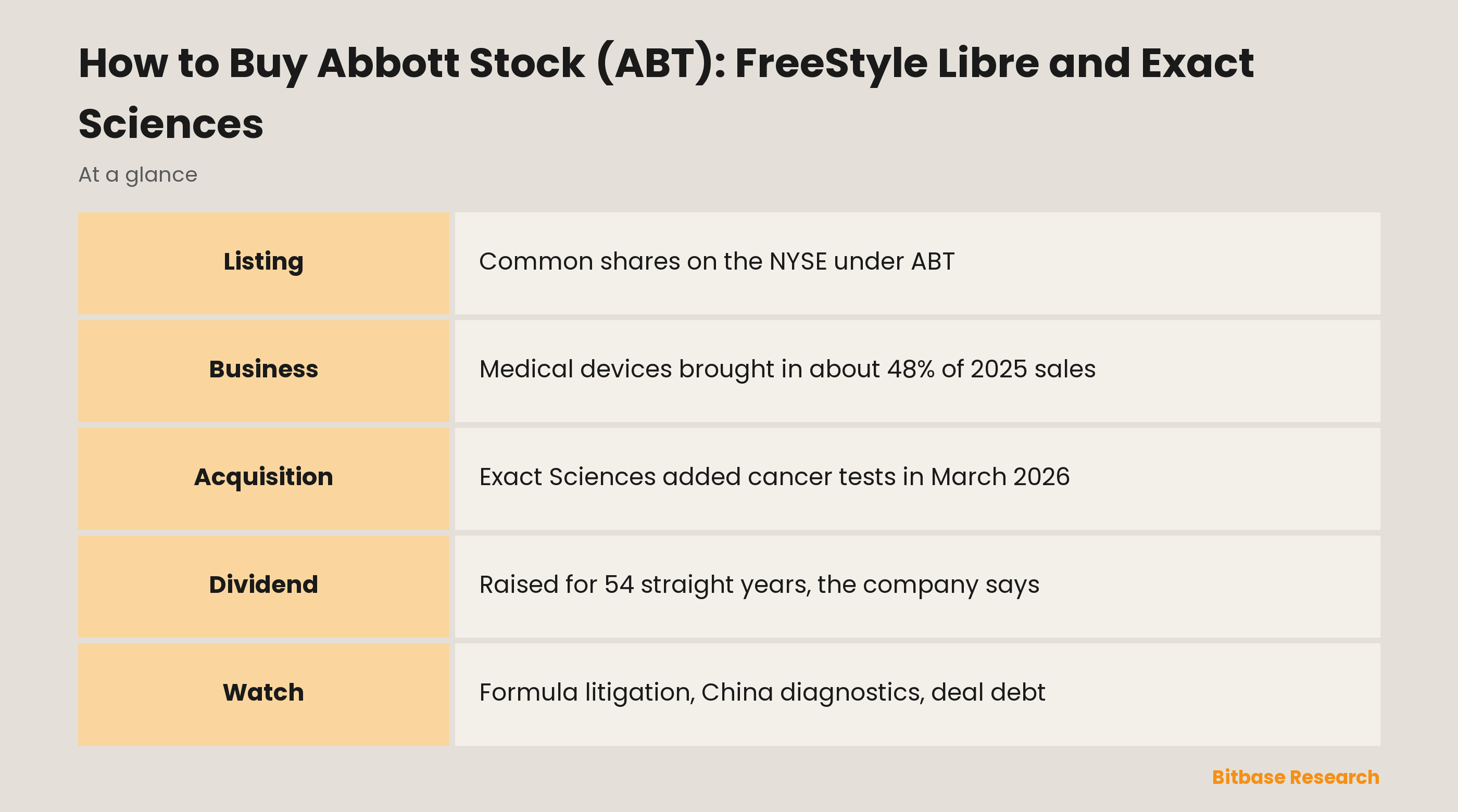
Its common shares trade on the New York Stock Exchange as ABT, so buying Abbott Laboratories stock takes a brokerage account with US market access and an order for that ticker. Behind the ticker sits a four-part healthcare business: medical devices, led by FreeStyle Libre glucose monitors, brought in about 48% of 2025 sales, while diagnostics, nutrition and branded generic medicines supplied the rest. Abbott spun off AbbVie in 2013 and in March 2026 bought Exact Sciences to add cancer screening tests; its filings tie the main risks to infant formula, China and the debt behind that deal.
What Does Abbott Do?
Abbott Laboratories, incorporated in Illinois in 1900 and based in Abbott Park, describes its principal business as "the discovery, development, manufacture, and sale of a broad and diversified line of healthcare products." It reports four segments.
Medical Devices is the largest. It sells Aveir leadless pacemakers, the Volt pulsed field ablation system, HeartMate heart pumps, vascular stents, structural-heart systems such as MitraClip and TriClip, and neuromodulation implants. It also houses diabetes care, home of the FreeStyle Libre continuous glucose monitoring (CGM) systems and of Lingo, a CGM sold for general wellness. Diagnostic Products sells Alinity laboratory instruments and tests, i-STAT point-of-care analyzers and rapid tests such as BinaxNOW and ID NOW. Nutritional Products covers Similac infant formula, PediaSure and Pedialyte for children, and Ensure and Glucerna for adults. Established Pharmaceutical Products sells branded generic medicines, Creon and the Influvac flu vaccine among them, and sells them only outside the United States, in emerging markets.
A few large transactions set this shape. On 1 January 2013 Abbott distributed 100% of AbbVie's common stock to its shareholders of record on 12 December 2012, one AbbVie share per Abbott share, and AbbVie took the research-based pharmaceuticals business with it. Abbott then added St. Jude Medical on 4 January 2017, Alere on 3 October 2017 and Cardiovascular Systems on 27 April 2023. Exact Sciences, agreed on 19 November 2025 and completed on 23 March 2026, brought the Cologuard, Oncotype DX and Cancerguard tests; since the closing it has been reported inside Diagnostic Products as Cancer Diagnostics.
Where Abbott's Revenue Comes From
Net sales rose 5.7% in 2025. By segment:
| Segment | Share of 2025 net sales | Change vs 2024 | Businesses inside |
|---|---|---|---|
| Medical Devices | 48.2% | +12.6% | Diabetes Care, Electrophysiology, Vascular, Rhythm Management, Structural Heart, Heart Failure, Neuromodulation |
| Diagnostic Products | 20.2% | −4.3% | Core Laboratory, Rapid Diagnostics, Point of Care, Molecular |
| Nutritional Products | 19.1% | +0.4% | Pediatric and adult nutrition |
| Established Pharmaceutical Products | 12.5% | +6.6% | Branded generics in emerging markets |
Percentages are worked out from the 10-K's segment sales to one decimal; changes are as reported, currency included.
Diabetes Care, at 18.0% of net sales, is larger on its own than the Established Pharmaceutical Products segment, and its CGM sales grew 17.4% in 2025 excluding currency. COVID-19 testing-related sales fell by about 60%, pulling Rapid Diagnostics down 18.1%, and sales in China dropped 9.7% amid what the 10-K calls "challenging market conditions in China, including the impact of volume-based procurement programs."
International markets supplied 61% of 2025 net sales and emerging markets 37%, and the 10-K states that "Abbott is not subject to significant concentration risks relating to customers, products, or geographic locations." Rebates are where pricing bites: 44% of 2025 gross revenues were subject to rebates and allowances, mostly in Nutrition and Diabetes Care.
ABT Stock at a Glance
| Item | Detail |
|---|---|
| Exchange | New York Stock Exchange (principal market); also NYSE Texas |
| Ticker | ABT |
| Security | Common shares without par value; no other class registered |
| Other listing | SIX Swiss Exchange |
| Sector | Healthcare: devices, diagnostics, nutrition, branded generics |
| Index membership | S&P 500; not in the Dow Jones Industrial Average |
| Headquarters | Abbott Park, Illinois |
| Incorporated | Illinois, 1900 |
| Fiscal year | Calendar year, to 31 December |
| Dividend policy | Quarterly cash dividend, declared by the board each time |
| Spin-off | AbbVie (ABBV), 1 January 2013 |
| SEC identifier | CIK 1800 |
None of these rows moves with the market; for the live price, market value and yield, see the Abbott stock page on Bitbase.
How to Buy Abbott Stock
ABT is the ordinary common stock of a US company, with no depositary receipt in between. The steps:
1. Find a broker with NYSE access. A local firm offering US markets and an international broker both work; check who holds your shares and who regulates them.
2. Open and verify the account. Non-US individuals usually file IRS Form W-8BEN to certify foreign status for dividend withholding.
3. Add money. Currency conversion is a cost of its own, so weigh the exchange rate alongside the commission.
4. Search ABT and check the name. It should read Abbott Laboratories common shares; ABBV is AbbVie.
5. Choose the order type. FINRA says a market order "provides the most certainty that your order will be executed because it's not tied to any restrictions"; with a limit order "you're guaranteed to get your limit price or a better price if your order is executed," but it may never fill. How a market order fills explains the gap between quoted and filled prices.
6. Size the order. "The availability of fractional share trading varies by brokerage firm," FINRA notes, and "as a fractional share owner, you might not have shareholder voting rights."
7. Save the paperwork. Trade confirmations show what you paid, and account statements list the dividends; your tax return at home will need both.
For non-US investors, US tax is withheld from each dividend. The IRS says "most types of U.S. source income received by a foreign person are subject to U.S. tax of 30%," and a tax treaty can lower that rate or remove it. Tax may also be due where you live.
Through a fund, Abbott comes as one S&P 500 constituent among hundreds; State Street's SPY listed it in its holdings file of 16 October 2026, and what an index tracker actually owns is set by the index rather than by the fund provider. Funds that track the Dow do not hold it.
What Moves the ABT Share Price
Glucose monitoring. Diabetes Care is the heaviest single business, and its growth comes from CGM sensors. Because rebates concentrate here, reimbursement terms shape what each sensor earns, and the product line keeps changing: Libre Duo, a dual glucose-ketone sensor, received a CE Mark in May 2026.
Heart devices. Electrophysiology grew 12.0% in 2025, Structural Heart 12.3% and Heart Failure 13.2%. The year's key approvals included FDA approval and a CE Mark for the Volt pulsed field ablation system, FDA approval of the Tendyne mitral valve replacement system and approval of TriClip in Japan; in May 2026 Abbott completed its FDA submission for the Amulet 360 device.
Diagnostics and Exact Sciences. Rapid testing has shrunk as pandemic demand faded, and China's procurement programs weigh on laboratory sales. Exact adds cancer screening, but the second-quarter 10-Q shows the purchase was funded mainly with long-term debt issued in March 2026, and Abbott estimates its 2026 amortization of intangible assets well above the 2025 level.
Infant formula. In February 2022 Abbott recalled certain powder formula made in Sturgis, Michigan, paused production there and in May 2022 entered a consent decree with the FDA. US Pediatric Nutritionals fell 2.3% in 2025, and in the second quarter of 2026 the Nutrition segment fell 3.1%, which Abbott linked to lower volumes and to pricing actions from late 2025.
Currency and tariffs. With 61% of sales outside the United States, exchange rates move reported results; the stronger dollar cut total 2024 sales by 2.6%. The 10-K also lists "higher costs, including tariffs" among the offsets to its 2025 margin gains.
One driver is largely absent: "There are no significant patent or license expirations in the next three years that are expected to materially affect Abbott."
Risks Abbott Flags in Its Filings
The 10-K lists many risk factors; five matter most for an ABT holder:
Manufacturing. "The manufacture of many of Abbott's products is a highly exacting and complex process, and if Abbott or one of its suppliers or manufacturers encounters problems manufacturing products, Abbott's business could suffer." The filing cites Sturgis as its example.
Product liability. "Significant safety concerns could arise for Abbott's products," the 10-K warns, and product liability losses are self-insured. Abbott faces lawsuits alleging that its preterm infant formula caused necrotizing enterocolitis (NEC). After the Missouri Court of Appeals affirmed a jury verdict in the Gill case in May 2026, Abbott agreed on 20 August 2026 to resolve it together with claims for about 2,000 other infants, calling the agreements "not in any way an admission of liability"; roughly 1,700 lawsuits remained pending. The US Department of Justice and several states have also partially intervened in a civil qui tam suit tied in part to Sturgis.
Debt. "Abbott will incur additional indebtedness in connection with the Exact Sciences acquisition, which could adversely affect its business, including decreasing its business flexibility."
Cost containment. "Abbott is subject to cost containment efforts that could cause a reduction in future revenues and operating earnings."
Trade and geopolitics. The 10-K warns that tariffs and trade measures could disrupt its global supply chain, and it puts operations in Russia and Ukraine at about 2% of revenues and net assets.
Beyond the business, one stock concentrates your money, no dividend is guaranteed until the board declares it, and a home currency other than the dollar adds exchange-rate risk.
Where to Check Abbott's Numbers
Abbott's SEC filer number is CIK 1800: look for the 10-K each year, 10-Qs each quarter and 8-Ks for events such as the Exact Sciences closing, the August 2026 NEC agreements and every earnings release. In the 10-K, the business section names products by segment, management's discussion splits sales by business, and the segment note breaks sales out by segment and by country. The structured cover data of the 2025 report, R1.htm, shows one registered security, the ABT common shares.
Two cautions. Figures for 2026 include Exact Sciences only from 23 March 2026, and filings from before 2013 describe a company that still contained what is now AbbVie. For other companies, the Bitbase list of US stock pages is the place to start.
Abbott Stock: Common Questions
Does Abbott pay a dividend?
Yes, quarterly. In June 2026 the board declared its 410th consecutive quarterly dividend, and Abbott says it has raised its payout for 54 consecutive years and belongs to the S&P 500 Dividend Aristocrats Index. In December 2025 it raised the quarterly dividend by 6.8%; amounts and dates appear in each earnings release.
Can I buy Abbott stock with crypto?
Not directly. You buy ABT through a broker, and US exchange trades settle in dollars, so any crypto must first be sold and the cash sent to your broker, a sale that may be taxable where you live. Treat it as two decisions, because owning a share differs from owning a crypto asset.
Is Abbott the same company as AbbVie?
No. AbbVie was Abbott's research-based pharmaceuticals business until 1 January 2013, when Abbott handed all of AbbVie's shares to its own shareholders, one for one. The two have filed separately ever since, so an ABT share carries no AbbVie stake.
Is ABT in the S&P 500 or the Dow?
The S&P 500, yes: State Street's SPY holdings file of 16 October 2026 lists Abbott Laboratories. The Dow, no: the file for DIA, which tracks the 30-stock Dow Jones Industrial Average, did not include it that day.
Where is Abbott stock listed?
Principally on the New York Stock Exchange, as ABT. The 10-K adds NYSE Texas and, outside the United States, the SIX Swiss Exchange.
Conclusion
Buying ABT is a routine order: an account with NYSE access, the right ticker rather than AbbVie's ABBV, and a market or limit order. What takes longer is understanding the company behind it: devices led by glucose monitors, diagnostics that now include Exact Sciences, nutrition still facing formula litigation, and generics sold only in emerging markets. Read the latest annual report and the quarterly filings since the Exact closing before sizing a position.
Related reading
Other Bitbase articles on this topic:
- How to Buy AbbVie Stock (ABBV): Skyrizi and Rinvoq After Humira
- How to Buy Amgen Stock (AMGN): Repatha, Prolia and MariTide
- How to Buy argenx Stock (ARGX): Nasdaq, Brussels and VYVGART
- How to Buy Sanofi Stock (SNY): Half-Share ADS and Dupixent
Disclaimer: This article is educational content from Bitbase Academy, provided for information only. It explains what a company or fund does and how the instruments referenced here differ from one another; it does not constitute investment, trading, tax, or financial advice, and it is neither a recommendation nor an endorsement of any security, token, or trading strategy. A tokenized stock is issued by a third party and is designed to give economic exposure to an underlying asset: it is not a share, it carries no shareholder rights, and it depends on the issuer's structure, eligibility rules, and redemption terms, which the issuer can change. Perpetual futures are leveraged derivatives that hold no underlying asset and can be liquidated, and trading hours, product availability, and eligibility differ by instrument and by jurisdiction and can change at any time. Written as of October 2026; verify everything yourself through company filings, the issuer's own documentation, and the product pages of the venue you trade on.
References
[1] Abbott Laboratories Form 10-K, fiscal 2025: business, segment sales, risk factors and listing (SEC EDGAR) www.sec.gov
[2] Abbott Laboratories Form 10-Q for the quarter ended 30 June 2026: Exact Sciences, financing and legal matters (SEC EDGAR) www.sec.gov
[3] Abbott Laboratories Form 8-K, 20 November 2025: merger agreement with Exact Sciences (SEC EDGAR) www.sec.gov
[4] Abbott Laboratories Form 8-K, 23 March 2026: completion of the Exact Sciences acquisition (SEC EDGAR) www.sec.gov
[5] Abbott second-quarter 2026 results release, 16 July 2026: segment sales and dividend record (Form 8-K exhibit) www.sec.gov
[6] Abbott Laboratories Form 8-K, 20 August 2026: agreements resolving part of the NEC preterm infant formula litigation (SEC EDGAR) www.sec.gov
[7] Abbott Laboratories Form 8-K, 2 January 2013: completed distribution of AbbVie shares to Abbott shareholders (SEC EDGAR) www.sec.gov
[8] Abbott Laboratories Form 8-K, 5 January 2017: completion of the St. Jude Medical acquisition (SEC EDGAR) www.sec.gov
[9] Abbott Laboratories Form 8-K, 3 October 2017: completion of the Alere acquisition (SEC EDGAR) www.sec.gov
[10] State Street SPDR S&P 500 ETF Trust (SPY): daily holdings file www.ssga.com
[11] State Street SPDR Dow Jones Industrial Average ETF Trust (DIA): daily holdings file www.ssga.com
[12] FINRA: Order Types www.finra.org
[13] FINRA: Investing in Fractional Shares www.finra.org
[14] IRS: NRA Withholding www.irs.gov





