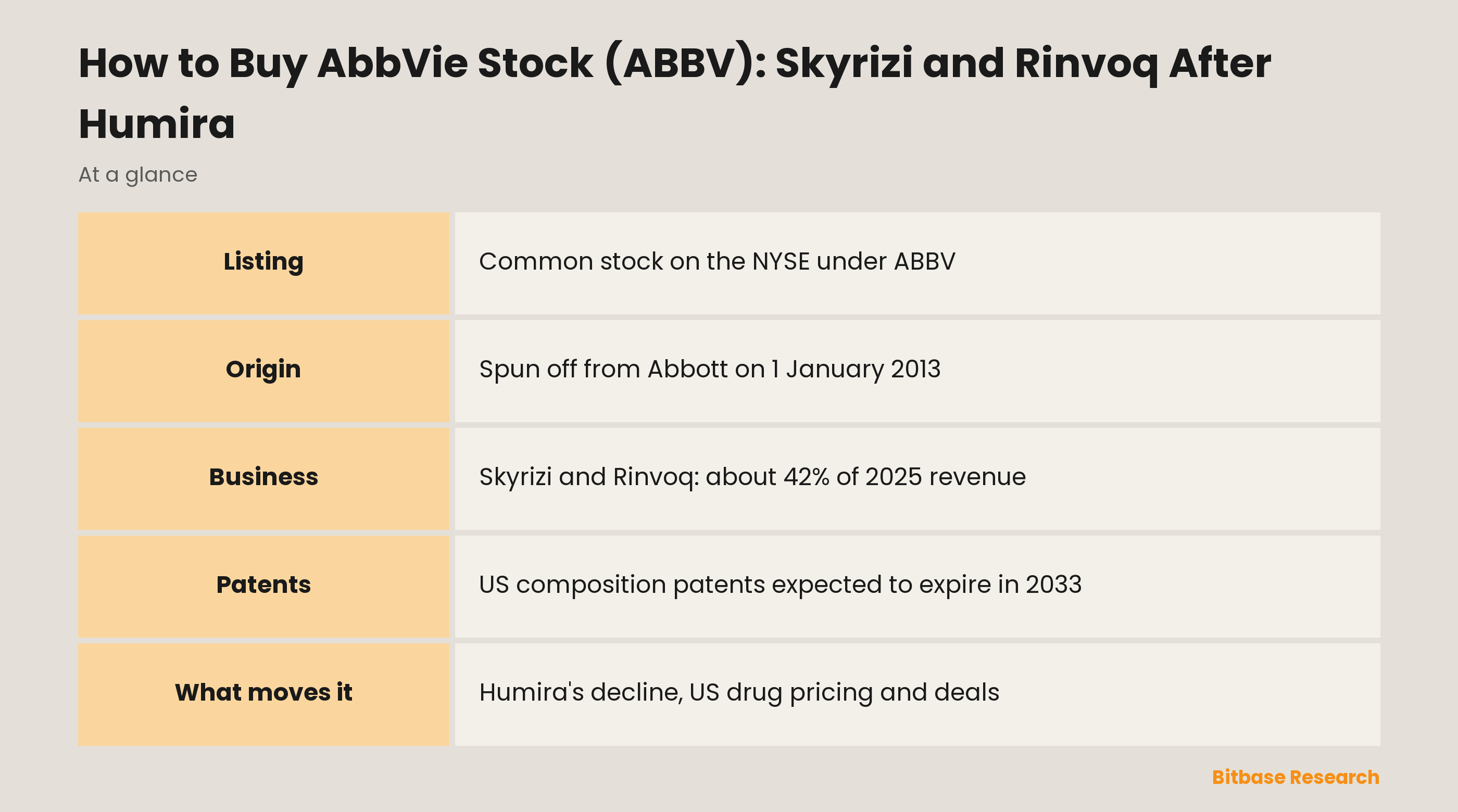
Through a brokerage account that can reach the New York Stock Exchange, you can buy AbbVie's common stock under the ticker ABBV. The company is a 2013 spin-off: Abbott Laboratories handed its research-based drug business to its own shareholders, one AbbVie share for every Abbott share. As recently as 2020, Humira alone brought in about 43% of net revenues; in 2025 the immunology medicines Skyrizi and Rinvoq brought in about 42%, while Humira was down to about 7%. This guide covers where the revenue comes from, how the purchase works, and which dates in the filings matter most.
What Does AbbVie Do?
AbbVie discovers, makes and sells prescription medicines and aesthetic products. Its annual report calls it "a global, diversified research-based biopharmaceutical company" with "leadership positions across immunology, neuroscience, oncology and aesthetics." It reports a single global business segment and is based in North Chicago, Illinois.
Where it came from. AbbVie was incorporated in Delaware on 10 April 2012 to take over Abbott's research-based pharmaceuticals business. On 1 January 2013 Abbott distributed 100% of AbbVie's common stock to its shareholders of record on 12 December 2012, one AbbVie share for each Abbott share, in a distribution structured to be tax-free. ABBV has traded on the NYSE as an independent company since, and Abbott carries on separately as ABT.
What it sells. In immunology, Skyrizi is an IL-23 inhibitor for psoriasis, psoriatic arthritis and inflammatory bowel disease; Rinvoq is a once-daily oral JAK inhibitor approved from rheumatoid arthritis to atopic dermatitis; and Humira, an injected biologic, was still the largest product in 2023. Neuroscience covers Vraylar for schizophrenia and bipolar disorder, Botox Therapeutic, the migraine drugs Ubrelvy and Qulipta, and Vyalev for advanced Parkinson's disease. Oncology rests on the blood-cancer drugs Imbruvica and Venclexta; aesthetics on Botox Cosmetic and Juvederm fillers. Eye care and a few other products, such as the hepatitis C treatment Mavyret, complete the list.
What Allergan added. On 8 May 2020 AbbVie completed its acquisition of Allergan plc, whose lines the 2020 annual report flagged in its revenue table: Botox in both forms, Juvederm, Vraylar, Ubrelvy and Linzess among them. All of aesthetics came from that deal, and in 2025 three Allergan products, Vraylar, Botox Therapeutic and Ubrelvy, made up about 80% of neuroscience revenue. The buying continues: Apogee Therapeutics, with an antibody in development for atopic dermatitis, joined on 3 September 2026, and the 10-K names obesity among its "new sources of growth."
How AbbVie Makes Money
Net revenues rose 8.6% in 2025. The product table in the 10-K shows where they came from:
| Area | Share of 2025 net revenues | Products named in the 10-K |
|---|---|---|
| Immunology | 49.7% | Skyrizi, Rinvoq, Humira |
| Neuroscience | 17.6% | Vraylar, Botox Therapeutic, Ubrelvy, Qulipta, Vyalev |
| Oncology | 10.9% | Imbruvica, Venclexta, Elahere, Epkinly |
| Aesthetics | 7.9% | Botox Cosmetic, Juvederm Collection |
| Other key products | 6.1% | Mavyret, Creon, Linzess |
| Eye care | 3.4% | Ozurdex, Lumigan, Alphagan |
| All other | 4.3% | Products outside the named lines |
Shares are calculated from the fiscal 2025 product revenue table and rounded to one decimal.
Two products carry the weight: Skyrizi came to 28.7% of 2025 net revenues and Rinvoq to 13.6%, about 42% together. The risk factors say it plainly: "A significant portion of AbbVie's revenues and operating earnings are derived from two major products." Concentration itself is nothing new here; only the names have changed. By the company's own count, Humira still accounted for about 27% of net revenues in 2023, two years before it fell to about 7%.
Most of the money arrives through intermediaries. The United States produced 76.2% of 2025 net revenues, and there three wholesalers, McKesson, Cardinal Health and Cencora, handled "substantially all" of AbbVie's pharmaceutical sales, while pharmacy benefit managers, health plans and programs such as Medicare shape what a medicine finally earns. Abroad, AbbVie sells mainly to wholesalers and distributors and agrees reimbursement with largely centralized national payers; its largest national markets after the US in 2025 were Germany and Japan.
One line is booked differently: Imbruvica combines US product sales with collaboration revenue from abroad, AbbVie's half of the profit from its partnership with Janssen.
ABBV Stock at a Glance
| Item | Detail |
|---|---|
| Exchange | New York Stock Exchange (NYSE); also listed on NYSE Texas |
| Ticker | ABBV |
| Security | Common stock; no other share class is registered |
| Other listed securities | Five senior note series, each with its own symbol (ABBV27, for example) |
| Sector | Healthcare: biopharmaceuticals and aesthetics |
| Index membership | S&P 500 |
| Headquarters | North Chicago, Illinois |
| Incorporated | Delaware, 10 April 2012 |
| Independent since | 1 January 2013, by distribution from Abbott Laboratories |
| Fiscal year | Calendar year, ending 31 December |
| Dividend policy | The board declares a cash dividend each quarter; raised for 2026 |
| SEC identifier | CIK 1551152 |
No row here says what the stock costs today; for the live quote, market value and dividend yield, see the AbbVie stock page on Bitbase.
How to Buy AbbVie Stock
AbbVie is incorporated in Delaware and its shares trade directly on the NYSE, so no depositary receipt sits between you and the stock. Everything runs through a broker:
1. Choose a broker with access to US exchanges. Outside the United States, compare local brokers that offer US markets with international ones, and find out which company actually holds your account and under which regulator.
2. Complete the account checks. Expect identity verification and, as a non-US individual, IRS Form W-8BEN, which certifies foreign status for dividend withholding.
3. Move money in. If you fund in another currency, the conversion is a cost in its own right, so the rate you are quoted matters as much as the commission.
4. Confirm the ticker. ABBV is AbbVie Inc. common stock. ABT belongs to Abbott Laboratories, a separate company, and codes such as ABBV27 or ABBV31 are AbbVie bonds listed on the same exchange.
5. Decide how to price the order. A market order puts getting filled ahead of the price; Investor.gov notes it "does not guarantee the execution price." A limit order sets the ceiling instead: "A buy limit order can only be executed at the limit price or lower."
6. Size the position. Fractional shares let you buy by amount rather than by share count, but availability varies: "Even if your brokerage firm offers this service, it may not offer this service to all its customers." Some brokers restrict order types for fractions, which may also carry no voting rights.
7. Save the paperwork. Trade confirmations and periodic statements document your cost basis and dividends, which your tax return at home will likely need.
For investors outside the United States, the IRS rule that matters is the one on US-source income: "Most types of U.S. source income received by a foreign person are subject to U.S. tax of 30%," generally withheld at payment, though a tax treaty can lower or remove it. That is why brokers want Form W-8BEN, and your home country may tax the dividend again.
Through a fund, you can hold AbbVie without picking it. As an S&P 500 constituent it sits in every fund that fully replicates that index; State Street's SPY, for one, listed it on 16 October 2026. Either way it is one holding among many, and how an S&P 500 tracker decides what it holds is the same whoever runs the fund.
What Moves ABBV Stock
The handoff inside immunology. At constant currency, Skyrizi grew 50% in 2025 and Rinvoq 39%, both on "continued strong market share uptake as well as market growth across all indications," while Humira fell 49%. In the United States, where Humira lost exclusivity on 31 January 2023, its sales dropped 57.1% in 2025 alone. With so much revenue on the pair, each new approval and head-to-head trial carries weight; in October 2025 the SELECT-SWITCH study found Rinvoq superior to Humira in rheumatoid arthritis patients who had responded inadequately to, or not tolerated, one other TNF inhibitor.
Patent dates spelled out in the filing. The US composition of matter patents covering risankizumab and upadacitinib, the active ingredients of Skyrizi and Rinvoq, are expected to expire in 2033. For Rinvoq tablets, a September 2025 settlement with every generic manufacturer that had filed with the FDA means no US generic entry is expected before April 2037, subject to standard acceleration provisions and assuming pediatric exclusivity is granted. Skyrizi, a biologic, faces the biosimilar pathway instead, the one that cut into Humira. The Eli Lilly guide explains why generics and biosimilars reach the market through different doors.
US drug pricing. Under the Inflation Reduction Act, Medicare sets prices for selected high-spend drugs, and four of AbbVie's are on the lists: Imbruvica, chosen in August 2023 with Part D prices from 1 January 2026; Vraylar and Linzess, chosen in January 2025 for 2027; and Botox, chosen in January 2026 for Medicare Parts B and D from 2028. Imbruvica's 2025 revenues fell 14% on "decreased demand and unfavorable pricing in the United States." Separately, a January 2026 voluntary agreement with the US government commits AbbVie to low Medicaid prices, more direct-to-patient sales and US investment, in return for a three-year exemption from tariffs and future price mandates.
Aesthetics and the consumer. In 2025 US sales of Botox Cosmetic fell 11%, which the company attributes to "unfavorable pricing due to customer loyalty program changes, lower market share and decreased consumer demand," and Juvederm fell 15%. These lines are small next to immunology, but the 10-K's explanations for both declines point to consumers rather than payers.
Deals and the accounting they leave behind. AbbVie buys and licenses pipeline as well as building its own; 2025 charges for acquired research included Capstan Therapeutics and Gilgamesh Pharmaceuticals. Because the company "does not forecast acquired IPR&D and milestones expense," it discloses each quarter's charge in an 8-K ahead of the earnings release, as on 5 October 2026, and adjusts its guidance. Older deals leave amortization and changes in the fair value of contingent consideration, which in 2025 "reflected higher estimated Skyrizi sales." GAAP earnings and the adjusted figures the company guides to can sit far apart; check which one a headline quotes.
Key Risks for ABBV Shareholders
Item 1A of the 10-K runs to more than thirty headings. These bear most directly on an ABBV share:
Exclusivity. The first risk factor warns that "the expiration or loss of patent protection and licenses" may hurt revenues and earnings, and the next adds that "AbbVie's major products could lose patent protection earlier than expected": generic makers argue patents are invalid or not infringed, and challengers use inter partes review at the US Patent and Trademark Office. With two products carrying so much of the total, both warnings point at Skyrizi and Rinvoq.
Pricing and intermediaries. "Pharmacy benefit managers and other supply chain intermediaries exert significant influence over pricing and patient access to our products." Rebates and chargebacks sit between list price and what AbbVie keeps.
Acquisitions and impairments. Intangible assets from past deals "are subject to impairment testing and may result in impairment charges." Imbruvica shows how that works: its selection for Medicare price setting in 2023 cut the expected cash flows enough to trigger an impairment review.
Debt and litigation. "AbbVie has debt obligations that could adversely affect its business," and it added nine series of senior notes in August 2026. On the legal side, the 10-K lists roughly 335 opioid lawsuits pending against Allergan, plus class actions over Humira's list price and rebating practices.
Two risks sit above the business. A single stock ties your money to one company, and this one leans heavily on two drugs. And the dividend is a board decision, not a promise: "AbbVie cannot guarantee the timing, amount, or payment of dividends on its common stock or the repurchase of its common stock." If you invest from another currency, both the share price and the dividend also reach you through currency conversion.
How to Check ABBV in the Filings
AbbVie's SEC filer number (CIK) is 1551152. Beside the annual 10-K and quarterly 10-Qs, its 8-Ks carry earnings releases and the early notices of acquired research charges described above.
In the 10-K, Item 1 lists the products and holds the patent paragraph with the 2033 and 2037 dates, Item 7 splits each drug's revenue into US and international, and the segment note breaks revenue down by country. The performance graph in Item 5 measures the stock against the S&P 500 Index and the NYSE Arca Pharmaceuticals Index, the benchmarks the company itself picks.
Two checks prevent mix-ups. The XBRL cover page of the 2025 annual report (R1.htm) lists six registered securities, of which only the common stock carries the bare ABBV symbol. For anything before 2013, look in Abbott's filings and AbbVie's 2012 Form 10 information statement. Live prices are on the stock page linked earlier, and other US stock pages on Bitbase let you compare companies.
AbbVie Stock FAQ
How are AbbVie and Abbott related?
AbbVie was Abbott's research-based pharmaceuticals business until 1 January 2013, when Abbott distributed all of AbbVie's shares to its own shareholders, one for one. Since then they have been separately listed companies, AbbVie as ABBV and Abbott as ABT, both on the NYSE, and each files its own reports with the SEC. Because the distribution covered 100% of AbbVie's stock, buying ABT gives you no AbbVie shares, and the reverse is also true.
Does AbbVie pay a dividend?
Yes, quarterly, as declared by the board. In October 2025 it was raised by about 5.5%, starting with the payment due on 17 February 2026. The company said then that its quarterly dividend had risen by more than 330% since its 2013 inception, and that it belongs to the S&P Dividend Aristocrats Index, which tracks companies that have raised dividends for at least 25 consecutive years. Amounts and dates are in its latest announcements.
Can I buy AbbVie stock with crypto?
Not directly. ABBV is a listed share that you buy through a broker, and NYSE trades settle in US dollars, so crypto would first have to be converted to cash and transferred to the brokerage account; that conversion may itself be taxable where you live. It helps to treat the two steps as separate choices: weighing crypto against stocks is one decision, putting money into a single drugmaker is another.
Is ABBV in the S&P 500 or the Dow?
It is in the S&P 500: State Street's daily holdings file for SPY listed AbbVie on 16 October 2026. It is not among the 30 Dow Jones Industrial Average stocks; State Street's DIA, which tracks that index, did not hold it on the same date. Memberships change, so check current files.
Does AbbVie make Botox?
Yes. Botox came with Allergan in May 2020, and AbbVie reports it twice: Botox Therapeutic, for uses such as chronic migraine and spasticity, in neuroscience, and Botox Cosmetic, for frown lines and crow's feet, in aesthetics. In Japan, GSK markets Botox Therapeutic.
Conclusion
Buying ABBV takes an account at a broker that trades NYSE stocks, the correct ticker, which means neither Abbott's ABT nor the ABBV-coded bonds, and a market or limit order. Knowing what the share holds takes longer: revenue that leans on two immunology drugs with US patent dates in the 2030s, Medicare price setting that already reaches four products, and a habit of buying pipeline that shows up as charges in earnings. Read the latest 10-K and the 8-Ks filed since before you decide what share of your money one drugmaker should carry.
Related reading
Other Bitbase articles on this topic:
- How to Buy Amgen Stock (AMGN): Repatha, Prolia and MariTide
- How to Buy argenx Stock (ARGX): Nasdaq, Brussels and VYVGART
- How to Buy Bristol Myers Squibb Stock (BMY): Eliquis and Opdivo
- How to Buy Takeda Stock (TAK): Two ADSs per Share, Entyvio
Disclaimer: This article is educational content from Bitbase Academy, provided for information only. It explains what a company or fund does and how the instruments referenced here differ from one another; it does not constitute investment, trading, tax, or financial advice, and it is neither a recommendation nor an endorsement of any security, token, or trading strategy. A tokenized stock is issued by a third party and is designed to give economic exposure to an underlying asset: it is not a share, it carries no shareholder rights, and it depends on the issuer's structure, eligibility rules, and redemption terms, which the issuer can change. Perpetual futures are leveraged derivatives that hold no underlying asset and can be liquidated, and trading hours, product availability, and eligibility differ by instrument and by jurisdiction and can change at any time. Written as of October 2026; verify everything yourself through company filings, the issuer's own documentation, and the product pages of the venue you trade on.
References
[1] AbbVie Form 10-K for fiscal 2025: products, patents, product revenue and risk factors (SEC EDGAR) www.sec.gov
[2] AbbVie Form 10-K for fiscal 2023: Humira's US loss of exclusivity (SEC EDGAR) www.sec.gov
[3] AbbVie Form 10-K for fiscal 2020: completion of the Allergan acquisition (SEC EDGAR) www.sec.gov
[4] AbbVie Form 10 information statement, 2012: terms of the distribution by Abbott (SEC EDGAR) www.sec.gov
[5] AbbVie third-quarter 2025 results release, 31 October 2025: dividend increase (Form 8-K, Exhibit 99.1) www.sec.gov
[6] AbbVie press release, 3 September 2026: completion of the Apogee Therapeutics acquisition (Form 8-K, Exhibit 99.1) www.sec.gov
[7] AbbVie Form 8-K, 5 October 2026: third-quarter acquired IPR&D and milestones expense (SEC EDGAR) www.sec.gov
[8] AbbVie Form 8-K, 18 August 2026: completion of a senior notes offering (SEC EDGAR) www.sec.gov
[9] State Street SPDR S&P 500 ETF Trust (SPY): fund page and daily holdings www.ssga.com
[10] State Street SPDR Dow Jones Industrial Average ETF Trust (DIA): fund page and daily holdings www.ssga.com
[11] Investor.gov (SEC): Types of Orders www.investor.gov
[12] Investor.gov (SEC): Investor Bulletin on fractional share investing www.investor.gov
[13] IRS: NRA Withholding www.irs.gov





