
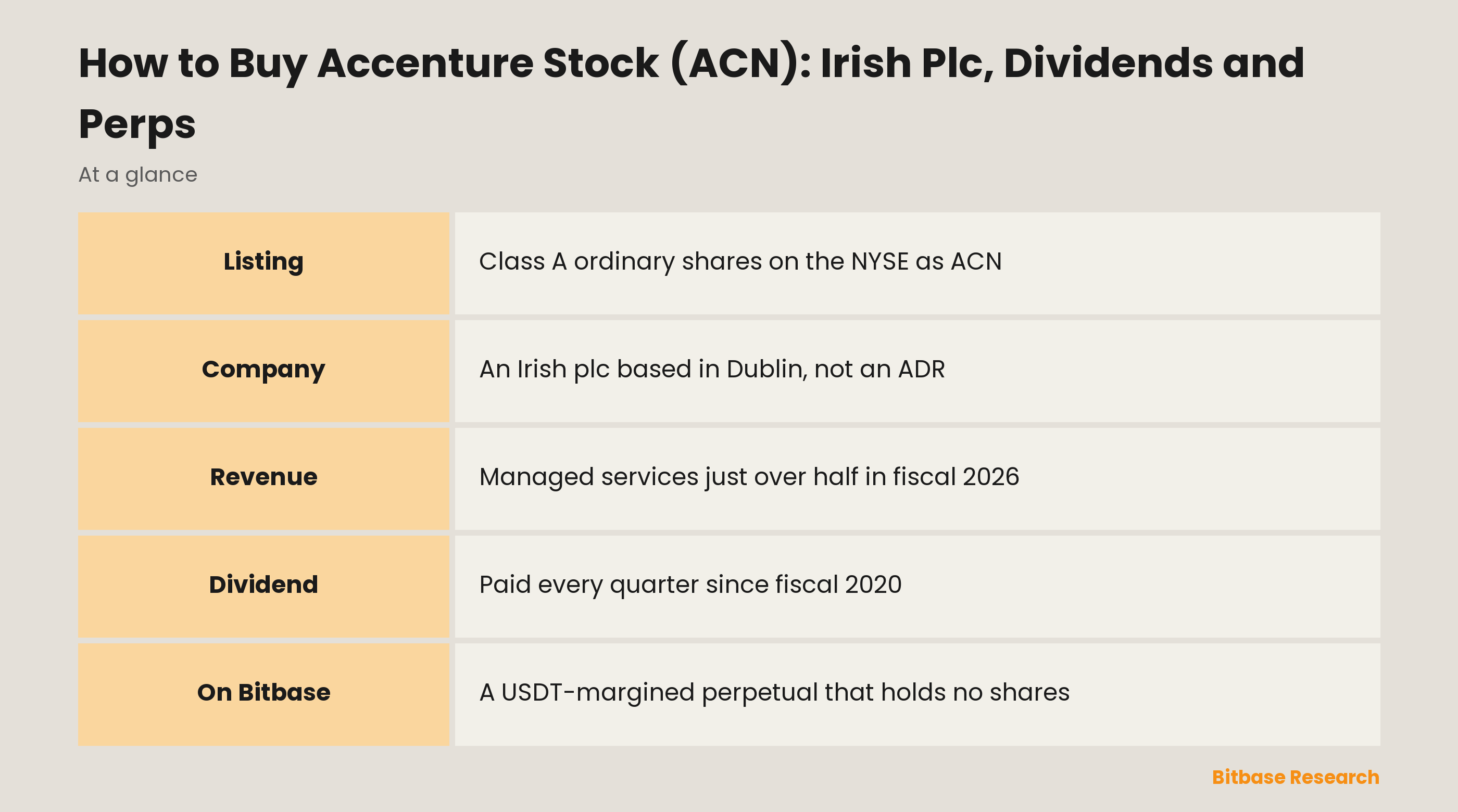
You can buy Accenture stock through any broker with access to the New York Stock Exchange, where the company's Class A ordinary shares trade directly under the ticker ACN, not as depositary receipts. Behind the ticker is a consulting, technology and managed services firm incorporated in Ireland, and in fiscal 2026 its revenue split almost evenly between finite consulting projects and longer-running managed services. The shares themselves are not on Bitbase, which instead lists a USDT-margined ACN perpetual that follows the price, keeps trading while the NYSE is closed and holds no stock.
What Does Accenture Do?
Accenture sells the work of its people to large organisations: strategy advice, technology projects, and the day-to-day running of systems and business processes. Its 10-K opens with a one-line definition, "Accenture is a business reinvention and technology company," and says it delivers that expertise "through consulting, managed services, proprietary assets and platforms, and increasingly, software." It serves more than 9,000 clients, including about three quarters of the Fortune Global 100 and Fortune Global 500 and every G7 government, and says it has worked with 85% of its top 200 commercial clients for 20 years or more.
The three geographic markets, Americas, EMEA and Asia Pacific, are the reporting segments and own the client relationships; five industry groups cut across them. Much of the work runs on other companies' technology: according to the 10-K, its key 18 ecosystem partners represented approximately 65% of fiscal 2026 revenue. Alongside them sit proprietary platforms such as GenWizard and SynOps, and businesses such as Avanade and Dragos, the latter acquired for operational technology security. To deliver all this, Accenture had approximately 814,000 people on 31 August 2026, most of them in India, the Philippines and the US.
The history explains the corporate shape. The firm was known as Andersen Consulting until 1 January 2001, after arbitration completed in August 2000 ended its association with Andersen Worldwide and Arthur Andersen, and it had operated as a series of partnerships and companies controlled by its partners. Class A common shares of Accenture Ltd, a Bermuda company, began trading on the NYSE under ACN on 19 July 2001. On 1 September 2009, a scheme of arrangement under Bermuda law exchanged every share one for one into Accenture plc, an Irish company, and the ticker stayed the same.
The 10-K describes its competitors by type, from large IT service providers and offshore firms "particularly in India" to consultancies, AI-native companies and clients' own IT departments. The view runs the other way as well: IBM's 10-K names Accenture among its consulting competitors, as the guide to buying IBM stock notes.
How Accenture Makes Money
Accenture earns fees for its people's work and reports them as two types. Consulting covers strategy, management and technology consulting and technology integration, which the 10-K calls "a finite, distinct project or set of projects with a defined outcome." Managed services are "ongoing, repeatable services or capabilities provided to transition, run and/or manage operations of client systems or business functions."
The balance has tilted. Consulting was about 51% of revenue in fiscal 2024; in fiscal 2026, the year to 31 August 2026, managed services edged ahead with just over half. Total revenue grew 6% in US dollars and 5% in local currency that year, and managed services grew faster than consulting on both measures.
By client location, the Americas produced about 49% of fiscal 2026 revenue, EMEA about 36% and Asia Pacific about 14%. The United States alone accounted for 44%, while Ireland, the country of domicile, accounted for about 1%. The industry groups give a second cut:
| Industry group | Client types named in the 10-K | Share of fiscal 2026 revenue |
|---|---|---|
| Products | Consumer goods, retail and travel; industrials; life sciences | 30% |
| Health & Public Service | Health providers and insurers; defence, tax and other public agencies | 20% |
| Financial Services | Banks, capital markets firms and insurers | 19% |
| Communications, Media & Technology | Telecoms and media; high tech; software and platforms | 17% |
| Resources | Chemicals and natural resources; energy; utilities | 13% |
Shares are calculated from the fiscal 2026 revenue table and rounded.
Work for the US federal government, delivered through a subsidiary called Accenture Federal Services, made up approximately 7% of total revenue in fiscal 2026. Costs are mostly people: "compensation costs are the most significant portion of our operating expenses," the 10-K says, which is why it reports the utilization of its professionals, 93% in fiscal 2026. And while results are reported in US dollars, "the majority of our revenues are denominated in other currencies, including the Euro, U.K. pound and Japanese yen."
ACN Stock at a Glance
| Item | Detail |
|---|---|
| Exchange | New York Stock Exchange |
| Ticker | ACN |
| Security | Class A ordinary shares, the only class registered on the 10-K cover |
| Depositary receipt | None: the NYSE line is the ordinary share itself |
| Other share class | Class X ordinary shares, untraded and not entitled to dividends |
| Industry | Consulting, technology services and managed services |
| Index membership | S&P 500, per the SPY holdings file dated 28 October 2026 |
| Incorporated | Ireland, as a public limited company; Irish parent since September 2009 |
| Principal executive offices | Dublin, Ireland |
| Tax residence | Ireland, according to the 10-K |
| Listed since | 19 July 2001, as Accenture Ltd of Bermuda |
| Fiscal year end | 31 August |
| Reporting currency | US dollar |
| Dividend policy | Quarterly cash dividend, each declared by the board |
| Share buybacks | Open-market purchase program since August 2001, with no expiration date |
| SEC identifier | CIK 1467373; files 10-K, 10-Q and 8-K reports |
The table leaves out anything that moves with the market; the current quote and price history are on the Accenture stock page on Bitbase.
How to Buy Accenture Stock
Being Irish does not turn ACN into a depositary receipt: the NYSE line is the Class A ordinary share itself, priced in US dollars, with no ADR ratio to convert.
1. Pick a broker that offers NYSE stocks. Confirm that it takes clients from where you live.
2. Open and verify the account. Non-US individuals opening an account with a US broker are normally asked for IRS Form W-8BEN, which the IRS says is given "to the withholding agent or payer if you are a foreign person."
3. Fund it in dollars. If you deposit another currency, the conversion spread is part of your cost.
4. Find the right line. Search for ACN and check that the result reads Accenture plc Class A ordinary shares on the NYSE.
5. Choose an order type. A market order takes whatever price is available when it reaches the exchange; a limit order names the worst price you will accept and can go unfilled.
6. Set the size. Buy whole shares, or part of one where the broker supports fractional orders.
Outside the United States, the withholding that matters most is Irish. The 10-K says that "as an Irish tax resident company, we may be required to deduct Irish dividend withholding tax," at a rate it gives as 25%. Shareholders resident in "relevant territories," which include EU member states other than Ireland, the US and countries with an Irish tax treaty, may be exempted; those elsewhere "will generally be subject to Irish DWT." This is general information, not tax advice.
In a broker account, a depository nominee such as Cede & Co. is the holder of record. Accenture's description of its securities explains that trades between people who both hold through the same depository are not registered on its Irish share register, whereas moving shares into or out of direct registration needs an instrument of transfer, which "may give rise to Irish stamp duty."
Through a fund, ownership is indirect: SPY, which tracks the S&P 500, listed Accenture among its holdings on 28 October 2026, one company among hundreds.
Trading ACN on Bitbase
Bitbase lists an ACN perpetual futures contract, margined and settled in USDT. It follows Accenture's share price but is not the share: there is no Class A ordinary share behind the position, no dividend and no vote. In return, you can go long or short, use leverage, and keep trading at night and over weekends, when the NYSE is closed.
To hold the contract near the share price, longs and shorts exchange a periodic funding payment, with the direction set by which side is more crowded, and a position is liquidated against a mark price, not the last trade, once its margin runs out. Outside NYSE hours the contract keeps moving while the share cannot, so the two can meet at a different level when the exchange reopens. The stock perpetual guide walks through these mechanics.
The funding interval and formula, margin tiers, maximum leverage, and how the mark price and funding are handled while the NYSE is closed are all defined in the contract rules on Bitbase, which are worth reading first. The wider range of stock-linked products is in Bitbase's TradFi listings.
What Moves ACN Stock
Bookings and the consulting cycle. Consulting is the part clients can trim quickly: the 10-K says "the discretionary spending environment continues to impact smaller contracts with a shorter duration." In fiscal 2026, consulting bookings rose 9% in US dollars and managed services bookings 2%, and the company warns that bookings can swing from quarter to quarter with the timing of "a small number of large managed services contracts."
AI, in both directions. AI brings new projects and threatens old ones. The risk factors note that "limited client technology budgets may be increasingly allocated to AI investments," which may cut demand for some existing services, and that results may suffer if clients do not accept new pricing models for AI-enabled work.
Pricing. Accenture defines pricing as "the contract profitability or margin on the work that we sell." For fiscal 2026 as a whole it was "relatively stable," but the company reported lower pricing "in many areas of the business during the fourth quarter."
People costs. With compensation the largest expense, margins depend on matching people to demand, on pay rises and on visa rules; the 10-K notes that government actions can raise "the cost of obtaining or maintaining H-1B or similar visas in the U.S."
US federal spending. Federal work is about 7% of revenue, and in fiscal 2026 growth in the Americas was "partially offset by a decline in Public Service, including our U.S. federal business."
Currency and buybacks. Most revenue is earned outside the dollar, so a weaker dollar flatters reported growth, as it did in fiscal 2026. Buybacks shrink the share count, one of the factors the 10-K lists behind higher adjusted earnings per share that year.
Risks for ACN Shareholders
Item 1A runs to many pages; these are the risks closest to how Accenture earns its money:
Short, cancellable contracts. "Many of our consulting contracts are less than 12 months in duration, and these contracts typically permit a client to terminate the agreement with as little as 30 days' notice." In a downturn, clients can end up "reducing, delaying or eliminating spending under existing contracts."
Automation of its own services. The filing states that "some services and tasks currently performed by our or our clients' people have been and will continue to be replaced by automation."
Government contracting. Government clients can cut scope or end projects for lack of funding. After Accenture Federal Services made a voluntary disclosure, the 10-K says, the US Department of Justice "initiated a civil and criminal investigation" into whether employees gave inaccurate submissions to an assessor evaluating one of its service offerings.
Cyber incidents. Accenture runs client systems and handles client data, and it has "experienced" data security incidents in the past.
Irish incorporation. Irish law differs from US law and, the 10-K warns, "might afford less protection to our shareholders." The United States and Ireland have no treaty for the reciprocal enforcement of civil judgments, and the company flags the risk of losing access to the US-Ireland tax treaty.
The stock itself. Shares can fall, each dividend needs board approval, and holders outside the dollar receive both price and dividend through an exchange rate.
Risks specific to the perpetual. Leverage enlarges losses as well as gains, funding keeps accruing while a position is open, and a jump in price when the NYSE reopens can push a position past its liquidation level.
How to Research ACN Yourself
Accenture files with the SEC under CIK 1467373. The fiscal 2026 10-K arrived on 16 October 2026: Item 1 covers the business, Item 1A the risk factors, Item 5 the listing, dividends and buybacks, and the segment note gives revenue by market, industry and type of work. Each 10-K also carries a description of Accenture's securities, which sets out the Irish rules on dividends, share transfers and Class X shares. Quarterly results come on Form 8-K, filed for fiscal 2026 in December 2025, March 2026, June 2026 and, for the full year, on 1 October 2026. The investor site, investor.accenture.com, has the dividend history.
Accenture Stock FAQ
Is Accenture an American company?
Not by incorporation. Accenture plc is an Irish public limited company based in Dublin and tax resident in Ireland, though it files a 10-K, reports in US dollars and earned 44% of fiscal 2026 revenue in the United States. The 10-K adds that "Accenture never conducted business under a U.S. parent company and pays U.S. taxes on all of its U.S. operations."
Is ACN stock an ADR?
No. An ADR is a certificate issued by a depositary bank against shares held abroad, trading at a set ratio to them. ACN is Accenture plc's Class A ordinary share itself, listed directly on the NYSE, so one ACN is one share.
Does Accenture pay a dividend?
Yes, quarterly. Accenture paid nothing from its 2001 listing until October 2005, when its board declared the first cash dividend; payments were then annual, became twice-yearly in fiscal 2010 and quarterly in fiscal 2020. The board declares each one, and Irish dividend withholding tax may apply depending on where you live.
What are Accenture Class X shares?
A second class of ordinary shares with "no trading market." Each Class X share carries one vote, but holders are "not entitled to receive dividends" or to any payment from surplus assets in a winding-up, and they need Accenture's written consent to transfer them. The class is linked to exchangeable shares of a subsidiary, Accenture Canada Holdings Inc., held by some former members of Accenture leadership. Anyone buying ACN gets Class A shares.
Is Accenture in the S&P 500?
Yes. On 28 October 2026, State Street's daily holdings file for SPY, the fund that tracks the S&P 500, included Accenture plc Class A shares. Index constituents are reviewed and can change, which is why the date is given.
Can I buy Accenture stock with crypto?
Not directly. The shares are bought through a broker in US dollars, so crypto would first need to be sold and the cash moved to the brokerage account. What USDT can trade on Bitbase is the ACN perpetual, a derivative that follows Accenture's price without being stock: no dividend, no vote, and a position can be liquidated. The routes are compared in buying stocks with crypto.
Conclusion
Buying ACN is a routine NYSE trade; understanding it takes more reading. The share is a stake in an Irish-domiciled firm whose revenue now splits almost evenly between consulting projects and longer managed services contracts, whose costs are mostly people, and whose dividends may meet Irish withholding before they reach you. For exposure to the price alone, the Bitbase perpetual is a different instrument, with its own funding and liquidation risk and no ownership of Accenture.
Related reading
Other Bitbase articles on this topic:
- How to Buy Adobe (ADBE) Stock: Trading Methods, Costs and Risks
- How to Buy ADP Stock (ADP): Payroll Fees and Client Fund Interest
- How to Buy Cadence Design Systems Stock (CDNS): Chip Design Tools
- How to Buy SpaceX Stock (SPCX): Class A, Starlink and Perps
Disclaimer: This article is educational content from Bitbase Academy, provided for information only. It explains what a company or fund does and how the instruments referenced here differ from one another; it does not constitute investment, trading, tax, or financial advice, and it is neither a recommendation nor an endorsement of any security, token, or trading strategy. A tokenized stock is issued by a third party and is designed to give economic exposure to an underlying asset: it is not a share, it carries no shareholder rights, and it depends on the issuer's structure, eligibility rules, and redemption terms, which the issuer can change. Perpetual futures are leveraged derivatives that hold no underlying asset and can be liquidated, and trading hours, product availability, and eligibility differ by instrument and by jurisdiction and can change at any time. Written as of October 2026; verify everything yourself through company filings, the issuer's own documentation, and the product pages of the venue you trade on.
References
[1] Accenture plc fiscal 2026 Form 10-K (SEC EDGAR) www.sec.gov
[2] Accenture plc: description of securities filed with the fiscal 2026 10-K (SEC EDGAR) www.sec.gov
[3] Accenture plc Form 8-K, 1 September 2009: completion of the move from Bermuda to Ireland (SEC EDGAR) www.sec.gov
[4] Accenture Ltd Form 10-K, fiscal 2001: NYSE listing and the Andersen Consulting name (SEC EDGAR) www.sec.gov
[5] Accenture Ltd Form 10-K, fiscal 2005: first cash dividend (SEC EDGAR) www.sec.gov
[6] Accenture investor relations: dividend history investor.accenture.com
[7] State Street: SPY daily holdings, 28 October 2026 www.ssga.com
[8] IRS: About Form W-8 BEN www.irs.gov





