
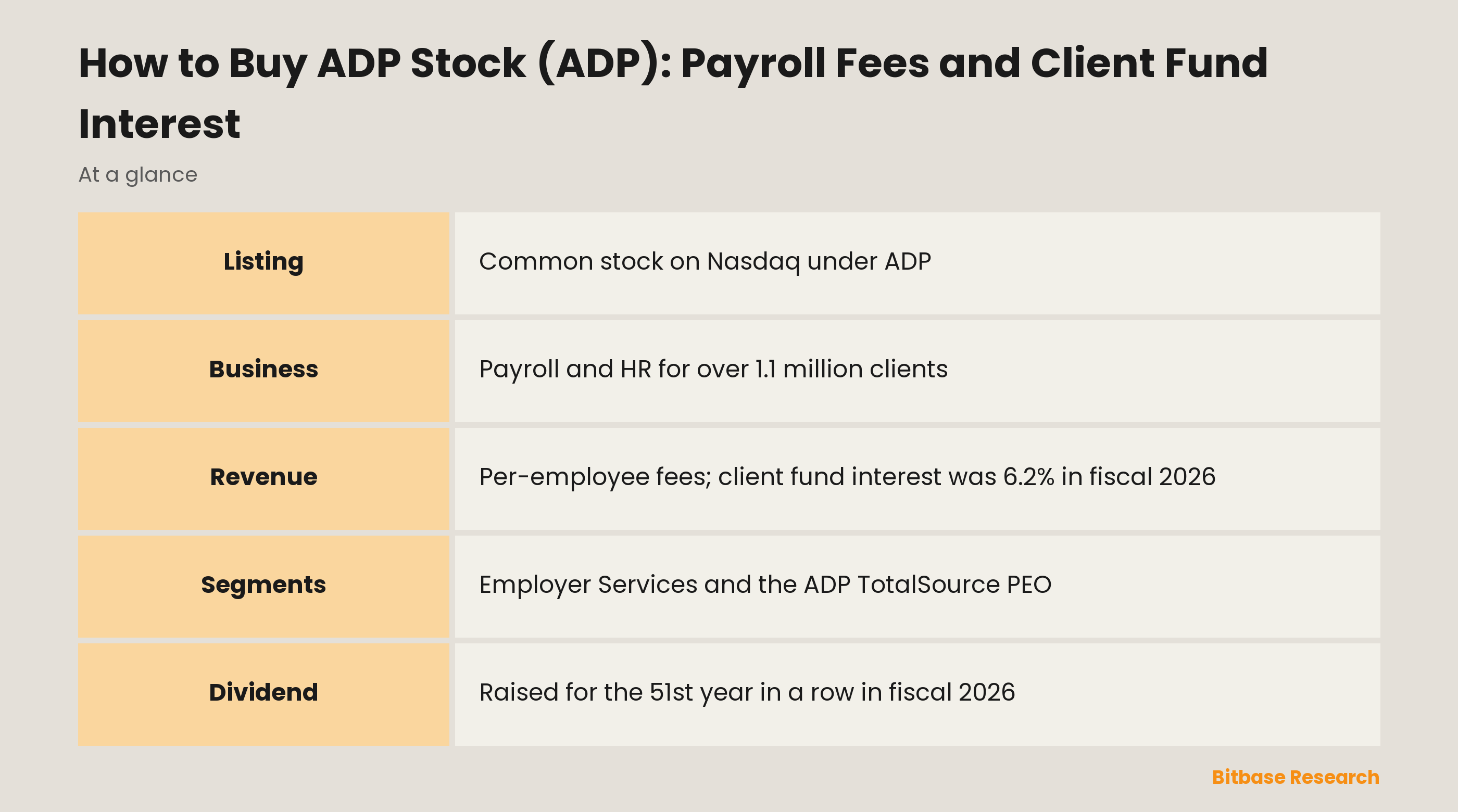
Your payslip may already carry ADP's name, but owning a piece of the company takes a brokerage account that reaches Nasdaq, where the common stock of Automatic Data Processing, Inc. trades under the ticker ADP. The business was founded in 1949 to run other companies' payrolls, and by the count in its fiscal 2026 10-K it now pays about one in every six workers in the United States. Most of its revenue comes from fees, but it also earns interest on client money between collecting a payroll and paying it out, and in fiscal 2026 its board raised the dividend for the 51st consecutive year.
What Does ADP Do?
ADP sells human capital management, the industry's name for the software and services an employer uses to hire, pay, insure and keep records on its staff. Payroll is the core: preparing paychecks and pay statements, calculating withholding and, for US clients, preparing and filing federal, state and local payroll tax returns. Around it sit benefits administration, time and attendance tools, talent management, compliance services and retirement plan recordkeeping. The fiscal 2026 10-K counts more than 1.1 million clients in over 140 countries and territories.
The products are sorted by client size. RUN Powered by ADP serves over 980,000 small businesses; ADP Workforce Now is used by over 90,000 mid-sized and large businesses in North America; ADP Lyric HCM is the global system for large enterprises. Since January 2026 the company has been adding AI agents under the ADP Assist name across its payroll, benefits, HR and compliance products, and in October 2024 it acquired WorkForce Software.
ADP reports two segments. Employer Services covers everything above, for clients from one-person firms to multinationals. PEO Services, sold as ADP TotalSource, works on a different model: ADP becomes a co-employer of a small or mid-sized client's staff, runs their payroll and payroll taxes, and offers them benefits and workers' compensation cover through its own plans. ADP TotalSource is the largest PEO certified by the Internal Revenue Service as a Certified Professional Employer Organization, and it serves employees in the United States only.
The ADP name also sits on a labor-market statistic. ADP Research publishes the ADP National Employment Report, "a high-frequency measure of the change in U.S. nonfarm, private employment and pay" built from anonymous payroll data of ADP's clients with the Stanford Digital Economy Lab and released free each month. It is a separate series from the government's nonfarm payrolls estimate, the release examined in CPI, payrolls and crypto volatility, and it describes the labor market, not ADP's own finances.
Maria Black, at ADP since 1996, has been president and chief executive officer since January 2023, and Peter Hadley took over as chief financial officer in July 2025.
How ADP Makes Money
Three kinds of revenue run through ADP's income statement. The largest is fees: revenue is recognized "based on a fixed fee per employee serviced," so a client that adds staff generally pays more. The second is a pass-through: PEO clients' health and other benefit costs flow into revenue and straight back out as cost, which the company calls "zero-margin benefits pass-throughs." The third is interest. Employers hand ADP the money for wages and payroll taxes before it is due to employees and tax authorities, and ADP invests it in the meantime, booking interest "on collected but not yet remitted funds held for clients."
The revenue note in the 10-K splits the total by type:
| Revenue type | Fiscal 2026 | Fiscal 2024 |
|---|---|---|
| HCM: payroll, HR, benefits, time and related services in the US | 41.5% | 42.5% |
| PEO zero-margin benefits pass-throughs | 21.0% | 20.7% |
| HR outsourcing, excluding those pass-throughs | 18.1% | 18.5% |
| Global: services outside the US and for multinationals | 13.2% | 13.0% |
| Interest on funds held for clients | 6.2% | 5.3% |
Shares are calculated from the 10-K's revenue note and rounded to one decimal; each fiscal year ends on 30 June.
The two segments earn very different margins, and the pass-through is part of the reason. In fiscal 2026 Employer Services earned a pretax margin of 36.7%, up from 36.1%, while PEO Services earned 13.1%, down from 14.2%. Total revenue grew 7%, and measured by the location of the billing entity, the United States produced about 87.8% of it.
Interest is the smallest line in the table, yet the 10-K lists "contributions from client funds interest revenues" first among the reasons its fiscal 2026 margin rose. Two inputs set its size: average client fund balances, up 7.4% in fiscal 2026, and the yield on them, which averaged 3.4% against 3.2% a year earlier.
ADP does not keep all of that money in cash. Its strategy is "structured to allow us to average our way through an interest rate cycle," laddering maturities out to five years in the extended portfolio and ten years in the long portfolio. To hold those bonds and still meet every payroll, it uses each day's incoming client money to settle other clients' obligations and covers short gaps with commercial paper and reverse repurchase agreements. In the United States the funds sit in ADP Client Trust, whose sole trustee is ADP Trust Company, National Association, a national trust bank authorized in 2019 and supervised by the Office of the Comptroller of the Currency.
The client base is broad: no single client or group of affiliated clients accounted for more than 2% of fiscal 2026 revenue, and the 10-K estimates client retention at roughly 13 years in Employer Services and 6 years in PEO.
ADP Stock at a Glance
| Field | Detail |
|---|---|
| Exchange | Nasdaq Global Select Market, since 21 October 2008; previously the NYSE |
| Ticker | ADP |
| Security | Common stock, the single class listed on the 10-K cover |
| Issuer | Automatic Data Processing, Inc. |
| Sector | Human capital management: payroll, HR, benefits and PEO services |
| Index membership | S&P 500 and Nasdaq-100 |
| Headquarters | Roseland, New Jersey |
| Incorporated | Delaware |
| Founded | 1949 |
| Fiscal year | Ends 30 June |
| Reporting rhythm | Quarterly results and 10-Qs; the fiscal 2026 10-K was filed on 5 August 2026 |
| Dividend policy | Regular quarterly dividend, raised for the 51st consecutive year in fiscal 2026 |
| Share repurchases | Board authorization approved in January 2026, with no expiration date |
| SEC identifier | CIK 8670 |
For the live quote, the day's range and the market value, use the ADP stock page on Bitbase.
How to Buy ADP Stock
With one listed share line and no ADR to weigh against it, the real choice is between holding the shares yourself and holding a fund that owns them. Buying the shares directly runs like this:
1. Pick a broker that can reach Nasdaq. Many brokers outside the United States offer US shares; find out which company will actually keep your account and who supervises it.
2. Complete the tax form. Non-US individuals are normally asked for IRS Form W-8BEN; the IRS says to "submit Form W-8 BEN when requested by the withholding agent or payer."
3. Fund the account in US dollars. Converting from another currency has its own cost, so compare the exchange spread as well as the commission.
4. Search for ADP and check the name. The result should show Automatic Data Processing, Inc. common stock on Nasdaq.
5. Choose the order type. FINRA defines a limit order as "an order to buy or sell a security at or better than a specified price": you are "guaranteed to get your limit price or a better price if your order is executed," but "there's a chance your order doesn't get executed at all." A market order "provides the most certainty that your order will be executed."
6. Decide the size. "The availability of fractional share trading varies by brokerage firm," FINRA notes; a fractional owner "might not have shareholder voting rights," and "at the moment, you can't transfer fractional shares to another brokerage firm."
7. Know how the shares are registered. A broker normally holds your shares in "street name," which makes its nominee the holder of record and you the beneficial owner. ADP's 10-K counted 28,950 holders of record on 30 June 2026 and a further 2,004,432 holders in street name, so most of its shareholders own the stock this way.
Withholding on dividends. The IRS states that "most types of U.S. source income received by a foreign person are subject to U.S. tax of 30%," and that a reduced rate, including exemption, may apply under a tax treaty with your country of residence. ADP's dividends fall into that category, so the W-8BEN on file decides the rate your broker withholds; your home country may tax them again.
Owning it through a fund. ADP belongs to both the S&P 500 and the Nasdaq-100, so index funds tracking either hold it; Nasdaq-100 funds such as QQQM are one example. Inside a fund ADP is one position among roughly a hundred or five hundred, and the fund, not you, votes the shares.
What Moves ADP Stock
Hiring at client companies. Because fees are charged per employee, revenue follows clients' headcount. ADP tracks this with pays per control, which the 10-K defines as "the approximate growth in the number of employees on ADP clients' processed payrolls in the United States when measured on a same-store-sales basis." It rose 1% in fiscal 2026 and 2% in the quarter to 30 September 2026. The risk factors warn that "negative changes, including in employment levels (as a result of AI or otherwise)," may hurt the business.
Interest rates and client balances. Client fund interest has two inputs: how much money clients leave with ADP and what it earns. In the first quarter of fiscal 2027, average client fund balances rose 6% and the average yield rose 30 basis points to 3.6%, lifting interest on funds held for clients by 15%. With the portfolio laddered over several years, a change in market rates reaches the average yield step by step as maturing securities are reinvested, in either direction.
Bookings and retention. Employer Services new business bookings grew 6% in fiscal 2026, and client revenue retention was 92.1%. Bookings become revenue only once a client is implemented, which the 10-K says can take as little as 24 hours for a small client and generally six to nine months for a large one.
PEO growth and costs. Because PEO revenue includes the benefits pass-through, the segment can grow while its margin narrows. In fiscal 2026 average worksite employees rose 2% and the margin slipped to 13.1%; the company pointed to selling costs, pass-through costs, state unemployment insurance and a larger pretax loss at ADP Indemnity, its workers' compensation insurance unit.
Tax and payroll rules. Interest income depends on how long tax money sits with ADP. The 10-K is explicit: a rule change "decreasing the amount of taxes to be withheld or allowing less time to remit taxes to government authorities would adversely impact average client balances."
AI and competition. ADP lists its competitors by type: business outsourcers, ERP providers, cloud HCM vendors, financial institutions and employers' in-house systems. Its 10-K warns that generative and agentic AI "may be disruptive to the HCM industry," even as the company builds those tools into its own products.
Risks Inside ADP's Payroll Model
Item 1A of the fiscal 2026 10-K is long; for a shareholder, the entries below matter most:
Moving other people's money. Payroll and tax processing "involve the collection, custody and transmission of a significant volume of funds in short-time frames," and errors, fraud or a failure to recover funds from clients "could result in significant financial losses." The company adds that "a systemic shutdown of the banking industry would impede our ability to process payments."
Data security. ADP stores payroll, tax, bank account and health data on its clients' employees and says "we are regularly targeted by unauthorized parties using malicious tactics, code and viruses."
The client fund portfolio. The securities bought with client money "are subject to general market, interest rate, credit and liquidity risks." If employment falls and balances shrink, ADP may sell securities to match, and such a sale "may result in the recognition of losses."
Co-employment. As co-employer, the PEO can be liable for worksite employees' wages and taxes, and "it is possible that our clients will not remit such payments despite their contractual obligations."
Technology change. New AI-based HCM products could "place us at a competitive disadvantage or even render obsolete our technology, products and solutions."
Activist investors. ADP has faced activist proposals before and says such campaigns "may cause periods of fluctuation in our stock price."
Beyond the company, one stock concentrates your money in one business, and this one is tied closely to US hiring and US interest rates; if your savings are counted in another currency, the dollar's moves change the value of the shares and of each dividend.
How to Research ADP Stock Yourself
ADP's filings are on SEC EDGAR under CIK 8670. With a fiscal year ending on 30 June, the 10-K arrives in summer and 10-Qs follow the September, December and March quarters. Each quarterly results release is filed with an 8-K and carries the figures this article relies on: pays per control, PEO worksite employees, average client fund balances and their yield.
Inside the 10-K, three places do most of the work: the revenue note; the market-risk discussion, which explains how the client fund portfolio is laddered and financed; and Item 5, whose performance graph compares ADP's return with the S&P 500 and with the Nasdaq Dividend Achievers Select Index, companies "with at least ten consecutive years of increasing annual regular dividend payments." The investor site, investors.adp.com, posts news releases, SEC filings and presentations.
The stock page linked above shows the live quote, and the index of US stock pages on Bitbase lets you put ADP beside other payroll and software companies.
ADP Stock FAQ
Does ADP pay a dividend?
Yes. ADP pays a regular quarterly dividend, and its 2026 annual report says the board "increased the dividend for the 51st consecutive year" in fiscal 2026. Dividends declared per share rose 10.3% that year. The board sets each payment, so the amount can change; the latest figure is in ADP's most recent dividend announcement.
Can I buy ADP stock with crypto?
Not directly. A broker settles ADP purchases in US dollars, so you would sell the crypto for cash first, which may be taxable where you live, then transfer that cash to the brokerage. What you then hold is a voting share of a Delaware corporation; how crypto differs from stocks sets out what separates the two.
Is ADP in the S&P 500 and the Nasdaq-100?
Yes, both. The 28 October 2026 holdings file of State Street's SPY, an S&P 500 ETF, lists Automatic Data Processing under ADP, and Nasdaq's own Nasdaq-100 constituent list dated 29 October 2026 includes it. Index membership can change at any review.
Has ADP stock ever split?
Yes. The fiscal 1999 10-K records a two-for-one split effective 1 January 1999, and ADP's 10-K filings since then have not reported another. Its price history was reshaped instead by two spin-offs: Broadridge Financial Solutions in March 2007, at one Broadridge share for every four ADP shares, and CDK Global in September 2014, at one CDK share for every three.
Is the ADP jobs report the same as ADP's earnings?
No. The ADP National Employment Report is a labor-market statistic, published monthly and, since October 2025, with a preliminary weekly estimate as well. ADP's own results come in its quarterly releases and SEC filings, where the closest operating measure is pays per control.
When does ADP report earnings?
Every quarter, on a fiscal year that ends on 30 June. Results for the July to September quarter of fiscal 2027 came out on 28 October 2026, and the full-year 10-K follows the June year-end.
Conclusion
The purchase itself is short: a Nasdaq-capable broker, the right listing on screen, and an order type and size that suit you. Understanding the company means following three things the filings make plain: how many people ADP's clients keep on payroll, how much client money passes through its hands and at what yield, and how the lower-margin PEO business grows. Read the latest quarterly release and the 10-K's revenue note before deciding how much one payroll company should weigh in your portfolio.
Related reading
Other Bitbase articles on this topic:
- How to Buy Accenture Stock (ACN): Irish Plc, Dividends and Perps
- How to Buy Adobe (ADBE) Stock: Trading Methods, Costs and Risks
- How to Buy Cadence Design Systems Stock (CDNS): Chip Design Tools
- How to Buy GOOGL: One Company, Two Nasdaq Tickers
Disclaimer: This article is educational content from Bitbase Academy, provided for information only. It explains what a company or fund does and how the instruments referenced here differ from one another; it does not constitute investment, trading, tax, or financial advice, and it is neither a recommendation nor an endorsement of any security, token, or trading strategy. A tokenized stock is issued by a third party and is designed to give economic exposure to an underlying asset: it is not a share, it carries no shareholder rights, and it depends on the issuer's structure, eligibility rules, and redemption terms, which the issuer can change. Perpetual futures are leveraged derivatives that hold no underlying asset and can be liquidated, and trading hours, product availability, and eligibility differ by instrument and by jurisdiction and can change at any time. Written as of October 2026; verify everything yourself through company filings, the issuer's own documentation, and the product pages of the venue you trade on.
References
[1] ADP Form 10-K, fiscal 2026 (SEC EDGAR) www.sec.gov
[2] ADP release, 28 October 2026: fiscal 2027 first-quarter results www.sec.gov
[3] ADP 2026 Annual Report to stockholders www.sec.gov
[4] ADP Form 10-K, fiscal 1999: two-for-one stock split www.sec.gov
[5] ADP Form 10-K, fiscal 2007: Broadridge spin-off www.sec.gov
[6] ADP Form 10-K, fiscal 2015: CDK Global spin-off www.sec.gov
[7] ADP Form 8-K, 26 September 2008: move from the NYSE to Nasdaq www.sec.gov
[8] ADP, 23 August 2022: new National Employment Report methodology mediacenter.adp.com
[9] ADP, 28 October 2025: weekly preliminary employment estimate mediacenter.adp.com
[10] State Street: SPY daily holdings, 28 October 2026 www.ssga.com
[11] Nasdaq: Nasdaq-100 constituents, 29 October 2026 www.nasdaq.com
[12] FINRA: Order Types www.finra.org
[13] FINRA: Fractional Shares www.finra.org
[14] IRS: Form W-8 BEN www.irs.gov
[15] IRS: NRA Withholding www.irs.gov





