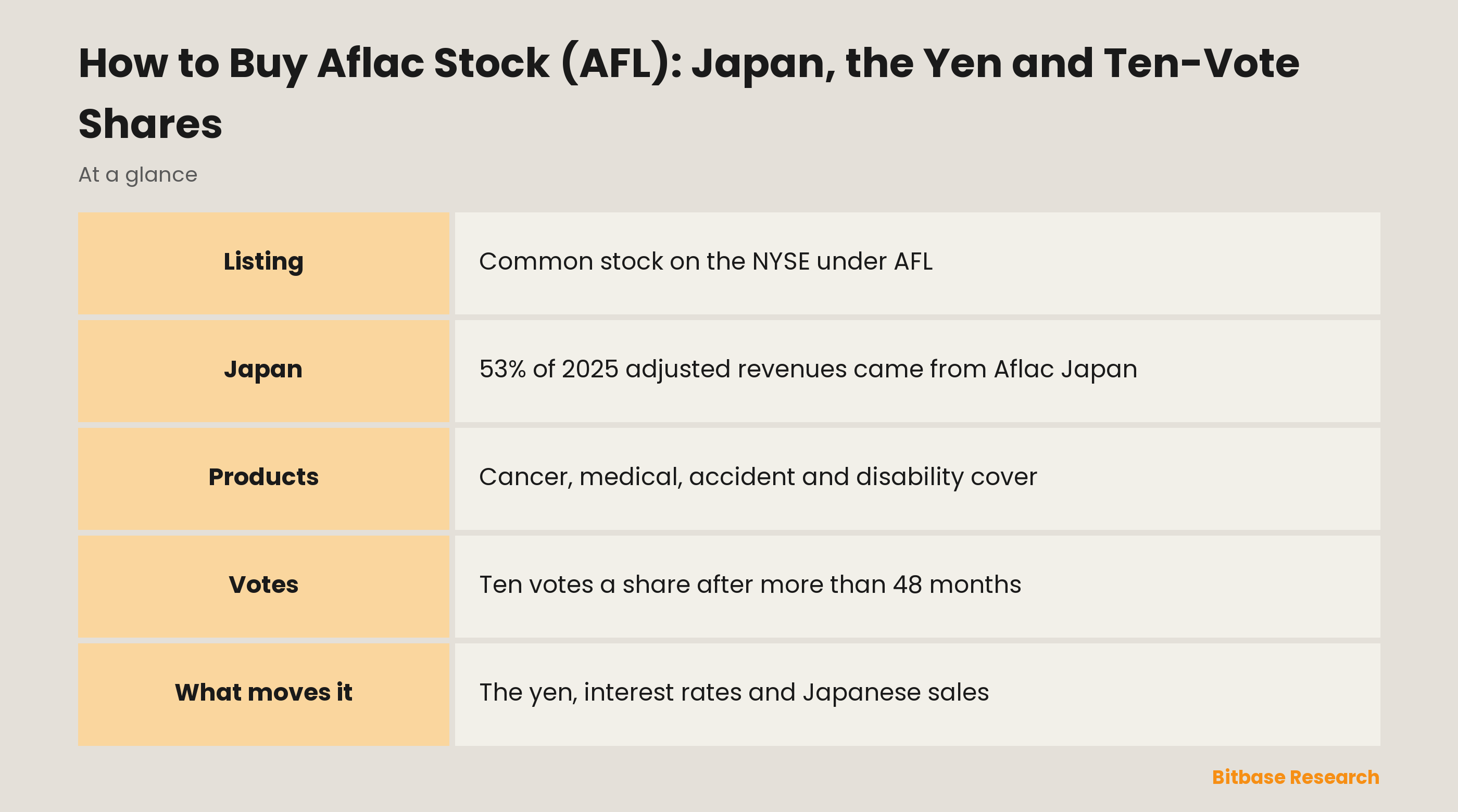
Anyone holding a brokerage account that reaches the NYSE can buy Aflac stock: the common shares are listed in New York under the ticker AFL, and the Tokyo listing ended in October 2019. Aflac sells cancer, accident and other supplemental cover in the United States, yet Aflac Japan supplied 53% of its 2025 adjusted revenues, so a share priced in dollars carries a large yen business inside it. This guide covers how that business earns money, how to place the order, why long-held shares can carry ten votes, and which risks the filings put first.
What Does Aflac Do?
Aflac Incorporated is a holding company, incorporated in Georgia in 1973 and headquartered in Columbus, Georgia. Its annual report states the principal business plainly: "supplemental health and life insurance products." When a policyholder "gets sick or hurt, the Company pays cash benefits," and in the United States those benefits are paid "regardless of other insurance." The 10-K speaks of a 70-year history; the main US subsidiary is American Family Life Assurance Company of Columbus, which the filing shortens to Aflac.
The insurance business reports two segments. Aflac Japan operates through Aflac Life Insurance Japan, which became a Japanese subsidiary in April 2018 after years as a branch. It "pioneered the cancer insurance market in Japan in 1974," and the 10-K calls it the largest insurer in Japan by cancer and medical policies in force: more than 22 million individual policies at the end of 2025, about 14 million of them for cancer.
Japan sorts private insurance into sectors. Cancer and medical cover is the "third sector," designed to pay costs the national health insurance system does not reimburse; life insurance is the "first sector." Aflac Japan sells both, including the Miraito cancer product launched in March 2025, the Anshin Palette medical product launched that December, and Tsumitasu, a savings-type life policy.
Aflac U.S. sells accident, disability, cancer and critical illness, hospital indemnity, dental and vision, and life insurance, mostly at the workplace. Career agents, independent contractors paid on commission, focus on employers with three to 99 workers; brokers serve employers with 100 or more. Individual policies are portable, so an employee who changes jobs can keep the cover. The company's earnings releases call Aflac the No. 1 provider of supplemental health insurance in the US, citing a LIMRA 2025 market report.
A third bucket, Corporate and other, holds the parent company, the investment managers and Aflac Re Bermuda, which reinsures certain policies written by the Japanese subsidiary. Its mascot is the Aflac Duck, which the 10-K calls "one of the most familiar advertising icons in the world"; brand awareness hovered at about 10% in 1999, before the duck's first US commercial aired on 1 January 2000 to teach viewers how to pronounce the name.
How Aflac Makes Money
Customers pay premiums, and the company invests them until claims fall due. Measured by adjusted revenues, which leave out investment gains and losses, Aflac Japan produced 53% of the 2025 total, down from 60% in 2023; Aflac U.S. produced about 39% and Corporate and other the remainder. Profit leans further toward Japan: of 2025 pretax adjusted earnings, the measure the company uses to judge its segments, Aflac Japan contributed about 69% and Aflac U.S. about 29%. Japan also accounts for 76% of total assets.
The policy liabilities note splits each segment's 2025 gross premiums by product:
| Segment | Product line | Share of the segment's 2025 gross premiums |
|---|---|---|
| Aflac Japan | Cancer | 49.4% |
| Aflac Japan | Medical and other health | 30.9% |
| Aflac Japan | Life | 17.8% |
| Aflac Japan | Other | 1.9% |
| Aflac U.S. | Critical care (cancer and critical illness) | 28.4% |
| Aflac U.S. | Disability | 22.6% |
| Aflac U.S. | Accident | 19.8% |
| Aflac U.S. | Hospital indemnity | 11.7% |
| Aflac U.S. | Life | 11.0% |
| Aflac U.S. | Dental and vision | 3.3% |
| Aflac U.S. | Other | 3.2% |
Shares are calculated from the 10-K's premium figures and rounded to one decimal.
New business in Japan leans even harder on cancer: cancer products made up 67.2% of Aflac Japan's 2025 new annualized premium sales, up from 57.5% in 2024, helped by Miraito. Affiliated corporate agencies, a channel that includes Japan Post Group, Dai-ichi Life and Daido Life, brought in 49.2% of those sales, and Aflac Japan has selling agreements with about 90% of the banks in Japan. Japan Post is the partner the filings single out: cancer policies sold through it made up about 6.7% of Aflac Japan's 2025 earned premium.
The second engine is investment income. Premiums collected in yen must eventually pay claims in yen, but Japanese yields are low and long-dated yen fixed income "beyond JGBs," Japanese government bonds, is scarce. Aflac Japan therefore also buys dollar assets: in 2025 about 66% of its net investment income came from US dollar-denominated investments. Part of that portfolio is hedged back to yen and part is deliberately left unhedged, which ties the investment line to exchange rates as well as interest rates.
AFL Stock at a Glance
| Field | AFL |
|---|---|
| Listing venue | NYSE (New York Stock Exchange) |
| Symbol | AFL |
| Security | Common stock, the only security registered on the 10-K cover |
| Former listing | Tokyo Stock Exchange, code 8686, until October 2019 |
| Sector | Insurance: supplemental health and life |
| Index membership | S&P 500 |
| Headquarters | Columbus, Georgia |
| Incorporated | Georgia, 1973 |
| Fiscal year | Calendar year, ending 31 December |
| Voting | One vote per share; ten after more than 48 months with the same owner |
| Dividend policy | Quarterly cash dividend; 2025 was the 43rd straight year of increases |
| SEC filer number | CIK 4977 |
The table leaves out price, market value and dividend yield because they move all day; the live AFL quote on Bitbase has them.
How to Buy Aflac Stock
Because Aflac is an American issuer, there are no depositary receipts in the picture: what trades on the NYSE is the common stock. Buying it takes seven steps:
1. Find a broker with US market access. Investors abroad can use a domestic firm that routes orders to New York or an international broker; either way, confirm which legal entity will hold your shares and which regulator supervises it.
2. Complete the account checks. Brokers ask non-US residents for IRS Form W-8BEN, the declaration of foreign status they rely on when applying a treaty rate to US dividends.
3. Move money in. Paying from a non-dollar account means a currency conversion, and its spread is a cost alongside the trading fee.
4. Look up AFL and confirm the issuer. The line you want is Aflac Incorporated common stock on the NYSE; code 8686 refers to the former Tokyo listing, which ended in 2019.
5. Choose market or limit. A market order buys at whatever price is available next; a limit order buys only at your price or lower, protecting you from a bad fill at the risk of no fill.
6. Settle the amount. Fractional shares, sold by some brokers for a fixed cash sum, are not offered everywhere, and a fraction may not carry a vote.
7. Save every confirmation. Beyond cost basis and dividend records, at Aflac the purchase dates also prove how long you have owned each share, and that sets its voting weight.
Brokers that accept orders before or after the main session quote prices that can drift from regular trading, as this guide to reading stock prices explains; when volume is light, a limit order keeps the price under your control.
Ten votes after four years. Aflac's articles give each share one vote until the same beneficial owner has held it continuously for more than 48 months before a meeting's record date; from then on it carries ten. Shareholders approved the structure in 1985, and the proxy statement stresses that the time-phased voting rights "differ significantly from dual-class share structures": both kinds of share receive the same dividends. The catch is custody. Shares held in "street" or nominee name, meaning registered through your broker rather than directly to you, are presumed to carry one vote; to claim ten, you complete the affidavit on the reverse of the proxy, and the board may ask for evidence.
Holders abroad have US tax withheld from dividends. Under IRS rules, "most types of U.S. source income received by a foreign person are subject to U.S. tax of 30%," while "a reduced rate, including exemption, may apply" where a treaty provides one; the W-8BEN tells the broker which rate fits. Tax at home can come on top.
Fund investors may own Aflac already. Two State Street funds held it on 29 October 2026, according to their daily holdings files: SPY, which tracks the S&P 500, and XLF, the Financial Select Sector fund, each with Aflac as one position among many.
What Moves AFL Stock
The yen. Aflac Japan collects premiums and pays claims in yen, while AFL reports and pays dividends in dollars, so a weaker yen shrinks the Japanese business in dollar terms even when nothing changed on the ground. The second quarter of 2026 shows the size of the effect: Aflac Japan's net earned premiums fell 3.7% in yen but 12.7% in dollars, with the average exchange rate 9.3% weaker than a year earlier. The company translates at the published MUFG Bank telegraphic transfer middle rate and reports Japan's results with and without currency effects.
Interest rates on both sides of the Pacific. Low Japanese yields hold down income on new yen investments, and the 10-K notes that first-sector life products are more rate-sensitive than cancer and medical cover; the Bank of Japan ended its negative interest rate policy in March 2024. In the US, lower short-term rates cut floating-rate income, the main reason adjusted net investment income fell in both segments in 2025. And a wider gap between short-term US and Japanese rates raises the cost of hedging Aflac Japan's dollar assets into yen.
Japan's shrinking premium base. In yen, Aflac Japan's net earned premiums fell 3.9% in 2025. The 10-K gives two causes: an internal cancer reinsurance transaction with Aflac Re set up in late 2024, and limited-pay policies reaching paid-up status, after which premiums stop while the cover continues. In 2026 an external reinsurance transaction for WAYS and Tsumitasu added to the drag. Sales push the other way: new annualized premium sales in Japan rose 16.0% in yen in 2025, led by Miraito, and whether Miraito and Anshin Palette keep that going is the line to watch each quarter.
Japan Post. The sales partnership dates from 2008, and in 2018 Japan Post Holdings agreed to buy roughly 7% of Aflac's shares through a trust. The risk factors say Japan Post "in recent periods has accounted for a significant portion of Aflac Japan's total sales." Japan Post Holdings has no board seat, and its trust must vote any shares above 20% of the voting power in proportion to other holders.
The US worksite calendar. Aflac U.S. net earned premiums rose 2.9% in 2025 on improved sales. Group sales cluster around employers' open enrollment, so over one third of a year's US sales typically arrive in the fourth quarter. The 10-K also describes major medical carriers moving into supplemental products and "bundling and discounting" them with their core benefits.
Capital returns. The weighted-average basic share count fell about 5.3% in 2025 as the company bought back stock, and the board raised the quarterly dividend 5.2% from the first quarter of 2026. Both depend on dividends from the subsidiaries, Aflac Japan above all; the parent hedges the yen in those payments, and Aflac Japan's dividend capacity is aligned with Japanese solvency rules that have just changed: the FSA's economic value-based regime, measured by the solvency ratio known as ESR, applies from fiscal year-end 2025, and Aflac Japan published its first ESR, as of 31 March 2026, in July 2026.
The Uncertainties Hanging Over Aflac
Of the many risk factors in Item 1A, these speak most directly to someone holding AFL:
Concentration in Japan. "The Company's concentration of business in Japan poses risks to its operations and financial condition," including "a substantial concentration of JGBs in its investment portfolio."
Currency and hedging. "The Company is exposed to foreign currency fluctuations in the yen/dollar exchange rate," and the 10-K is frank about its defences: "These hedging activities are limited in scope and the strategies may not be successful."
Data security. The filing warns that "a failure to maintain the security, confidentiality, integrity or privacy of sensitive data" could harm the business, and both segments have had incidents. In the US, unauthorized access detected on 12 June 2025 involved personal information of about 22.65 million individuals; the latest 10-Q reports pending disputes and says the potential loss "cannot be reasonably estimated." In Japan, an outsider accessed Aflac Japan systems between 15 and 25 June 2026, reaching policy details and bank account information. In both cases the company says it does not believe a material impact is reasonably likely.
Sales force classification. "A majority of the Company's U.S. sales force is, and has historically been, comprised of independent agents," and "allegations or determinations of agent misclassification could adversely affect" results and liquidity.
Holding-company structure. "As a holding company, the Parent Company depends on the ability of its subsidiaries to transfer funds to it," and Nebraska insurance law and Japan's Companies Act both limit those transfers.
Two more apply to the share itself. Owning one stock ties your outcome to one company, and this one is largely a Japanese insurer reporting in dollars, so the yen shapes your return whether or not you watch it. And past dividend increases do not oblige the board to keep raising: it declares each payment separately.
Reading Aflac's Filings in Two Currencies
Everything Aflac sends the SEC sits under CIK 4977: an annual 10-K, 10-Qs for the other quarters and 8-Ks for events in between, including every quarterly earnings release and the June 2026 notice on the Japanese cyber incident. A quarterly financial supplement is posted on its investor site.
Within the 10-K, the business section (Item 1) lays out the segments and Item 1A the risks, while the MD&A gives Japan's results in both dollars and yen, plus percentage changes with and without currency effects. The yen columns show how the Japanese business itself performed; the dollar columns show what reached shareholders. Japan's regulatory reports follow a fiscal year ending 31 March, so Japanese capital figures and the US annual report cover different periods.
The proxy statement explains the time-phased votes and the Japan Post shareholders agreement, and the 10-K's performance graph benchmarks AFL against the S&P 500 and the S&P 500 Life & Health Insurance index. Live prices are on the AFL page linked earlier, and Bitbase's US stock pages cover other listed companies.
Aflac Stock FAQ
Does Aflac pay a dividend?
Yes, every quarter. The company describes 2025 as its 43rd consecutive year of dividend increases, and the board raised the quarterly payment 5.2% from the first quarter of 2026. Each dividend is declared by the board, with amounts and dates in the earnings releases.
Can I buy Aflac stock with crypto?
Not directly. A broker sells you AFL and NYSE trades settle in dollars, so the crypto must first be converted to cash and the cash transferred into the brokerage account; depending on where you live, that conversion may be a taxable sale. The switch also changes what you own: a share is a registered stake in Aflac, paying dividends and carrying voting power that builds the longer you hold, which is how a stock differs from a crypto asset.
Why do some Aflac shares have ten votes?
Because the articles reward long holding. A share carries one vote until the same beneficial owner has held it for more than 48 months, then ten. Shares in street name are presumed to carry one vote unless the holder submits the affidavit printed on the proxy. Dividends are the same either way.
Is Aflac still listed in Tokyo?
No. In August 2019 the board authorized a voluntary delisting from the Tokyo Stock Exchange, and the annual report for that year says the stock was listed there under code 8686 until the beginning of October 2019. The New York listing was unaffected and is the only one on the current 10-K cover.
Is AFL in the S&P 500?
Yes. State Street's daily holdings file for SPY, its S&P 500 trust, listed Aflac on 29 October 2026; the company also appears in the Financial Select Sector fund, XLF. Index weights change daily.
Has Aflac stock ever split?
Yes, more than once. A two-for-one split paid on 16 March 2018 was, according to the company's announcement, the ninth since its NYSE listing in 1974. Per-share figures from before March 2018 need adjusting before any comparison.
Conclusion
The mechanics are short: open an account that reaches the NYSE, look up AFL, decide how to price the order. Understanding the share takes longer. It holds a US worksite insurer joined to a Japanese cancer-insurance business that supplies most of the profit, plus a voting rule that rewards patience. Before sizing a position, read the yen and dollar columns of the latest 10-K side by side, together with the risk factors on currency, rates and data security.
Related reading
Other Bitbase articles on this topic:
- How to Buy Allstate Stock (ALL): Auto Rates, Storms and Buybacks
- How to Buy Aon Stock (AON): Dublin plc, NYSE Shares, USI Deal
- How to Buy Arthur J. Gallagher Stock (AJG): Broker, Not Insurer
- How to Buy Chubb Stock (CB): Swiss Shares, Dividend, Catastrophes
Disclaimer: This article is educational content from Bitbase Academy, provided for information only. It explains what a company or fund does and how the instruments referenced here differ from one another; it does not constitute investment, trading, tax, or financial advice, and it is neither a recommendation nor an endorsement of any security, token, or trading strategy. A tokenized stock is issued by a third party and is designed to give economic exposure to an underlying asset: it is not a share, it carries no shareholder rights, and it depends on the issuer's structure, eligibility rules, and redemption terms, which the issuer can change. Perpetual futures are leveraged derivatives that hold no underlying asset and can be liquidated, and trading hours, product availability, and eligibility differ by instrument and by jurisdiction and can change at any time. Written as of October 2026; verify everything yourself through company filings, the issuer's own documentation, and the product pages of the venue you trade on.
References
[1] Aflac Form 10-K for 2025: business, segments, results, risk factors (SEC EDGAR) www.sec.gov
[2] Aflac Form 10-Q for the quarter ended 30 June 2026 (SEC EDGAR) www.sec.gov
[3] Aflac second-quarter 2026 earnings release, 6 August 2026 (Form 8-K) www.sec.gov
[4] Aflac Form 8-K on the Aflac Japan cyber incident, 30 June 2026 www.sec.gov
[5] Aflac 2026 proxy statement: voting rights and the Japan Post agreement (SEC EDGAR) www.sec.gov
[6] Aflac Form 8-K on delisting from the Tokyo Stock Exchange, 14 August 2019 www.sec.gov
[7] Aflac Form 10-K for 2019: the Tokyo listing until October 2019 (SEC EDGAR) www.sec.gov
[8] Aflac announces a two-for-one stock split, 13 February 2018 (Form 8-K) www.sec.gov
[9] State Street: SPY daily holdings, 29 October 2026 www.ssga.com
[10] State Street: XLF daily holdings, 29 October 2026 www.ssga.com
[11] IRS: NRA Withholding www.irs.gov
[12] IRS: About Form W-8 BEN www.irs.gov





