
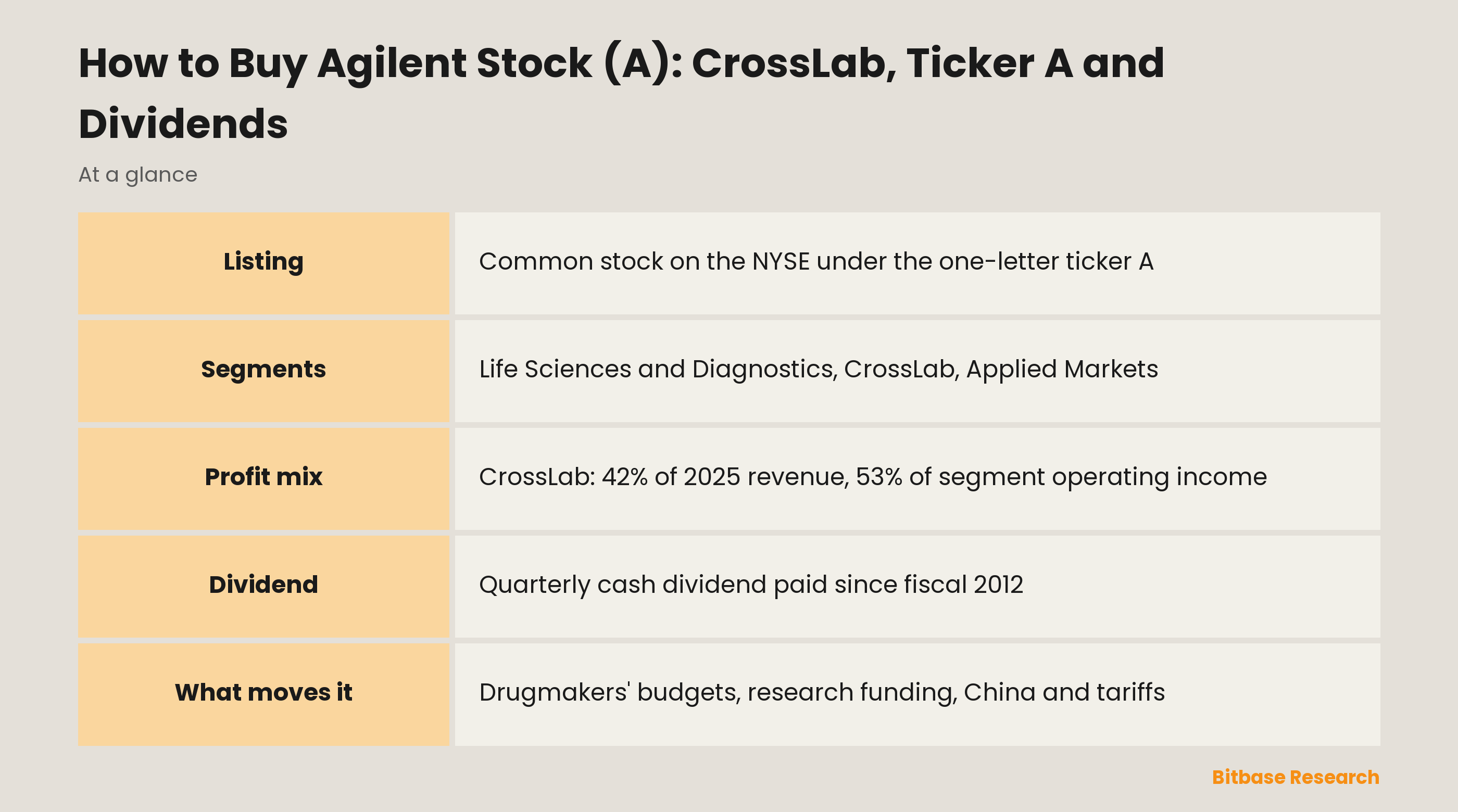
Agilent is listed on the New York Stock Exchange under a single letter, A, so buying its shares takes an ordinary brokerage account with NYSE access and a careful ticker search. The company sells the instruments, consumables and services that drug, chemical, clinical and environmental labs run on, and in fiscal 2025 its service-and-supplies arm, Agilent CrossLab, brought in 42% of revenue and 53% of segment operating income. This guide covers what Agilent does, how an order works, and what its filings say moves the business, from drugmakers' budgets to tariffs.
What Does Agilent Do?
The company describes itself as "a global leader in life sciences, diagnostics and applied markets, providing application focused solutions that include instruments, software, services and consumables for the entire laboratory workflow." In plainer terms, it builds machines that separate, identify and measure what is in a sample, and sells the columns, reagents, software and service visits that keep them working.
Agilent was incorporated in Delaware in May 1999, the year it separated from Hewlett-Packard, and is based in Santa Clara, California. On 1 November 2014 it spun off its electronic measurement business: Agilent shareholders received one Keysight Technologies share for every two Agilent shares they held, a story told in our Keysight stock guide.
Since November 2024 Agilent has reported three segments. Life Sciences and Diagnostics Markets combines liquid chromatography and liquid chromatography mass spectrometry with cell analysis, pathology, companion diagnostics, genomics and biomolecular analysis. It also holds Agilent Advanced Therapeutics, formerly called the specialty contract development and manufacturing business, which produces oligonucleotide active pharmaceutical ingredients for drugmakers. Two purchases have shaped it: BIOVECTRA, acquired on 20 September 2024 to expand contract manufacturing, and Biocare, a pathology company acquired on 24 June 2026 that the company says "expands our pathology portfolio."
Agilent CrossLab is the services and consumables business: repairs, maintenance, installation, training and compliance support, along with chromatography columns, sample preparation products, laboratory software such as the OpenLab suite, and lab automation. The 10-K says "most of the portfolio is vendor neutral," so CrossLab can supply a lab whatever brand of instrument it owns, and that the service and consumables businesses "are mostly recurring in nature."
Applied Markets sells gas chromatography and gas chromatography mass spectrometry systems, atomic and molecular spectroscopy instruments, vacuum products used in semiconductor and battery manufacturing, and certified pre-owned instruments. Its customers test food, water, fuels, chemicals and forensic evidence.
At the end of fiscal 2025 Agilent employed about 18,100 people. It counted about 22,200 customers in Life Sciences and Diagnostics Markets, 59,700 in CrossLab and 17,200 in Applied Markets, with many labs buying from more than one segment. Among the principal competitors the 10-K names are Thermo Fisher Scientific, Waters, Shimadzu, Danaher, Bruker and PerkinElmer; our Thermo Fisher stock guide covers one of them.
How Agilent Makes Money
Agilent's fiscal year ends on 31 October, so fiscal 2025 ran from November 2024 to October 2025. Revenue rose 7% that year, with growth in all three segments and all regions; BIOVECTRA added about two percentage points. Here is how the segments compare:
| Segment | Share of fiscal 2025 revenue | Share of segment operating income | Segment operating margin | Revenue growth, fiscal 2025 |
|---|---|---|---|---|
| Life Sciences and Diagnostics Markets | 39% | 30% | 19.7% | 11% |
| Agilent CrossLab | 42% | 53% | 32.5% | 6% |
| Applied Markets | 19% | 17% | 22.9% | 1% |
Operating income shares come from the segment note in the 10-K and cover the three segments only, leaving out costs Agilent keeps unallocated.
CrossLab earns the most and at the widest margin, because a lab keeps buying columns, supplies and service after an instrument is installed. Instruments made up 35% of fiscal 2025 revenue; consumables, services and everything else made up 65%.
By end market, pharmaceutical and biopharmaceutical customers accounted for 36% of fiscal 2025 revenue, chemicals and advanced materials 22%, diagnostics and clinical 15%, environmental and forensics 10%, food 9%, and academia and government 8%. Measured by where customers are, 34% came from the United States and 18% from China, including Hong Kong. The 10-K adds that "no customer represented 10 percent or more" of total net revenue.
The year before shows the other side of that mix. In fiscal 2024 revenue fell 5%, mostly in the pharmaceutical market, "due primarily to the overall pressures on our customers' capital expenditure spending," and CrossLab was the only segment that grew.
Agilent Stock at a Glance
| Feature | Agilent (A) |
|---|---|
| Exchange | New York Stock Exchange |
| Ticker | A |
| Share class | Common stock; no other class is registered under Section 12(b) |
| Sector | Life science tools, diagnostics and analytical instruments |
| Segments | Life Sciences and Diagnostics Markets, Agilent CrossLab, Applied Markets |
| Index membership | S&P 500; also held by the Health Care Select Sector SPDR Fund (XLV) |
| Headquarters | Santa Clara, California |
| Incorporated | Delaware, May 1999 |
| Fiscal year | Ends 31 October |
| Dividend | Quarterly cash dividend, paid since the first quarter of fiscal 2012 |
| SEC identifier | CIK 1090872 |
Quotes, market value and yield move all day; the Agilent stock page on Bitbase shows them live.
How to Buy Agilent Stock
As a Delaware company listed in New York, Agilent has no depositary receipt; the NYSE trades its common stock directly. At a broker, the process runs like this:
1. Pick a broker that reaches the NYSE. Outside the US this can be a local firm with American market access or a global one; find out which legal entity holds your shares and who regulates it.
2. Get the account approved. Investors who are not US persons generally certify that status on Form W-8BEN, which the IRS tells people to hand in "when requested by the withholding agent or payer."
3. Fund it. Depositing a currency other than dollars adds a conversion step, so look at the exchange rate as closely as at the commission.
4. Search the ticker with care. A one-letter symbol is easy to mistype, and a search for "A" can return a long list of unrelated names. Confirm that the result reads Agilent Technologies, Inc. common stock on the New York Stock Exchange.
5. Choose how the order executes. According to FINRA, a market order "provides the most certainty that your order will be executed"; a limit order fills only "at or better than a specified price."
6. Decide how much to buy. Brokers with fractional shares let you spend a fixed sum, though FINRA notes that some limit them to "large-cap stocks or ETFs" or skip them entirely, and that "as a fractional share owner, you might not have shareholder voting rights."
7. File the paperwork. Each confirmation and account statement records what you paid and every dividend credited.
Withholding tax. Under IRS rules, "most types of U.S. source income received by a foreign person are subject to U.S. tax of 30%"; a tax treaty between the US and your country can lower that rate, which is why brokers ask for the W-8BEN. Your home country may tax the same dividends as well.
Through funds. Agilent sits in the S&P 500, so index funds such as State Street's SPY hold it as one position among hundreds, and the same firm's health care sector fund, XLV, holds it too.
What Moves Agilent Stock
Drugmakers' spending. Drug and biotech companies are the largest end market, and their equipment budgets swing. After the fiscal 2024 decline, the company wrote in its 10-Q for the quarter ended 31 July 2026 that "customer capital budget availability has largely normalized, supporting improved investment activity across our key end markets." Revenue in that quarter rose 8%, with Life Sciences and Diagnostics Markets up 11%, CrossLab 6% and Applied Markets 7%.
Research and government budgets. Academia and government is a smaller market, but the 10-K warns that revenue from customers relying on public or research funding "may vary significantly due to factors that can be difficult to forecast." In the first nine months of fiscal 2026 its revenue fell about 3% while pharmaceutical revenue grew, and within Life Sciences and Diagnostics Markets the 10-Q traces the decline to cell analysis and liquid chromatography instruments.
China and tariffs. China, including Hong Kong, is a large source of revenue, and the risk factors cite tariffs "by the U.S. government on various imports from China and by the Chinese government on certain U.S. goods." Tariffs raised Agilent's cost of revenue from the second half of fiscal 2025. On 20 February 2026 the US Supreme Court struck down certain tariffs that had been levied under the International Emergency Economic Powers Act; Agilent has filed refund claims, but says their timing and approval "are uncertain." In the latest quarter, the 10-Q points to higher demand in China for consumables and services.
Contract manufacturing. Agilent Advanced Therapeutics ties part of the business to individual drug programs. The 10-K notes that when Agilent supplies drug components or companion diagnostics, "we face risks that those drug programs may be cancelled upon clinical trial failures."
Order timing. Quarterly results are "highly dependent on the volume and timing of orders received during the fiscal quarter, which are difficult to forecast," and customers can cancel orders they have placed.
Funding Swings, Tariffs and Order Timing at Agilent
Of the risk factors in Item 1A of the 10-K, these are the ones most tied to the share price:
The economy. "Our business is sensitive to negative changes in general economic conditions, both inside and outside the United States," with possible effects including longer sales cycles and more order cancellations.
Customer budgets. "Demand for some of our products and services depends on the capital spending policies of our customers, research and development budgets and on government funding policies."
International exposure. Agilent expects revenue from outside the United States "will continue to represent a majority of our total revenue." Currency hedging programs "reduce, but do not always entirely eliminate" exchange rate effects, and tariffs or export controls "may restrict our ability to ship products globally or source critical components."
Competition and technology. Without timely new products, "our products and services may become technologically obsolete over time."
Fixed costs. Because a large part of operating expenses is "relatively fixed in nature," a sudden drop in orders can squeeze margins before costs can be cut.
Beyond the business itself, owning one stock concentrates your money in a single company, and the payout is not guaranteed: "We cannot assure that we will continue to pay dividends on our common stock."
How to Research Agilent Yourself
Everything Agilent files with the SEC is listed under CIK 1090872. The annual 10-K (the fiscal 2025 report was filed on 22 December 2025) is joined by a 10-Q after each of the first three quarters and by 8-Ks when something material happens; quarterly results arrived by 8-K on 25 February, 27 May and 26 August 2026. investor.agilent.com carries the same documents free of charge.
In the 10-K, Item 1 describes the segments and names competitors, Item 1A lists the risks, and the revenue and segment notes split sales by region, end market and segment. Item 5 sets Agilent's total shareholder return against the S&P 500 and against a peer group of every health care and materials company in that index.
Two checks prevent mistakes. Segments were reorganized in November 2024 and earlier years were recast, so compare segment data only on the new basis. And business names change: the 10-Q calls Agilent Advanced Therapeutics "formerly known as" the contract development and manufacturing business. Quotes are on the stock page linked in the at-a-glance section, and Bitbase's index of US stock pages leads to other listed companies.
Agilent Stock FAQ
Can I buy Agilent stock with crypto?
No, not directly. A broker sells Agilent shares for US dollars, which means converting crypto to cash first and transferring it, and in many countries that conversion counts as a taxable sale. A share and a token are different assets: the share gives you dividends and a vote in a registered company, as set out in our comparison of stocks and crypto.
What is Agilent's ticker symbol?
A. Agilent's common stock trades on the New York Stock Exchange under that single letter, and it is the only class of stock the company has registered for exchange trading. Because a lone letter is easy to confuse in a search box, confirm the company name before you place an order.
Does Agilent pay a dividend?
Yes. Agilent has paid a quarterly cash dividend since the first quarter of fiscal 2012, and the total declared per share rose about 5% in fiscal 2025. The board decides the timing and amount of each payment; check the latest earnings release for the current figure.
Is Agilent in the S&P 500?
Yes. On 5 November 2026, Agilent Technologies was listed among the holdings in State Street's daily file for SPY, which tracks the S&P 500, and in the one for XLV, its health care sector fund. Weights move daily.
Is Agilent still part of HP?
No. Agilent separated from Hewlett-Packard in 1999, and its 10-K lists HP Inc. and Hewlett-Packard Enterprise among companies with which it has "previously been affiliated." In 2014 it carried out a separation of its own, spinning off Keysight Technologies to its shareholders.
Conclusion
Agilent earns at two speeds: steadily through CrossLab's services and supplies, and in step with drugmakers' and governments' budgets on its instruments. On top of that, its costs move with tariffs and trade policy, and the one-letter ticker A is worth checking against the company name. Before buying, work through the newest 10-K and 10-Q, look at all three segments over a whole cycle, and size the position by how much one lab-tools company should carry in your portfolio.
Related reading
Other Bitbase articles on this topic:
- How to Buy AerCap Stock (AER): Jet Leasing and Dividend Tax
- How to Buy Carrier Stock (CARR): HVAC, Viessmann and Data Centers
- How to Buy Comfort Systems Stock (FIX): Data Centers and Backlog
- How to Buy Astera Labs Stock (ALAB): Retimers, Switches and Perps
Disclaimer: This article is educational content from Bitbase Academy, provided for information only. It explains what a company or fund does and how the instruments referenced here differ from one another; it does not constitute investment, trading, tax, or financial advice, and it is neither a recommendation nor an endorsement of any security, token, or trading strategy. A tokenized stock is issued by a third party and is designed to give economic exposure to an underlying asset: it is not a share, it carries no shareholder rights, and it depends on the issuer's structure, eligibility rules, and redemption terms, which the issuer can change. Perpetual futures are leveraged derivatives that hold no underlying asset and can be liquidated, and trading hours, product availability, and eligibility differ by instrument and by jurisdiction and can change at any time. Written as of November 2026; verify everything yourself through company filings, the issuer's own documentation, and the product pages of the venue you trade on.
References
[1] Agilent Form 10-K for fiscal 2025 (SEC EDGAR) www.sec.gov
[2] Agilent fiscal 2025 Form 10-K, XBRL cover page (SEC EDGAR) www.sec.gov
[3] Agilent fiscal 2025 Form 10-K, XBRL segment profitability (SEC EDGAR) www.sec.gov
[4] Agilent fiscal 2025 Form 10-K, XBRL revenue by end market (SEC EDGAR) www.sec.gov
[5] Agilent fiscal 2025 Form 10-K, XBRL revenue by type (SEC EDGAR) www.sec.gov
[6] Agilent fiscal 2025 Form 10-K, XBRL revenue by geography (SEC EDGAR) www.sec.gov
[7] Agilent Form 10-Q for the quarter ended 31 July 2026 (SEC EDGAR) www.sec.gov
[8] Agilent 10-Q for the quarter ended 31 July 2026, XBRL revenue by end market (SEC EDGAR) www.sec.gov
[9] Keysight Form 10-K for fiscal 2025: separation history (SEC EDGAR) www.sec.gov
[10] Keysight Form 10-K for fiscal 2014: separation from Agilent (SEC EDGAR) www.sec.gov
[11] State Street SPDR S&P 500 ETF Trust (SPY): daily holdings file www.ssga.com
[12] State Street Health Care Select Sector SPDR Fund (XLV): daily holdings file www.ssga.com
[13] FINRA: Order Types www.finra.org
[14] FINRA: Investing in Fractional Shares www.finra.org
[15] IRS: NRA Withholding www.irs.gov
[16] IRS: About Form W-8 BEN www.irs.gov





