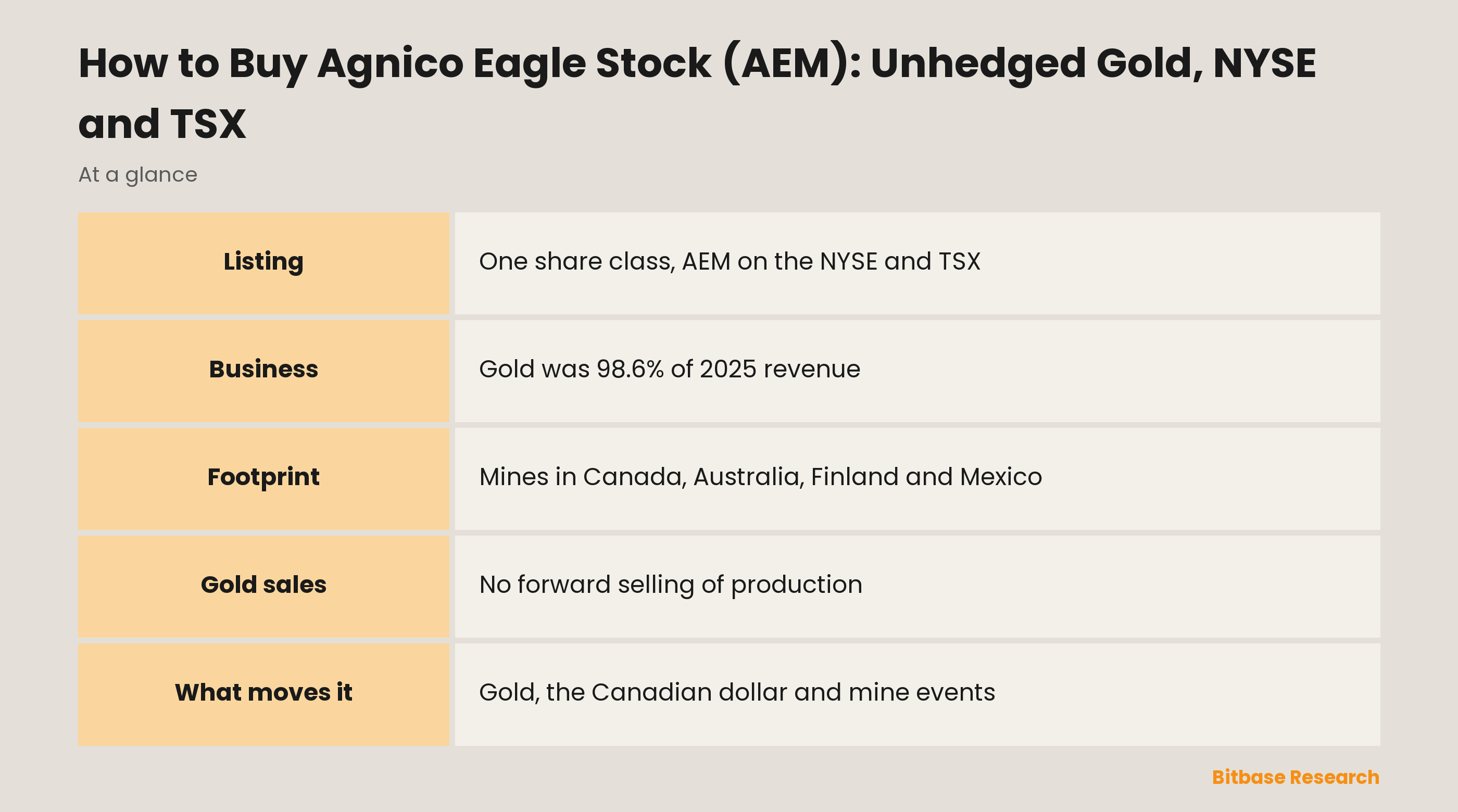
Across two exchanges, Toronto and New York, Agnico Eagle stock is one class of common shares under one ticker, AEM, so any brokerage account that reaches either market can buy it. The company calls itself Canada's largest mining company and does not sell its gold forward, so the gold price passes straight into its results. In 2025, gold made up 98.6% of its revenue, and mines in Canada supplied 86.4%.
What Does Agnico Eagle Do?
Agnico Eagle Mines Limited explores for, builds and runs gold mines. It is an Ontario corporation, formed in 1972 when Agnico Mines and Eagle Gold Mines amalgamated, though it dates its founding to 1957, and its head office is in Toronto. Its annual information form (AIF), the yearly business description Canadian issuers file, calls it "Canada's largest mining company and the second largest gold producer in the world."
The mines sit in four countries. Quebec has LaRonde, between Rouyn-Noranda and Val-d'Or, Canadian Malartic with its underground Odyssey mine, and Goldex. Ontario has Detour Lake and Macassa. In Nunavut, Meliadine operates on Inuit-owned land and the Meadowbank mill processes ore trucked from the Amaruq deposit. All Canadian operating mines are wholly owned. Abroad there are Fosterville in the Australian state of Victoria, Kittila in Finland and Pinos Altos in northern Mexico.
Much of that map was bought. On 8 February 2022 Agnico Eagle acquired every share of Kirkland Lake Gold, a deal the AIF calls the Merger, and with it Detour Lake, Fosterville and Macassa. On 31 March 2023 it took Yamana Gold's Canadian assets, including the half of Canadian Malartic it did not yet own, while Pan American Silver bought Yamana itself. In 2026, three transactions in Finland's Central Lapland Greenstone Belt added Rupert Resources, Aurion Resources and full ownership of the FinGold joint venture, bringing the Ikkari gold project and exploration ground near Kittila.
Several projects are lined up behind the current mines. In May 2026 the company announced a positive investment decision for Hope Bay, a Nunavut project acquired with TMAC Resources in 2021 and planned as an underground mine; its filings also name Detour Lake underground and Upper Beaver in Ontario, plus San Nicolás, a 50/50 copper-zinc joint venture with Teck in Mexico. On the life-of-mine plans in the March 2026 AIF, production is planned to end first at Pinos Altos, in 2028, and last at Detour Lake, in 2052.
How Agnico Eagle Makes Money
Agnico Eagle sells metal. Gold and silver go to customers as bullion and doré bars, generally counted as sold once credited to the buyer's metal account, while concentrates, mainly zinc and copper with some gold and silver, go to smelters. In 2025 gold supplied 98.6% of revenue from mining operations, and the MD&A puts gold and silver together at 99.5%. Unlike a diversified miner such as BHP, which mines copper, iron ore and coal, Agnico Eagle rests on one metal.
That shows in 2025: revenue from mining operations rose 43.7% while the volume of gold sold fell 1.0%, an increase the MD&A attributes primarily to higher realized gold prices. The segment note in the audited statements splits the total by mine:
| Mine | Where | Share of 2025 revenue | How Agnico Eagle came to own it |
|---|---|---|---|
| Detour Lake | Ontario | 19.8% | Kirkland Lake Gold merger, 2022 |
| Canadian Malartic | Quebec | 17.5% | Half with Yamana in 2014, the rest from Yamana in 2023 |
| Meadowbank | Nunavut | 14.3% | Cumberland Resources acquisition, 2007 |
| Meliadine | Nunavut | 11.2% | Comaplex Minerals acquisition, 2010 |
| LaRonde | Quebec | 10.9% | First stake in 1974, wholly owned since 1989 |
| Macassa | Ontario | 8.6% | Kirkland Lake Gold merger, 2022 |
| Kittila | Finland | 6.3% | Riddarhyttan Resources acquisition, 2005 |
| Fosterville | Australia | 4.5% | Kirkland Lake Gold merger, 2022 |
| Goldex | Quebec | 3.9% | Held since 1993 |
| Pinos Altos | Mexico | 2.7% | Option exercised with Peñoles, 2006 |
Shares are rounded; non-operating sites made up the remaining 0.4%.
The top three mines brought in just over half of the total, and all three arrived through acquisitions. By country, Canada supplied 86.4%, Finland 6.3%, Australia 4.5% and Mexico 2.8%. Buyers are concentrated as well: four customers each took more than 10% of 2025 revenue, about 76.3% together, though the statements note that gold "can be sold through numerous gold market traders worldwide."
AEM Stock at a Glance
| Item | Detail |
|---|---|
| Exchanges | New York Stock Exchange (NYSE) and Toronto Stock Exchange (TSX) |
| Ticker | AEM on both |
| Security | Common shares without par value, the only class; one vote per share |
| Trading currency | US dollars in New York, Canadian dollars in Toronto |
| Sector | Gold mining; SEC industry code 1040, gold and silver ores |
| Index funds | Held by S&P/TSX 60 funds; not in the S&P 500 (October 2026 holdings) |
| Headquarters | Toronto, Ontario |
| Fiscal year | Ends 31 December |
| Reporting | IFRS, in US dollars; Form 40-F yearly, Form 6-K in between |
| Dividend policy | Quarterly, at the board's discretion; declared every year since 1983 |
| SEC identifier | CIK 2809 |
For live prices in either currency, open the Agnico Eagle stock page on Bitbase.
How to Buy Agnico Eagle Stock
No depositary receipt is involved. AEM is interlisted like Royal Bank of Canada: one class of shares, listed in both cities. The real choice is the market, and with it the currency.
1. Choose the market. NYSE access means paying in US dollars, TSX access in Canadian dollars. Check which entity holds your account and who regulates it.
2. Open and verify the account. The tax residence you declare decides how dividends are handled later.
3. Fund it in the trading currency. Conversion from a third currency can cost more than the commission.
4. Find the right line. Search AEM and confirm it reads Agnico Eagle Mines common shares on your chosen exchange; the 40-F cover registers only this security on the NYSE.
5. Pick an order type. A market order fills promptly at the available price; a limit order fills only at your price or better.
6. Decide the size. Fractional shares, and whether a fraction votes, depend on the broker.
7. Keep the records. Confirmations and dividend statements show your cost and any tax taken.
To compare the two quotes, convert the currency and check that the time stamps match; a gap may be nothing more than the exchange rate.
Tax on dividends. The dividend is declared in US dollars. The annual filings do not say how it is taxed for holders outside Canada, so ask your broker what will be withheld, whether a treaty rate applies and which form it needs. Your home country may tax it again.
Through a fund. BlackRock's iShares S&P/TSX 60 Index ETF (XIU) listed AEM among its holdings on 29 October 2026; S&P 500 funds do not hold it.
What Moves AEM Stock
Gold, without a hedge. The MD&A says shareholders "have full exposure to gold prices due to the Company's long-standing policy of no forward gold sales." The AIF's list of gold-price drivers runs from central bank buying and interest rates to "investor interest in cryptocurrencies and other investment alternatives," and in 2025 revenue rose 43.7% on slightly lower volume.
Costs that follow gold. Sales at Canadian Malartic, Detour Lake and Macassa exclude in-kind royalties of 5.0%, 2.0% and 1.5% of gold production, and 2025 production costs rose "primarily due to higher royalties arising from higher gold prices," plus higher underground contractor and labour costs. A rising gold price lifts part of the cost base too.
The Canadian dollar. "All of the Company's revenues are earned in U.S. dollars but the majority of its operating costs at Canadian operations … are incurred in Canadian dollars." A weaker Canadian dollar eased 2025 costs; Kittila's costs run mostly in euros and Fosterville's in Australian dollars, and the company uses currency options and forwards to soften the swings.
Mine-level events. On 1 July 2026, rock moved along the north wall of the Barnat open pit at Canadian Malartic. No one was hurt; mining stopped while the mill ran on low-grade stockpiles and restarted on 27 September 2026, but the company still expects lower Canadian Malartic output in the second half of 2026 and in 2027 and 2028. LaRonde "continues to experience seismic events" that periodically close parts of the mine.
Arctic logistics. Most supplies for Meadowbank must pass through the port of Baker Lake, which the AIF says is accessible only about 10 weeks a year. If supplies miss that window, or ore haulage from Amaruq is interrupted, operations can slow or stop.
Deals and buybacks. Several deals were paid partly or wholly in shares: Kirkland Lake Gold holders received 0.7935 of an AEM share each, and Rupert holders got shares plus contingent value rights. Against that, a normal course issuer bid renewed in May 2026 allows buybacks of up to 5% of outstanding shares until May 2027, all cancelled.
How an AEM Holding Can Lose Value
The AIF's risk factors run for pages. These headings bear most directly on the shares:
Metal prices. Results "may fluctuate widely due to volatile and unpredictable commodity prices," and with no forward sales a falling gold price hits revenue in full.
Accidents and ground conditions. Mining accidents may mean the mines "yield less gold than estimated"; the examples include rock falls, rock bursts and pit wall failures.
Remoteness and currency. The company "may experience difficulties at its Nunavut operations as a result of their remote location," and exchange rates against the US dollar "may adversely affect" results.
Estimates. Reserve and resource figures "are only estimates," prepared under Canada's NI 43-101 standard, and the AIF warns they "may not be comparable to similar information disclosed by U.S. companies."
Operations abroad and partners. Risks in Australia, Finland and Mexico "may include" expropriation and the renegotiation of permits; San Nicolás, shared with Teck, brings the risk of disagreement and limited control.
Volatility. "The trading price for the Company's securities is volatile."
Two risks apply to any holder. Ten mines in four countries are still one issuer, so a single stock carries that company's mistakes in full. And a dividend record is not a promise: future dividends "will be at the discretion of the Board," and anyone whose home currency is not the US dollar takes the exchange rate on every payment.
How to Research AEM Yourself
Agnico Eagle files with the SEC under CIK 2809, as a Canadian issuer under the multi-jurisdictional disclosure system. The yearly Form 40-F bundles the AIF, the audited statements and the annual MD&A; quarterly reports and news releases arrive on Form 6-K. In that bundle, the AIF covers mines, deals, dividends and risk factors, the statements hold revenue by mine, country and customer, and the MD&A explains metals, royalties and currency effects.
Two details save time. Do not expect insider trades on EDGAR as Form 4 filings: an SEC order of 5 March 2026 exempts the company's directors and officers because they report under Canada's NI 55-104 through the SEDI system. And the NI 43-101 technical reports behind reserve estimates are filed with Canadian regulators; the AIF points readers to SEDAR+ and the company's website. For other listed companies, browse more stock pages on Bitbase.
Agnico Eagle Stock FAQ
Does Agnico Eagle pay a dividend?
Yes, quarterly, and a cash dividend has been declared every year since 1983. The quarterly amount held steady through 2023, 2024 and 2025 and was raised in February 2026. Each payment is declared in US dollars at the board's discretion; amounts and dates are in the latest 6-K.
Can I buy Agnico Eagle stock with crypto?
Not directly. AEM shares are bought through a broker and settle in US or Canadian dollars, so crypto has to be sold for cash and the cash moved first, and that sale can be taxable depending on where you live. Treat them as two decisions: a common share carries a vote and a claim to declared dividends, which is how a listed share differs from a crypto asset.
Is AEM the same stock in Toronto and New York?
Yes. The single class of common shares is listed on the TSX and the NYSE under AEM. The two quotes are in different currencies, so they line up only after conversion.
Is Agnico Eagle in the S&P 500?
No. State Street's holdings file for its S&P 500 trust (SPY) did not include it on 29 October 2026, while BlackRock's XIU, which tracks the S&P/TSX 60, held it that day.
How did Kirkland Lake Gold and Yamana change Agnico Eagle?
They supplied its two biggest revenue earners. The 2022 merger brought Detour Lake, Macassa and Fosterville, and the 2023 Yamana deal gave it full ownership of Canadian Malartic; together those four produced a little over half of 2025 revenue.
Does Agnico Eagle hedge its gold?
Not its gold sales: it has "traditionally sold all of its production at the spot price of gold." It does use options and forwards on currencies, diesel fuel, interest rates and by-product metal prices.
Conclusion
Buying AEM starts with a broker choice: New York in US dollars or Toronto in Canadian dollars, then the line that reads Agnico Eagle Mines common shares. What the share holds is an unhedged gold producer that earned most of its 2025 revenue in Canada and grew largely by acquisition. Read the latest 40-F and quarterly MD&A, starting with the risk factors and the segment note, before deciding how much belongs in one mining stock.
Related reading
Other Bitbase articles on this topic:
- How to Buy Air Products Stock (APD): Hydrogen Exits and NEOM
- How to Buy Barrick Stock (B): Formerly GOLD, ABX on the TSX
- How to Buy CRH Stock (CRH): Aggregates, Arcosa and the NYSE Move
- How to Buy Howmet Aerospace Stock (HWM): Engine Parts, Alcoa Roots
Disclaimer: This article is educational content from Bitbase Academy, provided for information only. It explains what a company or fund does and how the instruments referenced here differ from one another; it does not constitute investment, trading, tax, or financial advice, and it is neither a recommendation nor an endorsement of any security, token, or trading strategy. A tokenized stock is issued by a third party and is designed to give economic exposure to an underlying asset: it is not a share, it carries no shareholder rights, and it depends on the issuer's structure, eligibility rules, and redemption terms, which the issuer can change. Perpetual futures are leveraged derivatives that hold no underlying asset and can be liquidated, and trading hours, product availability, and eligibility differ by instrument and by jurisdiction and can change at any time. Written as of October 2026; verify everything yourself through company filings, the issuer's own documentation, and the product pages of the venue you trade on.
References
[1] Agnico Eagle Mines Form 40-F, fiscal 2025: MJDS status and insider reporting (SEC EDGAR) www.sec.gov
[2] Agnico Eagle Mines, fiscal 2025 Form 40-F XBRL cover page, R1.htm (SEC EDGAR) www.sec.gov
[3] Agnico Eagle Mines 2025 annual information form: mines, acquisitions, dividends and risk factors (SEC EDGAR) www.sec.gov
[4] Agnico Eagle Mines 2025 audited financial statements: revenue by mine, country and customer (SEC EDGAR) www.sec.gov
[5] Agnico Eagle Mines 2025 annual MD&A: revenue by metal, royalties and costs (SEC EDGAR) www.sec.gov
[6] Agnico Eagle Mines MD&A for the third quarter of 2026: Barnat, Finland, buyback and tariffs (Form 6-K, SEC EDGAR) www.sec.gov
[7] BlackRock Canada, iShares S&P/TSX 60 Index ETF (XIU): holdings as of 29 October 2026 www.blackrock.com
[8] State Street, SPDR S&P 500 ETF Trust (SPY): daily holdings as of 29 October 2026 www.ssga.com





