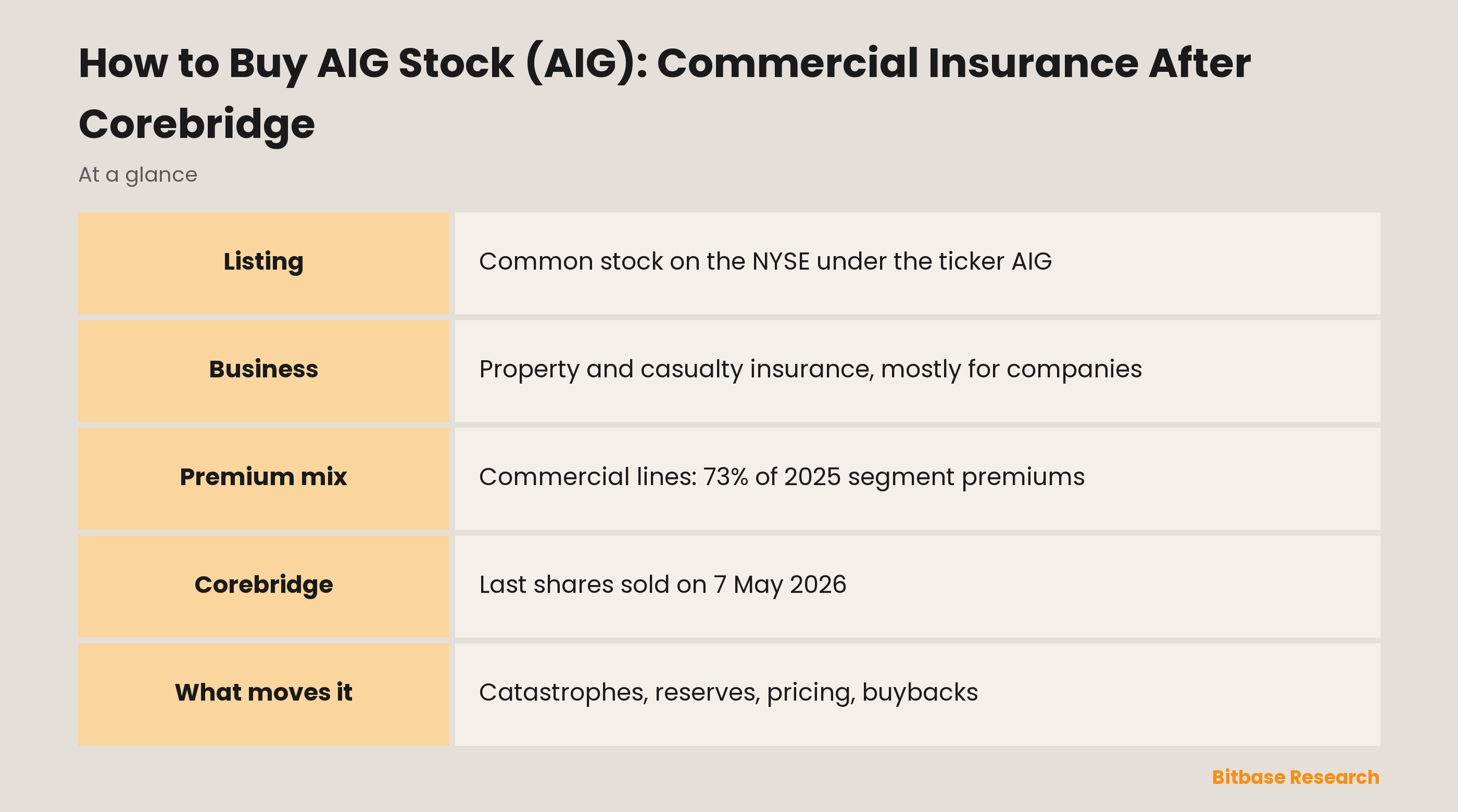
With access to the New York Stock Exchange through a broker, you can buy AIG stock in an ordinary order: American International Group's common stock is listed there under the ticker AIG, and it is the only class of security the company has registered on an exchange. What that share represents shifted in 2026. On 7 May AIG sold its last Corebridge Financial shares, ending a sell-down that began with Corebridge's IPO in September 2022, and what remains is an insurer whose commercial business in North America and abroad earned about 73% of its 2025 segment premiums. This guide covers the company, the purchase and the measures its filings ask investors to follow: catastrophe losses, claims reserves, pricing and buybacks.
What Does AIG Do?
AIG sells property and casualty insurance, along with accident and health cover, to companies and individuals. The 10-K calls it "a leading global insurance organization" serving clients "in over 200 countries and jurisdictions" through its own operations and licenses or through network partners.
Results are reported through three segments plus Other Operations:
North America Commercial and International Commercial sell the same four product families. Property & Short Tail covers commercial and industrial property, including business interruption. Casualty covers general liability, environmental, commercial auto, workers' compensation and excess casualty. Financial Lines covers professional liability, from directors and officers to cyber risk and kidnap and ransom. Global Specialty covers marine, energy, aviation, political risk and trade credit.
Global Personal sells accident and health cover, such as group policies for employers, and personal lines: auto and homeowners in selected markets, warranty and device protection, and Private Client Select, a US offering for high net-worth households.
Policies are written by operating companies such as National Union Fire Insurance Company of Pittsburgh, Pa., American Home Assurance Company, Lexington Insurance Company and Talbot Underwriting. At the end of 2025 AIG had about 22,100 employees in about 45 countries; 27% were based in North America, 47% in Asia Pacific and 26% in Europe, the Middle East, Africa and Latin America.
The company has narrowed itself over several years. It sold Crop Risk Services in July 2023, sold the reinsurer Validus Re to RenaissanceRe in November 2023, and in December 2024 sold its individual personal travel insurance and assistance business to Zurich Insurance Group. Corebridge, which had been part of AIG, went public in September 2022, was deconsolidated on 9 June 2024 and was sold down in stages until the final block in May 2026.
At the same time AIG has bought into other businesses. On 6 February 2026 it closed the purchase of a 35% equity interest in Convex Group, a global specialty insurer, and a 9.9% stake in the asset manager Onex. Through a quota share agreement it also reinsures 7.5% of Convex's underwriting portfolio in 2026, rising to 10.0% in 2027 and 12.5% in 2028. In October 2025 it agreed to buy the renewal rights to Everest Group's global retail commercial insurance portfolios.
How AIG Makes Money
The 10-K says AIG earns revenues "primarily from insurance premiums and income from investments." In 2025 premiums made up about 89% of total revenues and net investment income about 16%, while net realized losses subtracted about 4%. Insurers generally collect premiums before they pay claims, and investing that money in the meantime is the second engine.
Underwriting income, the profit on the policies themselves, came from the three segments very unevenly in 2025:
| Segment | Share of 2025 segment premiums earned | Share of 2025 underwriting income | 2025 combined ratio |
|---|---|---|---|
| North America Commercial | 36% | 49% | 86.8 |
| International Commercial | 36% | 48% | 86.9 |
| Global Personal | 27% | 3% | 99.0 |
A combined ratio is losses plus expenses as a share of premiums earned; below 100 means the policies made money before investment income. Global Personal was close to break-even in 2025, and its net premiums written fell 12% after the sale of the travel business. Across General Insurance the combined ratio improved to 90.1 from 91.8 in 2024, and underwriting income rose 22%.
Geography is split almost evenly: North America produced about 47% of 2025 revenues and international operations about 53%.
The listed company itself does not write policies. The 10-K describes AIG Parent as "a holding company with no significant business operations of its own" that "depends on dividends from our subsidiaries to meet our obligations," and dividends above prescribed limits need regulatory approval. Dividends and buybacks for shareholders are funded from that flow.
AIG Stock at a Glance
| Feature | AIG |
|---|---|
| Exchange | New York Stock Exchange (NYSE) |
| Ticker | AIG |
| Security | Common stock, the only class registered under Section 12(b) |
| Business | Property and casualty insurance for commercial clients and individuals |
| Segments | North America Commercial, International Commercial, Global Personal |
| Index membership | S&P 500 |
| Headquarters | New York, New York |
| Incorporated | Delaware |
| Fiscal year | Calendar year, ending 31 December |
| Payouts | Quarterly cash dividend, plus share repurchases under a board authorization |
| Leadership | Eric Andersen, President and CEO since 1 June 2026; John Rice, Chair since 15 September 2026 |
| SEC identifier | CIK 5272 |
Quotes, market value and yield move all day; for live figures, use the AIG stock page on Bitbase.
How to Buy AIG Stock
AIG is a US company, so no depositary receipt is involved: the NYSE line is the common stock itself. An order takes seven steps:
1. Pick a broker that offers NYSE stocks. Abroad, confirm the firm's legal name and the regulator that supervises it.
2. Open the account and complete its checks. Non-US individuals generally certify their foreign status on IRS Form W-8BEN. The IRS instructs filers to submit it "when requested by the withholding agent or payer."
3. Fund it. If you deposit in a currency other than dollars, the conversion rate is part of your cost, alongside any commission.
4. Find the right line. Search for AIG and confirm the name reads American International Group, Inc. common stock on the NYSE.
5. Choose an order type. A market order executes at whatever price is available; a limit order caps what you pay, at the risk of no execution.
6. Decide the size. If you want to put in a set sum rather than whole shares, ask whether the broker offers fractions and whether a fraction carries a vote.
7. Keep your records. Confirmations and statements show your purchase price and every dividend you receive.
Withholding tax for non-US investors. In the IRS's words, "most types of U.S. source income received by a foreign person are subject to U.S. tax of 30%," and a tax treaty can reduce the rate or remove it. That is why brokers ask for the W-8BEN. Your own country may tax the dividend as well.
Owning it through a fund. The 10-K's performance graph refers to "the S&P's 500 stock index (which includes AIG)," and the SPY holdings list State Street published for 6 November 2026 includes American International Group, so an S&P 500 index fund holds AIG as one position among about 500.
What Moves AIG Stock
Catastrophe losses. In 2025 catastrophe losses and reinstatement premiums cost General Insurance 3.9 points of combined ratio, after 5.0 points in 2024. In the third quarter of 2026 the charge was 4.4 points, driven by severe convective storms in North America, against 1.6 points a year earlier, and the quarter's combined ratio rose to 91.3 from 86.8.
Reserve releases. Each year AIG re-estimates what older claims will cost. In 2025, favorable prior year development lowered the combined ratio by 2.1 points; in the third quarter of 2026 the benefit was smaller than a year before. The direction can flip, and the 10-K says estimation uncertainty is particularly relevant for long-tail lines such as excess casualty and workers' compensation.
Premium growth and pricing. Net premiums written in General Insurance rose 7% in the third quarter of 2026, 8% at constant exchange rates, and 10% excluding North America Property lines; over the first nine months they were up about 12%. Chief executive Eric Andersen said AIG kept strong underwriting performance "despite a more challenging market environment."
Buybacks and the dividend. Repurchases in 2025 cut the number of shares outstanding by 11%, and AIG bought back roughly 22 million more in the first nine months of 2026. The quarterly dividend rose 12.5% in 2025 and 11% in 2026. Because the parent depends on subsidiary dividends, how much capital the insurance companies can release matters to both.
New stakes, one stake gone. Until 2026 AIG's results also moved with Corebridge's share price, because the retained shares were carried at fair value. That link is gone. In its place come the Convex holding, accounted for under the equity method, and the Onex stake, along with the quota share on Convex's book.
Where AIG's 10-K Locates the Losses
These items from Item 1A speak most directly to an AIG shareholder:
Claims beyond reserves. "The amount and timing of insurance liability claims are difficult to predict and such claims may exceed the related liability for unpaid losses and loss adjustment expenses."
Catastrophes and mass torts. AIG's results, liquidity, financial condition and ratings "are subject to the effects of natural and man-made catastrophic events as well as mass torts," and the models used to manage that exposure "may prove to be ineffective."
Reinsurance. "Reinsurance may be unavailable or too expensive relative to its benefit and may not be adequate to protect us against losses."
Ratings. A downgrade of the insurers' financial strength ratings "could limit their ability to write or prevent them from writing new business."
The holding company. "AIG Parent's ability to access funds from our subsidiaries is limited, and our sources of liquidity may be insufficient to meet our needs."
Deals and technology. "Strategic transactions, including business or asset acquisitions and dispositions, may expose us to certain risks," a point that applies to Convex and Onex, and the company's "development and use of new technology, such as generative artificial intelligence, may present risks."
Two risks belong to the stock rather than the business. One company's shares concentrate your exposure. And the dividend is discretionary: the third-quarter 2026 10-Q says "the payment of any future dividends will be at the discretion of the Board and will depend on various factors."
How to Research AIG Yourself
AIG's filings sit on EDGAR under CIK 5272, and the 10-K says its reports are free on aig.com as well as sec.gov. The annual report is the 10-K, the first three quarters come in 10-Qs, and each quarterly earnings release arrives as an exhibit to an 8-K; in 2026 those were filed on 10 February, 30 April, 6 August and 3 November.
In the 10-K, Item 1 lays out the segments and operating companies, Item 1A the risks and Item 5 the buyback record. The MD&A gives each segment's combined ratio together with the catastrophe and prior year development points that move it, and Note 3 sets out the segment figures.
Watch the labels. Adjusted after-tax income, core operating return on equity and adjusted book value per share are non-GAAP measures, reconciled in each release to reported figures. Book value per share and adjusted book value per share can move in opposite directions: at 30 September 2026 the first was 1% lower than a year before and the second 5% higher.
To compare AIG with other insurers, see our Chubb stock guide and Travelers stock guide. Live prices are on the stock page linked above, and Bitbase's list of US stock pages covers other listed companies.
AIG Stock FAQ
Can I buy AIG stock with crypto?
Not directly. AIG shares are bought through a brokerage account in US dollars, which means converting crypto to cash and transferring it before you place the order; the conversion can be a taxable event where you live. The two assets also behave differently: a share is a registered stake that carries dividend and voting rights, as our guide to how stocks differ from crypto explains.
Does AIG pay a dividend?
Yes, a quarterly cash dividend. It was raised by 12.5% in 2025 and by 11% in 2026, and on 3 November 2026 the board declared the next one, payable on 30 December 2026. Future payments are at the board's discretion; the latest 8-K or 10-Q gives the current amount.
Does AIG still own Corebridge Financial?
No. Corebridge bought back part of AIG's stake in February 2026, the two remaining AIG designees left its board on 23 March 2026, and on 7 May 2026 AIG sold its remaining 25.5 million shares.
Is AIG in the S&P 500?
Yes. The 10-K describes the S&P 500 as an index "which includes AIG," and State Street's SPY holdings file dated 6 November 2026 lists the company. Its weight in the index changes daily.
Has AIG stock ever split?
AIG's shareholders approved a one-for-twenty reverse stock split that took effect on 30 June 2009, so 20 old shares became one. Per-share figures from before that date are restated in later filings; check that any old data you use has been adjusted.
Who runs AIG?
Eric Andersen, formerly President of Aon, has been President and Chief Executive Officer since 1 June 2026, succeeding Peter Zaffino. John Rice, previously the lead independent director, became Chair of the Board on 15 September 2026, when Zaffino left the board.
Conclusion
The AIG of 2026 is easier to describe than the one that came before it: a property and casualty insurer, mostly commercial, with no Corebridge stake left and new positions in Convex and Onex. Whether the share suits you depends on how you view catastrophe years, reserve swings and a holding company that pays out what its insurers can send up. Go through the newest annual report and earnings release, follow the combined ratio through a bad storm season as well as a quiet one, and size an AIG position as one company among the rest of your portfolio.
Related reading
Other Bitbase articles on this topic:
- How to Buy Arch Capital Stock (ACGL): Reinsurance and Mortgages
- How to Buy Cincinnati Financial Stock (CINF): Insurer and Investor
- How to Buy Prudential Financial Stock (PRU): Not Prudential plc
- How to Buy Chunghwa Telecom Stock (CHT): 10-Share ADS, State Stake
Disclaimer: This article is educational content from Bitbase Academy, provided for information only. It explains what a company or fund does and how the instruments referenced here differ from one another; it does not constitute investment, trading, tax, or financial advice, and it is neither a recommendation nor an endorsement of any security, token, or trading strategy. A tokenized stock is issued by a third party and is designed to give economic exposure to an underlying asset: it is not a share, it carries no shareholder rights, and it depends on the issuer's structure, eligibility rules, and redemption terms, which the issuer can change. Perpetual futures are leveraged derivatives that hold no underlying asset and can be liquidated, and trading hours, product availability, and eligibility differ by instrument and by jurisdiction and can change at any time. Written as of November 2026; verify everything yourself through company filings, the issuer's own documentation, and the product pages of the venue you trade on.
References
[1] AIG Form 10-K for 2025 (SEC EDGAR) www.sec.gov
[2] AIG 2025 Form 10-K, XBRL cover page (SEC EDGAR) www.sec.gov
[3] AIG 2025 Form 10-K, XBRL segment data (SEC EDGAR) www.sec.gov
[4] AIG Form 10-Q for the third quarter of 2026 (SEC EDGAR) www.sec.gov
[5] AIG third-quarter 2026 earnings release, filed with Form 8-K (SEC EDGAR) www.sec.gov
[6] AIG Form 8-K, 27 April 2026: CEO appointment (SEC EDGAR) www.sec.gov
[7] AIG Form 8-K, 2 September 2026: board chair change (SEC EDGAR) www.sec.gov
[8] AIG second-quarter 2009 results, filed with Form 8-K: reverse stock split (SEC EDGAR) www.sec.gov
[9] State Street SPDR S&P 500 ETF Trust (SPY): fund page and daily holdings www.ssga.com
[10] IRS: NRA Withholding www.irs.gov
[11] IRS: About Form W-8 BEN www.irs.gov





