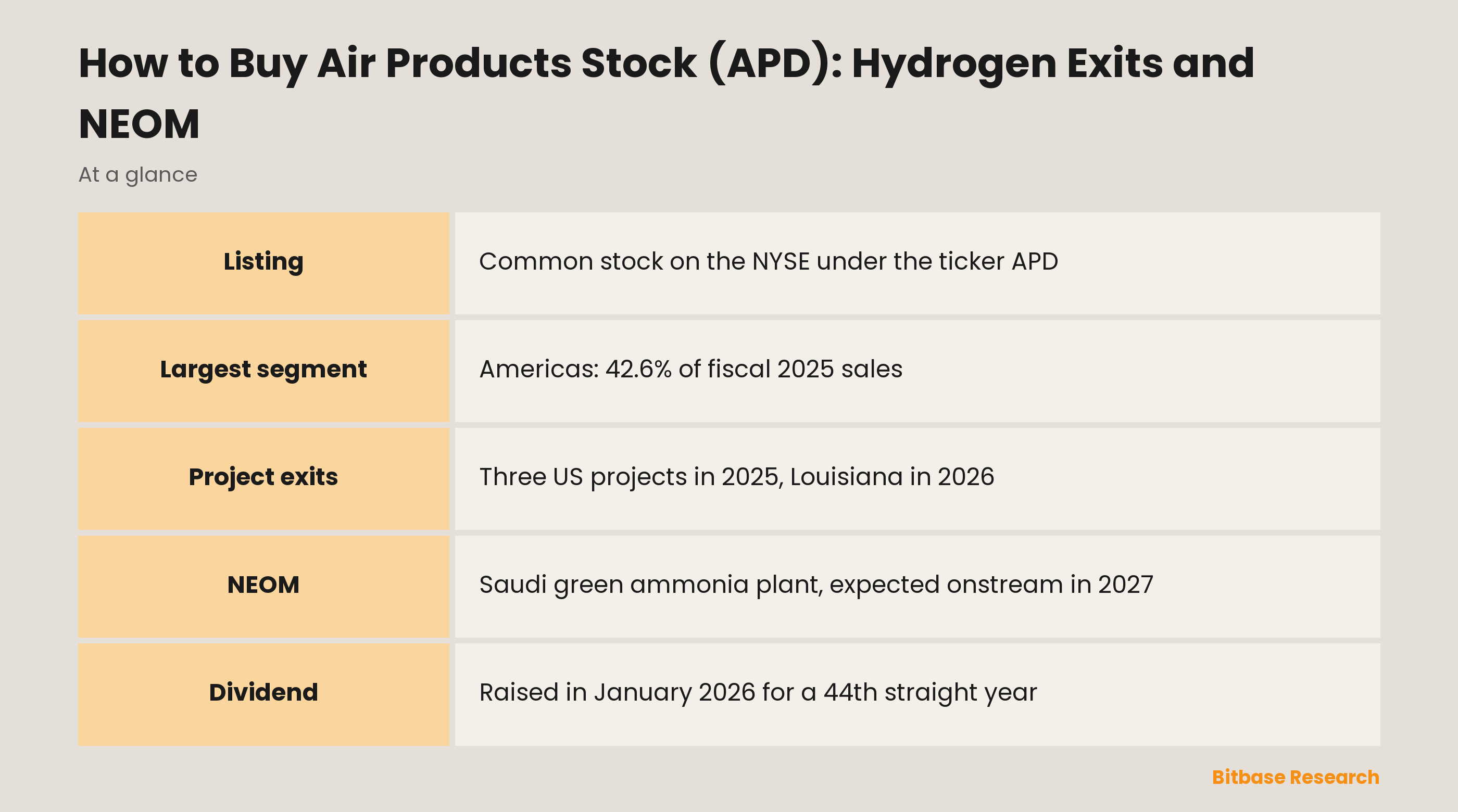
Some brokerage apps list the company as Air Products & Chemicals and others simply as APD, but the purchase is the same everywhere: the common stock trades on the New York Stock Exchange under the ticker APD, and any broker with NYSE access can take the order. Behind the ticker is an industrial gases business, about half of it supplied from plants built on or next to customers' sites. Since a proxy contest reshaped the board in January 2025, the company has walked away from several large clean energy projects while it keeps building the NEOM green hydrogen project in Saudi Arabia.
What Does Air Products Do?
Air Products makes and delivers industrial gases and builds the equipment that produces them. Its 10-K describes "a Delaware corporation founded in 1940" and "a world-leading industrial gases company," headquartered in Allentown, Pennsylvania. Customers are mostly businesses in refining, chemicals, metals, electronics, manufacturing, healthcare and food. At 30 September 2025 it had about 21,300 employees, roughly 75% of them outside the United States.
The products fall into two groups. Atmospheric gases (oxygen, nitrogen and argon) are mostly recovered by cryogenic distillation of air and account for about half of regional industrial gas sales, which in turn make up over 90% of the total. Process gases include hydrogen, helium, carbon dioxide, carbon monoxide and syngas. Most of the hydrogen is gray hydrogen, purified from byproduct streams without carbon capture. Helium comes as a byproduct of natural gas extraction; the company keeps stocks of it in underground storage at Amarillo and Beaumont, Texas.
How the gas is delivered decides the contract. On-site customers, such as refineries, chemical plants and chip factories, get a plant on or near their site or a pipeline feed, under contracts that generally run 15 to 20 years with fixed monthly charges or minimum purchases; this mode brings in about half of total sales. Merchant customers receive liquid gas by tanker or packaged gas in cylinders, with no minimum purchase and contracts of five years or less. A small equipment line, which includes Rotoflow turboexpanders and Gardner Cryogenics containers, made up less than 10% of sales.
In every region the 10-K names the same three global competitors: Air Liquide, Messer and Linde, whose own business is covered in our guide to Linde shares.
Joint ventures add a further layer. In Saudi Arabia, the Jazan Integrated Gasification and Power Company (JIGPC), in which Air Products accounts for a 55% interest, supplies electricity, steam, hydrogen and utilities to an Aramco refinery and terminal complex under a 25-year agreement that began in fiscal 2022.
How Air Products Makes Money
Air Products reports four regional industrial gas segments plus Corporate and other, which holds the equipment businesses and head-office costs:
| Segment | Main markets named in the 10-K | Share of fiscal 2025 sales | On-site share of segment sales | Segment operating margin |
|---|---|---|---|---|
| Americas | United States, Canada, Chile, Brazil | 42.6% | 56.9% | 29.6% |
| Asia | China, South Korea, Taiwan | 27.2% | 67.0% | 26.0% |
| Europe | Netherlands, United Kingdom, Spain | 24.8% | 33.3% | 28.3% |
| Middle East and India | Saudi Arabia, India | 1.1% | 57.8% | 7.1% |
| Corporate and other | Equipment sales and corporate costs | 4.3% | None | Operating loss |
Shares and margins are calculated from fiscal 2025 segment figures and rounded to one decimal; segment results exclude charges for business and asset actions.
Middle East and India looks tiny by sales, but its joint ventures, JIGPC among them, produced 52.1% of segment equity affiliates' income in fiscal 2025, and the segment also consolidates NEOM, still under construction. Company-wide, on-site sales were 51.3% of the total, merchant 44.3% and equipment 4.3%.
Sales fell 1% in fiscal 2025. Volumes dropped 4%, reflecting the September 2024 sale of the liquefied natural gas equipment business to Honeywell, "lower global helium demand" and the project exits, while energy cost pass-through added 2% and pricing 1%. Pass-through means that when natural gas or power costs rise, contracts let Air Products bill them on, so sales grow without much extra profit and the margin narrows.
Reported profit looked very different from the operating business. Project exit charges pushed fiscal 2025 into an operating loss, while adjusted operating income, which excludes them, fell 3%. In the third quarter of fiscal 2026, the three months to June, sales rose 5%, with 3% from higher volumes at new on-site plants, and adjusted operating income grew 9%, even though another large charge produced a GAAP operating loss.
APD Stock at a Glance
| Item | Detail |
|---|---|
| Exchange | New York Stock Exchange (NYSE) |
| Ticker | APD |
| Security | Common stock, the only equity security registered on the 10-K cover |
| Other NYSE-listed securities | Six series of euro-denominated notes with their own symbols, from APD28 to APD37 |
| Sector | Industrial gases; the 10-K compares returns with the S&P 500 Materials Index |
| Index membership | S&P 500 |
| Headquarters | Allentown, Pennsylvania |
| Incorporated | Delaware; founded in 1940 |
| Fiscal year | Ends 30 September |
| Dividend policy | Quarterly cash dividend; the January 2026 increase marked the 44th consecutive year of increases |
| SEC identifier | CIK 2969 |
Quotes, market value and yield change through the trading day, so they are left out here; for live figures, open the Air Products stock page on Bitbase.
How to Buy Air Products Stock
Air Products is incorporated and listed in the United States, so the NYSE share is the stock itself, with no depositary receipt in between:
1. Choose a broker that reaches the NYSE. Outside the US that can be a local firm with US market access or an international broker; check which entity holds your account and who regulates it.
2. Complete the tax form. Non-US individuals usually provide IRS Form W-8BEN, which the IRS says to submit "when requested by the withholding agent or payer."
3. Fund the account. Converting another currency into dollars has a cost, so compare the exchange rate as well as the commission.
4. Pick the right line. Search for APD and confirm that it reads Air Products and Chemicals common stock on the NYSE. Symbols such as APD28 belong to the company's euro notes, which are bonds.
5. Set the order type. With a market order, FINRA warns, "you might not get the price you saw or were originally quoted"; a buy limit order "can be executed only at or below the limit price," though it may not fill.
6. Decide on size. "The availability of fractional share trading varies by brokerage firm," FINRA notes, and "you might not have shareholder voting rights" on a fraction.
7. Keep the paperwork. Confirmations record what you paid; statements log dividends and tax withheld.
If your broker takes orders outside the main session, it helps to understand regular-session and extended-hours prices first.
Dividend tax abroad. The IRS states that "most types of U.S. source income received by a foreign person are subject to U.S. tax of 30%," and a tax treaty can lower that rate. The W-8BEN lets the broker apply it, and your home country may tax the dividend again.
Through a fund. As an S&P 500 constituent, Air Products is held by index funds that track the benchmark; State Street's SPY holdings file dated 29 October 2026 includes it.
What Moves APD Stock
The project review. On 24 February 2025 the company said it would exit three US projects: a sustainable aviation fuel expansion with World Energy in California, a green liquid hydrogen plant in Massena, New York, whose hydroelectric supply no longer qualified for the federal 45V clean hydrogen tax credit, and a carbon monoxide project in Texas. On 26 June 2026 it decided to exit the Louisiana Clean Energy Complex, a green hydrogen plant at Casa Grande, Arizona, and smaller clean energy distribution projects, citing "slower than expected development in certain markets, largely hydrogen for mobility." The fiscal 2025 10-K had warned that the review "remains ongoing and may result in additional costs in future periods," and each round has brought a large charge outside adjusted results.
NEOM. The NEOM Green Hydrogen Project in Saudi Arabia is a renewable-powered ammonia plant owned in equal shares by Air Products, ACWA Power and NEOM Company. Air Products is the exclusive buyer of its output under a long-term take-if-tendered agreement, and project financing without recourse to Air Products is expected to cover about 73% of the cost. The timetable has moved: in February 2025 the company described the plant as approaching 80% completion, with production expected at the end of 2026, while the fiscal 2025 10-K expected it to "come onstream and deliver green ammonia in 2027." In June 2026 Air Products and Yara finalized an agreement for Yara to market and distribute the ammonia worldwide.
Energy and helium. Electricity is the largest cost in making atmospheric gases and natural gas the main feedstock for hydrogen, costs that contracts largely pass on. Helium is the weaker spot: lower demand weighed on volumes in fiscal 2025, the 10-K's outlook mentioned "continued helium headwinds," and lower helium pricing offset gains elsewhere in the first nine months of fiscal 2026.
Electronics and new plants. In July 2026 the company announced a long-term agreement for its Taiwan business, Air Products San Fu, to build, own and operate four large air separation units and new underground pipelines for a semiconductor manufacturer's expansion in Taiwan.
Currency. About 60% of sales come from outside the US, and the company chooses "not to hedge the translation of our foreign subsidiaries' earnings into dollars," so a stronger dollar shrinks reported results.
The Hard Parts of Owning APD
From the 10-K's risk section, these headings bear most closely on an APD share:
Large projects. "Risks related to the approval, execution, and operation of our projects, particularly with respect to our largest projects, may adversely affect our operations or financial results." The section adds that its "large-scale clean hydrogen projects are being built before finalization of offtake agreements for a substantial percentage of expected production."
International operations. "Our extensive international operations can be adversely impacted by operational, economic, political, security, legal, and currency translation risks that could decrease profitability." China, India, the Middle East and Uzbekistan are named among the locations of its larger projects.
Energy costs. "Interruption in ordinary sources of raw material or energy supply or an inability to recover increases in energy and raw material costs from customers could result in lost sales or reduced profitability."
Climate policy. "Legislative, regulatory, societal, and market efforts to address global climate change may impact our business and create financial risk." Demand for its solutions, the company adds, could suffer if the public and private sectors "reduce their focus on reducing carbon emissions."
Safety. "Our operations may present a safety risk to our employees and others."
A single stock also concentrates your money in one company's capital decisions, a dividend record is history rather than a promise, and investors outside the dollar take on currency risk as well.
A Reading Guide to APD's SEC Filings
Air Products files with the SEC under CIK 2969 and posts the same documents on its investor website. Because the fiscal year ends on 30 September, the 10-K arrives in November (the fiscal 2025 report was filed on 20 November 2025), and 8-Ks carry events in between, including the project exits of February 2025 and June 2026.
In the 10-K, the note on business and asset actions lists the exit charges and the projects behind them, the note on variable interest entities explains who owns and controls NEOM and JIGPC, and the segment and revenue notes split sales by region and by supply mode. Two habits prevent misreadings: read GAAP and adjusted figures side by side, and date each figure by fiscal year, since "the third quarter of fiscal 2026" means April to June 2026. For quotes on other listed companies, browse the full list of US stock pages on Bitbase.
Air Products Stock FAQ
Does Air Products pay a dividend?
Yes, quarterly, usually in the sixth week after a fiscal quarter closes. In January 2026 the board approved an increase that the company called its 44th consecutive year of dividend increases.
Can I buy Air Products stock with crypto?
Not directly. Brokers settle APD trades in US dollars, so the crypto has to be sold first, possibly a taxable event, and the cash moved to a brokerage account; this guide to buying stocks with crypto covers that route. The result is ordinary common stock, with dividend and voting rights.
Is APD in the S&P 500?
Yes. State Street's holdings file for SPY dated 29 October 2026 lists Air Products under the ticker APD.
Why did Air Products drop the Louisiana Clean Energy Complex?
The expected returns fell short. The company had said it would not make a final investment decision without firm offtake agreements, costs in line with its return expectations and a sale of the ammonia and carbon sequestration parts, and on 26 June 2026 it concluded that the returns "would not meet its return criteria."
Who runs Air Products?
Eduardo Menezes, chief executive since 7 February 2025 and previously an executive vice president at Linde. His appointment followed a proxy contest by Mantle Ridge, three of whose four nominees were elected at the January 2025 annual meeting; the former chief executive, Seifollah Ghasemi, was not re-elected. Wayne T. Smith chairs the board.
Conclusion
Buying APD takes an account with NYSE access, a check that the line is the common stock and not a euro note, and a market or limit order. Judging what the share holds is harder: a contract-heavy gases business with about half its sales tied to long on-site agreements, plus a shrinking but still large set of energy transition bets led by NEOM. Read the fiscal 2025 10-K and the June 2026 filings before deciding how much of one industrial gases stock belongs in your portfolio.
Related reading
Other Bitbase articles on this topic:
- How to Buy Agnico Eagle Stock (AEM): Unhedged Gold, NYSE and TSX
- How to Buy Barrick Stock (B): Formerly GOLD, ABX on the TSX
- How to Buy CRH Stock (CRH): Aggregates, Arcosa and the NYSE Move
- How to Buy Newmont Stock (NEM): Gold Miner, ASX CDIs, Barrick JV
Disclaimer: This article is educational content from Bitbase Academy, provided for information only. It explains what a company or fund does and how the instruments referenced here differ from one another; it does not constitute investment, trading, tax, or financial advice, and it is neither a recommendation nor an endorsement of any security, token, or trading strategy. A tokenized stock is issued by a third party and is designed to give economic exposure to an underlying asset: it is not a share, it carries no shareholder rights, and it depends on the issuer's structure, eligibility rules, and redemption terms, which the issuer can change. Perpetual futures are leveraged derivatives that hold no underlying asset and can be liquidated, and trading hours, product availability, and eligibility differ by instrument and by jurisdiction and can change at any time. Written as of October 2026; verify everything yourself through company filings, the issuer's own documentation, and the product pages of the venue you trade on.
References
[1] Air Products Form 10-K for fiscal 2025 (SEC EDGAR) www.sec.gov
[2] Air Products Form 10-Q for the quarter ended 30 June 2026 (SEC EDGAR) www.sec.gov
[3] Air Products news release, 24 February 2025: exit of three US projects (SEC EDGAR) www.sec.gov
[4] Air Products Form 8-K, 30 June 2026: exit of the Louisiana Clean Energy Complex (SEC EDGAR) www.sec.gov
[5] Air Products news release, 30 July 2026: fiscal 2026 third-quarter results (SEC EDGAR) www.sec.gov
[6] Air Products Form 8-K, 27 January 2025: 2025 annual meeting results (SEC EDGAR) www.sec.gov
[7] Air Products Form 8-K, 4 February 2025: new chief executive (SEC EDGAR) www.sec.gov
[8] State Street: SPY daily holdings, 29 October 2026 www.ssga.com
[9] FINRA: Order Types www.finra.org
[10] FINRA: Investing in Fractional Shares www.finra.org
[11] IRS: NRA Withholding www.irs.gov
[12] IRS: About Form W-8 BEN www.irs.gov





