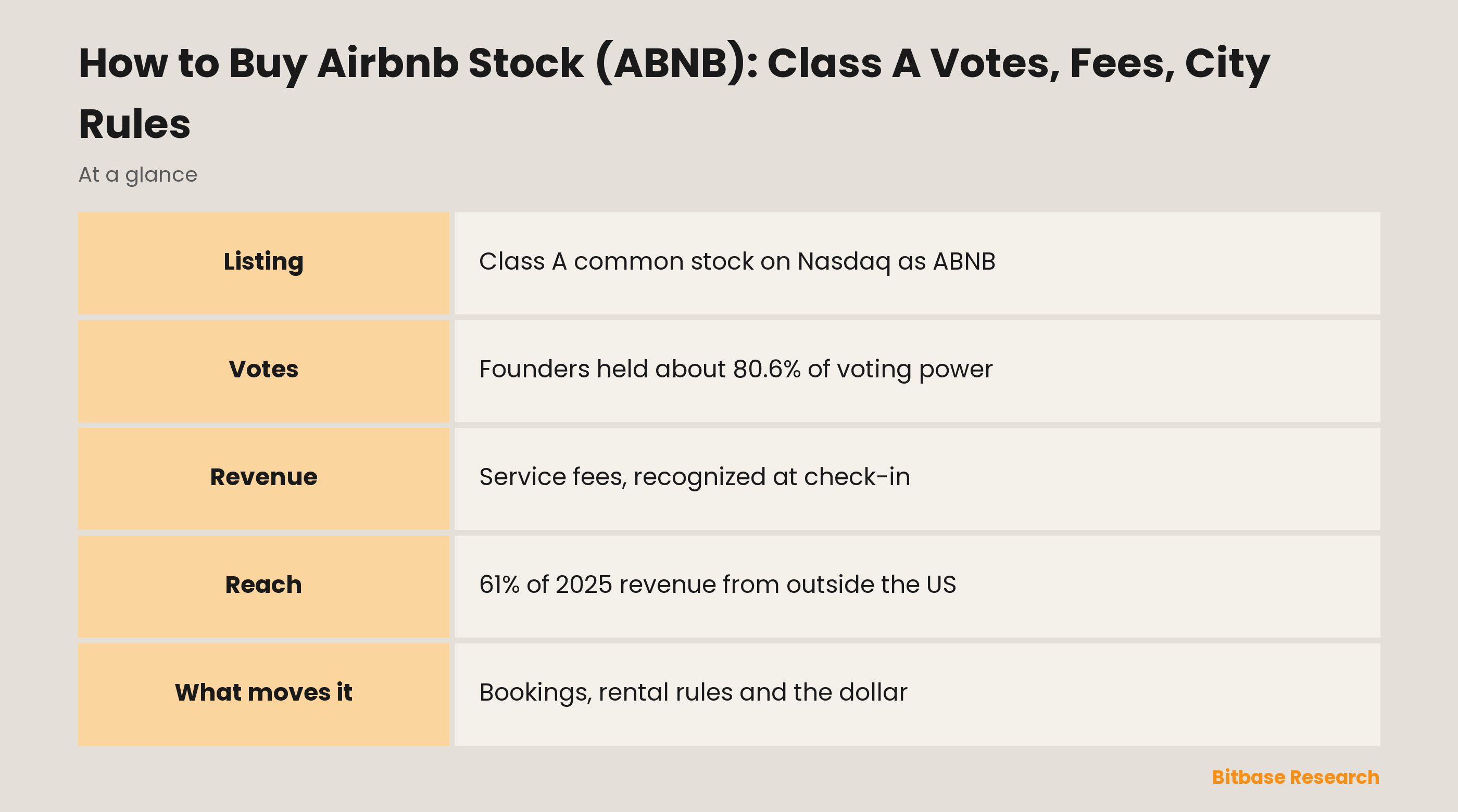
An Airbnb share is bought like most US stocks: through a brokerage account that can trade on the Nasdaq Global Select Market, where Airbnb's Class A common stock has been listed as ABNB since 10 December 2020. That class carries one vote per share, while the unlisted Class B carries twenty, and the three co-founders held about 80.6% of the voting power in April 2026. Behind the ticker is a marketplace that keeps a service fee on bookings, with 61% of 2025 revenue coming from listings outside the United States. Below: how the fees work, the order itself, and the risks the filings put first, from local limits on short-term rentals to founder control.
What Does Airbnb Do?
Airbnb runs an online marketplace where hosts offer places to stay, experiences and services, and guests search for and book them. Its annual report traces the company to 2007, "when two hosts welcomed three guests to their San Francisco home," and Airbnb, Inc. was incorporated in Delaware in June 2008. The 10-K for 2025 counts over 5 million hosts and over 2.5 billion guest arrivals, with offerings in over 220 countries and regions; the quarterly report for the period ended June 2026 put the host count above 5.5 million.
Stays are the core of the business, and its brands include HotelTonight, from an acquired business. In May 2025 the company launched Airbnb Services and a redesigned experiences offering, and the same year it redesigned its app with unified search and booking for all three. The 10-K says it plans "to continue to expand our business beyond travel accommodations."
Hosts get tools for scheduling, pricing, payments and reviews, and a Co-Host Network connects them with experienced hosts who can help run a listing. Trust features include reviews, risk scoring, anti-party technology and an urgent safety line, with AirCover protections for both hosts and guests. Payments run in approximately 50 currencies. Airbnb reports one operating segment, and its chief executive, co-founder Brian Chesky, assesses performance on consolidated net income. The other co-founders, chief strategy officer Nathan Blecharczyk and Joe Gebbia, also sit on the board.
The 10-K's list of competitors runs from online travel agencies such as Booking Holdings, Expedia Group with its Vrbo brand, and Trip.com Group; search engines such as Google, "and those powered by AI"; hotel chains such as Marriott, Hilton, Accor and Wyndham; property managers; to activity platforms such as Viator, GetYourGuide and Klook.
How Airbnb Makes Money
Airbnb does not own the homes, set the nightly prices or carry inventory. It earns service fees on the bookings it facilitates. For stays, those fees are "charged to customers as a percentage of the value of the booking, excluding taxes," and they vary with the booking's value, length, location and type of host. Experiences and services earn only a host fee. For most of its history Airbnb split the fee between host and guest; in October 2025 it began moving to a single fee charged only to the host, while bookings still on the split model continue to be charged on both sides.
Two accounting rules shape the reported figures. Revenue is presented net, as an agent, so the host's payout, cleaning and pet fees and taxes never count as Airbnb revenue. And it is recognized at check-in rather than at booking: fees collected in advance wait on the balance sheet as unearned fees and are refunded if the booking is canceled. That is why the company also reports gross booking value (GBV), the full value of bookings including host earnings, fees and taxes, which it calls "a leading indicator of revenue."
In 2025 revenue grew 10.3% and GBV 11.6%, so revenue equalled about 13.4% of GBV. Nights and Seats Booked, the volume measure that adds nights for stays to seats for experiences and services, rose 8%. The company states that "substantially all of our revenue comes from stays booked on our platform." By region, based on where the listing is located:
| Region | Share of 2025 revenue | Revenue growth vs 2024 | Nights and Seats Booked growth |
|---|---|---|---|
| North America | 42.4% | 3.8% | 3% |
| Europe, Middle East and Africa | 38.6% | 14.4% | 7% |
| Latin America | 9.5% | 19.7% | 18% |
| Asia Pacific | 9.4% | 16.5% | 15% |
| All regions | — | 10.3% | 8% |
Revenue shares and growth are calculated from the 10-K's regional revenue; volume growth is as the 10-K prints it.
Most of the money now comes from abroad: 61% of 2025 revenue was generated from listings outside the United States, and about 56% was earned in currencies other than the dollar. Profit did not keep pace with sales: net income fell 5% in 2025, which the 10-K attributes mainly to higher compensation and marketing costs and lower interest income.
ABNB Stock at a Glance
| Item | ABNB |
|---|---|
| Exchange | Nasdaq Global Select Market |
| Ticker | ABNB |
| Security | Class A common stock; no other class is listed |
| Other share classes | Class B (20 votes, unlisted), Class C (none outstanding), Class H (no votes, held by the Host Endowment Fund) |
| Listed since | 10 December 2020 |
| CUSIP | 009066101 |
| Sector | Travel marketplace; a holding of State Street's Consumer Discretionary Select Sector fund (XLY) |
| Index membership | S&P 500 and Nasdaq-100 |
| Headquarters | San Francisco, California |
| Incorporated | Delaware, June 2008 |
| Fiscal year | Calendar year, ending 31 December |
| Dividend policy | No cash dividend; capital returned through Class A buybacks |
| SEC identifier | CIK 1559720 |
The table leaves out anything that moves daily; price and market value are on the Airbnb stock page on Bitbase.
How to Buy Airbnb Stock
Airbnb is a US company listed at home, so no depositary receipt sits between you and the shares: the broker sells you the Class A common stock itself.
1. Choose a broker that reaches Nasdaq. Outside the US, that may be a local firm offering US markets or a global brokerage; find out which legal entity keeps your assets and who regulates it.
2. Open the account and declare your tax status. Non-US individuals normally sign IRS Form W-8BEN, which certifies foreign status for US withholding.
3. Move money in. Converting into dollars has its own price, so compare it alongside the commission.
4. Look up ABNB. Check that the result reads Airbnb, Inc. Class A common stock on Nasdaq. No other Airbnb share class trades on an exchange.
5. Pick an order type. Investor.gov explains that a market order "guarantees that the order will be executed, but does not guarantee the execution price," while a limit order executes only "at a specific price or better."
6. Set the amount. A fractional order buys a cash amount rather than whole shares, but "not every brokerage firm offers fractional share investing," "some firms only allow market orders for fractional share investing," and you "may not have voting rights" on a fraction.
7. Keep the confirmation. It shows your cost per share for when you sell.
Brokers that take orders before the open or after the close may display extended-hours prices that differ from the regular session; in thin trading, a limit order is the safeguard on price.
The vote that comes with it. Each ABNB share carries one vote, against twenty for each Class B share. Class B stock is not listed, can be converted into Class A at any time and generally converts when it is transferred. The 10-K is plain about the consequence: "This concentrated control limits or precludes other stockholders' ability to influence corporate matters for the foreseeable future."
Outside the United States, the IRS says that most US-source income received by a foreign person is "subject to U.S. tax of 30%," and that "a reduced rate, including exemption, may apply" under a tax treaty. Because Airbnb pays no dividend, that withholding currently has no dividend to apply to; your home country may still tax a gain when you sell.
Through a fund, Airbnb comes as one position among hundreds. On 28 October 2026 it appeared in State Street's daily holdings for SPY, the S&P 500 fund, and for XLY, the consumer discretionary sector fund; Nasdaq's constituent list of 29 October 2026 puts it in the Nasdaq-100, so funds that fully replicate that index own it too.
What Moves ABNB Stock
Bookings first, revenue at check-in. A booking made in spring for a summer stay shows up in GBV straight away but in revenue only when the guest arrives. The 10-K describes the resulting calendar: Nights and Seats Booked are lowest in the fourth quarter, revenue has "historically been highest in the third quarter and lowest in the first quarter," and holidays such as Easter can shift results between quarters. In the second quarter of 2026 revenue rose 17%, or 13% at constant currency, GBV 16% and Nights and Seats Booked 10%, and the report added that "the conflict in the Middle East has had and may continue to have an impact on booking trends."
Short-term rental rules. Hosting is regulated at city, state and national level, and the 10-K gives examples rather than one rulebook. Its risk factors state that "the City of New York has effectively banned short-term rentals, and this has led to similar restrictions being considered throughout the State of New York," and that the EU Short-Term Rental Regulation "will enter into force in May 2026" with requirements including "reporting and data sharing to local authorities." In 2025 Spain's consumer affairs ministry proposed a fine over alleged non-compliance with short-term rental listing rules; Airbnb disputes it, and in May 2026 it arranged a court-ordered surety bond that suspends enforcement until the case concludes. The 10-K also notes that no single city accounted for more than 2% of 2025 revenue before incentives and refunds.
Fees and new lines. Two 2025 changes sit inside current results: the shift toward a host-only fee from October, and the May relaunch of services and experiences. Experiences and services earn only a host fee while stays still produce substantially all revenue, so the quarterly reports show whether the push "beyond travel accommodations" registers in the numbers.
The dollar and the regional mix. With about 56% of revenue in other currencies, the 10-K warns that "a strong U.S. dollar can negatively impact our revenue," and the company runs a hedging program to soften the effect. The gap between 17% reported and 13% constant-currency growth in the second quarter of 2026 shows currency working in Airbnb's favour. Growth is also faster outside North America: in 2025 Latin America and Asia Pacific grew revenue by 19.7% and 16.5% against 3.8% at home, and the second-quarter report links higher marketing spend to "paid growth marketing initiatives in emerging markets and partnerships."
Buybacks and the balance sheet. Instead of dividends, Airbnb repurchases and retires Class A shares: 29.7 million in 2025 and 16.0 million in the first half of 2026, under authorizations that have no expiration date. In March 2026 it issued senior notes maturing in 2029, 2031 and 2036 and used most of the proceeds to repay its convertible notes due 2026 at maturity; the 10-Q says the fixed rates on the new notes "will materially increase our ongoing semi-annual cash interest obligations."
Airbnb's Warnings to ABNB Shareholders
Of the many risk factors in the 10-K, these sit closest to a Class A shareholder:
Travel demand. "Any decline or disruption in the travel and hospitality industries or economic downturn could materially adversely affect our business, results of operations, and financial condition." The filing points to extreme weather, natural disasters, pandemics and conditions such as inflation, tariffs and currency swings.
Limits on hosting. "Host listings may also be limited by night caps, density restrictions, onerous permitting requirements, primary residence or host presence requirements, permit caps, minimum night stays, and/or discretionary permitting or lottery systems." The same section says hotels and hotel-affiliated groups lobby "for stricter regulations governing our business."
Trust and safety. "Host, guest, or third-party actions that are criminal, violent, inappropriate, dangerous, or fraudulent may undermine the trust and safety or the perception of safety and security on our platform." Claims against the company have involved, among other things, hidden camera and carbon monoxide incidents.
Search engines as rivals. "We also face competition from search engines like Google, which can influence search traffic and promote their own travel services, potentially disintermediating our platform." The 10-K adds that changes to search algorithms "can reduce our platform's prominence."
The share structure. "Our multi-series structure may have a material adverse effect on the market price of our Class A common stock," the 10-K states, noting that it "could make us ineligible for inclusion in certain indices." A related entry warns that the focus on all stakeholders "may conflict with short- or medium-term financial interests and business performance."
Owning one stock adds two more: your result rests on a single company's execution, and with no dividend it comes entirely from the share price, converted back through an exchange rate if your savings are in another currency.
How to Research ABNB Yourself
Airbnb's filings are on EDGAR under CIK 1559720, and investors.airbnb.com carries the same reports plus webcasts of each quarterly results call. Annual results come in the 10-K and the first three quarters in 10-Qs, while 8-Ks report events in between, from results releases to shareholder vote tallies. The annual proxy statement carries the beneficial ownership table, the place to see how much voting power each founder holds.
In the 10-K, the business section and Item 1A frame the company, the management discussion defines Nights and Seats Booked and GBV and breaks results down by region, and the commitments and contingencies note covers lodging taxes and regulatory disputes such as the Spanish fine.
Two reading notes. In Airbnb's filings ADR means average daily rate, not American depositary receipt, which ABNB does not have. And the XBRL cover page, R1.htm, registers one security, the Class A stock, yet reports shares outstanding for all four classes, Class C at zero. The stock page linked above has the quotes, and other US stocks on Bitbase are a click away.
Airbnb Stock FAQ
Does Airbnb pay a dividend?
No. The 10-K states: "We intend to retain any future earnings and do not anticipate declaring or paying any cash dividends in the foreseeable future." Cash goes back to shareholders through repurchases of Class A stock instead.
Can I buy Airbnb stock with crypto?
Not directly. Brokers settle ABNB purchases in US dollars, so the crypto must be converted to cash and transferred before the order; depending on your country, that sale can be a taxable event. The result is a Class A share with a vote, not a token, and our guide to buying stocks with crypto explains the conversion step.
What is the difference between Airbnb's Class A and Class B shares?
Class A is the listed class, with one vote per share. Class B has 20 votes, is not listed and generally becomes Class A when transferred. As of 8 April 2026, Brian Chesky held about 31.9% of the voting power, Nathan Blecharczyk 31.1% and Joe Gebbia 17.6%. Two more classes exist: Class C, with no votes and none outstanding, and Class H, also voteless, held by the Host Endowment Fund to support hosts and converted into Class A if sold to anyone outside the Airbnb group. At the 5 June 2026 annual meeting, a shareholder proposal to set a sunset date for the structure was not approved.
Is ABNB in the S&P 500 and the Nasdaq-100?
Yes. Airbnb appears in the SPY holdings file of 28 October 2026 and in Nasdaq's Nasdaq-100 constituent list of 29 October 2026. Index weights change every day.
When did Airbnb go public?
In December 2020. The prospectus for the initial public offering of Class A shares is dated 9 December 2020, and the stock has been listed on the Nasdaq Global Select Market since 10 December. At Airbnb's request, the underwriters reserved shares for a directed share program open to eligible hosts on the platform and certain people named by its officers and directors.
Conclusion
Buying ABNB takes a broker with Nasdaq access and a market or limit order for the Class A stock. Owning it means holding a one-vote share in a company where the founders' Class B stock carries most of the votes, whose revenue arrives at check-in rather than at booking, and whose supply depends on rules that cities and countries set. Read the latest 10-Q for bookings and regional growth, and the proxy statement for voting power, before deciding how much of one travel platform belongs in your portfolio.
Related reading
Other Bitbase articles on this topic:
- How to Buy Booking Holdings Stock (BKNG): The 25-for-1 Split
- How to Buy Carvana Stock (CVNA): Class A Shares, Split and Perps
- How to Buy Ferrari Stock (RACE): Dual Listing and Loyalty Votes
- How to Buy O'Reilly Automotive Stock (ORLY): Split, No Dividend
Disclaimer: This article is educational content from Bitbase Academy, provided for information only. It explains what a company or fund does and how the instruments referenced here differ from one another; it does not constitute investment, trading, tax, or financial advice, and it is neither a recommendation nor an endorsement of any security, token, or trading strategy. A tokenized stock is issued by a third party and is designed to give economic exposure to an underlying asset: it is not a share, it carries no shareholder rights, and it depends on the issuer's structure, eligibility rules, and redemption terms, which the issuer can change. Perpetual futures are leveraged derivatives that hold no underlying asset and can be liquidated, and trading hours, product availability, and eligibility differ by instrument and by jurisdiction and can change at any time. Written as of October 2026; verify everything yourself through company filings, the issuer's own documentation, and the product pages of the venue you trade on.
References
[1] Airbnb Form 10-K for fiscal 2025 (SEC EDGAR) www.sec.gov
[2] Airbnb Form 10-Q for the quarter ended 30 June 2026 (SEC EDGAR) www.sec.gov
[3] Airbnb 2026 proxy statement, Form DEF 14A (SEC EDGAR) www.sec.gov
[4] Airbnb Form 8-K, 11 June 2026: annual meeting voting results (SEC EDGAR) www.sec.gov
[5] Airbnb initial public offering prospectus, 9 December 2020 (SEC EDGAR) www.sec.gov
[6] State Street SPDR S&P 500 ETF Trust (SPY): fund page and daily holdings www.ssga.com
[7] State Street Consumer Discretionary Select Sector SPDR ETF (XLY): fund page and daily holdings www.ssga.com
[8] Nasdaq: Nasdaq-100 index and constituents www.nasdaq.com
[9] Investor.gov (SEC): Types of Orders www.investor.gov
[10] Investor.gov (SEC): Investor Bulletin on fractional share investing www.investor.gov
[11] IRS: NRA Withholding www.irs.gov





