
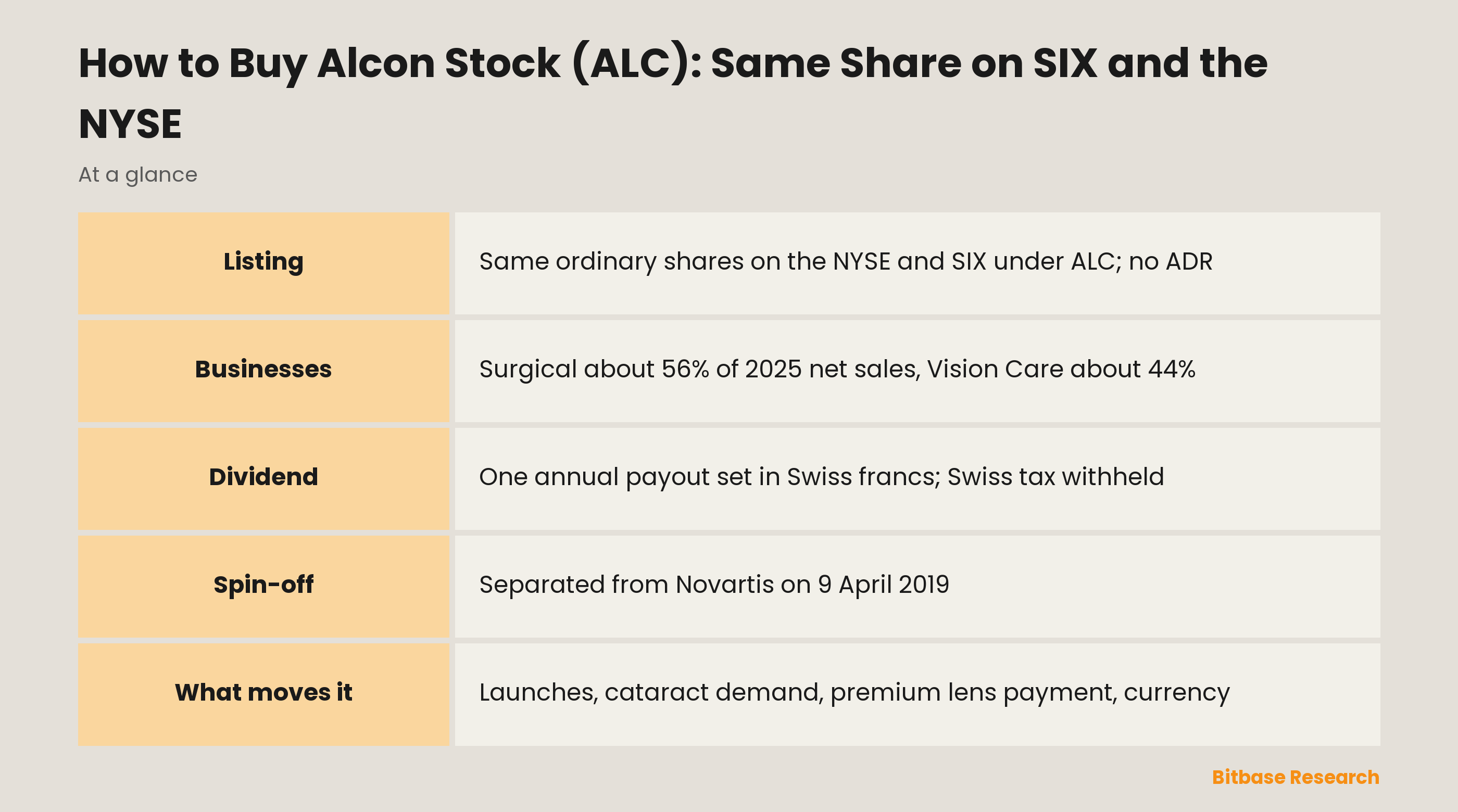
An Alcon share bought through a US broker is the ordinary share itself: Alcon Inc., a Swiss company, lists one class of registered shares on both the New York Stock Exchange and the SIX Swiss Exchange under ALC, with no depositary receipt in between, so any broker with NYSE access can fill the order. Novartis spun the eye care business off in April 2019, and in 2025 its Surgical side, from cataract lenses to operating-room consoles, brought in about 56% of net sales. Below: the two businesses, the buying steps, the Swiss-franc dividend and the risks in the annual report.
What Does Alcon Do?
Alcon makes eye care products in two businesses, Surgical and Vision Care. Its annual report on Form 20-F calls it "the global leader in eye care" and says that, by 2025 sales, it ranks first by global market share in both. It employs more than 25,000 people and sells in over 140 countries and territories.
Surgical serves cataract, vitreoretinal, refractive laser and glaucoma surgery with three kinds of product. Implantables stay in the eye, chiefly intraocular lenses (IOLs) that replace a clouded natural lens; Alcon's are built on its Clareon material and include the trifocal PanOptix, the extended-depth-of-focus Vivity and the newer PanOptix Pro. Consumables, such as instruments, solutions and Custom Pak kits, are used once per operation. Equipment means consoles, lasers and diagnostic devices, such as the UNITY VCS system that replaced the Constellation vitrectomy platform in 2025 and the WaveLight lasers used in LASIK. The 20-F says Surgical has "the largest installed base of equipment worldwide, which we use to cross-promote our surgical consumables and IOLs."
Vision Care sells contact lenses, among them DAILIES TOTAL1, PRECISION1 and TOTAL30, and ocular health products: Systane artificial tears, Pataday allergy drops, Opti-Free and Clear Care lens solutions, and TRYPTYR, described as "a first-in-class prescription treatment for dry eye disease."
Two pharmacists opened a small pharmacy under the Alcon name in Fort Worth, Texas, in 1945. Nestlé bought it in 1977 and floated about a quarter of the shares in 2002 under the NYSE symbol ACL, and between 2008 and 2011 Novartis acquired all of it. On 9 April 2019 Novartis completed the spin-off, and the shares began trading as ALC in Switzerland and New York; the parent that remained is profiled in our guide to Novartis stock. Alcon is domiciled in Fribourg, headquartered in Geneva and runs its US operations from Fort Worth.
How Alcon Makes Money
Net sales grew 5% in 2025, split across five product lines:
| Product line | Business | Share of 2025 net sales | Change vs 2024 | Examples |
|---|---|---|---|---|
| Consumables | Surgical | 29% | +6% | Instruments, solutions, Custom Paks |
| Contact lenses | Vision Care | 27% | +6% | DAILIES TOTAL1, PRECISION1, TOTAL30 |
| Implantables | Surgical | 17% | Flat | Clareon IOLs, PanOptix, Vivity |
| Ocular health | Vision Care | 17% | +5% | Systane, Pataday, TRYPTYR |
| Equipment/other | Surgical | 9% | +6% | UNITY, WaveLight lasers |
Shares are calculated from the net sales the 20-F reports for each line, rounded to whole numbers.
Surgical made up about 56% of sales and grew 4%; Vision Care about 44%, growing 6%. Implantables were held back by "soft market conditions and competitive pressures," while consumables grew on "vitreoretinal procedural growth and price increases, partially offset by soft cataract market conditions." Contact lenses and ocular health rose mainly on price and new products.
Profit tilts further toward Surgical. Its segment contribution margin was 25.4% against 21.5% for Vision Care, so Surgical supplied about 60% of the two segments' combined contribution. The group operating margin slipped to 13.2% from 14.4% as launch spending, research and new tariffs rose.
"No single customer accounted for more than 10% of our global sales in 2025." The United States produced 45% of net sales and international markets 55%, with Japan and China at about 6% each and Switzerland at 1%.
The 20-F names the rivals. In surgery: Carl Zeiss Meditec, Bausch & Lomb, Hoya, Glaukos and Johnson & Johnson. In vision care: Johnson & Johnson, Bausch & Lomb and The Cooper Companies, with AbbVie's Allergan in ocular health. Only Johnson & Johnson appears on both lists; see our Johnson and Johnson stock guide.
ALC Stock at a Glance
| Feature | ALC |
|---|---|
| Listings | New York Stock Exchange (US dollars) and SIX Swiss Exchange (Swiss francs) |
| Ticker | ALC on both exchanges |
| Security | Ordinary registered shares, identical in both markets; no ADR |
| Sector | Eye care: surgical devices, contact lenses, eye drops |
| Index membership | Swiss Market Index (SMI), among others |
| Headquarters | Geneva; registered office in Fribourg |
| US operations | Fort Worth, Texas |
| Listed as ALC | 9 April 2019, after the Novartis spin-off |
| Fiscal year | Calendar year, ending 31 December |
| Accounting | IFRS, reported in US dollars |
| Dividend policy | One cash dividend a year, set in Swiss francs, approved by shareholders |
| SEC filings | Form 20-F (annual) and Form 6-K (quarterly results, other news); CIK 1167379 |
Anything that moves during the trading day is left out; for the live price, open the Alcon stock page on Bitbase.
How to Buy Alcon Stock
The 20-F calls the shares "global registered shares" that "can be traded and transferred across applicable borders, without the need for conversion." The steps for the NYSE line:
1. Pick the listing. The NYSE line trades in dollars during US hours; the SIX line trades in francs and needs a broker with Swiss market access.
2. Open an account with a regulated broker. Check which entity holds your assets, and state your tax residence correctly, since it decides what Swiss tax you can reclaim.
3. Fund it. In another currency, compare the conversion rate as well as the commission.
4. Search for ALC. The result should read Alcon Inc. ordinary shares on the NYSE, the single class on the 20-F cover.
5. Choose the order type. FINRA explains the trade-off: a market order is the likeliest to fill but fixes no price; a limit order will not execute at a worse price than the one you set.
6. Size it. Some brokers sell fractional shares; FINRA notes that not every firm offers them for every stock, and a fraction may carry no vote.
The dividend and Swiss tax. Alcon "expects that it will continue to recommend to shareholders the payment of a regular annual cash dividend based on the prior year's core net income." Dividends are "denominated in Swiss francs," so a weaker franc means fewer dollars. Switzerland withholds tax "at a current rate of 35%"; residents of treaty countries may reclaim part of it, by procedures that vary by country, and your home country may tax the dividend again. The ex-dividend dates also differ: in 2026, 5 May for shares held through SIX SIS and 6 May for those held through DTC, the US depository, because US settlement moved to one day in 2024.
Two quotes for one share. Prices on the two exchanges can drift apart because of "fluctuations in the US dollar/Swiss franc exchange rate and differences in trading schedules." New York is not the minor venue: in 2025 average daily volume was about 1.8 million shares on the NYSE and 1.1 million on SIX.
Through a fund. The 20-F lists Alcon in the SMI, the main Swiss benchmark; check a fund's published holdings before relying on it.
What Moves ALC Stock
Launches and cataract demand. In the second quarter of 2026 sales rose 8%, or 7% at constant exchange rates, with equipment up 26% and ocular health 13%. Chief executive David Endicott said "UNITY, PanOptix Pro, TRYPTYR and other recent launches are driving growth." The other side is the cataract market: implantables did not grow in 2025, held back by soft demand and rival lenses.
Who pays for premium lenses. The 20-F says "a considerable portion of sales and growth relies on patient-pay premium technologies," above all advanced IOLs. It puts their US penetration at about 20%. In the US, CMS rulings let Medicare cover part of the cost while the patient pays the rest; if that changes, "our sales and growth could be negatively impacted."
Write-offs and deals. In the second quarter of 2026 Alcon ended the lens programs bought from PowerVision in 2019, after "persistent unpredictable post-surgical visual outcomes reported in a subset of the patients." The non-cash charge cut that quarter's reported operating margin to 0.4% from 9.6%, while the core operating margin, a non-IFRS measure, rose to 20.6% from 19.1%. A deal to buy STAAR Surgical, announced in August 2025, was terminated in January 2026 after STAAR failed to win shareholder approval.
Currency and tariffs. Alcon reports in dollars, but its spending in Swiss francs and US dollars exceeds its revenue in them, so exchange rates move reported profit. Tariffs also weighed on 2025 margins.
Buybacks. A program launched in 2025 finished early, in January 2026, and a new three-year authorization followed that "may be suspended or discontinued at any time."
Recalls, Pricing and Swiss Law at Alcon
Price. "In an environment of managed care, provider consolidation, increased competition, and declining reimbursement rates, failure to innovate could force us to compete primarily on price."
Product safety. "We may implement product recalls or voluntary market withdrawals of our products," and manufacturing is "highly regulated and complex." Some products come from one plant, and inputs such as sterilization services have one or few suppliers.
The contact lens channel. If the US or other countries dropped the prescription requirement for contact lenses, Alcon says its marketing and distribution model would need significant, costly changes.
Acquisitions. "We may not successfully complete or integrate strategic acquisitions," the 20-F says, citing STAAR.
Swiss corporate law. Shareholders must approve dividends and changes to share capital, which "may limit our flexibility to raise capital, issue dividends and manage capital needs," and "it may be difficult to enforce US judgments against us."
The holding itself. "We may not pay or declare dividends."
How to Research ALC Yourself
Alcon files with the SEC as a foreign private issuer under CIK 1167379: an annual Form 20-F, the 2025 edition on 24 February 2026, and a Form 6-K each quarter carrying the press release and an interim financial report.
In the 20-F, the business overview names products and competitors, the operating review breaks out product lines and regions, and the taxation section covers Swiss withholding tax.
Read both IFRS and "core" figures, which exclude items such as amortization and impairments, and compare growth at constant exchange rates, which the company prints beside reported growth: in the first quarter of 2026 sales rose 10% as reported but 6% at constant rates. The live quote is on the stock page linked above, and the full list of stock pages on Bitbase covers other companies.
Alcon Stock FAQ
Can I buy Alcon stock with crypto?
Not directly. ALC is bought through a brokerage account, so crypto must first be sold for cash, a sale that may be taxable where you live. The share carries voting and dividend rights in a Swiss company, which is how a share differs from a crypto asset.
Is Alcon stock an ADR?
No. The 20-F cover lists ordinary shares, nominal value CHF 0.04, and the identical shares trade on the NYSE and SIX. There is no depositary bank and no conversion ratio.
Does Alcon pay a dividend?
Yes, once a year. The board proposes a cash dividend in Swiss francs, linked to the prior year's core net income, and shareholders vote on it at the annual general meeting. Swiss withholding tax is deducted first.
Is Alcon still part of Novartis?
No. Novartis completed the spin-off on 9 April 2019.
Conclusion
Alcon earns most of its money in the operating room, where an installed base of consoles keeps consumables and lenses selling, and the rest from contact lenses and eye drops that people buy again and again. Because the New York share is the Swiss share, what needs thought is the franc, Swiss withholding tax and an annual dividend. Read the latest 20-F and quarterly 6-K, compare core with IFRS results, and see whether implantables and equipment keep pace with the launch calendar.
Related reading
Other Bitbase articles on this topic:
- How to Buy Centene Stock (CNC): Medicaid, Ambetter and Wellcare
- How to Buy Dexcom Stock (DXCM): G7, Stelo and Medicare Bidding
- How to Buy GE HealthCare Stock (GEHC): Scanners and Imaging Agents
- How to Buy Coherent Stock (COHR): From II-VI to AI Optics
Disclaimer: This article is educational content from Bitbase Academy, provided for information only. It explains what a company or fund does and how the instruments referenced here differ from one another; it does not constitute investment, trading, tax, or financial advice, and it is neither a recommendation nor an endorsement of any security, token, or trading strategy. A tokenized stock is issued by a third party and is designed to give economic exposure to an underlying asset: it is not a share, it carries no shareholder rights, and it depends on the issuer's structure, eligibility rules, and redemption terms, which the issuer can change. Perpetual futures are leveraged derivatives that hold no underlying asset and can be liquidated, and trading hours, product availability, and eligibility differ by instrument and by jurisdiction and can change at any time. Written as of November 2026; verify everything yourself through company filings, the issuer's own documentation, and the product pages of the venue you trade on.
References
[1] Alcon Form 20-F for 2025 (SEC EDGAR) www.sec.gov
[2] Alcon 2025 Form 20-F, XBRL cover page (SEC EDGAR) www.sec.gov
[3] Alcon second-quarter 2026 results release, filed with Form 6-K (SEC EDGAR) www.sec.gov
[4] Alcon first-quarter 2026 results release, filed with Form 6-K (SEC EDGAR) www.sec.gov
[5] Alcon 2026 annual general meeting agenda and dividend timetable, Form 6-K (SEC EDGAR) www.sec.gov
[6] Alcon terminates agreement to acquire STAAR Surgical, Form 6-K (SEC EDGAR) www.sec.gov
[7] FINRA: Order Types www.finra.org
[8] FINRA: Investing in Fractional Shares www.finra.org





