
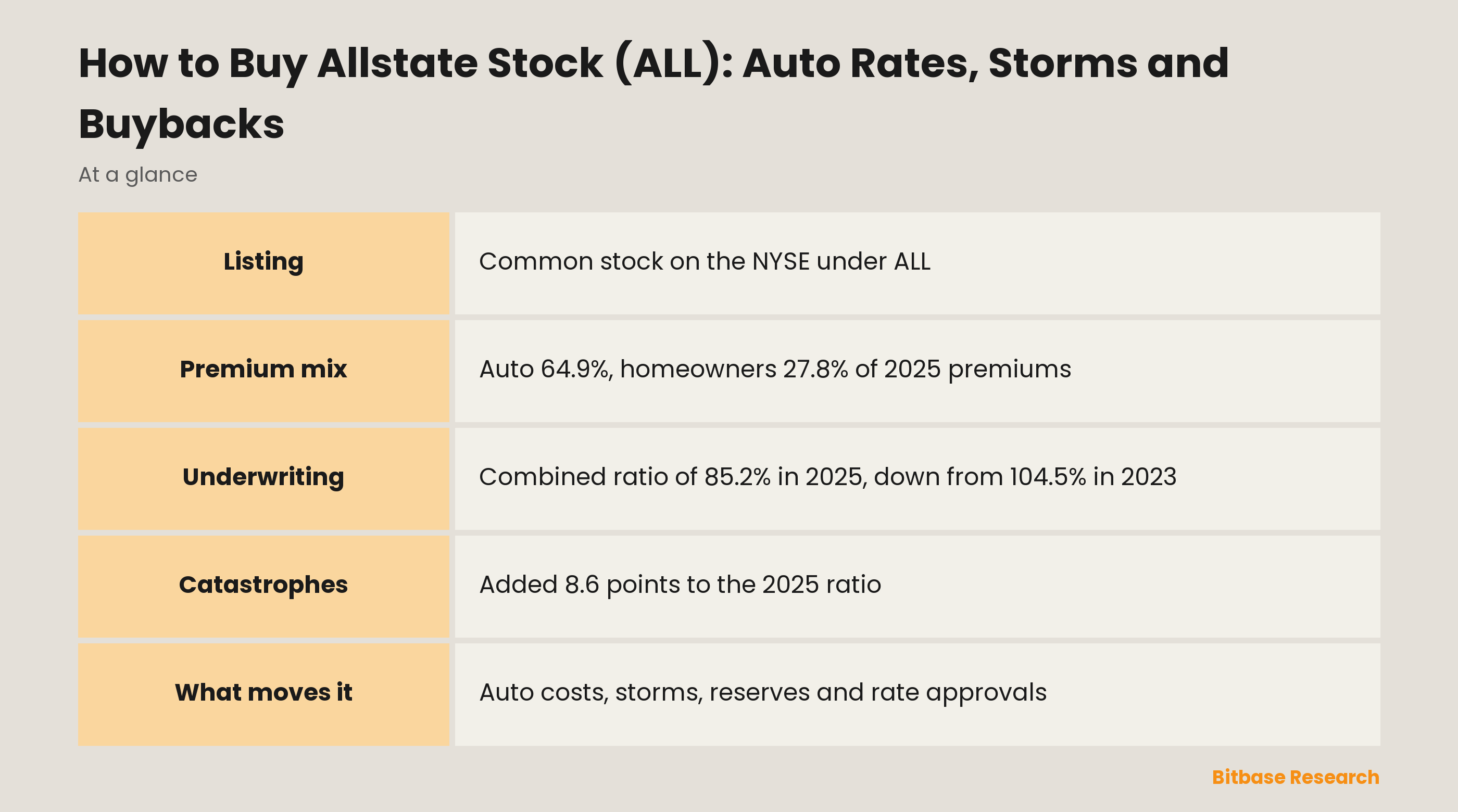
Its three-letter ticker, ALL, is also an everyday English word, so buying The Allstate Corporation starts with picking the right line from your broker's search results: the company's common stock on the New York Stock Exchange. From there it is an ordinary US share purchase through any broker with access to American exchanges. Behind the symbol is a personal lines insurer that took 64.9% of its 2025 premiums from auto policies and 27.8% from homeowners policies, and whose combined ratio fell from 104.5% in 2023, an underwriting loss, to 85.2% in 2025.
What Does Allstate Do?
The Allstate Corporation is the holding company for Allstate Insurance Company. It was incorporated in Delaware in 1992 for that purpose, keeps its head office in Northbrook, Illinois, and describes itself in its 10-K as "one of the largest publicly held personal lines insurers in the United States." Citing A.M. Best, the same filing places it third among US personal property and casualty insurers by 2024 statutory direct premiums written. At the end of 2025 it counted 211 million policies in force and about 53,000 employees, and its best-known asset may be a slogan: "You're In Good Hands With Allstate."
The insurer is older than its holding company. Sears, Roebuck and Co. established Allstate in 1931, and Sears still owned 80.3% of The Allstate Corporation until 30 June 1995, when it handed that stake to its own shareholders as a tax-free dividend.
Allstate now reports four segments.
Allstate Protection sells private passenger auto insurance, homeowners insurance, other personal lines such as renters, condominium, landlord, boat and umbrella cover, and a small, shrinking commercial book. It sells under the Allstate, National General and Direct Auto brands, and owns Answer Financial, an agency that compares quotes from several insurers. It reaches customers through three channels: more than 27,400 Allstate exclusive agents and licensed sales professionals, about 58,700 independent agent locations, and around 2,200 sales representatives working in contact centers and online.
Protection Services groups five businesses. Protection Plans covers phones, electronics, appliances and furniture sold by retailers and mobile operators; Roadside provides towing and similar help; Dealer Services sells vehicle service contracts and related products through car dealerships; Identity Protection sells identity theft protection and restoration; and Arity turns driving data into risk scores and marketing leads. The segment held 81.6% of Allstate's policies in force at the end of 2025 but produced only 5.0% of its revenue.
Run-off Property-Liability holds commercial policies written from the 1960s to the mid-1980s that still generate asbestos, environmental and other claims, and Corporate covers holding company activities.
The group has also become narrower. It bought National General on 4 January 2021 and still uses that brand, and in the same year it sold its life insurance companies to Everlake and to Wilton Reassurance. In 2025 it sold its Employer Voluntary Benefits business to StanCorp Financial Group, known as The Standard, closing on 1 April, and its Group Health business to Nationwide, closing on 1 July. The individual health business was kept and now sits outside the reportable segments.
How Allstate Makes Money
Almost all of Allstate's revenue is insurance premiums. In 2025, property and casualty premiums made up 89.4% of total revenue, net investment income 5.1%, other revenue such as fees and commissions 4.4%, and accident and health premiums 1.4%; net losses on investments trimmed the total slightly. Net investment income grew 11.5% that year.
Within Allstate Protection, auto is the core of the business:
| Line | Share of 2025 premiums written | 2025 combined ratio | 2024 combined ratio | 2023 combined ratio |
|---|---|---|---|---|
| Auto | 64.9% | 85.0% | 95.0% | 103.4% |
| Homeowners | 27.8% | 84.4% | 90.1% | 106.8% |
| Other personal lines | 5.5% | 93.9% | 97.6% | 101.6% |
| Commercial lines | 0.7% | 67.3% | 139.4% | 132.7% |
| Other business lines | 1.1% | 64.6% | 69.1% | 79.1% |
Shares are calculated from the 2025 10-K premiums table; combined ratios are as reported for Allstate Protection. Other business lines are mostly commissions on brokered products.
The combined ratio puts losses, loss adjustment expenses and the cost of acquiring and running policies over earned premiums, so a figure under 100% means the policies made money before any investment income. Across property-liability, Allstate went from 104.5% in 2023 to 94.3% a year later and 85.2% in 2025. Auto produced 65.8% of Allstate Protection's underwriting income in 2025 and homeowners 27.5%.
Price did much of the work. In 2025 Allstate implemented auto rate increases of 3.5% and homeowners rate increases of 7.6%, while auto policies in force grew 2.3%. Auto premiums written rose 3.6% and homeowners premiums written 14.9%, the latter also reflecting higher insured replacement costs. The 10-K attributes the drop in the auto loss ratio to "increased earned premiums, lower claim frequency and the benefit of prior year non-catastrophe reserve releases."
That last item matters. Reserve releases, where claims from earlier years turn out cheaper than set aside, lowered the 2025 combined ratio by 3.1 points, and after tax they were equal to 14.1% of net income applicable to common shareholders. Net income in 2025 also included one-off gains on the two health and benefits sales.
Protection Services contributes far less profit. Protection Plans earned 82% of the segment's 2025 adjusted net income, while Arity ran at a loss.
ALL Stock at a Glance
| Feature | ALL |
|---|---|
| Exchange | New York Stock Exchange, the principal market; also listed on NYSE Texas |
| Ticker | ALL |
| Security | Common stock; the 10-K cover also registers preferred depositary shares and subordinated debentures under other symbols |
| Sector | Personal property and casualty insurance |
| Index membership | S&P 500 (State Street SPY holdings file, 29 October 2026) |
| Headquarters | Northbrook, Illinois |
| Incorporated | Delaware, 1992 |
| Origin | Established by Sears in 1931; Sears distributed its stake on 30 June 1995 |
| Fiscal year | January to December |
| Dividend | Paid quarterly; the quarterly amount rose 8% from April 2026 |
| Share count | Down 71.1% since 1995, mainly through buybacks |
| SEC identifier | CIK 899051 |
Quotes, market capitalization and yield move with every trade, so they are left out here; the Allstate stock page on Bitbase tracks them live.
How to Buy Allstate Stock
Allstate is a Delaware corporation with its common stock listed on the NYSE, so an order there buys the share itself; no depositary receipt sits in between. The steps:
1. Pick a broker that reaches the NYSE. Outside the United States that may be a local bank or broker with a US gateway, or an international platform. Check which legal entity will hold your account and which regulator supervises it.
2. Open and verify the account. Non-US investors are usually asked for a tax form; the IRS tells foreign beneficial owners to "Give Form W-8 BEN to the withholding agent or payer."
3. Fund it. US shares are priced in dollars, so money in another currency is converted, and the exchange spread is part of your cost.
4. Search carefully. Typing ALL can bring up Allstate's preferred depositary shares as well as the common stock. Choose the line that names The Allstate Corporation common stock on the NYSE.
5. Choose an order type. A market order executes at the best available price when it arrives, which can differ from the last quote you saw, as explained in how market orders fill; a limit order names the highest price you will pay and may not execute.
6. Set the size. Some brokers sell fractions of a share, but FINRA notes that "the availability of fractional share trading varies by brokerage firm," and that "while some brokerage firms allow proxy voting for holders of fractional shares, other firms don't."
Dividend tax. According to the IRS, "most types of U.S. source income received by a foreign person are subject to U.S. tax of 30%," unless an Internal Revenue Code provision or a US treaty with your country of residence sets a lower rate. Dividends can also be taxed again at home.
Through a fund. If you would rather not pick one insurer, funds offer indirect exposure. On 29 October 2026, the holdings files for State Street's SPY, which tracks the S&P 500, and its Financial Select Sector SPDR ETF, XLF, both listed Allstate, though in each it is one holding among many.
What Moves ALL Stock
Auto claims against auto rates. With auto at almost two-thirds of premiums, the gap between claim costs and the rates regulators allow drives the earnings line. The auto combined ratio went from 103.4% in 2023 to 85.0% in 2025. The 10-K says 2025 claim severity still rose on "higher repair costs, mix of total loss frequency, medical consumption and attorney representation."
Storm losses, reported every month. Catastrophes added 8.6 points to the property-liability combined ratio in 2025, 9.2 points in 2024 and 11.6 points in 2023; over ten years the average was 8.8 points, ranging from 7.1 to 11.6. In 2025 no hurricane or tropical storm caused catastrophe losses: wind and hail from 110 separate events produced most of the total, and four wildfire events, including those in California in January, most of the rest. Homeowners carries the heaviest load, at 26.6 points of that line's 2025 loss ratio. Allstate also files a release each month, furnished on Form 8-K, that estimates the previous month's catastrophe losses, so the storm bill reaches the market before each quarter closes.
Reserve development. Releases cut 3.1 points from the 2025 ratio and 5.6 points in the first half of 2026, when the combined ratio was 84.3% against 94.2% a year earlier. Releases depend on old claims settling for less than reserved, which can turn either way.
Regulators. Rates need prior approval in 21 locations for auto and 20 for home, and some states restrict profits. After the January 2025 wildfires, California's insurance commissioner ordered a one-year moratorium on non-renewals and cancellations of residential cover in affected zip codes. Allstate stopped writing new homeowners business in California in 2022 and has cut its California homeowners exposure by more than 50% since 2007; in Florida it writes no new homeowners business.
Growth. New issued auto applications rose 25.3% in 2025 as the company pushed its Affordable, Simple, Connected products, which the second-quarter 2026 release put in 45 states for auto and 41 for homeowners.
Capital returns. Allstate repurchased 2.3% of its shares in 2025 and 3.0% in the first half of 2026, and its share count is down 71.1% since 1995, so earnings per share can grow faster than profit.
Investment results. Performance-based investments, mainly limited partnership interests in areas such as private equity and real estate, are recorded on a lag, and the company says their income "can fluctuate significantly."
When Claims Outrun Allstate's Premiums
Item 1A of the 10-K lists many risks; these five reach an Allstate shareholder fastest:
Reserves. "The ultimate cost of losses, or current estimates, have and may continue to vary materially from recorded reserves," and any variance flows into results when reserves are reestimated.
Claim severity. Bodily injury costs rise with "an increase in claims with attorney representation, higher medical consumption and inflation," and vehicle repairs with tariffs, labor rates and the price of fixing cameras and sensors in driver assistance systems.
Catastrophes. "Catastrophic events could adversely affect operating results and cause them to vary significantly from one period to the next," and "climate change could contribute to increased variability of catastrophe losses and underwriting results."
Rate approval. Regulators may hold back increases during inflation, and "certain states impose or are contemplating regulatory limitations on the amount of profit that insurance companies may earn," which could force premium credits or refunds.
Holding company cash. The Allstate Corporation relies on dividends from Allstate Insurance Company, which Illinois law restricts. If Allstate ever deferred interest on its subordinated debentures, their terms would bar dividends on common stock.
The share carries its own risks as well. A single stock ties you to one company's results, dividends can be cut, and for investors outside the dollar both price and dividend are converted at the prevailing exchange rate.
Where to Read Allstate's Own Numbers
Every Allstate filing is on SEC EDGAR, searchable by CIK 899051. Beyond the 10-K and the three 10-Qs a year, the 8-K stream carries earnings, deals and the monthly catastrophe release. Each quarterly earnings release is furnished together with an investor supplement, and the company says financial information is "routinely posted" on allstateinvestors.com.
Inside the 10-K, segments, brands and distribution are described in Item 1 and risks in Item 1A; the most useful tables, combined ratio by line, catastrophe losses by type of event and reserve reestimates by accident year, sit in the management discussion. To compare Allstate with its peers, use the Item 5 graph: from the end of 2020 to the end of 2025, its shares returned 114.1% with dividends reinvested, the S&P Property and Casualty Insurance Index 128.8% and the S&P 500 96.0%. For other listed companies, Bitbase's US stock list is the starting point.
Allstate Stock FAQ
Does Allstate pay a dividend?
Yes, every quarter. On 4 February 2026 the company announced that the quarterly common dividend would rise 8%, starting with the payment on 1 April 2026. Future dividends are for the board to decide, and each one is declared ahead of its payment date.
Can I buy Allstate stock with crypto?
Only by turning it into cash first. Brokers settle ALL purchases in US dollars, so the crypto has to be sold and the proceeds moved into the brokerage account. That sale may be a taxable event where you live, so treat it and the share purchase as two separate decisions.
Is ALL in the S&P 500?
Yes. State Street's SPY holdings file dated 29 October 2026 includes Allstate, as does the file for XLF, its financial sector fund. The S&P 500 is also the index behind S&P 500 futures, which trade the index level rather than any one member.
Why do some Allstate symbols have extra letters after ALL?
They belong to other securities. The 10-K cover lists depositary shares, each representing 1/1,000th of a share of 5.100% Series H, 4.750% Series I or 7.375% Series J noncumulative preferred stock, and 5.100% fixed-to-floating rate subordinated debentures due 2053. Each has its own terms, and buying one is not buying ALL common stock.
Is Allstate still part of Sears?
No. Sears founded Allstate in 1931 and kept a majority until 30 June 1995, when it distributed its 80.3% stake to Sears shareholders. Allstate has been a standalone listed company since then.
Does Allstate still sell life insurance or workplace benefits?
No. It sold its life insurance companies in 2021, its Employer Voluntary Benefits business on 1 April 2025 and its Group Health business on 1 July 2025. It kept its individual health business.
Conclusion
Buying ALL takes three things: a broker that reaches the NYSE, the common stock selected instead of a preferred line, and an order type that matches how much price risk you accept. What it buys is a company whose earnings rise and fall with auto claim costs, storm seasons, reserve development and the rates regulators allow. The monthly catastrophe releases and the combined ratio tables in each quarterly report show those forces as they happen, and the latest 10-K is the place to weigh them before you size a position in a single insurer.
Related reading
Other Bitbase articles on this topic:
- How to Buy Aflac Stock (AFL): Japan, the Yen and Ten-Vote Shares
- How to Buy Aon Stock (AON): Dublin plc, NYSE Shares, USI Deal
- How to Buy Arthur J. Gallagher Stock (AJG): Broker, Not Insurer
- How to Buy Manulife Stock (MFC): One Share on Four Exchanges
Disclaimer: This article is educational content from Bitbase Academy, provided for information only. It explains what a company or fund does and how the instruments referenced here differ from one another; it does not constitute investment, trading, tax, or financial advice, and it is neither a recommendation nor an endorsement of any security, token, or trading strategy. A tokenized stock is issued by a third party and is designed to give economic exposure to an underlying asset: it is not a share, it carries no shareholder rights, and it depends on the issuer's structure, eligibility rules, and redemption terms, which the issuer can change. Perpetual futures are leveraged derivatives that hold no underlying asset and can be liquidated, and trading hours, product availability, and eligibility differ by instrument and by jurisdiction and can change at any time. Written as of October 2026; verify everything yourself through company filings, the issuer's own documentation, and the product pages of the venue you trade on.
References
[1] Allstate Form 10-K for 2025: business, segments, results, risk factors (SEC EDGAR) www.sec.gov
[2] Allstate Form 10-Q for the quarter ended 30 June 2026 (SEC EDGAR) www.sec.gov
[3] Allstate second-quarter 2026 earnings release, 5 August 2026 (Form 8-K) www.sec.gov
[4] Allstate September 2026 monthly release on catastrophe losses, 15 October 2026 (Form 8-K) www.sec.gov
[5] Allstate completes sale of Employer Voluntary Benefits business, 1 April 2025 (Form 8-K) www.sec.gov
[6] Allstate completes sale of Group Health business, 1 July 2025 (Form 8-K) www.sec.gov
[7] Allstate Form 10-K for 1996: the 1931 founding and the 1995 Sears distribution (SEC EDGAR) www.sec.gov
[8] State Street: SPY daily holdings, 29 October 2026 www.ssga.com
[9] State Street: XLF daily holdings, 29 October 2026 www.ssga.com
[10] FINRA: Investing in Fractional Shares www.finra.org
[11] IRS: NRA Withholding www.irs.gov
[12] IRS: About Form W-8 BEN www.irs.gov





