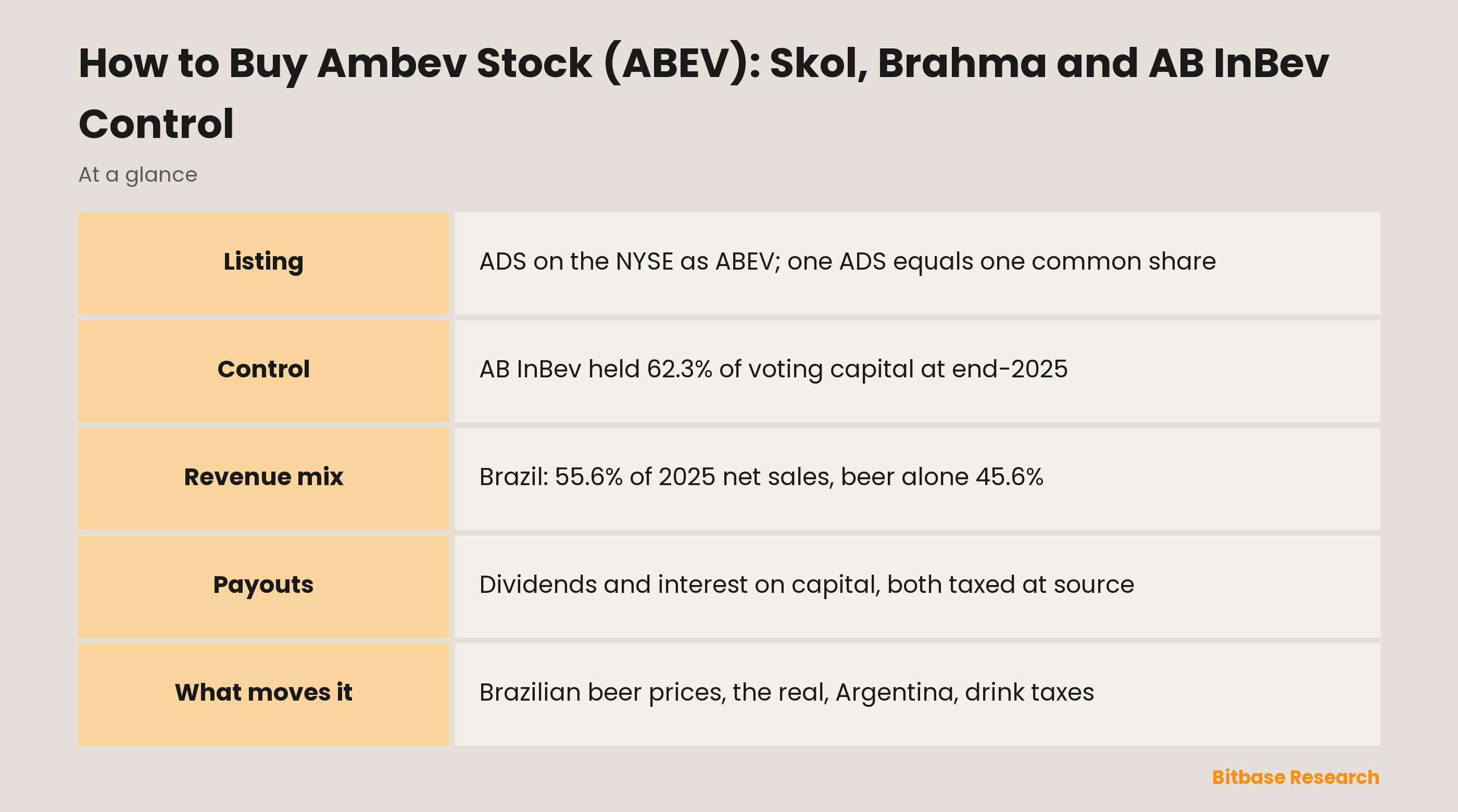
Buying into Ambev from outside Brazil usually means the ABEV American depositary share (ADS) on the New York Stock Exchange, where each ADS stands for one common share of the São Paulo brewer; the same shares trade at home on B3 as ABEV3. Ambev calls itself the largest brewer in Latin America by sales volume, with Skol, Brahma and Antarctica at the core, and AB InBev indirectly held 62.3% of its voting capital at the end of 2025. Below: what the company sells, how an order works, and why Brazilian withholding tax and the real can matter as much to an ADS holder as beer volumes do.
What Does Ambev Do?
Ambev brews, bottles and distributes beer and soft drinks across the Americas. Its annual report on Form 20-F describes the company as "the largest brewer in Latin America in terms of sales volumes and one of the largest beer producers in the world, according to our estimates," selling directly in 11 countries.
The roots are older than the name. Ambev is the successor of Antarctica, founded in 1885, and Brahma, founded in 1888, two of Brazil's oldest brewers. In 2004 it combined with Belgium's Interbrew, which became InBev and, after buying Anheuser-Busch in 2008, Anheuser-Busch InBev. The company listed today, Ambev S.A., was incorporated in 2005 and absorbed the old Ambev in a 2013 stock swap that gave five new common shares for each old common or preferred share, replacing a dual-class structure with a single class of voting stock. The new shares and ADSs began trading on B3 and the NYSE on 11 November 2013.
Operations fall into four segments. Brazil reports beer and non-alcoholic beverages (NAB) as two divisions. Central America and the Caribbean (CAC) covers the Dominican Republic, Cuba, Guatemala and Panama. Latin America South (LAS) covers Argentina, Bolivia, Paraguay, Uruguay and Chile. Canada is run through Labatt.
Much of the brand list is licensed. In Brazil the three big beer families are Skol, Brahma and Antarctica, sold next to Budweiser, Stella Artois, Corona, Michelob Ultra, Spaten and other labels that Ambev produces or distributes under agreements with AB InBev and its subsidiaries. In soft drinks, Guaraná Antarctica is Ambev's own brand, while Pepsi, H2OH!, Gatorade and Lipton Iced Tea come through a long-term exclusive agreement with PepsiCo, whose drinks are covered in our PepsiCo stock guide. PepsiCo products made up about 39% of Ambev's NAB volume in Brazil in 2025. In Canada, Labatt sells Labatt Blue, Kokanee and Alexander Keith's alongside Budweiser and Bud Light, brewed under licenses that run to January 2098.
Reaching roughly one million points of sale in Brazil takes a large network. At the end of 2025 Ambev worked through 207 exclusive third-party distributor operations and 89 of its own distribution centers. More than 94% of its active buyers in Brazil order through BEES, its business-to-business app. Zé Delivery, its consumer delivery app, operates in more than 800 cities across all 27 Brazilian states. The 20-F names The Heineken Company as the closest beer competitor in Brazil and The Coca-Cola Company as the main rival in soft drinks.
How Ambev Makes Money
Ambev reports in Brazilian reais under IFRS. In 2025 net sales fell 1.4% as volume dropped 3.3% and net revenue per hectoliter rose 2.1%, yet income from operations grew 7.0% and net income 7.7%. The segments contribute very differently:
| Segment | Share of 2025 net sales | Share of 2025 volume | Share of 2025 income from operations |
|---|---|---|---|
| Brazil (beer and NAB) | 55.6% | 70.0% | 53.4% |
| Latin America South | 20.4% | 18.3% | 16.8% |
| Central America and the Caribbean | 12.4% | 6.8% | 20.0% |
| Canada | 11.6% | 4.9% | 9.7% |
Shares of income from operations are calculated from the 20-F segment table; CAC's share is lifted by exceptional items booked in that segment in 2025.
Inside Brazil, beer alone brought in 45.6% of group sales and NAB 10.0%. The gap between the volume and sales columns is price. Canada supplied less than a twentieth of the liters but more than a ninth of sales, because a hectoliter sold there earned more than four times as much as one sold in Brazilian NAB.
The year also showed how Ambev leans on pricing. Brazilian beer volume fell 4.5% while net revenue per hectoliter rose 4.8%, leaving beer sales flat, and NAB sales grew 4.9%. LAS sales fell 9.3%, a figure shaped by hyperinflation accounting in Argentina. Currency runs through every line: in 2025, 44.4% of net revenue came from operating companies whose functional currency is not the real.
2026 has been firmer so far. In the first nine months, volume grew 0.7%, organic net revenue 7.3% and Normalized EBITDA 9.3%, according to the third-quarter release. Chief executive Carlos Lisboa said the third quarter delivered "growth in volumes, net revenue and Normalized EBITDA, alongside margin expansion."
ABEV Stock at a Glance
| Feature | ABEV |
|---|---|
| Issuer | Ambev S.A., incorporated in Brazil, headquartered in São Paulo |
| US security | American depositary shares on the NYSE, ticker ABEV |
| ADS ratio | One ADS represents one common share |
| Brazilian line | ABEV3 on B3 |
| Share classes | A single class of voting common shares |
| ADS depositary | The Bank of New York Mellon; custodian in Brazil: Banco Bradesco |
| Controlling shareholder | AB InBev, 62.3% of total and voting capital excluding treasury shares (end of 2025) |
| Sector | Beer and soft drinks |
| Fiscal year | Calendar year; IFRS, reported in reais |
| Payout rule | Minimum mandatory dividend of 40% of adjusted net income, paid as dividends or interest on capital |
| SEC identifier | CIK 1565025; Forms 20-F and 6-K |
The ADS price, market value and yield move with every trade; for live figures, open the Ambev stock page on Bitbase.
How to Buy Ambev Stock
For most investors outside Brazil the practical route is the ADS, which trades in US dollars during New York hours. The steps at a broker:
1. Choose a broker with NYSE access. Abroad, that means a local broker offering US-listed shares or an international one; check the legal entity behind the account and its regulator.
2. Open and verify the account. Expect identity checks and tax forms; non-US individuals are usually asked for IRS Form W-8BEN.
3. Fund it. If you deposit in another currency, compare the conversion spread as well as the commission.
4. Find the right line. Search ABEV and confirm the result reads Ambev S.A. American depositary shares on the NYSE; the 20-F cover lists one registered trading symbol.
5. Pick an order type. A market order fills at the next available price; a limit order fills only at your price or better.
6. Size the position. Some brokers sell fractions of an ADS, others only whole units.
7. Keep the records. Confirmations and statements show your cost and the payouts you receive, net of any tax withheld.
ADS or ABEV3. Behind each ADS sits one common share held in Brazil by Banco Bradesco as custodian for the depositary. On 18 February 2026 ADSs represented 6.3% of Ambev's shares outstanding, so most of the stock trades in São Paulo, and the ADS price reflects ABEV3 converted into dollars. Buying ABEV3 directly means registering as a foreign investor with Brazil's Central Bank and securities regulator, the CVM, and appointing a local custodian, broker, legal representative and tax representative. The 20-F also warns that surrendering ADSs for shares can cost holders the custodian's registration for remitting money abroad and "certain Brazilian tax attributes."
Brazilian withholding. Ambev pays shareholders in two forms. Interest on capital, known in Brazil as JCP (juros sobre capital próprio), is a distribution that Brazilian law lets a company deduct; for amounts declared from January 2026 the withholding rate is 17.5%, up from 15%, and 25% for holders in low-tax jurisdictions. Dividends paid to the depositary or to non-Brazilian holders now carry 10% withholding under a law effective 1 January 2026. The 20-F notes that "there is currently no income tax treaty between Brazil and the United States," so whether your own country credits the Brazilian tax is a question for your broker or tax adviser. On the ADS line, the depositary may also deduct per-ADS fees from cash distributions, listed in the 20-F's table of ADS fees. Our Itaú Unibanco stock guide walks through the same rules at a Brazilian bank.
Through AB InBev. Because AB InBev controls Ambev, owning AB InBev shares gives an indirect, diluted exposure to the same breweries, mixed with the rest of a global beer group.
What Moves ABEV Stock
Brazilian beer, price against volume. Brazil produced more than half of 2025 sales and operating income, and its beer volume fell while revenue per hectoliter rose. The 20-F ties consumption to employment and income: Brazilian unemployment stood at 5.1% at the end of 2025.
The real. Most sales are in reais, but the 20-F says a significant portion of cost of sales, including aluminum cans, PET bottles, sugar, hops and malt, is "denominated in or linked to the U.S. dollar." The real lost 27.9% against the dollar in 2024 and regained 11.1% in 2025. For an ADS holder the currency counts twice: in Ambev's costs and in the dollar value of every real it earns.
Commodities. Aluminum, sugar, corn, wheat and PET make up "a significant portion" of cost of sales. Ambev hedges when instruments are available, but the commodity table in the 20-F shows a 17.0% fluctuation for aluminum and −23.9% for sugar in 2025.
Argentina. LAS sales fell 9.3% in 2025 under hyperinflation accounting, even as Argentine consumer inflation slowed to 31.5% from 117.8%. For 2026 Ambev changed how it counts organic growth, capping Argentine price growth at 2% a month, so read reported and organic figures side by side.
Taxes on drinks. Brazil's consumption tax reform adds an excise tax on alcoholic beverages and sugary drinks to a new dual VAT, with rates not yet fully set; the 20-F says changes "may be significant." Several states also raised the value-added tax on soft drinks for 2025 and 2026.
Capital returns. On 28 October 2026 the board approved a buyback of up to about 1.2% of the company's shares, mainly for cancellation and valid until April 2028, after the previous program was completed and treasury shares were cancelled in August. Interest on capital is declared in tranches; the record date for the latest ADS tranche was 23 September 2026, with payment due by the end of the year.
Seasons. Southern summer and year-end holidays make the fourth quarter the strongest: it carried 27.6% of 2025 volume, while Canada peaks in the second and third quarters.
Ambev's Risk File: Control, Currency and Cuba
These items from the 20-F risk section bear most directly on an ABEV holding.
A controlling shareholder. AB InBev "is able to elect the majority of the members of our Board of Directors and Fiscal Council and generally determine the outcome of most other actions requiring shareholder approval, including dividend distributions," and with FAHZ, the foundation linked to the former Antarctica owners, it held 72.6% of voting capital at the end of 2025. Its interests "may differ from ours."
Competition. Ambev competes with brewers and other beverage companies, and competition "could cause us to reduce pricing, increase capital investment, increase marketing and other expenditures."
Cuba. Ambev owns 50% of Cervecería Bucanero through a Canadian subsidiary; the other half belongs indirectly to the Government of Cuba. Bucanero sold about 0.7% of Ambev's 2025 volume, but US sanctions on Cuba mean the venture "may adversely affect our reputation and the liquidity and value of our securities."
Litigation. A suit filed in 2008 by Brazil's Federal Prosecutor's Office against Ambev and two other brewers claims damages over beer advertising; Ambev rates its chance of loss as remote, and a decision has been pending since 2025.
ADS holder limits. Only the depositary is registered in Ambev's books, so "only the Depositary (and not the ADS holder) is entitled to attend Ambev's shareholders' meetings"; you vote by instructing it. As a foreign private issuer Ambev follows Brazilian governance rules and is exempt from several US listing standards.
No promised payout. The board may skip a distribution it considers "inadvisable in view of our financial condition at the time."
Beyond the filing, a single stock concentrates your money in one company.
How to Research ABEV Yourself
Ambev files with the SEC under CIK 1565025: the annual 20-F, the latest filed on 3 March 2026, and 6-Ks for results, board minutes, material facts and interest-on-capital notices. In 2026 the quarterly releases were furnished on 5 May, 30 July and 29 October. It also reports to the CVM, and its investor site is ri.ambev.com.br.
The 20-F gives separate sections to the risks, the brands, markets and licenses, the segment tables, the dividend policy and legal proceedings, the taxes and the ADS fees; its table of contents leads to each. The AB InBev stock guide shows the same breweries from the parent's side.
Two checks prevent common mistakes. Quarterly releases lead with organic growth, which strips out currency and scope changes and caps Argentine pricing, while the 20-F reports in nominal reais; compare like with like. And the 20-F dividend table shows amounts net of withholding on interest on capital, while notices quote gross amounts, so check which one you are reading. Live quotes are on the stock page linked earlier, and the full list of stock pages on Bitbase covers other listed companies.
Ambev Stock FAQ
Can I buy Ambev stock with crypto?
Not directly. The ABEV ADS settles in US dollars and ABEV3 in reais through a brokerage account, so crypto has to be sold for cash and moved to the broker first, and that sale may be a taxable event where you live.
Does Ambev pay a dividend?
Yes. Its bylaws set a minimum mandatory dividend of 40% of adjusted annual net income, and Ambev pays through both dividends and interest on capital, often in several installments a year. Brazil withholds tax on both, and the board can decide not to pay in a given year.
What is the difference between ABEV and ABEV3?
ABEV is the ADS on the NYSE, priced in dollars; ABEV3 is the common share on B3, priced in reais. One ADS represents one common share, so both carry the same economic claim, but ADS holders vote through the depositary and pay its fees.
Who controls Ambev?
AB InBev, which indirectly held 62.3% of Ambev's total and voting capital, excluding treasury shares, at the end of 2025. A shareholders' agreement links it with FAHZ, and together they held 72.6%. AB InBev's chief executive, Michel Doukeris, chairs Ambev's board.
Does Ambev own Budweiser?
No. Budweiser belongs to AB InBev. Ambev holds a license to produce, distribute and market it exclusively in Brazil and Argentina, sells it elsewhere in Latin America under other arrangements, and Labatt brews it under license in Canada.
Conclusion
AB InBev controls Ambev, so an ABEV holder shares the company with a controlling shareholder: a brewer that earns mostly in reais from Brazilian beer and pays out partly as interest on capital, which Brazil now taxes at a higher rate. Next to that, choosing between the NYSE line and ABEV3, which needs Brazil's registration, is the easy decision. Read the latest 20-F and quarterly release, check how withholding applies to you, and decide how much one Latin American brewer should weigh in your portfolio.
Related reading
Other Bitbase articles on this topic:
- How to Buy ADM Stock (ADM): Grain, Biofuels and Dividends
- How to Buy Church and Dwight Stock (CHD): Baking Soda to Waterpik
- How to Buy Coca-Cola Europacific Partners Stock (CCEP): No ADR
- How to Buy EchoStar Stock (ECHO): Spectrum Sales, SpaceX Deal
Disclaimer: This article is educational content from Bitbase Academy, provided for information only. It explains what a company or fund does and how the instruments referenced here differ from one another; it does not constitute investment, trading, tax, or financial advice, and it is neither a recommendation nor an endorsement of any security, token, or trading strategy. A tokenized stock is issued by a third party and is designed to give economic exposure to an underlying asset: it is not a share, it carries no shareholder rights, and it depends on the issuer's structure, eligibility rules, and redemption terms, which the issuer can change. Perpetual futures are leveraged derivatives that hold no underlying asset and can be liquidated, and trading hours, product availability, and eligibility differ by instrument and by jurisdiction and can change at any time. Written as of November 2026; verify everything yourself through company filings, the issuer's own documentation, and the product pages of the venue you trade on.
References
[1] Ambev Form 20-F for 2025 (SEC EDGAR) www.sec.gov
[2] Ambev 2025 Form 20-F, XBRL cover page (SEC EDGAR) www.sec.gov
[3] Ambev third-quarter 2026 results, Form 6-K, 29 October 2026 www.sec.gov
[4] Ambev material fact on the share buyback program, Form 6-K, 28 October 2026 www.sec.gov
[5] Ambev notice to shareholders on interest on capital, Form 6-K, 29 July 2026 www.sec.gov
[6] Ambev material fact on share cancellation, Form 6-K, 13 August 2026 www.sec.gov





