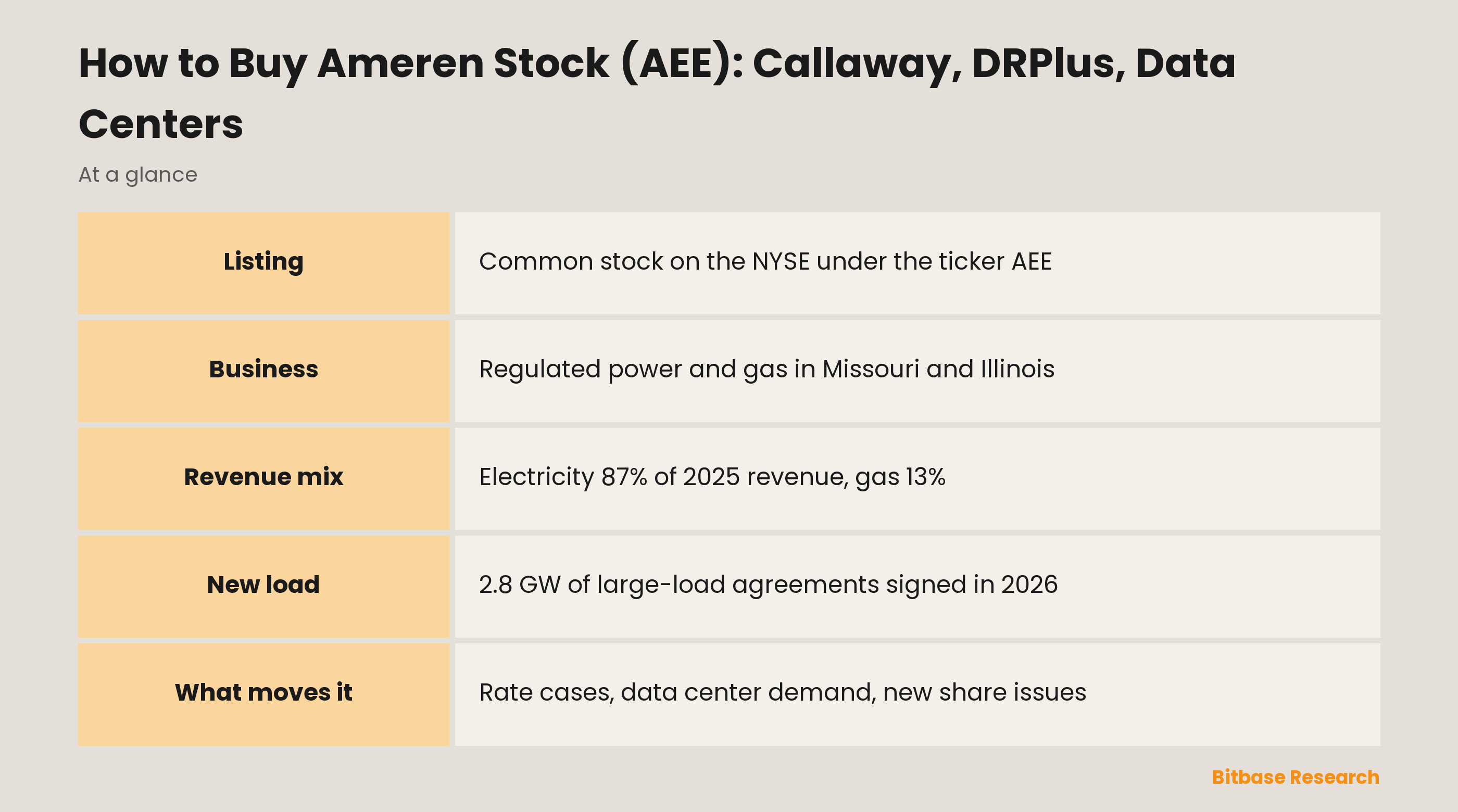
Your AEE shares can come from any broker that reaches the New York Stock Exchange, where Ameren Corporation's common stock trades under that ticker, or from DRPlus, the company's dividend reinvestment and direct stock purchase plan. Either way you own a St. Louis holding company whose regulated utilities deliver electricity and gas in Missouri and Illinois, whose Missouri arm runs the Callaway nuclear plant, and whose 2026 filings report agreements with large-load customers for 2.8 gigawatts of new demand.
What Does Ameren Do?
Ameren was formed in 1997 and is headquartered in St. Louis. Its annual report calls it "a public utility holding company whose primary assets are its equity interests in its subsidiaries." Three subsidiaries do the selling.
Ameren Missouri, legally Union Electric Company, was incorporated in 1922 and is, in the 10-K's words, "the largest electric utility in the state of Missouri." It serves 1.3 million electric and 0.1 million gas customers across central and eastern Missouri, including Greater St. Louis, and it both generates and delivers power.
Ameren Illinois, incorporated in 1923, delivers electricity and gas in central and southern Illinois to 1.2 million electric and 0.8 million gas customers. It buys all of its capacity through MISO, the regional grid operator.
ATXI, Ameren Transmission Company of Illinois, owns high-voltage lines inside MISO, has no retail customers and answers to federal rate regulators only.
Ameren Missouri owns the big plants. The Callaway Energy Center, a nuclear unit, began operating in 1984 and is licensed until 2044. The Osage and Keokuk dams and the Taum Sauk pumped-storage plant add hydro. Both coal-fired energy centers were built before 1978; at the end of 2025 they made up 5% of Ameren's rate base and 11% of Ameren Missouri's.
How Ameren Makes Money
A regulated utility earns a return on its rate base, the investment that regulators accept into customer prices. Ameren says its rates "significantly influence the results of operations," and they are set by the Missouri Public Service Commission (MoPSC), the Illinois Commerce Commission (ICC) and the Federal Energy Regulatory Commission (FERC). The 10-K maps 2025 operating revenue to the rate orders behind it:
| Rate order | Regulator | Share of 2025 operating revenue | Allowed return on equity |
|---|---|---|---|
| Ameren Missouri electric service | MoPSC | 52% | Not specified in the order |
| Ameren Missouri gas delivery | MoPSC | 2% | Not specified in the order |
| Ameren Illinois electric distribution | ICC | 26% | 8.72% |
| Ameren Illinois gas delivery | ICC | 11% | 9.60% |
| Ameren Illinois electric transmission | FERC | 6% | 10.48% |
| ATXI electric transmission | FERC | 2% | 10.48% |
| Ameren Illinois energy-efficiency investments | ICC | 1% | 10.65% |
The shares include pass-through costs such as purchased power and gas, so they describe billing, not profit. Added up, electricity accounts for 87% and gas for 13%.
The two states pay Ameren differently. In Illinois, balancing riders decouple approved electric distribution and gas revenue from sales volumes, and electric distribution rates follow a four-year plan for 2024 to 2027. Missouri is where the weather shows: Ameren says its Missouri results are "affected by seasonal fluctuations in winter heating and summer cooling demands and by weather conditions." Transmission has the shortest regulatory lag, because its formula rates are reset each January from forecasts.
In 2025, operating revenue rose about 15% from 2024 and net income attributable to common shareholders about 23%, per the 10-K income statement.
AEE Stock at a Glance
| Item | Detail |
|---|---|
| Exchange | New York Stock Exchange |
| Ticker | AEE |
| Security | Common stock, the only Ameren class registered under Section 12(b) |
| Sector | Regulated electric and gas utility |
| Index membership | S&P 500, per State Street's SPY holdings file dated 9 November 2026 |
| Headquarters | St. Louis, Missouri |
| Incorporated | Missouri |
| Fiscal year end | 31 December |
| Dividend policy | Quarterly, at the board's sole discretion |
| SEC filer | CIK 1002910; one combined 10-K with Union Electric and Ameren Illinois |
| Holders of record | 31,149 on 30 January 2026 |
Quotes, market value and yield are on the Ameren stock page on Bitbase.
How to Buy Ameren Stock
AEE is the ordinary common stock of a US company, so no depositary receipt is involved:
1. Choose a broker with NYSE access and check who regulates it.
2. Open the account and pass identity checks. Non-US residents are usually asked for IRS Form W-8BEN, the "Certificate of Foreign Status of Beneficial Owner for United States Tax Withholding and Reporting."
3. Add funds. Money in another currency is converted into dollars at a spread.
4. Search for AEE and confirm the line. Union Electric and Ameren Illinois have preferred stock of their own, and their common stock has no trading market because Ameren holds all of it.
5. Pick an order type. FINRA says a market order "provides the most certainty that your order will be executed," though not at a set price; a limit order caps the price but may never fill.
6. Decide on whole or fractional shares. Fractional trading varies by broker, and FINRA warns that fraction owners may lack voting rights.
Buying from the company. The 10-K names DRPlus as Ameren's "dividend reinvestment and direct stock purchase plan" and says Ameren meets its requirements with newly issued shares. Eligibility, minimums and fees are in the plan's own documents, which this guide did not review.
From abroad, AEE dividends are US-source income. The IRS states that "Most types of U.S. source income received by a foreign person are subject to U.S. tax of 30%," and a treaty may lower that rate. This is background, not tax advice.
Through funds, State Street's 9 November 2026 files list Ameren in SPY and in XLU, the utilities sector fund.
What Moves AEE Stock
Data center demand. The 10-K concedes that Ameren "historically experienced minimal growth in energy demand for the past two decades." The third-quarter 2026 10-Q says Ameren Missouri signed electric service agreements with large-load customers representing 2.8 gigawatts, expected to begin "materializing in the second half of 2027" and reach full capacity in 2030. Serving it means a larger rate base. Our Entergy stock guide covers another MISO utility with data center contracts.
The Missouri rate review. In June 2026 Ameren Missouri asked the MoPSC for higher electric revenue, based on a 10.25% return on equity and a 52% equity share of capital. A decision is expected by May 2027, with new rates by June 2027.
The generation plan. Ameren Missouri's 2025 resource plan update called for 3,200 megawatts of renewables by 2030, 1,500 megawatts of new nuclear by 2040, new gas units and the retirement of every coal plant by 2042. Ameren targets net-zero carbon emissions by 2045.
New shares. Part of the spending is funded with equity. Ameren issued 5.8 million shares under its at-the-market program in 2025, held forward sale agreements for 6.4 million more to settle in 2026, and plans to use new shares for DRPlus and employee plans through at least 2030. Each issue spreads earnings over more shares.
Rate Cases, a Reactor and Other Risks Ameren Lists
Four risk factors matter most to a shareholder:
Cost recovery. Rate decisions are "largely outside of our control"; "Certain events could prevent us from recovering our costs in a timely manner or at all."
Demand that may not arrive. "Realized energy demand from current and potential new customers may differ significantly from forecasts." If data center customers delay, capacity built for them still has to be paid for.
Nuclear exposure. Callaway brings "business, financial, and waste disposal risks," including uncertainty over permanent federal storage of spent fuel, which leaves storage at the plant itself.
The holding company structure. Ameren's "ability to pay dividends on its common stock depends on the earnings of its subsidiaries" and on their ability to pass cash upward.
Beyond those, a single stock concentrates risk, and no dividend is promised.
How to Research AEE Yourself
Ameren files under CIK 1002910. Its 10-K is a combined report for three registrants, Ameren Corporation, Union Electric and Ameren Illinois, so check which entity each table covers. Earnings releases in 2026 came as 8-Ks on 11 February, 5 May, 30 July and 5 November, and each 10-Q updates the open rate cases in its rate and regulatory matters note.
In the 10-K, the business section holds the rate-order table, the risk factors follow it, and the MD&A sets out the funding plan. The market section adds a five-year return chart against the S&P 500, the S&P 500 Utility Index and the Philadelphia Utility Index.
Track one number across filings: the gigawatts of signed large-load agreements, which were 2.2 in the annual report and 2.8 by the third-quarter 10-Q. Live prices are on the stock page linked above, and other listed companies are on Bitbase's US stock pages.
Ameren Stock FAQ
Can I buy Ameren stock with crypto?
Not directly. Brokers and DRPlus take US dollars, so any crypto has to be converted to cash first, and that conversion may be a taxable event in your country. Holding AEE makes you an Ameren shareholder with a vote and a claim on declared dividends; see how stocks differ from crypto assets.
Does Ameren pay a dividend?
Yes, quarterly. Amount and timing are "within the sole discretion of Ameren's board of directors," and the 2025 10-K said Ameren expected a payout ratio of 50% to 60% of earnings over the next few years.
Is AEE in the S&P 500?
Yes. State Street's SPY holdings file dated 9 November 2026 lists Ameren Corporation.
Can I buy AEE shares directly from Ameren?
Ameren runs DRPlus, which the 10-K calls a direct stock purchase plan; the plan's documents set who may join and what it costs.
Does Ameren own a nuclear plant?
Yes. Ameren Missouri operates the Callaway Energy Center, licensed until 2044, and plans to seek an extension.
Conclusion
Ameren's earnings rest on what the MoPSC, the ICC and FERC allow it to charge, and over the next few years on whether 2.8 gigawatts of contracted data center load arrives on time. Missouri carries most of that bet, while Illinois revenue is cushioned by decoupling and transmission by formula rates. Read the rate-order table, the open Missouri case and the equity plan together, and decide how much weight one regulated utility deserves in your portfolio.
Related reading
Other Bitbase articles on this topic:
- How to Buy American Water Works Stock (AWK): Rates, PFAS, Merger
- How to Buy Atmos Energy Stock (ATO): Gas Only, Mostly in Texas
- How to Buy Brookfield Infrastructure Stock (BIP): Units to Shares
- How to Buy Eversource Stock (ES): The Utility, Not the Futures
Disclaimer: This article is educational content from Bitbase Academy, provided for information only. It explains what a company or fund does and how the instruments referenced here differ from one another; it does not constitute investment, trading, tax, or financial advice, and it is neither a recommendation nor an endorsement of any security, token, or trading strategy. A tokenized stock is issued by a third party and is designed to give economic exposure to an underlying asset: it is not a share, it carries no shareholder rights, and it depends on the issuer's structure, eligibility rules, and redemption terms, which the issuer can change. Perpetual futures are leveraged derivatives that hold no underlying asset and can be liquidated, and trading hours, product availability, and eligibility differ by instrument and by jurisdiction and can change at any time. Written as of November 2026; verify everything yourself through company filings, the issuer's own documentation, and the product pages of the venue you trade on.
References
[1] Ameren Form 10-K for 2025 (SEC EDGAR) www.sec.gov
[2] Ameren 2025 Form 10-K, XBRL cover page (SEC EDGAR) www.sec.gov
[3] Ameren 2025 Form 10-K, XBRL income statement (SEC EDGAR) www.sec.gov
[4] Ameren Form 10-Q for the third quarter of 2026 (SEC EDGAR) www.sec.gov
[5] State Street, SPY daily holdings www.ssga.com
[6] State Street, XLU daily holdings www.ssga.com
[7] FINRA, Order Types www.finra.org
[8] FINRA, Investing in Fractional Shares www.finra.org
[9] IRS, NRA Withholding www.irs.gov
[10] IRS, About Form W-8 BEN www.irs.gov





