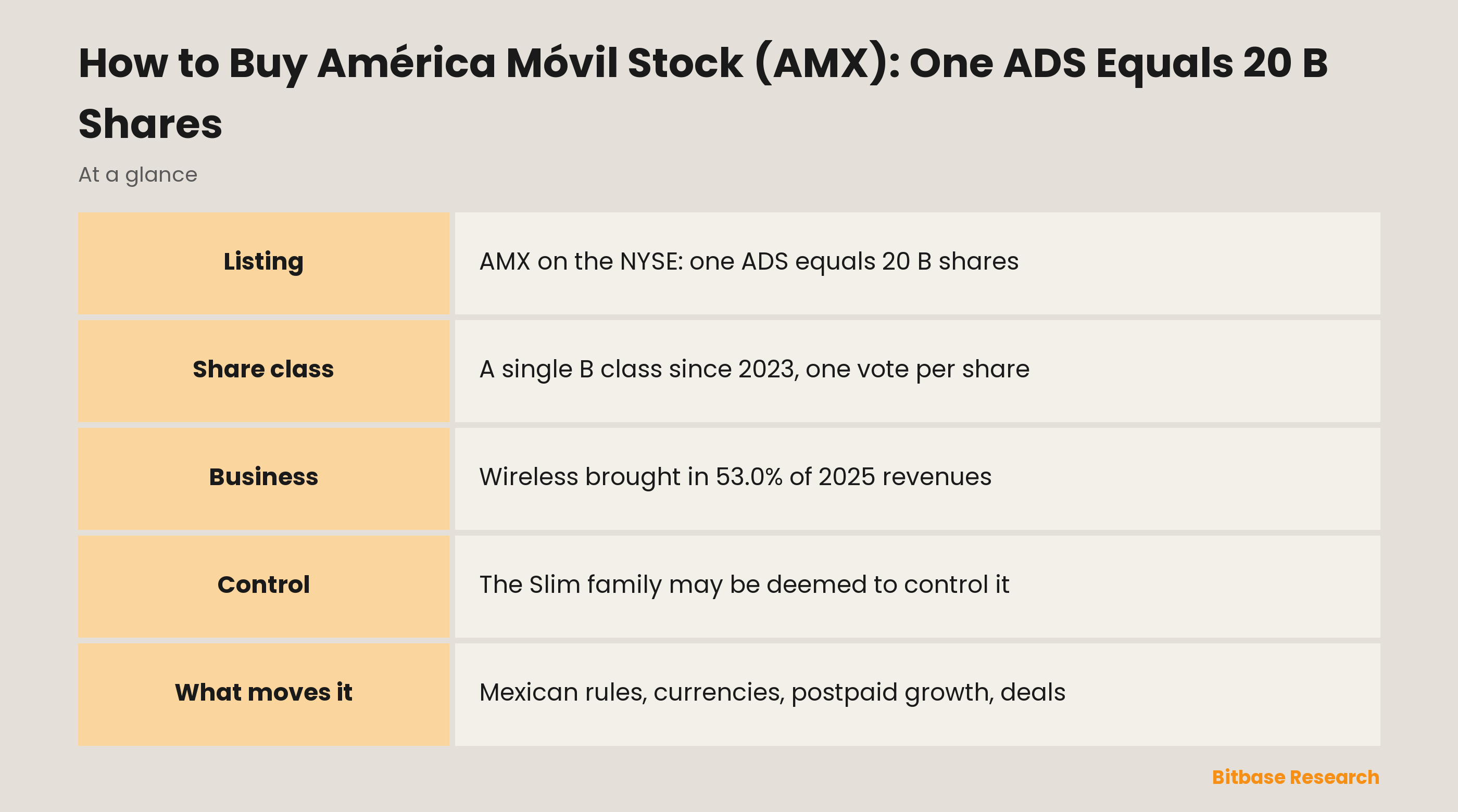
Throughout the Americas the company sells under the Telcel, Telmex and Claro names, yet buying it comes down to one ticker: AMX, the American depositary share (ADS) on the New York Stock Exchange that any broker with NYSE access can fill, or the B share quoted under the same symbol on the Mexican Stock Exchange. One ADS represents 20 B shares, and since a 2023 reclassification the B share has been América Móvil's only class, with one vote per share. Control still sits with Carlos Slim Helú and his family, who the annual report says may be deemed to control the company.
What Does América Móvil Do?
América Móvil is a telecommunications group organized under Mexican law and based in Mexico City. It was created in 2000, when Teléfonos de México (Telmex), the fixed-line operator Mexico privatized in 1990, spun off its wireless businesses in Mexico and other countries into a new company. It has since grown by acquisition across Latin America, the United States, the Caribbean and Europe, and Telmex itself now forms the core of its Mexico Fixed segment.
The group serves customers in 23 countries: 16 in the Americas and seven in Central and Eastern Europe. By its own count of revenue generating units (RGUs), one for each service a customer pays for, it ranks first in Latin America in wireless, fixed-line, broadband and pay television. Mexico and Brazil are the two largest operations and together account for more than half of all RGUs.
The brand changes with the border. In Mexico, mobile service is sold as Telcel and home internet and fixed lines as Telmex Infinitum. In Austria and the other European markets the brand is A1. Everywhere else, from Brazil and Colombia to Peru, Central America and Puerto Rico, the brand is Claro.
What customers buy falls into five groups:
1. Wireless voice and data on prepaid and postpaid plans, plus value-added services such as mobile banking.
2. Fixed services: voice, broadband over fiber or cable, data centers and IT for businesses.
3. Pay television by cable and satellite.
4. Streaming, led by ClaroVideo and ClaroMúsica.
5. Equipment such as handsets, plus other services from call centers to cybersecurity.
At the end of 2025 the group counted about 331 million wireless subscriptions, roughly four in five of its RGUs. Postpaid plans made up 43.1% of the wireless base, up from 40.8% a year earlier, with prepaid accounting for the remaining 56.9%. Fifth-generation (5G) coverage reached close to 60% of the population in Mexico and Brazil; Telcel launched 5G in Mexico in February 2022.
Europe came through Telekom Austria. A 10-year agreement signed in February 2023 with its Austrian partner ÖBAG secures América Móvil's control of the business, whose mobile towers were spun off that year into EuroTeleSites, listed in Vienna. América Móvil owned 60.9% of Telekom Austria at the end of 2025. In Chile, it began consolidating Claro Chile, SpA in October 2024 and took full ownership in July 2025.
The 20-F names AT&T Inc., Telefónica and Millicom as multinational competitors, alongside national rivals such as Telecom Argentina and Telecom Italia in Brazil, and expects Millicom to become its second-largest competitor in the region as Telefónica gradually leaves some Latin American markets. AT&T, which agreed in October 2026 to sell its wireless business in Mexico, is covered in the AT&T stock guide.
How América Móvil Makes Money
Most of the money comes from monthly bills. In 2025, wireless voice and data produced 53.0% of consolidated revenues and fixed voice, data, broadband and IT services 30.9%. The remaining 16.1% came from pay television, equipment sales and other services.
Revenues rose 8.6% in 2025 in Mexican pesos and 6.2% at constant exchange rates, a measure that excludes Argentina. Part of that growth came from consolidating Claro Chile; without it, revenues would have grown 4.1%. Mexico still matters most, but it is no longer the majority: operating revenues of foreign subsidiaries made up about 64% of the consolidated total in 2025, compared with 60% in 2023 and 61% in 2024.
| Segment | Share of 2025 revenues | 2025 operating margin |
|---|---|---|
| Mexico Wireless (mainly Telcel) | 29.2% | 33.5% |
| Brazil | 19.4% | 19.8% |
| Europe | 12.8% | 15.0% |
| Mexico Fixed (mainly Telmex) | 12.1% | 14.2% |
| Colombia | 8.4% | 13.5% |
| Andean Region (Ecuador and Peru) | 6.1% | 17.2% |
| Central America | 6.0% | 22.6% |
| Caribbean | 4.0% | 16.6% |
| Argentina | 3.9% | 2.8% |
| Paraguay, Uruguay and Chile | 2.9% | −29.3% |
Revenue shares come from the 20-F segment table and include sales between segments, which are eliminated in the consolidated total; the Mexico Wireless figure also carries headquarters activities.
The table shows where profit concentrates. Mexico Wireless is the largest segment and the most profitable of the ten, while Mexico Fixed is under pressure: after adjusting for transactions with other segments, it swung to an operating loss in 2025 as contractual wages, employee benefits, network maintenance and IT costs rose. Brazil grew segment revenues 7.5% and segment operating income 17.1%, helped by converting prepaid customers to postpaid plans. The newly consolidated Chilean operation pulled the Paraguay, Uruguay and Chile segment into a loss.
At group level, operating income grew 6.3% and the operating margin slipped to 20.3% from 20.7%. Net profit rose 219.4%, a jump that owed more to currencies than to customers: 2024 carried a large foreign-exchange loss, while 2025 brought a gain as the dollar weakened against the peso. The business is also seasonal, with more customers signing up in the fourth quarter, mainly for Christmas.
AMX Stock at a Glance
| Item | Detail |
|---|---|
| Issuer | América Móvil, S.A.B. de C.V., organized under Mexican law |
| US security | ADS on the New York Stock Exchange, ticker AMX |
| ADS ratio | One ADS represents 20 B shares |
| Mexican line | B shares on the Mexican Stock Exchange, ticker AMX |
| Share classes | One class, the B share, with one vote per share |
| ADS depositary | Citibank, N.A. |
| Sector | Telecommunications |
| Headquarters | Mexico City |
| Financial year | Calendar year; IFRS, reported in Mexican pesos |
| Dividend policy | Regular cash dividends, approved by shareholders and paid in two installments |
| SEC identifier | CIK 1129137; files Form 20-F and Form 6-K |
At 31 March 2026, 7.3% of the outstanding B shares were held in ADS form; the rest are held directly as B shares. Quotes move every trading day, so check them on the América Móvil stock page on Bitbase rather than in an article.
How to Buy América Móvil Stock
Any brokerage that lists NYSE securities can fill an order for the ADS; for the B shares you need one connected to the Mexican Stock Exchange, known as the BMV.
1. Pick the line. The AMX ADS is quoted in dollars in New York, the AMX B share in pesos in Mexico City. Both give you the same class of the same company.
2. Open the account. Use a brokerage regulated in your country and finish its identity checks.
3. Add money. If your cash is not in dollars or pesos, compare the conversion rate the broker applies, not only its commission.
4. Find the right security. The 20-F cover lists one equity line, the ADS under AMX. It also lists nine América Móvil bond issues on the NYSE with tickers such as AMX29 and AMX49; those are senior notes, not shares.
5. Decide how to order. A limit order names the highest price you will pay; a market order takes whatever price is available when it reaches the exchange.
6. Pick a quantity. Some brokers sell fractions of an ADS and some only whole units, so check before you size the order.
ADS or B shares. An ADS holder cannot attend shareholder meetings and votes only by instructing Citibank, the depositary. The 20-F also warns that ADS holders and US holders of B shares may be unable to use preemptive rights in a capital increase unless the company files a registration statement with the SEC. Citibank can deduct its fees from cash dividends, and ADS holders bear expenses such as converting pesos into dollars. Holding B shares directly avoids the depositary but needs a broker that can settle in Mexico.
Mexican withholding. Dividends on B shares and ADSs are generally subject to a 10.0% Mexican withholding tax, with no withholding on distributions of profits generated before 2014, and a tax treaty can lower the rate. Under current rules, residents of countries that have a tax treaty with Mexico pay no Mexican income tax when they sell ADSs on a recognized market such as the NYSE; for residents of other countries, the 20-F says the treatment "is not clear." Whether your home country gives credit for the Mexican tax, and how it taxes the dividend, depends on where you live; ask your broker or a tax adviser.
Ownership rules. Ordinary investors face no cap on B shares, but any person or group acquiring or transferring 10.0% or more of the capital needs board approval, and shares acquired by a foreign government or state are rendered without effect.
Through a fund. Country funds hold it too: America Movil SAB de CV, Series B appears in the iShares MSCI Mexico ETF's holdings list dated 31 May 2026.
What Moves AMX Stock
Mexican regulation. In 2014 the telecom regulator of the time, the IFT, declared América Móvil, with Grupo Carso and Grupo Financiero Inbursa, the "preponderant economic agent" in Mexican telecommunications because it served more than half of the country's customers. That status brings asymmetric rules: the regulator sets the rates América Móvil charges other carriers to terminate calls on its network, and the company must open towers, ducts and other passive infrastructure to rivals, let virtual operators resell its services and offer domestic roaming. After a 2024 constitutional reform the IFT was extinguished in October 2025 and replaced by a Telecommunications Regulatory Commission within the federal government; the asymmetric rules stay in force, the 2025 telecom law codified some of them, and the 20-F says they "may be reviewed every two years."
Television, still out of reach in Mexico. América Móvil applied in 2018 for a unified concession that would let it offer pay TV in Mexico and has sent reminders since, most recently in 2026, without a ruling. A new 30-year Telmex concession took effect in March 2026, but it does not include television.
Currencies. The accounts are in pesos while about 64% of revenue comes from foreign subsidiaries, so the euro, the Brazilian real, the Colombian peso and the dollar all feed into reported results. Before derivatives, about 73.9% of debt was in currencies other than the peso; after hedging, about 47.1% of net debt was in pesos. That mix is why net profit more than tripled in 2025 while operating income grew 6.3%, and AMX holders add a second layer because the ADS is priced in dollars.
The postpaid shift. The 20-F notes that prepaid customers typically generate lower levels of usage, so the move from 40.8% to 43.1% of the wireless base matters, and Brazil's postpaid base grew 8.4% in 2025 largely through conversions. On the other side, the 20-F lists declining demand for traditional pay TV among the long-term trends weighing on results.
Spectrum and network spending. Growth depends on buying radio spectrum, mostly at government auctions that can cap how much one operator may hold. Capital expenditure was about the same in 2025 as in 2024, and the 20-F warns that it can vary significantly from year to year with acquisition opportunities, concession renewals and the need for more spectrum.
Deals. América Móvil keeps buying: it took full control of Claro Chile in July 2025, closed the purchase of 72.83% of Desktop, S.A. in Brazil on 1 October 2026, a deal meant to strengthen Claro's fiber footprint in São Paulo state, and in July 2026 agreed to buy WOW, a fiber broadband operator mostly outside Lima, subject to approval by Peru's competition authority.
Dividends and buybacks. "We regularly pay cash dividends on our shares," the 20-F says, and shareholders approve each year's dividend; the 2026 dividend is payable in two installments, on 15 July and 11 November 2026. Shareholders also renew the buyback fund each April, and the number of B shares outstanding fell 3.5% between the end of 2023 and the end of 2025.
Hazards Behind the Telcel and Claro Brands
Rules that are still being written. On the new Mexican law, the company says plainly: "We are unable to anticipate the full impact of the application of the recently enacted telecommunications law." Its concessions run for fixed terms, typically five to 30 years, and authorities can revoke them, reclaim assets or take over the management of networks in emergencies such as threats to national security.
Competition. The 20-F's first operating risk is that "Competition in the telecommunications industry is intense and could adversely affect the revenues and profitability of our operations," with rivals able to subsidize handsets, bundle services or roll out technology faster.
Economies and currencies. "Economic, political and social conditions in Latin America, the Caribbean and Europe may adversely affect our business." Argentina is reported under hyperinflation accounting, and a weaker peso against the currencies of its debt would push foreign-exchange losses back into the income statement.
A controlling family. The Slim family "may be able to elect a majority of the members of our Board of Directors and to determine the outcome of other actions requiring a vote of our shareholders." The group also does significant business with companies that may be deemed under common control, including Grupo Carso, Grupo Financiero Inbursa and the tower companies Telesites and Sitios Latam.
Tax and legal disputes. "We are contesting significant tax assessments," the 20-F states, and some subsidiaries face significant litigation that could have a material adverse effect if it goes against them.
Limits for foreign holders. Legal actions over the bylaws can be brought only in Mexican courts, minority protections differ from those in the United States, and ADS holders vote only through the depositary.
Beyond what the filing lists, owning any single stock ties your result to one company, and here a dollar-quoted ADS sits on top of peso accounts.
How to Research AMX Yourself
América Móvil files under CIK 1129137. Unlike US carriers such as Verizon, which file 10-K and 10-Q reports, it files an annual report on Form 20-F, the latest on 28 April 2026, plus 6-Ks for quarterly results, shareholder resolutions and deals. The 20-F is organized in parts rather than numbered items, with a cross-reference guide at the back: risk factors sit in Part III, ownership, dividends and taxes in Part IV and regulation in Part VI, while a separate description of securities covers B-share voting and ADS fees. The English version is on the SEC site and americamovil.com; the Spanish one is on the websites of the Mexican Stock Exchange and Mexico's securities regulator.
Three traps are worth knowing. Figures are in pesos, and constant-currency comparisons leave Argentina out. Growth in 2025 is flattered by the Claro Chile consolidation, so the 20-F also gives figures without it. And per-share data is per B share: the annual report does not show earnings or dividends per ADS, so multiply by 20. To compare quotes across companies, the Bitbase stock pages list other listed names.
América Móvil Stock FAQ
How many shares does one AMX ADS represent?
Twenty B shares. The ADS trades on the NYSE and the B shares on the Mexican Stock Exchange, both under AMX, and both represent the same class of the same company.
What happened to América Móvil's L shares?
They no longer exist. On 20 December 2022 shareholders approved converting all AA, A and L shares into a single series of B shares on a one-for-one basis, and the B shares started trading on 16 March 2023. The latest 20-F lists the B share as the only class, with one vote per share.
Does América Móvil pay a dividend?
Yes. The company pays regular cash dividends, approved each year by shareholders; the 2026 ordinary dividend was approved on 23 April 2026 and is payable in two installments, on 15 July and 11 November 2026. Amounts are declared per B share in pesos, an ADS is entitled to 20 times that before depositary fees, and Mexico generally withholds 10.0%.
Who controls América Móvil?
The Slim family. At 31 March 2026 a family trust held 29.5% of the B shares, Control Empresarial de Capitales, a company that may be deemed controlled by the family, held 18.1%, and Carlos Slim Helú held 8.6% directly. Family members, including him, directly owned 22.9% in total outside the trust.
Can I buy América Móvil stock with crypto?
Not directly. Brokers settle the ADS in dollars and the B shares in pesos, so you would first convert crypto into one of those currencies and transfer it to the brokerage account. Depending on where you live, that conversion can be a taxable event, so check how crypto sales are taxed first.
Conclusion
Buying América Móvil comes down to one choice before the order: the AMX ADS in dollars, worth 20 B shares, or the B shares in pesos in Mexico City. Either way you get the company's only share class and a minority position beside the Slim family. Earnings depend on Mexican regulation, the shift to postpaid plans, network spending and a basket of currencies. Read the latest 20-F and the 6-K resolutions on dividends and buybacks, and work out how Mexican withholding applies to you before settling what share of your portfolio a single Latin American telecom group should take.
Related reading
Other Bitbase articles on this topic:
- How to Buy Comcast Stock (CMCSA): Versant, NBCUniversal Spin-Off
- How to Buy Spotify Stock (SPOT): Direct Listing, Founder Votes
- How to Buy T-Mobile Stock (TMUS): Dividend and the Telekom Stake
Disclaimer: This article is educational content from Bitbase Academy, provided for information only. It explains what a company or fund does and how the instruments referenced here differ from one another; it does not constitute investment, trading, tax, or financial advice, and it is neither a recommendation nor an endorsement of any security, token, or trading strategy. A tokenized stock is issued by a third party and is designed to give economic exposure to an underlying asset: it is not a share, it carries no shareholder rights, and it depends on the issuer's structure, eligibility rules, and redemption terms, which the issuer can change. Perpetual futures are leveraged derivatives that hold no underlying asset and can be liquidated, and trading hours, product availability, and eligibility differ by instrument and by jurisdiction and can change at any time. Written as of October 2026; verify everything yourself through company filings, the issuer's own documentation, and the product pages of the venue you trade on.
References
[1] América Móvil, Form 20-F for 2025 (SEC EDGAR) www.sec.gov
[2] América Móvil 20-F for 2025, XBRL cover page (R1) www.sec.gov
[3] América Móvil, description of securities filed with the 2025 20-F www.sec.gov
[4] América Móvil, Form 20-F for 2023: share reclassification (SEC EDGAR) www.sec.gov
[5] América Móvil 6-K, shareholders' resolutions, 23 April 2026 www.sec.gov
[6] América Móvil 6-K, agreement to acquire WOW Peru, July 2026 www.sec.gov
[7] América Móvil 6-K, Desktop acquisition closed, 1 October 2026 www.sec.gov
[8] América Móvil 6-K, third-quarter 2026 report www.sec.gov
[9] AT&T Inc. Form 8-K, October 2026 (SEC EDGAR) www.sec.gov
[10] iShares MSCI Mexico ETF, schedule of investments at 31 May 2026 (SEC EDGAR) www.sec.gov





