
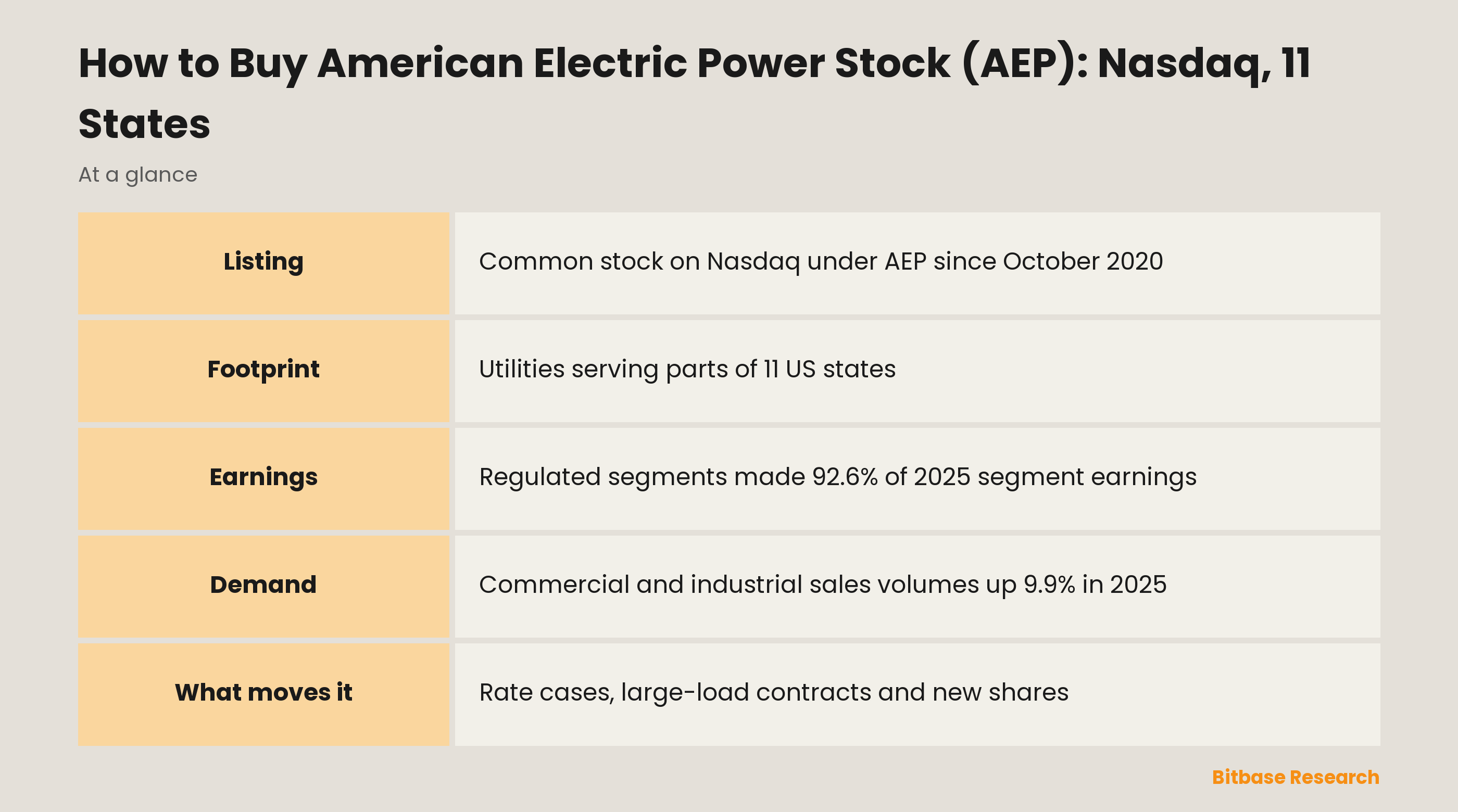
Eleven states, from Michigan down to Texas, get their electricity from American Electric Power's utilities, and you can buy into the parent company through any brokerage account that reaches Nasdaq, where its common stock trades under the ticker AEP. Most of what it earns depends on prices that state commissions and federal regulators approve, and AEP describes its high-voltage network as the nation's largest electric transmission system. Its filings now put data centers at the center of the story: commercial and industrial sales volumes rose 9.9% in 2025, and the 10-K warns that its investment plans depend partly on those customers arriving.
What Does American Electric Power Do?
American Electric Power Company, Inc. is a public utility holding company, incorporated in New York in 1906, reorganized in 1925 and based in Columbus, Ohio. It owns all of the common stock of its utility subsidiaries, which generate, transmit and distribute electricity for more than five million retail customers in parts of Arkansas, Indiana, Kentucky, Louisiana, Michigan, Ohio, Oklahoma, Tennessee, Texas, Virginia and West Virginia.
The system's size shows most clearly in its wires: at the end of 2025 the subsidiaries operated about 252,000 circuit miles of distribution lines and about 38,000 circuit miles of transmission lines, roughly 2,000 of them built for 765 kilovolts. They also owned about 25,000 megawatts of regulated generating capacity. The 10-K reports four segments.
Vertically Integrated Utilities generate, transmit and distribute power at regulated rates: Appalachian Power in southwestern Virginia and southern West Virginia, Indiana Michigan Power, Kentucky Power, Kingsport Power in Tennessee, Wheeling Power in northern West Virginia, Public Service Company of Oklahoma and Southwestern Electric Power Company (SWEPCo), which serves parts of Texas, Louisiana and Arkansas.
Transmission and Distribution Utilities are Ohio Power (AEP Ohio) and AEP Texas. Restructuring laws in Ohio and the ERCOT area of Texas required unbundled rates, so these two carry electricity generated by others: AEP Texas sells delivery to retail electric providers, and AEP Ohio buys energy and capacity at auction for customers who have not switched supplier.
AEP Transmission Holdco owns transmission-only companies that overlay the operating utilities, five in the PJM grid region and two in SPP, plus joint ventures such as Electric Transmission Texas, shared with Berkshire Hathaway Energy. Outside ERCOT, their rates are reset every year through formula rate filings with the Federal Energy Regulatory Commission (FERC). In June 2025 an investor controlled by funds of KKR and the Public Sector Pension Investment Board bought a 19.9% stake in Midwest Transmission Holdings, owner of the Ohio and Indiana Michigan transmission companies.
Generation & Marketing is the competitive part: AEP Energy supplies electricity and gas to homes and businesses in six states and Washington, D.C., and a wholesale desk trades power.
How American Electric Power Makes Money
A utility does not pick its own prices. State commissions have historically set electric rates "on a cost-of-service basis, which is designed to allow a utility an opportunity to recover its cost of providing service and to earn a reasonable return on its investment used in providing that service." That is why the 10-K's explanation of higher 2025 earnings begins with "investment in transmission assets, which resulted in higher revenues and income." Coal and gas costs are typically recovered through separate fuel mechanisms.
| Segment | What it does | Share of 2025 segment revenue | Share of 2025 segment earnings |
|---|---|---|---|
| Vertically Integrated Utilities | Plants and lines, power sold at regulated rates | 53.2% | 41.5% |
| Transmission and Distribution Utilities | AEP Ohio and AEP Texas delivery networks | 25.5% | 21.1% |
| AEP Transmission Holdco | Transmission-only companies and joint ventures | 9.9% | 30.0% |
| Generation & Marketing | Competitive retail supply and wholesale trading | 11.5% | 7.4% |
Shares are calculated from the segment note, before eliminating sales between AEP companies and before the loss at Corporate and Other, rounded to one decimal.
Transmission earns more than its revenue suggests. Most of AEP Transmission Holdco's revenue came from other AEP companies, yet it produced 30.0% of segment earnings. Part of that was one-off: a June 2025 FERC order on net operating loss carryforwards in transmission formula rates lifted reported income, which AEP strips out of its non-GAAP operating earnings. So GAAP earnings attributable to common shareholders rose 20.7% in 2025 while operating earnings rose 7.1%, on revenue up 10.9%.
Regulation dominates. The three regulated segments made 92.6% of segment earnings, unlike NextEra Energy, which pairs a Florida utility with a contracted renewables business.
Households pay the largest share. Retail sales were 73.1% of 2025 revenue; within retail, residential customers brought in 48.5%, commercial 29.3% and industrial 20.3%. Commercial revenue grew 9.2%, faster than the other two classes. In Texas, AEP Texas's two largest retail electric providers accounted for 38% of its 2025 operating revenue.
Some of the new load is digital. Among the principal industries the 10-K lists for AEP Texas, Indiana Michigan Power and AEP Ohio is "data processing," which "primarily includes data centers and cryptocurrency operations." Listed bitcoin miners sit on the other side of that relationship, since they pay for their computing work in electricity.
AEP Stock at a Glance
| Item | Detail |
|---|---|
| Exchange | Nasdaq Stock Market; moved from the NYSE on 1 October 2020 |
| Ticker | AEP |
| Security | Common stock, the only security on the fiscal 2025 10-K cover |
| Sector | Utilities: regulated electricity generation, transmission and distribution |
| Index membership | S&P 500, per SPY's holdings file dated 29 October 2026 |
| Headquarters | Columbus, Ohio |
| Incorporated | New York, 1906; reorganized 1925 |
| Fiscal year end | 31 December |
| Dividend policy | Quarterly, each payment declared by the board |
| Shareholders of record | 42,604 at 31 December 2025 |
| SEC filer | CIK 4904; one combined annual report with seven subsidiary registrants |
Price, market value and dividend yield change with every trade; for live figures, open the American Electric Power stock page on Bitbase.
How to Buy American Electric Power Stock
AEP is a US company listed in the United States, so no depositary receipt is involved: what trades on Nasdaq is the common stock itself.
1. Choose a broker that offers Nasdaq-listed stocks. Outside the US, check which entity holds your shares and who regulates it.
2. Open and verify the account. Non-US individuals are normally asked for IRS Form W-8BEN, the Certificate of Foreign Status of Beneficial Owner for United States Tax Withholding and Reporting.
3. Fund it. Currency conversion has its own spread, so compare exchange rates as well as commissions.
4. Search for AEP and check the name. You want American Electric Power Company, Inc. common stock. Subsidiaries such as Appalachian Power file SEC reports, but their common stock is held solely by AEP, so none trades on an exchange.
5. Pick an order type. FINRA explains that a market order "provides the most certainty that your order will be executed," but "you might not get the price you saw or were originally quoted"; with a limit order, "you're guaranteed to get your limit price or a better price if your order is executed. However, there's a chance your order doesn't get executed at all."
6. Decide the size. "The availability of fractional share trading varies by brokerage firm," "you can't transfer fractional shares to another brokerage firm," and "as a fractional share owner, you might not have shareholder voting rights."
7. Keep the paperwork. Confirmations and statements record your cost and each dividend for tax.
AEP's own plan. AEP also sponsors a Dividend Reinvestment and Direct Stock Purchase Plan, run by Computershare Trust Company, N.A. Its 2025 prospectus lets non-shareholders join with an initial cash investment and admits residents of other countries "if such participation would not violate laws applicable to the Company or the Participant." Compare its fee summary with your broker's costs.
Tax on dividends outside the US. The IRS states that "most types of U.S. source income received by a foreign person are subject to U.S. tax of 30%," with a reduced rate or exemption possible under a tax treaty. The tax is generally withheld before the money reaches you, including inside the plan. Your home country may tax the dividend again; this is general information, not tax advice.
Through a fund. On 29 October 2026, State Street's SPDR S&P 500 ETF Trust (SPY) and Utilities Select Sector SPDR ETF (XLU) both listed American Electric Power among their holdings, as one position among many.
What Moves AEP Stock
Signed large-load contracts. New data processing load lifted commercial and industrial sales volumes 12.7% in the first nine months of 2026 against the same period of 2025, after a 9.9% rise in 2025. By 30 September 2026 AEP had filed large-load tariffs in eight jurisdictions and won approval in six; terms may include contracts of up to 20 years and take-or-pay minimums covering 80% to 90% of contracted demand. Its October 2026 earnings release reported 15 gigawatts of new load commitments signed in the third quarter, each backed by an executed agreement.
Texas interconnection rules. In August 2026, the 10-Q notes, the Governor of Texas directed the state utility commission and ERCOT to verify all "Batch Zero" large-load requests and audit data center projects of 25 MW and above. ERCOT paused Batch Zero study work and said it would not let large loads energize until verification is complete.
One plant, three commissions. Eleven state commissions and FERC decide what AEP may charge, and they do not always agree. SWEPCo retired its Pirkey Plant in March 2023. Arkansas approved recovery of the remaining investment over 10 years with a 3% return, and Louisiana allowed recovery of and on the balance through 2032. In Texas, a settlement filed in September 2026 provides only partial recovery over 19 years with no return, which AEP records as a probable partial disallowance.
Transmission formula rates. The 10-K warns that "certain elements of AEP's transmission formula rates have been challenged, which could result in lowered rates and/or refunds of amounts previously collected." The 2025 FERC order swung the other way; its absence is the first reason AEP gives for lower GAAP earnings in the first nine months of 2026.
New shares and interest costs. In May 2026 AEP entered forward sale agreements for 23,543,308 shares, about 4.4% of those outstanding at the end of 2025, with settlement at its discretion and expected by May 2028; an at-the-market program can add more. Interest expense also rose in 2026 on "higher long-term debt balances and higher interest rates."
Coal, nuclear and weather. Coal and lignite produced 43% of the integrated utilities' net generation in 2025, up from 37% in 2023, against 22% for gas, 19% for nuclear and 16% for renewables. The two Cook nuclear units in Michigan are licensed to 2034 and 2037, and AEP has started applying to extend them to 2054 and 2057. And AEP "has historically sold and delivered less power, and consequently earned less income, when weather conditions are milder."
What AEP Cannot Control
Several of AEP's risk factors start from the same point: the company spends first and asks regulators to let it recover the money later.
| Risk | What the 10-K says | What it means for a shareholder |
|---|---|---|
| Cost recovery | "AEP may not be able to recover the costs of substantial planned investment in capital improvements and additions." | Without approved rate adjustments, spending sits on the books without matching revenue |
| Demand | Plans "depend, in part, on the continued growth and viability of data centers and large load customers" | Plants and lines built for customers who never connect are hard to pay for |
| Funding | Projects "may require levels of capital that exceed historical utility financing needs" | More debt raises interest costs; more shares dilute holders |
| Nuclear | Cook is "about a tenth of the regulated generating capacity in the AEP System" | Accidents, insurance limits and decommissioning costs fall on AEP |
| Emissions rules | Greenhouse gas regulation could "cause some electric generating units to be uneconomical to operate or maintain" | With coal at 43% of integrated generation, new rules could make some plants uneconomical to keep |
| Holding company | "AEP and AEPTCo have no income or cash flow apart from dividends paid or other payments due from their subsidiaries" | The dividend relies on cash that financing terms and regulators can restrict |
The share adds two more. One stock ties your result to one company, however many states it covers. And a dividend is a decision, not a promise: future dividends "may vary depending upon AEP's profit levels, operating cash flow levels and capital requirements," and investors outside the US receive price and dividend through an exchange rate.
How to Research AEP Yourself
AEP files with the SEC under CIK 4904. Its 10-K is combined with those of AEP Texas, AEP Transmission Company, Appalachian Power, Indiana Michigan Power, Ohio Power, Public Service Company of Oklahoma and SWEPCo, so check which registrant a table belongs to. 10-Qs follow each quarter, and 8-Ks carry events such as earnings releases.
In the 10-K, Item 1 describes subsidiaries and segments and Item 1A the risks; the "Electric Industry Transformation" section of the MD&A covers large-load tariffs, Note 4 tracks rate cases such as Pirkey, and Note 9 holds the segment figures used above. The performance graph compares AEP with the S&P 500 and the S&P 500 Utilities (Sector) Index.
Two checks save confusion. Operating earnings exclude specified items, so the 2025 FERC transmission order counts in GAAP earnings and not in operating earnings. And an older document placing AEP on the NYSE predates the October 2020 move; the ticker did not change. For quotes use the stock page above, and for other companies browse more US stock pages on Bitbase.
American Electric Power Stock FAQ
Can I buy American Electric Power stock with crypto?
Not directly. AEP shares are bought through a brokerage account or the company's plan, both in US dollars, so crypto has to be sold for cash first; depending on where you live, that sale may be taxable. A share is a registered stake in the company with dividend and voting rights, which no crypto asset gives you.
Is AEP listed on Nasdaq or the New York Stock Exchange?
Nasdaq. In September 2020 AEP told the NYSE it would delist its common stock after the close on 30 September and move the listing to Nasdaq from the opening on 1 October 2020, keeping the symbol AEP. A Nasdaq listing says nothing about index membership on its own: the exchange, the company that runs it and the Nasdaq-100 index are three separate things.
Does American Electric Power pay a dividend?
Yes, quarterly. The board declares each payment, and the amount declared in October 2026 was higher than in January 2026. The parent's income comes mainly from its share of the utility subsidiaries' earnings; amounts and dates are in the latest 10-Q and earnings release.
Is AEP in the S&P 500?
Yes. SPY's daily holdings file dated 29 October 2026 includes American Electric Power, as does the file for XLU, State Street's utilities sector fund. Weights change every day.
Does AEP sell electricity to crypto miners?
Its 10-K points that way: the "data processing" industry it lists for AEP Texas, Indiana Michigan Power and AEP Ohio "primarily includes data centers and cryptocurrency operations." The table attaches no revenue figure, so it shows the type of customer, not its size.
Conclusion
Placing an AEP order is routine: a broker with Nasdaq access, the right ticker and a market or limit order. Knowing what the share holds takes longer. Its earnings rest on eleven state commissions and FERC accepting what AEP charges, on a transmission network that earns a regulated return, and on large customers who have signed contracts but still have to connect. Read the latest 10-Q and earnings release before deciding how much one utility should weigh in your portfolio.
Related reading
Other Bitbase articles on this topic:
- How to Buy Constellation Energy Stock (CEG): Nuclear and Calpine
- How to Buy Dominion Energy Stock (D): NextEra Deal, Data Centers
- How to Buy Duke Energy Stock (DUK): Six States and 11 Reactors
- How to Buy Entergy Stock (ETR): Four States, Nuclear, Data Centers
Disclaimer: This article is educational content from Bitbase Academy, provided for information only. It explains what a company or fund does and how the instruments referenced here differ from one another; it does not constitute investment, trading, tax, or financial advice, and it is neither a recommendation nor an endorsement of any security, token, or trading strategy. A tokenized stock is issued by a third party and is designed to give economic exposure to an underlying asset: it is not a share, it carries no shareholder rights, and it depends on the issuer's structure, eligibility rules, and redemption terms, which the issuer can change. Perpetual futures are leveraged derivatives that hold no underlying asset and can be liquidated, and trading hours, product availability, and eligibility differ by instrument and by jurisdiction and can change at any time. Written as of October 2026; verify everything yourself through company filings, the issuer's own documentation, and the product pages of the venue you trade on.
References
[1] American Electric Power combined Form 10-K, fiscal 2025: business, segments and risk factors (SEC EDGAR) www.sec.gov
[2] American Electric Power Form 10-Q, quarter ended 30 September 2026: demand, large loads and rate cases (SEC EDGAR) www.sec.gov
[3] American Electric Power Form 8-K, 28 October 2026: third-quarter 2026 earnings release (SEC EDGAR) www.sec.gov
[4] American Electric Power Form 8-K, 14 May 2026: forward sale agreements for common stock (SEC EDGAR) www.sec.gov
[5] American Electric Power Form 8-K, 15 September 2020: transfer of the listing from the NYSE to Nasdaq (SEC EDGAR) www.sec.gov
[6] American Electric Power Dividend Reinvestment and Direct Stock Purchase Plan prospectus, 2025 (SEC EDGAR) www.sec.gov
[7] State Street SPDR S&P 500 ETF Trust (SPY): daily holdings file www.ssga.com
[8] State Street Utilities Select Sector SPDR ETF (XLU): daily holdings file www.ssga.com
[9] FINRA: Order Types www.finra.org
[10] FINRA: Investing in Fractional Shares www.finra.org
[11] IRS: NRA Withholding www.irs.gov
[12] IRS: About Form W-8 BEN, certificate of foreign status for withholding www.irs.gov





