
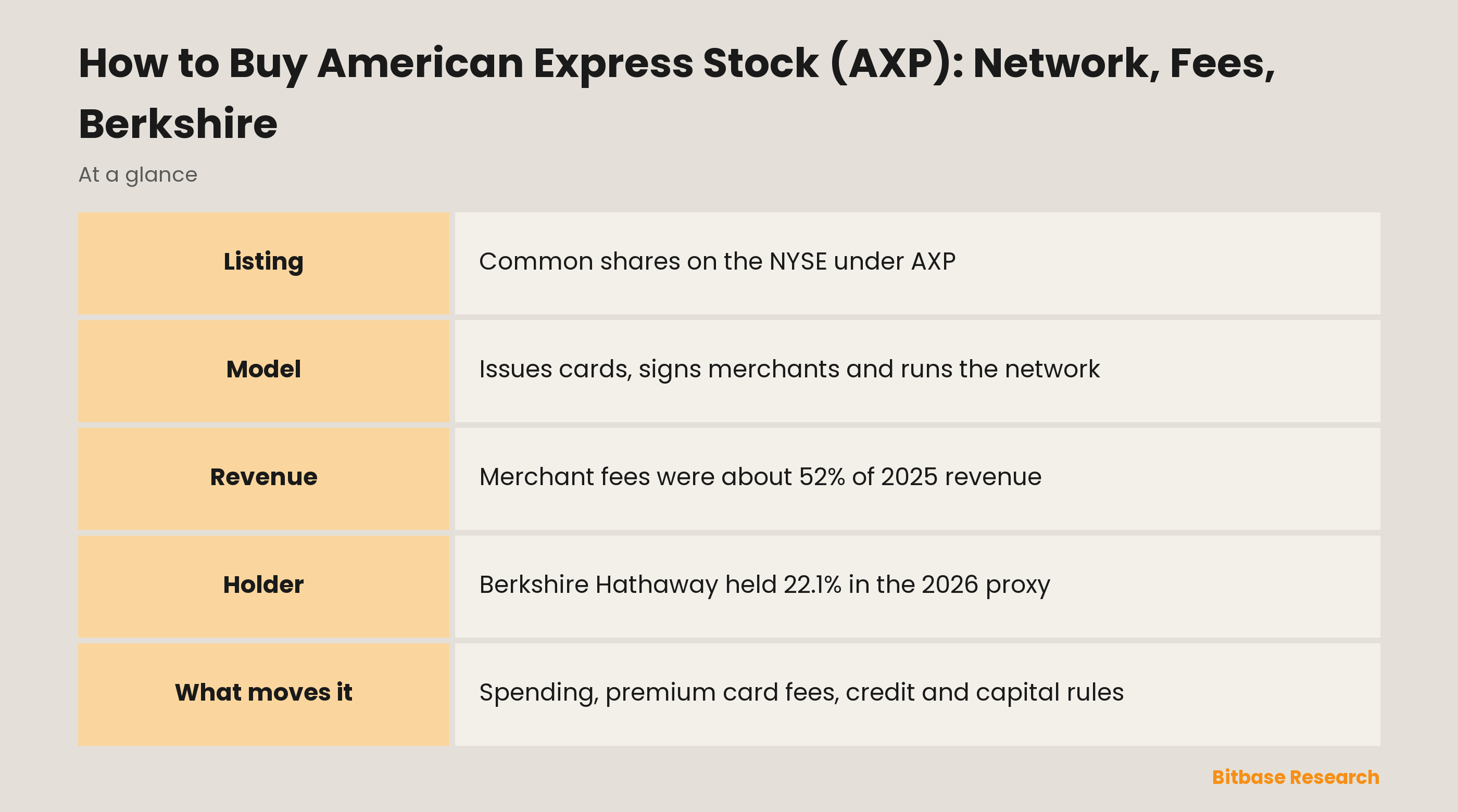
You take a stake in American Express by buying AXP, its common stock on the New York Stock Exchange, through any brokerage account with NYSE access. The company issues cards, signs up the merchants that accept them and runs the network between the two, a combination its annual report says distinguishes it from the bankcard networks. In 2025 merchant fees, booked as discount revenue, brought in about 52% of revenue, and the 2026 proxy statement showed Berkshire Hathaway holding 22.1% of the shares.
What Does American Express Do?
American Express describes itself as "a global payments and premium lifestyle brand powered by technology." Founded in 1850, it became a New York corporation in 1965. It is a bank holding company supervised by the Federal Reserve, and its US bank, American Express National Bank, takes customer deposits.
The distinctive part is how much of a transaction stays inside one company. On the Visa and Mastercard networks, the 10-K notes, the merchant's acquirer pays an interchange fee to the bank that issued the card; that is the four-party arrangement behind a card payment. American Express can play those parts itself: it issues cards and lends to Card Members, signs merchants and agrees the discount rate they pay, and operates the network that settles the transaction. That gives it "access to information at both ends of the card transaction," which it uses against fraud and in credit decisions.
It reports four segments:
U.S. Consumer Services issues consumer cards in the United States and offers travel, banking and lending products, plus the Resy and Tock dining platform.
Commercial Services issues corporate and small business cards to US companies, with expense management and financing products.
International Card Services issues consumer, small business and corporate cards outside the United States.
Global Merchant and Network Services runs the network, signs merchants and manages partners: institutions in about 110 countries and territories that issue American Express-branded cards or acquire local merchants, and the OptBlue program, under which third-party acquirers sign up small merchants and set their pricing.
At the end of 2025 American Express had issued 86.6 million cards itself, and partners had issued 66.2 million more on its network. Besides credit cards it issues charge cards, which "generally carry no pre-set spending limits" and must generally be paid in full each month. Regulation has also narrowed the network, which it exited in the EU and Australia because of rules there.
How American Express Makes Money
The annual report sets the order: the model "focuses on generating revenues primarily by driving spending on our cards and secondarily through finance charges and fees." In 2025 revenue net of interest expense rose 10%:
| Revenue line | What it covers | Share of 2025 revenue | Change vs 2024 |
|---|---|---|---|
| Discount revenue | What American Express keeps from merchants on purchases with its own cards | 52% | Up 6% |
| Net card fees | Annual membership fees on cards | 14% | Up 18% |
| Service fees and other revenue | Partner royalties, foreign exchange and late fees, travel commissions | 10% | Up 10% |
| Net interest income | Interest on loans minus the cost of funding them | 24% | Up 12% |
Shares are calculated from the 2025 income statement and rounded to whole percentages.
Spending drives the largest line. Discount revenue, "our largest revenue source" in the company's words, follows billed business, the spending on cards American Express issues itself, which rose 8% in 2025. Goods and services made up 74% of that spending and travel and entertainment 26%; small business and corporate clients accounted for about 41%. The rate has edged down: discount revenue equalled 2.24% of billed business in 2025, against 2.29% in 2023, and the filing attributes the 2025 dip to shifts in the geographic and merchant mix of spending.
Card fees grew fastest. Net card fees rose 18%, "primarily driven by growth in our premium card portfolios," and the average fee per card rose 14%.
Lending is the second engine. Net interest income grew 12% on larger balances and a wider yield, although about 29% of Card Member loans and receivables at the end of 2025 were charge balances due in full.
Of the four segments' combined 2025 revenue, U.S. Consumer Services produced 48.0%, Commercial Services 23.3%, International Card Services 17.9% and the network segment 10.7%; the international business grew fastest, at 13%. The United States supplied about 78% of total revenue.
Partners carry a large share, and they cost money. Cobranded cards with companies such as Delta Air Lines, Marriott and Hilton made up about 26% of worldwide billed business in 2025 and about 36% of Card Member loans. Delta alone accounted for about 13% of billed business and 21% of loans, under an agreement that runs to the end of 2029. Card Member rewards cost the equivalent of about 25% of 2025 revenue, and payments to cobrand partners have risen.
AXP Stock at a Glance
| Item | Detail |
|---|---|
| Exchange | New York Stock Exchange (NYSE) |
| Ticker | AXP |
| Security | Common shares |
| Other NYSE listings | Two series of notes, symbols AXP32 and AXP34 |
| Sector | Financials: card issuing, merchant acquiring, card network |
| Index membership | S&P 500 and Dow Jones Industrial Average (State Street SPY and DIA holdings, 16 October 2026) |
| Headquarters | New York, New York |
| Incorporated | New York, 1965; founded in 1850 |
| Fiscal year | Ends 31 December |
| Dividend policy | Quarterly cash dividend; raised by about 16% in March 2026 |
| Largest holder in the proxy | Berkshire Hathaway, 22.1% (2026 proxy statement) |
| Stock split | Three-for-one, shareholders of record on 25 April 2000 |
| SEC identifier | CIK 4962 |
For the quote, market value and dividend yield, go to the American Express stock page on Bitbase.
How to Buy American Express Stock
The share on the NYSE is the common stock itself, with no depositary receipt in between, and the purchase runs through a broker:
1. Pick a broker with NYSE access. Outside the United States, that means a local firm offering US shares or an international broker; check who regulates it.
2. Open and verify the account. Non-US investors should expect a request for IRS Form W-8BEN, which the IRS says to submit "whether or not you are claiming a reduced rate of, or exemption from, withholding."
3. Add money. Funding from another currency adds a conversion cost on top of any commission.
4. Search for AXP and read the result. It should say American Express common shares on the NYSE; AXP32 and AXP34 are notes, which are debt.
5. Choose the order type. A market order fills right away at a price that is not guaranteed, and a limit order trades only "at a specific price or better." With a stop order, "When the stop price is reached, a stop order becomes a market order."
6. Decide between whole and fractional shares. "Not every brokerage firm offers fractional share investing," some accept only market orders for fractions, and dividends arrive "based on the percentage of a whole share that you own."
7. Keep the paperwork. Confirmations and statements record what you paid and every dividend.
Dividends paid to non-US holders. The IRS states that "most types of U.S. source income received by a foreign person are subject to U.S. tax of 30%," and a tax treaty can lower that rate, which is what the W-8BEN on file lets the broker apply. Your home country may tax the dividend again.
Through a fund. As a member of the S&P 500 and the Dow, American Express is held by funds that replicate either index, one position among many.
What Moves AXP Stock
Spending and the merchant rate. Discount revenue moves with billed business and the rate merchants pay. The company reports "erosion of our merchant discount rates as we increase merchant acceptance," and where the law allows, merchants can surcharge or steer customers to other cards, in some places surcharging American Express more than competing networks. Spending follows the economy too: premium consumer spending "tends to decline during general economic downturns."
Premium card refreshes. The US Platinum cards were refreshed at the end of the third quarter of 2025, and the June 2026 quarterly report pointed to "the acceleration in the U.S. Platinum portfolio following the refresh last year" and called Millennial and Gen-Z Card Members its largest and fastest-growing cohort. A refresh lifts fees but also adds benefits that have to be paid for.
Rewards and partner terms. In 2025 rewards, business development and Card Member services expenses together grew faster than revenue. Partner contracts move spending, loans and costs at once: the Amazon and Lowe's small business cobrand portfolios were classified as held for sale, one such portfolio was sold in the second quarter of 2026, and the 10-K's own example of a lost partner is the end of its US relationship with Costco in 2016.
Credit and interest rates. With net interest income at about 24% of revenue, both rates and repayment reach earnings. The principal-only net write-off rate for consumer and small business Card Members was 2.0% in 2025, and US Card Members held about 79% of loans and receivables. Customer deposits made up about 73% of deposits and debt at the end of 2025, and the 10-K lists proposals to cap credit card interest rates among the policy changes that could reshape competition.
Capital and regulators. American Express submits a capital plan to the Federal Reserve each year and aims to keep its CET1 ratio between 10% and 11%. After a Federal Reserve announcement in February 2026, its stress capital buffer stays at the 2.5% minimum through 30 September 2027, absent further action. On 8 October 2026 the company and its bank consented to orders from the Federal Reserve and the Office of the Comptroller of the Currency resolving reviews of parts of its financial crimes compliance program; the bank also agreed to a civil money penalty, and the company said the orders "do not impose an asset cap."
Risks to Weigh Before Buying AXP
These risk factors from the annual report bear most directly on an AXP share:
The economic cycle. "Macroeconomic conditions are a major driver of our results of operations," and a downturn can hit spending, borrowing and repayment at once.
Bigger networks and new rails. "We believe Visa and Mastercard are larger than we are in most countries based on purchase volume," the company writes, and it cites "recent legislation in the U.S. establishing a regulatory framework for stablecoins" among the changes facilitating alternative payments.
Partners. "Competition for relationships with key business partners is very intense," and a lost or repriced cobrand deal can shrink billed business and loans together.
Merchant rules in court. Lawsuits challenge the anti-steering and non-discrimination provisions in its merchant contracts, proceedings the 10-K says "could have a material adverse effect" on the business.
Limits on payouts. The company is "limited in our ability to pay dividends and repurchase capital stock by our regulators," and common dividends are blocked, with some exceptions, if the last period's preferred dividends go unpaid.
Add the risks of any single stock: one company decides the outcome, and exchange rates change what it is worth to an investor in another currency.
How to Research AXP Yourself
American Express files with the SEC under CIK 4962: the 10-K each year, 10-Qs for the first three quarters and 8-Ks for events in between, such as the October 2026 consent orders. A monthly 8-K also reports delinquency and write-off rates for US consumer and small business card balances.
Each earnings release comes with statistical tables by segment, and the investor call that follows is streamed with slides on ir.americanexpress.com, where a replay stays available. In the 10-K, the business section explains the integrated model, the risk factors list the main threats and the MD&A tables track billed business, cards-in-force and write-off rates; the proxy statement lists holders of more than 5%. For other companies, see the index of US stock pages on Bitbase.
American Express Stock FAQ
Does American Express pay a dividend?
Yes, every quarter. The board raised the quarterly dividend on common shares by about 16% in March 2026, and the annual report says the company plans to keep returning excess capital while holding its CET1 ratio in the target range. Each payment is declared by the board and ranks behind preferred dividends.
Can I buy American Express stock with crypto?
Not in one step. AXP is bought through a brokerage account and trades in US dollars, so any crypto must first be turned into dollars and moved to the broker; depending on your country, that sale can itself be taxable. A share is a registered stake with a dividend and a vote, which is where the basic difference between owning stock and holding crypto begins.
How is American Express different from Visa and Mastercard?
On the Visa and Mastercard networks, the merchant's acquirer pays interchange to the bank that issued the card; American Express can do all of it in-house, so AXP carries credit risk and earns interest. It calls itself the fourth-largest general-purpose card network by purchase volume, behind Visa, China UnionPay and Mastercard, and Visa's description of the four-party model shows the network's side.
Does Berkshire Hathaway own American Express stock?
Yes. It is the largest holder in the 2026 proxy statement, with 22.1% of the common shares based on its holdings at 31 December 2025. A 1995 agreement is designed to keep the stake passive, and Berkshire has agreed to vote shares up to 17% of those outstanding as the board recommends while Stephen Squeri is chief executive and Berkshire owns 5% or more.
Has American Express stock ever split?
Yes. The 2000 annual report records a three-for-one split for shareholders of record on 25 April 2000. The 2005 spin-off of Ameriprise Financial, one Ameriprise share for every five American Express shares, was a distribution, not a split.
Conclusion
Buying AXP is routine: a broker that reaches the NYSE, the line for American Express common shares, and a market or limit order. What the share holds is less so: one company issues the cards, lends the money, signs the merchants and runs the network, so spending, premium fees, credit and the Federal Reserve all shape what returns to shareholders. Read the latest 10-K and quarterly reports before deciding what share of a portfolio one payments company should take.
Related reading
Other Bitbase articles on this topic:
- How to Buy Apollo Global Management Stock (APO): Athene and Credit
- How to Buy Blackstone Stock (BX): Fees, Carry and 24/7 Perps
- How to Buy Brookfield Asset Management Stock (BAM): BN Stake, Fees
- How to Buy Nu Holdings Stock (NU): Nubank's Parent, No Dividend
Disclaimer: This article is educational content from Bitbase Academy, provided for information only. It explains what a company or fund does and how the instruments referenced here differ from one another; it does not constitute investment, trading, tax, or financial advice, and it is neither a recommendation nor an endorsement of any security, token, or trading strategy. A tokenized stock is issued by a third party and is designed to give economic exposure to an underlying asset: it is not a share, it carries no shareholder rights, and it depends on the issuer's structure, eligibility rules, and redemption terms, which the issuer can change. Perpetual futures are leveraged derivatives that hold no underlying asset and can be liquidated, and trading hours, product availability, and eligibility differ by instrument and by jurisdiction and can change at any time. Written as of October 2026; verify everything yourself through company filings, the issuer's own documentation, and the product pages of the venue you trade on.
References
[1] American Express Form 10-K, fiscal 2025: business, segment results, risk factors and capital (SEC EDGAR) www.sec.gov
[2] American Express Form 10-Q for the quarter ended 30 June 2026: listed securities, Platinum portfolio, stress capital buffer (SEC EDGAR) www.sec.gov
[3] American Express Form 8-K, 2 March 2026: increase in the quarterly dividend on common shares (SEC EDGAR) www.sec.gov
[4] American Express Form 8-K, 8 October 2026: consent orders with the Federal Reserve and the OCC on financial crimes compliance (SEC EDGAR) www.sec.gov
[5] American Express 2026 proxy statement: holders of more than 5% and the Berkshire Hathaway agreement (SEC EDGAR) www.sec.gov
[6] American Express 2000 annual report (Form 10-K, Exhibit 13): note on the three-for-one stock split (SEC EDGAR) www.sec.gov
[7] American Express Form 10-K, fiscal 2005: spin-off of Ameriprise Financial (SEC EDGAR) www.sec.gov
[8] American Express second-quarter 2026 results release: statistical tables and the investor conference call (Form 8-K, Exhibit 99.1) www.sec.gov
[9] American Express Form 8-K, 15 October 2026: US consumer and small business delinquency and write-off statistics (SEC EDGAR) www.sec.gov
[10] State Street SPDR S&P 500 ETF Trust (SPY): fund page and daily holdings www.ssga.com
[11] State Street SPDR Dow Jones Industrial Average ETF Trust (DIA): fund page and daily holdings www.ssga.com
[12] Investor.gov (SEC): Types of Orders www.investor.gov
[13] Investor.gov (SEC): Investor Bulletin on fractional share investing www.investor.gov
[14] IRS: NRA Withholding www.irs.gov
[15] IRS: About Form W-8 BEN, Certificate of Foreign Status of Beneficial Owner www.irs.gov





