
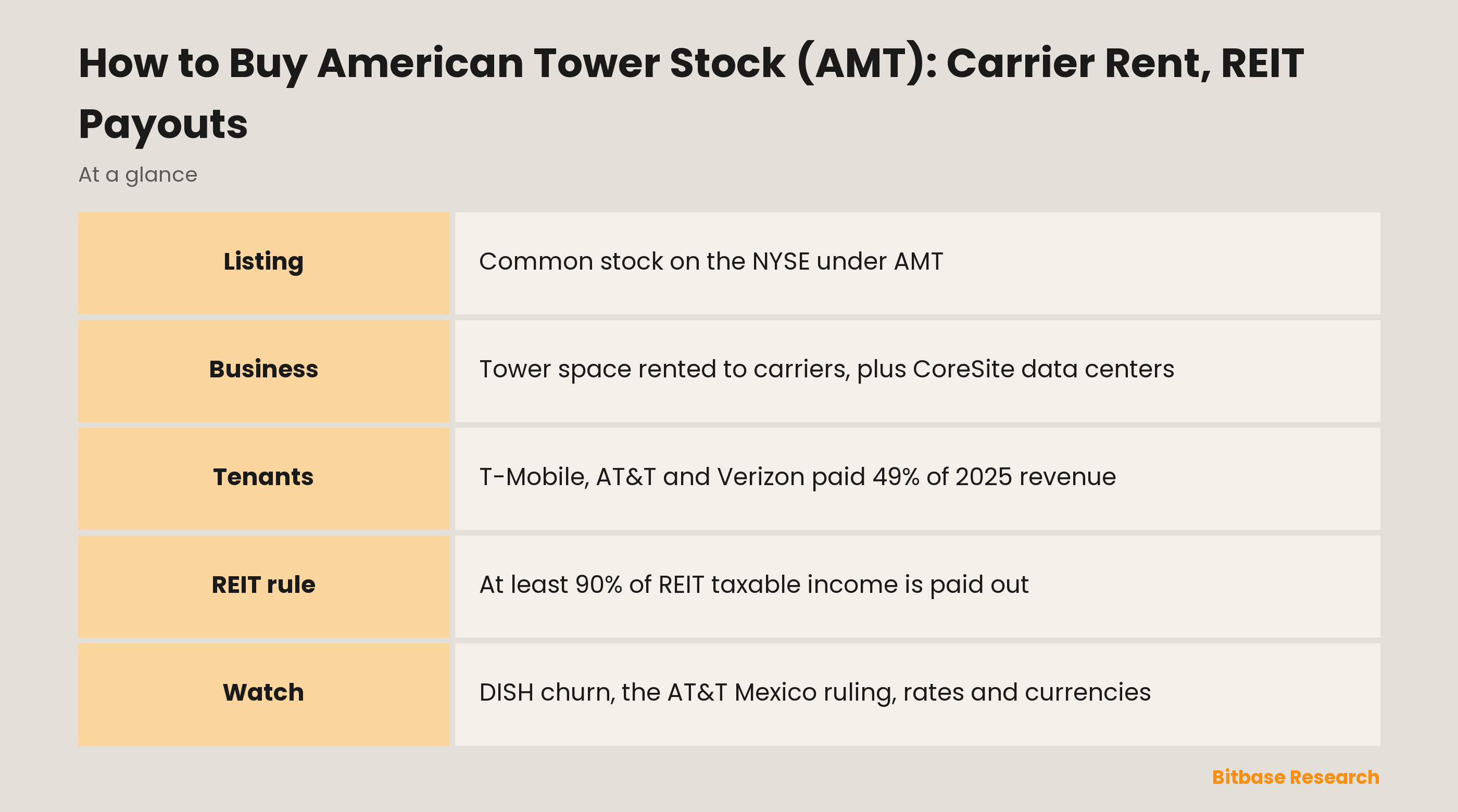
Beyond an account with a broker that trades New York Stock Exchange listings, buying American Tower stock takes no special setup: the common stock trades under AMT and is the only share among the 14 securities the company has registered there. Behind the ticker sits a real estate investment trust that rented space on 149,686 communications sites at the end of 2025, mostly to mobile carriers, and that also runs US data centers through CoreSite. Three carriers, T-Mobile, AT&T and Verizon, paid 49% of its 2025 revenue.
What Does American Tower Do?
American Tower calls itself "one of the largest global real estate investment trusts" and an independent owner, operator and developer of "multitenant communications real estate." It owns the structure and the land rights; tenants bring the antennas and pay rent. Each extra tenant on a tower "typically results in incremental revenue and modest incremental costs," so filling existing sites comes first in its strategy.
The 10-K counted 149,686 sites as of December 31, 2025: 47,081 in Latin America, 42,224 in the U.S. and Canada, 32,524 in Europe and 27,857 in Africa and Asia-Pacific. Beside the towers sit distributed antenna system (DAS) networks for in-building coverage, fiber in some markets abroad and, since the CoreSite acquisition in late 2021, 30 data centers in eleven US markets that serve as interconnection hubs for networks, cloud companies and enterprises.
Asset sales continue: India went in 2024, South Africa fiber in 2025 and a Philippines unit and a Bangladesh stake in 2026, and the Canadian sale is expected to close in the fourth quarter of 2026. American Tower is incorporated in Delaware, based in Boston and taxed as a REIT since 2012.
How American Tower Makes Money
Rent pays for almost everything: property operations, data centers included, produced 97% of 2025 revenue and services 3%. Carrier leases usually start with a non-cancellable five to ten years plus renewal options, and rent rises on a schedule, by a fixed escalator averaging about 3% a year in the United States or by an inflation index in most markets abroad. Churn, the billings lost to cancellations, non-renewals or rate cuts, was about 2% of tenant billings in 2025.
| Segment | What it rents out | Share of 2025 revenue | 2025 change |
|---|---|---|---|
| U.S. & Canada property | Towers, DAS, land under sites | 49% | Flat |
| Latin America property | Towers, urban telecom assets, fiber | 15% | Down 4% |
| Africa & APAC property | Towers, shared power systems | 13% | Up 18% |
| Data Centers | CoreSite space, power, interconnection | 10% | Up 14% |
| Europe property | Towers in France, Germany and Spain | 9% | Up 12% |
| Services | Permitting and construction work | 3% | Up 75% |
The 10-K rounds each share, so the column sums to 99%. In the U.S. & Canada segment, tenant billings grew, but other revenue, mostly straight-line revenue that spreads fixed rent increases over a lease, fell by about as much. Latin America lost ground to reserves on customers in Brazil and Mexico and to weaker currencies.
Who pays. In 2025 T-Mobile supplied 18% of total revenue, AT&T 17%, Verizon Wireless 14% and Telefónica 10%. The three US carriers made up 85% of U.S. & Canada revenue; Airtel and MTN 81% of Africa & APAC; Telefónica 70% of Europe.
The payout yardstick. The company's headline cash measure, AFFO attributable to common stockholders, starts from Nareit FFO, which removes real estate depreciation and property-sale gains from net income, then sets aside non-cash items such as straight-line rent and stock-based pay and subtracts cash spent on capital improvements. The 10-K says such non-GAAP measures are "not intended to replace net income."
AMT Stock at a Glance
| Item | Detail |
|---|---|
| Exchange | New York Stock Exchange (NYSE) |
| Ticker | AMT |
| Security | Common stock; the other 13 registered securities are senior notes |
| Tax status | Real estate investment trust since 2012 |
| Sector | Real estate: communications sites and data centers |
| Index membership | S&P 500 |
| Headquarters | Boston, Massachusetts |
| Incorporated | Delaware |
| Fiscal year | Ends December 31 |
| Dividend policy | Quarterly cash distributions set by the Board |
| Voting | One vote per share |
| SEC identifier | CIK 1053507 |
Price, yield and market value move all day; the American Tower stock page on Bitbase carries them live.
How to Buy American Tower Stock
American Tower is a US company, so no depositary receipt sits in between: the NYSE line is the common stock itself.
1. Choose a broker offering NYSE-listed shares where you live, and find out which company will keep your shares and which regulator oversees it.
2. Complete the identity checks. Investors outside the US usually file IRS Form W-8BEN, which a foreign beneficial owner gives "to the withholding agent or payer."
3. Fund it, looking at the foreign exchange spread and not only the commission.
4. Search AMT and check the line reads American Tower Corporation common stock. Codes such as AMT 34A belong to the company's senior notes, which are debt.
5. Pick an order type. FINRA says a market order "provides the most certainty that your order will be executed," but "you might not get the price you saw or were originally quoted"; a buy limit order "can be executed only at or below the limit price."
6. Decide on fractions. Fractional trading "varies by brokerage firm," and "you can't transfer fractional shares to another brokerage firm."
7. Keep records of your cost and each distribution.
How the payouts are taxed. This is general information, not tax advice. The 10-K says 2025 dividends "were primarily classified as ordinary income that may be treated as qualified REIT dividends under Section 199A of the Code," a US federal provision, and expects 2026 to be similar. For holders abroad, the IRS says "most types of U.S. source income received by a foreign person are subject to U.S. tax of 30%," which a tax treaty can reduce. Under IRS Publication 515, a REIT distribution on stock regularly traded in the US counts as a dividend, not a US real property gain, if the holder owned no more than 10% during the year before payment. Your own country may tax it too.
Through a fund. On October 29, 2026, AMT was a line in the daily holdings files State Street publishes for SPY, which tracks the S&P 500, and for XLRE, its real estate sector ETF. For another listed REIT with a very different tenant base, see the Welltower stock guide.
What Moves AMT Stock
Carrier budgets. Leasing follows carrier network spending. The 10-K ties US activity to "ongoing 5G network deployments," while markets abroad still add 4G. Organic tenant billings, which exclude newly acquired or built sites, grew 1.1% in the third quarter of 2026.
The DISH break. In September 2025 DISH Wireless claimed it was excused from its 2021 collocation agreement, then stopped paying. American Tower terminated the agreements effective June 2, 2026 and is suing for damages, naming parent EchoStar too; DISH filed for Chapter 11 on June 30. DISH was about 4% of 2025 U.S. & Canada property revenue, and all of it now counts as churn, which reached about 5% of tenant billings in the first nine months of 2026.
AT&T Mexico. The carrier's Mexican unit disputes how its monthly rent is calculated and withheld payments in 2025; since a September 2025 deal it pays most of the rent, with the balance held in escrow. The arbitration hearing began in August 2026, and a final ruling is expected in 2027.
Data centers. Data Centers revenue rose 14% in 2025, and segment cash revenue grew 16.3% in the third quarter of 2026. The 10-K notes the segment "contains certain operational differences" from tower leasing.
Rates and currencies. Higher inflation and interest rates can raise costs "beyond what we can recover through price increases." Revenue abroad is earned mainly in local currencies without significant hedging, so a stronger dollar cuts reported results, as the Brazilian real and Mexican peso did in 2025.
Portfolio moves. Each sale changes what one share owns, and on October 23, 2026 the board enlarged the share repurchase program.
Downside Scenarios in American Tower's Filings
Item 1A of the fiscal 2025 10-K, unchanged in substance by the September 2026 10-Q, flags these:
Few customers. "A substantial portion of our current and projected future revenue is derived from a small number of customers," and many of them carry heavy debt.
Consolidation and sharing. Revenue could suffer if customers "consolidate their operations, exit their businesses or share site infrastructure to a significant degree"; satellite technology and network sharing are listed as threats to demand.
Leverage. Debt service and buybacks "may materially and adversely affect our ability to raise additional financing" and can leave less for distributions.
REIT status. Losing it means corporate-rate tax and disqualification "for the four taxable years immediately following."
Owning one company's stock concentrates the outcome, and each distribution is a board decision.
How to Research AMT Yourself
Search EDGAR for CIK 1053507. The 10-K's Item 1 gives site counts and each segment's top tenants, Item 1A the risks, and the MD&A splits tenant billings into colocations, escalations and churn. Each 10-Q updates the DISH and AT&T Mexico disputes; 8-Ks carry results and distribution declarations. The fiscal 2025 cover, R1.htm, lists 14 NYSE securities, with plain AMT reserved for the common stock. Other listed names are a click away on Bitbase's stock list.
American Tower Stock FAQ
Is American Tower a REIT?
Yes, since 2012. It must distribute at least 90% of its REIT taxable income, excluding net capital gain. Its REIT operations generally owe no US federal income tax because of the dividends paid deduction; its taxable REIT subsidiaries and foreign operations still pay tax.
Does American Tower pay a dividend?
Yes, quarterly. The distribution declared on September 17, 2026 was 5.3% higher per share than a year earlier, and future payments are "at the sole discretion of our Board."
Can I buy American Tower stock with crypto?
Not in one step. Brokers fill AMT orders in US dollars, so the crypto must first become cash, possibly a taxable disposal where you live, before it reaches the broker. The share you then own carries voting and dividend rights; how shares and crypto assets differ is covered separately.
Who are American Tower's biggest customers?
T-Mobile, AT&T and Verizon Wireless: 18%, 17% and 14% of 2025 revenue. Telefónica added 10%.
Is AMT in the S&P 500?
Yes. State Street's SPY holdings file listed it on October 29, 2026.
Conclusion
Buying AMT is routine: an account with NYSE access, a check that you have the common stock rather than a note, and an order placed at market or with a limit. The holding itself is a REIT paid largely by three US carriers, where DISH's exit, the AT&T Mexico ruling and currencies all feed into what it can distribute. Read the latest 10-K and 10-Q before sizing a position.
Related reading
Other Bitbase articles on this topic:
- How to Buy Brookfield Corporation Stock (BN): BN vs BAM and BNT
- How to Buy Digital Realty Stock (DLR): Data Centers, Power, REIT
- How to Buy Equinix Stock (EQIX): Data Center REIT on Nasdaq
- How to Buy Prologis Stock (PLD): Warehouse REIT, SEGRO Deal
Disclaimer: This article is educational content from Bitbase Academy, provided for information only. It explains what a company or fund does and how the instruments referenced here differ from one another; it does not constitute investment, trading, tax, or financial advice, and it is neither a recommendation nor an endorsement of any security, token, or trading strategy. A tokenized stock is issued by a third party and is designed to give economic exposure to an underlying asset: it is not a share, it carries no shareholder rights, and it depends on the issuer's structure, eligibility rules, and redemption terms, which the issuer can change. Perpetual futures are leveraged derivatives that hold no underlying asset and can be liquidated, and trading hours, product availability, and eligibility differ by instrument and by jurisdiction and can change at any time. Written as of October 2026; verify everything yourself through company filings, the issuer's own documentation, and the product pages of the venue you trade on.
References
[1] American Tower Corporation Form 10-K, fiscal 2025: business, segments, customers, REIT status and risk factors (SEC EDGAR) www.sec.gov
[2] American Tower Corporation Form 10-Q for the quarter ended 30 September 2026: DISH and AT&T Mexico disputes, churn and divestitures (SEC EDGAR) www.sec.gov
[3] American Tower third-quarter 2026 results press release, filed with Form 8-K on 27 October 2026 (SEC EDGAR) www.sec.gov
[4] American Tower fiscal 2025 Form 10-K, structured XBRL cover page (R1.htm): registered securities, ticker and exchange (SEC EDGAR) www.sec.gov
[5] American Tower Corporation 2026 proxy statement (Schedule 14A): governance highlights, one vote per share (SEC EDGAR) www.sec.gov
[6] State Street SPDR S&P 500 ETF Trust (SPY): daily holdings file, as of 29 October 2026 www.ssga.com
[7] State Street Real Estate Select Sector SPDR ETF (XLRE): daily holdings file, as of 29 October 2026 www.ssga.com
[8] FINRA, Order Types www.finra.org
[9] FINRA, Investing in Fractional Shares www.finra.org
[10] IRS, NRA Withholding www.irs.gov
[11] IRS, About Form W-8 BEN www.irs.gov
[12] IRS Publication 515, Withholding of Tax on Nonresident Aliens and Foreign Entities: qualified investment entities www.irs.gov





