
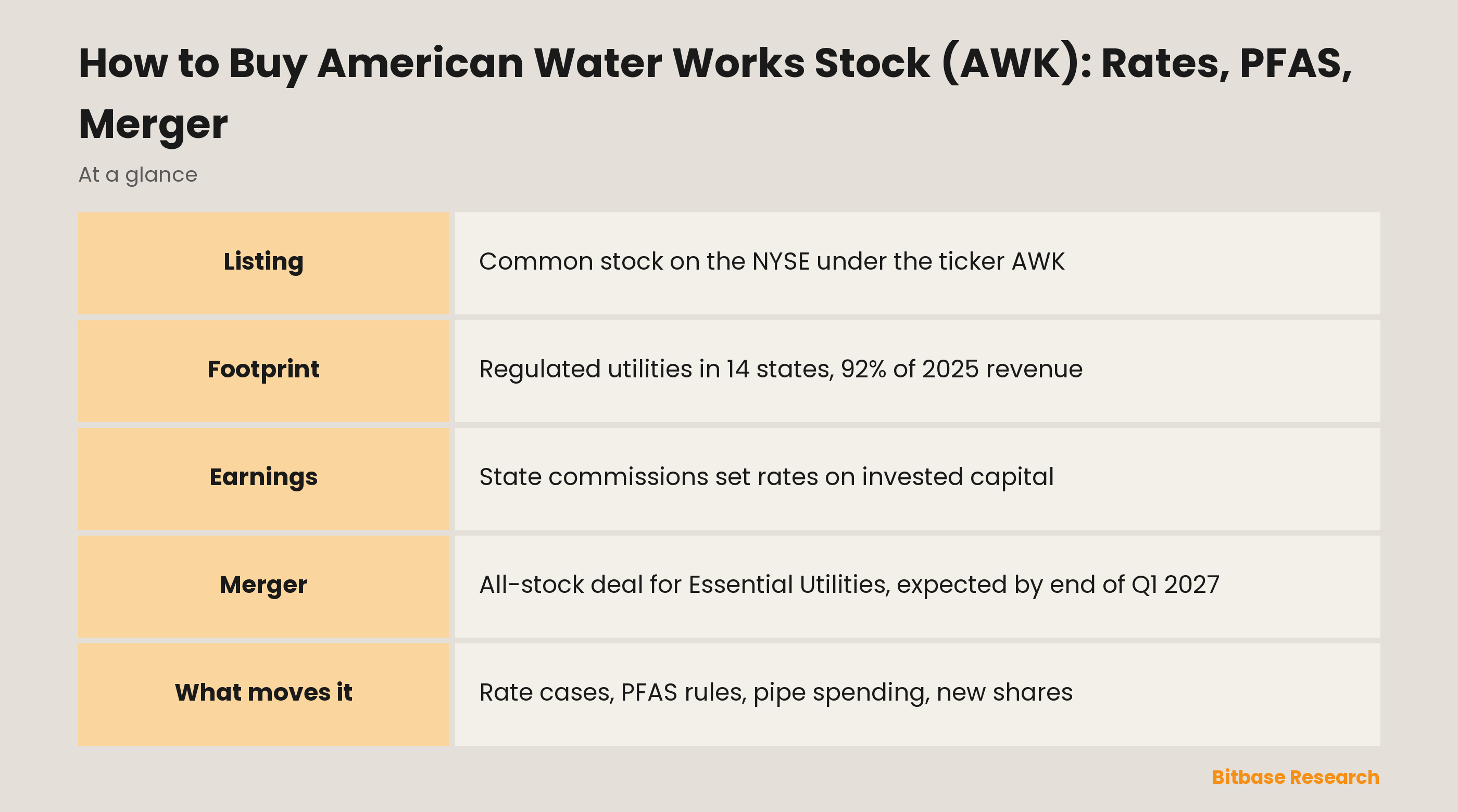
Shares of American Water Works have traded on the New York Stock Exchange under the ticker AWK since April 2008, so a brokerage account that reaches the NYSE is all an order needs. The share is a claim on a Camden, New Jersey holding company whose regulated water and wastewater utilities in 14 states produced 92% of its 2025 revenue, and which expects to acquire Essential Utilities, a water and natural gas group, by the end of the first quarter of 2027.
What Does American Water Works Do?
American Water pumps, treats and delivers drinking water, and collects and treats wastewater. The annual report traces its history to 1886 and calls it "the largest and most geographically diverse, publicly-traded water and wastewater utility company in the United States, as measured by both operating revenues and population served." The parent was first incorporated in Delaware in 1936, employs about 7,000 people, and through its subsidiaries serves roughly 14 million people in 24 states.
Most of that runs through one reportable segment, the Regulated Businesses: local utilities in 14 states with 3.6 million active customers, whose prices are set by state public utility commissions (PUCs). The utilities own the pipes, pumps, tanks and treatment plants, but "typically, the Company does not own the water." Rights to it come through contracts, permits and allocations. In 2025, 70% of supply came from rivers, lakes and reservoirs, 23% from wells and aquifers, and 7% was bought from other suppliers.
The rest sits in Other, chiefly the Military Services Group (MSG). The 10-K counts 18 military installations where MSG runs water and wastewater systems under 50-year contracts with the US government, which may end any of them early for convenience. These businesses are not regulated by state PUCs and need little capital.
The portfolio has been reshaped by deals in both directions. In December 2021 American Water sold its Homeowner Services Group to an entity owned by funds advised by Apax Partners, taking part of the price as a secured seller note. In June 2026 it completed the purchase of regulated systems in eight states from a subsidiary of Nexus Water Group, adding about 47,000 customer connections. And in October 2025 it agreed to combine with Essential Utilities in an all-stock merger, covered in detail below.
Inside its territories a water utility rarely meets a direct rival: it operates under franchises and certificates granted by regulators, and the cost of laying a second set of pipes keeps others out. Competition shows up when systems come up for sale. The 10-K names Essential, American States Water and California Water Service Group as its largest investor-owned competitors in acquisitions.
How American Water Works Makes Money
A regulated utility is paid on the money it invests. The PUC approves rates meant to cover operating costs plus a return on rate base, the capital regulators accept, so earnings grow when new pipes, plants and acquired systems go into rates. The 10-K says 2025 results were "driven primarily by the implementation of new rates in the Regulated Businesses from capital and acquisition investments," partly offset by higher production, employee, depreciation and financing costs. The income statement shows 2025 operating revenue up about 9.7% on 2024, with net income to common shareholders up about 5.7%.
Five states produced 79.1% of 2025 Regulated Businesses revenue:
| State | Share of 2025 Regulated Businesses revenue |
|---|---|
| Pennsylvania | 24.1% |
| New Jersey | 23.4% |
| Missouri | 12.2% |
| Illinois | 11.6% |
| California | 7.8% |
| Nine other states and other items | 20.9% |
The other nine are Georgia, Hawaii, Indiana, Iowa, Kentucky, Maryland, Tennessee, Virginia and West Virginia. Households paid 54% of regulated revenue and commercial customers 21%; wastewater brought in 9%. The customer base is 91% water and 9% wastewater, which the company presents as room to add sewer service where it already sells water.
Weather moves the volume. Demand rises with outdoor use, so revenue is normally highest in the third quarter, and a hot, dry summer lifts sales while a cool, wet one depresses them. Only California and Illinois have revenue stability mechanisms that partly or fully separate authorized revenue from the amount of water sold.
Affordability is the counterweight in every rate request; the company says its average residential bills are "at or below 1% of median household income."
AWK Stock at a Glance
| Item | Detail |
|---|---|
| Exchange | New York Stock Exchange, since 23 April 2008 |
| Ticker | AWK |
| Security | Common stock, the only class registered under Section 12(b) |
| Sector | Regulated water and wastewater utility |
| Index membership | S&P 500, per State Street's SPY holdings dated 9 November 2026 |
| Headquarters | Camden, New Jersey |
| Incorporated | Delaware, 1936 |
| Fiscal year | Calendar year, ending 31 December |
| Dividend policy | Quarterly, declared by the board |
| Pending deal | All-stock merger with Essential Utilities, expected to close by the end of Q1 2027 |
| SEC identifier | CIK 1410636 |
Quotes, market value and yield move all session long, so check the American Water Works stock page on Bitbase for live numbers.
How to Buy American Water Works Stock
AWK is common stock issued by a Delaware corporation, so there is no depositary receipt or foreign line to choose between. The order itself goes like this:
1. Open an account with a broker that trades NYSE stocks. Investors outside the US can use a local firm with US market access or an international broker; check which entity holds the account and who supervises it.
2. Complete the tax form. Non-US individuals are normally asked for IRS Form W-8BEN, the "Certificate of Foreign Status of Beneficial Owner for United States Tax Withholding and Reporting."
3. Fund the account in dollars. Converting from another currency adds a spread on top of commissions.
4. Find AWK and confirm the name. The line should read American Water Works Company, Inc. on the NYSE. Essential Utilities trades separately under WTRG.
5. Choose the order type. A market order fills at the next available prices; a limit order sets the most you will pay and may not fill at all.
6. Decide between whole and fractional shares. Not every broker offers fractions, and the rights attached to them vary by firm, so read the terms first.
From abroad, dividends from a US company are US-source income. The IRS says "most types of U.S. source income received by a foreign person are subject to U.S. tax of 30%," while a tax treaty can reduce that rate. Your home country may tax the same dividend again.
Through funds, State Street's 9 November 2026 holdings files list American Water in SPY, which tracks the S&P 500, and in XLU, the utilities sector fund.
What Moves AWK Stock
Rate cases. Every state commission decides how much of the company's spending reaches customer bills and at what return. In 2026 New Jersey approved a settlement with an authorized return on equity of 9.50%, and Pennsylvania granted new rates at 9.55%. Missouri is reviewing a filing that asks for 10.50%, with new rates expected in June 2027, and Illinois a two-step request at 10.75% whose first step would start on 1 January 2027. The gap between what is asked and what is allowed is where regulatory lag and investor returns are decided.
The Essential Utilities merger. Under the agreement, each Essential share would become 0.305 AWK shares, Essential would become a wholly owned subsidiary, and the combined company would keep the American Water name and its Camden headquarters. AWK shareholders approved the share issuance on 10 February 2026, and the federal antitrust waiting period expired on 14 August 2026. By 6 November 2026, regulators in Kentucky, Ohio, Virginia and Illinois had approved the deal, and settlements in Pennsylvania, North Carolina, Texas and New Jersey awaited their commissions. The companies expect to close by the end of the first quarter of 2027. Essential would also bring more than 740,000 natural gas connections, a line of business outside American Water's water and wastewater operations.
Pipes and acquisitions. The 10-K says pipe renewal has improved from a 250-year replacement cycle in 2009 to less than 150 years on average over the last five years, and it expects to reach better than 100 years within the next decade. Of planned infrastructure spending over ten years, 70% is for renewal, 10% for resiliency and 8% for water quality, including PFAS. Buying systems is the other lever: the EPA estimates municipal systems serve about 84% of the water market, and there are more than 50,000 community water systems, many of them small.
PFAS rules. The EPA set legally enforceable limits for six PFAS chemicals in April 2024. The 10-K says the agency has signaled it intends to extend the compliance deadline to 2031, but under the current rule utilities must comply by April 2029. The 10-K notes that PUCs have traditionally recognized the cost of complying with environmental mandates, but how much treatment is needed, and when, depends on where the rule ends up. American Water also takes part in litigation against PFAS manufacturers to recover cleanup costs.
New shares. Heavy capital spending is funded partly with equity. In August 2025 American Water signed forward sale agreements with three banks covering about 8.1 million shares, and settling them adds to the share count.
Regulatory Lag, Old Pipes and Other Risks in the 10-K
These Item 1A passages bear most directly on an AWK holder.
Regulators. The Regulated Businesses "are subject to extensive regulation by PUCs and other regulatory agencies, which significantly affects our business," and the rate-setting process "may result in a significant delay, also known as 'regulatory lag,'" between spending and recovery.
Water quality. Operations face "extensive and increasingly stringent environmental, water quality and health and safety laws and regulations, including with respect to contaminants of emerging concern."
Supply and infrastructure. Limits on water supplies "may adversely affect our access to sources of water," and "aging infrastructure may lead to service disruptions, property damage and increased capital expenditures and O&M expenses."
Funding and dilution. The utilities "require significant capital expenditures and may suffer if we fail to secure appropriate funding," and shareholders "may experience dilution" when the forward sale agreements settle in shares.
The merger. The exchange ratio "will not be adjusted" for share price moves, the deal "may not be accretive to our earnings," and "current shareholders will have reduced ownership and voting interests" after closing. The combined group would also carry Essential's exposure to the natural gas industry.
Dividends. The parent depends on its subsidiaries to pay "upstream dividends," and the 10-K says it "cannot assure" that it will keep paying quarterly dividends at the current rate or keep raising them as planned. Shareholders have "no contractual or other legal right to dividends that have not been declared."
A single utility stock also concentrates your money in one company, one set of regulators and, for now, one pending deal.
How to Research AWK Yourself
American Water files with the SEC under CIK 1410636. Its 2026 earnings releases came as 8-Ks on 18 February, 29 April, 29 July and 28 October, each followed by a 10-K or 10-Q. Merger documents appear as Rule 425 filings in the same list, so a search of the company's filings shows each regulatory step as it happens.
In the 10-K, Item 1 holds the state revenue table, the water supply mix and the regulatory mechanisms by state; Item 1A the risks; Item 3 litigation, including a condemnation action against the Monterey system in California stemming from a 2018 ballot measure; and the MD&A the capital plan. In each 10-Q, the regulatory note lists completed and pending rate cases with the requested and authorized returns, and Note 5 tracks the Essential merger. Comparing those returns with other regulated utilities, such as the one in our Duke Energy stock guide, shows how state commissions price the same kind of business.
Read the requested return, the approved return and the effective date of each case together. For live prices use the stock page linked earlier; Bitbase's US stock pages cover other listed companies.
American Water Works Stock FAQ
Can I buy American Water Works stock with crypto?
No. Brokers settle AWK purchases in US dollars, so crypto has to be sold for cash first, and that sale may be taxable where you live. Owning AWK makes you a shareholder of a regulated utility who can vote and receives any dividends the board declares, one of several things that separate stocks from crypto assets.
Does American Water Works pay a dividend?
Yes, quarterly, when declared by the board. The quarterly rate was raised by about 8% in both 2025 and 2026. The 10-K says there is no assurance that dividends will continue at the current rate or rise as planned.
Is AWK in the S&P 500?
Yes. American Water Works appears in State Street's SPY holdings for 9 November 2026, and also in XLU, its utilities sector fund.
What happens to AWK shares in the Essential Utilities merger?
Existing AWK shares are not exchanged. American Water is the acquirer and would issue new shares to Essential's holders, 0.305 for each Essential share. Your stake becomes a smaller slice of a larger company. The deal still needs the remaining state approvals and is expected to close by the end of the first quarter of 2027.
Where does American Water get its water?
In 2025, 70% came from surface sources such as rivers, lakes and reservoirs, 23% from groundwater and 7% from other suppliers. The company generally holds rights to use the water, not ownership of it.
Conclusion
American Water is a bet on state regulators continuing to let pipe replacement, treatment plants and purchased systems into rates at returns near the 9.50% and 9.55% approved in 2026, while the Essential merger, if completed, adds natural gas to a water company. Read the latest 10-Q rate case note and the merger filings side by side, follow the Missouri and Illinois decisions, and size the position as one regulated utility among the rest of your holdings.
Related reading
Other Bitbase articles on this topic:
- How to Buy Ameren Stock (AEE): Callaway, DRPlus, Data Centers
- How to Buy Atmos Energy Stock (ATO): Gas Only, Mostly in Texas
- How to Buy Brookfield Infrastructure Stock (BIP): Units to Shares
- How to Buy Exelon Stock (EXC): Six Utilities, No Power Plants
Disclaimer: This article is educational content from Bitbase Academy, provided for information only. It explains what a company or fund does and how the instruments referenced here differ from one another; it does not constitute investment, trading, tax, or financial advice, and it is neither a recommendation nor an endorsement of any security, token, or trading strategy. A tokenized stock is issued by a third party and is designed to give economic exposure to an underlying asset: it is not a share, it carries no shareholder rights, and it depends on the issuer's structure, eligibility rules, and redemption terms, which the issuer can change. Perpetual futures are leveraged derivatives that hold no underlying asset and can be liquidated, and trading hours, product availability, and eligibility differ by instrument and by jurisdiction and can change at any time. Written as of November 2026; verify everything yourself through company filings, the issuer's own documentation, and the product pages of the venue you trade on.
References
[1] American Water Works Form 10-K for 2025 (SEC EDGAR) www.sec.gov
[2] American Water Works 2025 Form 10-K, XBRL cover page (SEC EDGAR) www.sec.gov
[3] American Water Works 2025 Form 10-K, XBRL income statement (SEC EDGAR) www.sec.gov
[4] American Water Works Form 10-Q for the third quarter of 2026 (SEC EDGAR) www.sec.gov
[5] American Water and Essential Utilities joint release on Illinois merger approval, Rule 425 filing, 6 November 2026 (SEC EDGAR) www.sec.gov
[6] American Water Works Form 8-K on the special shareholder meeting of 10 February 2026 (SEC EDGAR) www.sec.gov
[7] State Street, SPY daily holdings www.ssga.com
[8] State Street, XLU daily holdings www.ssga.com
[9] IRS, NRA Withholding www.irs.gov
[10] IRS, About Form W-8 BEN www.irs.gov





