
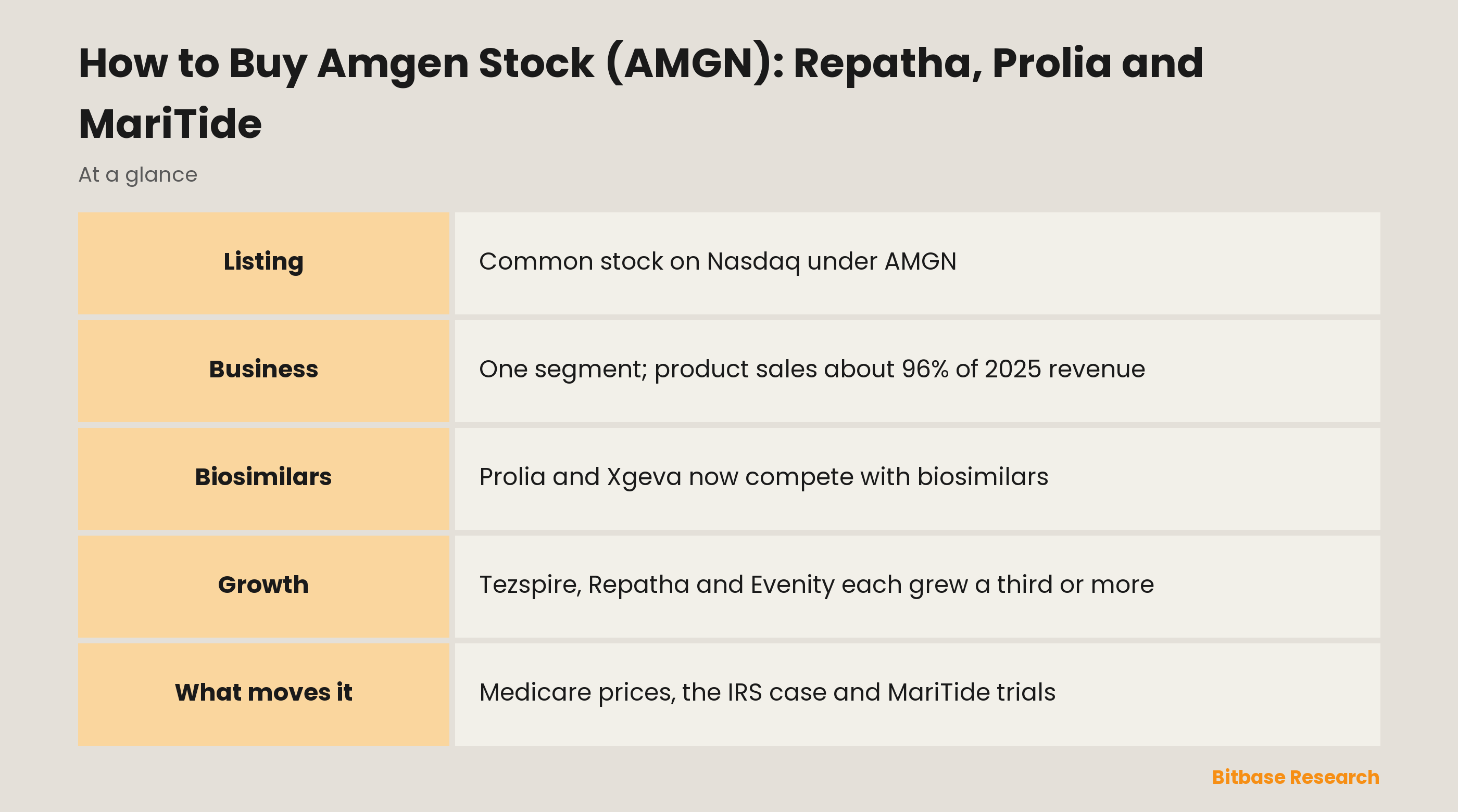
Its ticker is AMGN and its market is the Nasdaq Global Select Market, so buying Amgen stock comes down to a brokerage account with Nasdaq access and an order for that symbol. The company behind it says it helped launch the biotechnology industry more than 45 years ago, and most of what it sells are biologics. Its line-up is in transition: Prolia, the top seller of 2025, now competes with biosimilars, while Repatha, Evenity and Tezspire each grew by a third or more.
What Does Amgen Do?
Amgen discovers, develops, manufactures and sells what its annual report calls "innovative medicines to fight some of the world's toughest diseases." It was incorporated in California in 1980, became a Delaware corporation in 1987 and is headquartered in Thousand Oaks, California, with a presence in approximately 100 countries.
For accounting purposes there is a single business, as "Amgen operates in one operating segment: human therapeutics," but its earnings releases sort the products under five headings. General Medicine holds Repatha, a PCSK9 inhibitor that lowers LDL cholesterol, and the osteoporosis treatments Prolia and Evenity. Oncology includes Blincyto for a form of acute lymphoblastic leukemia, Kyprolis for multiple myeloma, Imdelltra for small cell lung cancer and Xgeva for bone complications of cancer that has spread. Inflammation covers the asthma drug Tezspire, Otezla for psoriasis, Enbrel and several biosimilars. Rare Disease is largely what came with Horizon: Tepezza for thyroid eye disease, Krystexxa for chronic refractory gout, and Uplizna. Established products such as Aranesp form the fifth group.
Most of these are biologics, produced in living cells; Otezla, Kyprolis and Lumakras are among the few small molecules. That shapes competition, because a biologic loses exclusivity to biosimilars rather than generics, and Amgen sits on both sides: since 2018 it has launched eight biosimilars of other companies' medicines.
Deals built much of the line-up: Otezla came from Bristol Myers Squibb in November 2019, Tavneos with ChemoCentryx in October 2022 and the rare-disease medicines with Horizon on 6 October 2023. Some products are shared: AstraZeneca leads Tezspire outside North America, and UCB leads Evenity in most of Europe.
How Amgen Makes Money
Almost entirely by selling medicines: product sales were about 96% of total revenues in 2025, and the remainder, reported as other revenues, grew mainly on royalty income. Under the earnings release's own headings, 2025 product sales split like this:
| Area | Share of 2025 product sales | Products the release lists under it |
|---|---|---|
| General Medicine | 27.1% | Repatha, Evenity, Prolia |
| Oncology | 27.1% | Blincyto, Xgeva, Nplate, Kyprolis, Vectibix, Imdelltra, Mvasi, Lumakras |
| Inflammation | 21.4% | Otezla, Enbrel, Tezspire, Pavblu, Amjevita, Wezlana |
| Rare Disease | 14.4% | Tepezza, Krystexxa, Uplizna, Tavneos, ultra-rare products |
| Established products | 6.2% | Aranesp, Neulasta, Parsabiv |
| Other products | 3.7% | Aimovig, Epogen and brands not reported separately |
Shares are calculated from the full-year product table in the fourth-quarter 2025 release and rounded to one decimal.
Prolia was the largest single product in 2025, at about 12.6% of product sales, followed by Repatha at about 8.6%. By the first half of 2026 that order had flipped.
Sales are concentrated. The United States produced about 73% of 2025 product sales, and there "substantially all of our sales are to pharmaceutical wholesale distributors": McKesson, Cencora and Cardinal Health together accounted for 77% of worldwide gross revenues. What the medicines finally earn then depends on coverage from government programs, insurers and pharmacy benefit managers.
Growth in 2025 came from volume, not price. Product sales rose 10%, with volume up 13% and net selling prices down 3%. Among the products the 10-K calls principal, Tezspire grew 52%, Repatha 36% and Evenity 34%, while Enbrel lost roughly a third of its sales, mainly to lower net prices tied to the 340B Program and the redesign of Medicare Part D.
AMGN Stock at a Glance
| Fact | AMGN |
|---|---|
| Exchange | Nasdaq Global Select Market |
| Ticker | AMGN |
| Security | Common stock, the only equity security registered on the 10-K cover |
| Other listed securities | The fiscal 2025 10-K cover also registered one note series, AMGN26 |
| Business | Biotechnology, reported as one segment: human therapeutics |
| Index membership | S&P 500, Dow Jones Industrial Average and Nasdaq-100 |
| Headquarters | Thousand Oaks, California |
| Incorporated | Delaware since 1987; originally California, 1980 |
| Fiscal year | Calendar year, ending 31 December |
| Dividend policy | Paid quarterly; each dividend requires board approval |
| SEC identifier | CIK 318154 |
Being listed on Nasdaq and belonging to the Nasdaq-100 are separate facts; the difference between the exchange and its index matters when you compare funds. For the live price, open the Amgen stock page on Bitbase.
How to Buy Amgen Stock
AMGN is the common stock of a US company, so no depositary receipt sits between you and the share. Everything goes through a broker:
1. Find a broker that offers Nasdaq-listed shares. Outside the United States, confirm which company actually keeps your account and which regulator oversees it.
2. Open and verify the account. If you are not a US person, you sign IRS Form W-8BEN so that dividends can be withheld at a treaty rate rather than the default.
3. Fund it. A currency conversion has its own cost, so compare the rate, not just the commission.
4. Search AMGN and read the line. It should show Amgen Inc. common stock on Nasdaq; AMGN26, a symbol on the 2025 annual report cover, belongs to a note, not the shares.
5. Choose the order type. A market order "guarantees that the order will be executed, but does not guarantee the execution price"; a limit order fills only "at a specific price or better."
6. Decide the amount. Fractional shares allow a fixed cash amount in place of whole shares, the mechanic behind dollar-cost averaging, but "not every brokerage firm offers fractional share investing," and you "may not have voting rights" on a fraction.
If you live outside the United States, tax is withheld from dividends before they reach you. The IRS states that "most types of U.S. source income received by a foreign person are subject to U.S. tax of 30%," and a treaty between the US and your country can cut that rate; the W-8BEN is how you claim it. Your own country may then tax the dividend as well.
Via index funds, Amgen comes as one holding among many: State Street's SPY and DIA track the S&P 500 and the Dow Jones Industrial Average, Invesco's QQQ tracks the Nasdaq-100, and all three hold it.
What Moves AMGN Stock
Biosimilars, product by product. The 10-K expects "increasing competition from biosimilars and generics," and Prolia and Xgeva are the live case: their antibody patents expired in the US in February 2025 and in select European countries that November. In the first half of 2026 Prolia sales fell 33% and Xgeva's 31%. The patent table dates what follows: the earliest US patents it lists run to February 2028 for Otezla, November 2028 for Enbrel and August 2029 for Repatha, with later patents behind several of them.
The growth brands. Tezspire, Repatha and Evenity grew fastest among principal products in 2025, and in August 2025 the FDA broadened Repatha's label to adults at increased risk of major cardiovascular events, dropping the earlier requirement of diagnosed cardiovascular disease.
US drug pricing. Under the Inflation Reduction Act, Medicare sets prices for selected drugs, and two of Amgen's are on the list: Enbrel's Part D price took effect on 1 January 2026 and Otezla's takes effect on 1 January 2027, "in each case at significantly lower prices." In December 2025 Amgen also said it was meeting the administration's most-favored-nation pricing requests and widening its direct-to-patient program, AmgenNow.
Seasonality. The first quarter "historically represents the lowest product sales quarter for the year," partly because US patients restart deductibles and plans change; Enbrel and Otezla feel it most. Compare a first quarter with the same quarter a year earlier.
Tax and trade. Amgen is contesting IRS adjustments for 2010 through 2015 over how profits were allocated between its US and Puerto Rico entities. The Tax Court trial ended in January 2025, and the company expects a decision no earlier than late 2026 or early 2027; a similar draft adjustment for 2016 through 2018 arrived in April 2026. Separately, Amgen has relief from Section 232 tariffs for about three years from December 2025.
The obesity pipeline. MariTide (maridebart cafraglutide) is an investigational antibody-peptide conjugate that activates the GLP-1 receptor and blocks GIPR. Its Phase 3 program, MARITIME, spans chronic weight management, cardiovascular outcomes, heart failure and sleep apnea. It is not approved, so each readout is an event in its own right.
Risks Worth Reading in Amgen's 10-K
Of the many headings in Item 1A, these bear most directly on an AMGN share:
Payers and pricing. "Our sales depend on coverage and reimbursement from government and commercial third-party payers, and pricing and reimbursement pressures have affected, and are likely to continue to affect, our profitability."
Concentrated customers. Another heading covers "concentration of sales at certain of our wholesaler distributors," the 77% figure above seen as a risk.
One main plant. Amgen performs "a substantial majority of our commercial manufacturing activities at our facility in the U.S. territory of Puerto Rico," where disruptions "could significantly impair our ability to supply our products."
Regulators can revisit an approval. In January 2026 the FDA asked Amgen to withdraw Tavneos voluntarily, and Amgen declined. On 27 April 2026 the agency's drug center proposed withdrawing the approval; Amgen requested a hearing, and Tavneos stays on the market while the process runs.
Data security. In July 2026 Amgen found unauthorized activity in data held in third-party cloud environments, and some data, including patient health information, was exfiltrated. It judged the incident material on 29 July 2026 while stating it is not reasonably likely to have a material impact on its financial condition or results.
R&D can fail. "We may not be able to develop commercial products despite significant investments in R&D." In February 2026, after two Phase 3 studies, Amgen dropped plans to seek approval of bemarituzumab in first-line gastric cancer.
Above the business, a single stock ties your money to one company's patents, prices and trials, and a dividend is declared quarter by quarter, not promised.
How to Research AMGN on Your Own
Amgen's SEC filings sit under CIK 318154: the 10-K each year, a 10-Q each quarter and 8-Ks for events in between, including earnings releases and the July 2026 cybersecurity disclosure.
In the 10-K, Item 1 holds the products, the patent table and a competitor table; Item 1A the risks; the MD&A a sales table for each principal product with the reasons it moved; the income tax note the IRS dispute.
Two habits help. The competitor table pairs Repatha with Novartis's Leqvio and with Praluent from Regeneron and Sanofi, and Otezla with medicines including AbbVie's Skyrizi. And because one sales line can hide a patent loss in one market and a launch in another, read the US and rest-of-world columns separately. For other companies, see Bitbase's US stock pages.
Amgen Stock FAQ
Does Amgen pay a dividend?
Yes, quarterly. The 10-K says it expects "to continue to pay quarterly dividends, although the amount and timing of any future dividends are subject to approval by our Board of Directors." Dividends have usually been declared in December, March, July and October, and the one declared in December 2025 was 6% higher than a year earlier.
Can I buy Amgen stock with crypto?
Not directly. Your broker takes dollars, not tokens: Nasdaq trades in AMGN settle in US dollars, so any crypto must first be sold and the proceeds transferred to the brokerage account. In many countries that sale is itself one of the taxable crypto events, so treat it as a separate decision.
Is AMGN in the S&P 500, the Dow and the Nasdaq-100?
Yes, all three. The holdings files of SPY, DIA and QQQ dated 16 October 2026 each list Amgen; weights change daily.
What is MariTide?
An investigational medicine Amgen is testing in Phase 3 for chronic weight management and related conditions. The company says its "long-acting design supports starting with monthly dosing." It has not been approved.
Does Amgen make biosimilars?
Yes, eight launched since 2018, including Wezlana, a biosimilar to Stelara, and Bkemv, a biosimilar to Soliris, both in the US in 2025. Pavblu was the only commercially available biosimilar to Eylea in the US during the second quarter of 2026. The same mechanism now works against Prolia and Xgeva.
Conclusion
Buying AMGN takes a broker with Nasdaq access, the correct listing picked on the order ticket and a market or limit order. Deciding how much to hold is harder, because the share rests on a hand-over: Prolia and Xgeva are losing ground to biosimilars, Enbrel and Otezla face Medicare price setting, and Repatha, Evenity, Tezspire and the MariTide program have to supply what comes next. The Tax Court decision, the Tavneos review and the July 2026 data incident are dated items to follow in the next filings.
Related reading
Other Bitbase articles on this topic:
- How to Buy AbbVie Stock (ABBV): Skyrizi and Rinvoq After Humira
- How to Buy argenx Stock (ARGX): Nasdaq, Brussels and VYVGART
- How to Buy Bristol Myers Squibb Stock (BMY): Eliquis and Opdivo
- How to Buy Vertex Pharmaceuticals Stock (VRTX): Cystic Fibrosis
Disclaimer: This article is educational content from Bitbase Academy, provided for information only. It explains what a company or fund does and how the instruments referenced here differ from one another; it does not constitute investment, trading, tax, or financial advice, and it is neither a recommendation nor an endorsement of any security, token, or trading strategy. A tokenized stock is issued by a third party and is designed to give economic exposure to an underlying asset: it is not a share, it carries no shareholder rights, and it depends on the issuer's structure, eligibility rules, and redemption terms, which the issuer can change. Perpetual futures are leveraged derivatives that hold no underlying asset and can be liquidated, and trading hours, product availability, and eligibility differ by instrument and by jurisdiction and can change at any time. Written as of October 2026; verify everything yourself through company filings, the issuer's own documentation, and the product pages of the venue you trade on.
References
[1] Amgen Form 10-K, fiscal 2025: business, product sales, patents, risk factors and the IRS dispute (SEC EDGAR) www.sec.gov
[2] Amgen Form 10-Q for the quarter ended 30 June 2026: product sales, Tavneos review and IRS dispute (SEC EDGAR) www.sec.gov
[3] Amgen fourth-quarter and full-year 2025 results release (Form 8-K, Exhibit 99.1) www.sec.gov
[4] Amgen second-quarter 2026 results release, including the MariTide pipeline update (Form 8-K, Exhibit 99.1) www.sec.gov
[5] Amgen Form 8-K, 31 July 2026: material cybersecurity incident (Item 1.05) www.sec.gov
[6] State Street SPDR S&P 500 ETF Trust (SPY): fund page and daily holdings www.ssga.com
[7] State Street SPDR Dow Jones Industrial Average ETF Trust (DIA): fund page and daily holdings www.ssga.com
[8] Invesco QQQ: fund overview and holdings (tracks the Nasdaq-100) www.invesco.com
[9] Investor.gov (SEC): Types of Orders www.investor.gov
[10] Investor.gov (SEC): Investor Bulletin on fractional share investing www.investor.gov
[11] IRS: NRA Withholding www.irs.gov





