
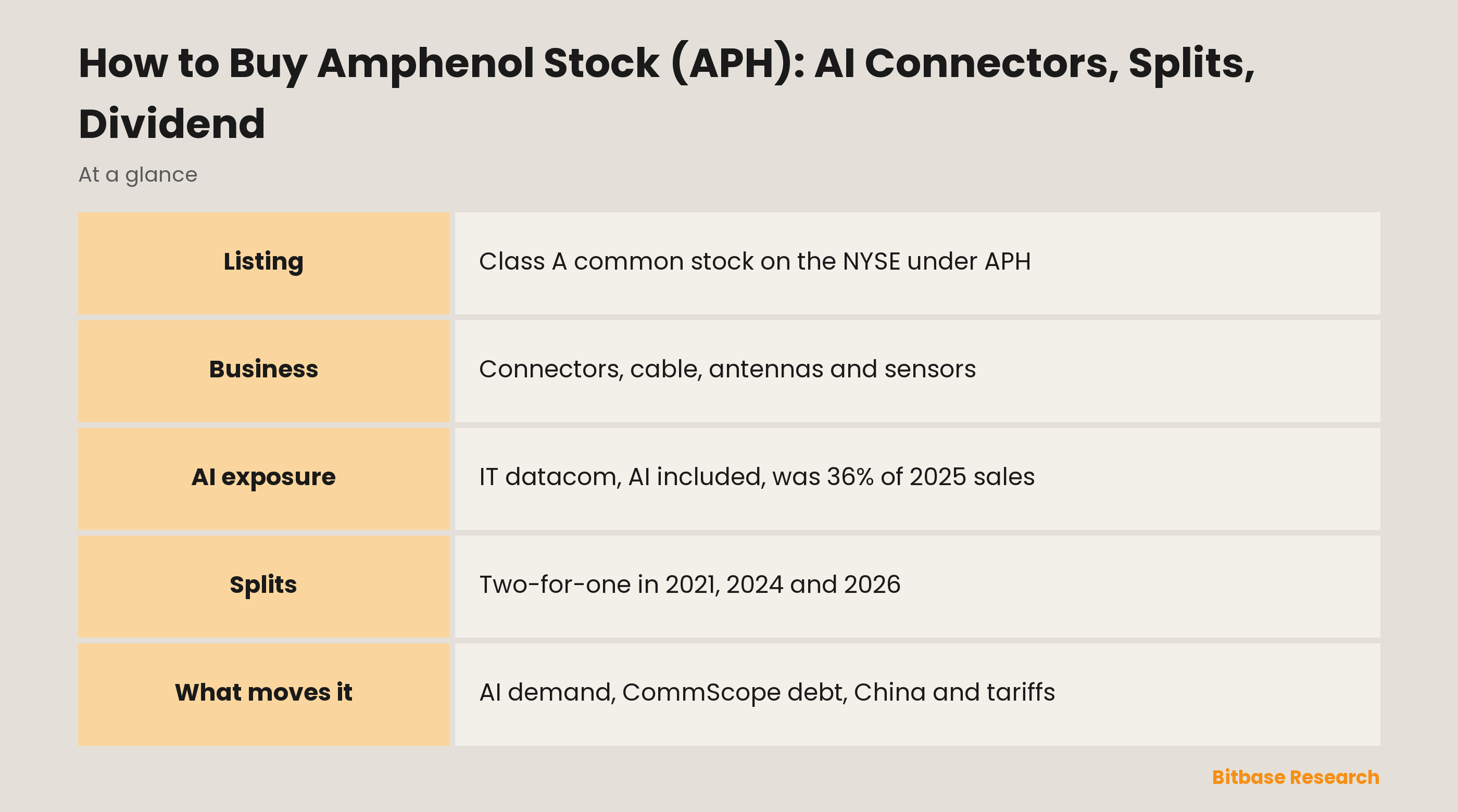
After three two-for-one stock splits since 2021, Amphenol still has just one listed share for investors: Class A common stock on the New York Stock Exchange under the ticker APH, which any broker with access to US shares can buy for you. The company makes the connectors, cables, antennas and sensors that carry power and data inside other manufacturers' equipment, and in 2025 the IT datacom market, AI systems included, accounted for about 36% of its sales. Below are the revenue sources, the steps to an order, and the risks its filings spell out: AI demand, a record acquisition, China and tariffs.
What Does Amphenol Do?
Amphenol makes the hardware through which power and signals pass from one circuit board, server rack, aircraft system or vehicle module to the next. Its annual report calls the company "one of the world's largest designers, manufacturers and marketers" of connectors and interconnect systems, antennas, sensors and cable.
The business is older than the listing. Certain predecessor businesses were founded in 1932, the current company was incorporated in Delaware in 1986, and its Class A common stock has traded on the New York Stock Exchange since an initial public offering in November 1991. Headquarters are in Wallingford, Connecticut.
The 10-K reports three segments. Communications Solutions sells high-speed, radio frequency, power and fiber optic interconnect products, along with coaxial, fiber optic and high-speed cable and antennas for consumer devices and network infrastructure. Harsh Environment Solutions makes ruggedized connectors, specialty cable and printed circuit boards for defense, aerospace and industrial equipment. Interconnect and Sensor Systems pairs sensors that measure force, pressure, position, temperature and other quantities with busbars, power distribution systems and cable assemblies.
Its buyers are other businesses: thousands of original equipment makers, contract manufacturers and design houses, plus telecom and web service providers. No single customer reached 10% of net sales in 2023, 2024 or 2025. Products are built in about 40 countries and sold through Amphenol's own sales force, independent representatives and distributors, which took about 19% of 2025 sales.
Acquisitions have reshaped the portfolio in quick succession. Amphenol bought Carlisle Interconnect Technologies (CIT) in May 2024 and completed five deals in 2025, among them Andrew, a base-station antenna and distributed antenna business bought from CommScope, since renamed Vistance Networks. On 9 January 2026 it closed the purchase of that company's Connectivity and Cable Solutions business, which the 10-K calls "the largest acquisition in the Company's history." The unit, which adds fiber optic connectivity for data centers and networks, now sits inside Communications Solutions.
How Amphenol Makes Money
Amphenol sells components, so its revenue follows how much equipment its customers build and in which industries. The 10-K splits 2025 net sales across seven end markets:
| End market | Share of 2025 net sales | Applications named in the 10-K |
|---|---|---|
| IT datacom | 36% | AI, servers, cloud computing, storage, data centers |
| Industrial | 19% | Factory automation, medical equipment, energy generation, rail |
| Automotive | 15% | Electric and hybrid vehicles, sensing systems, infotainment |
| Communications networks | 10% | Base stations, antenna systems, fiber management |
| Defense | 9% | Avionics, radar, missile systems, satellites, ground vehicles |
| Mobile devices | 6% | Smartphones, laptops, tablets, wearables |
| Commercial aerospace | 5% | Avionics, engines, in-flight connectivity |
Shares are as stated in the 10-K, each rounded to a whole percentage. By segment, Communications Solutions brought in about 52% of 2025 net sales, Harsh Environment Solutions about 26% and Interconnect and Sensor Systems about 22%.
Growth in 2025 was fast, and not all of it organic. Net sales rose 52% in US dollars and 38% organically, the measure the company uses to strip out currency moves and acquisitions; the gap between the two is mostly revenue from businesses that were not in the 2024 base. Communications Solutions grew 91%, or 71% organically, which the 10-K attributes mainly to IT datacom demand, "with particular strength in AI-related applications." Harsh Environment Solutions rose 33% (17% organically) and Interconnect and Sensor Systems 15% (13% organically).
About 65% of 2025 net sales came from outside the United States, and China alone accounted for about 16%. Amphenol reports in US dollars, so sales made in other currencies are translated at the rates of the day.
APH Stock at a Glance
| Field | APH |
|---|---|
| Exchange | New York Stock Exchange (NYSE) |
| Ticker | APH |
| Share class | Class A common stock, the only stock registered on the 10-K cover |
| Other listed security | Senior notes due 2032, symbol APH32, which are a bond |
| Industry | Connectors, cable, antennas and sensors |
| Index membership | S&P 500 |
| Headquarters | Wallingford, Connecticut |
| Incorporated | Delaware, 1986 |
| Listed since | Initial public offering in November 1991 |
| Fiscal year | Calendar year, ending 31 December |
| Dividend policy | Quarterly cash dividend, declared by the board |
| Stock splits | Two-for-one in 2021, 2024 and 2026 |
| SEC identifier | CIK 820313 |
Quotes, market value and dividend yield change with every trade, so they are left out of the table; check them on the Amphenol stock page on Bitbase.
How to Buy Amphenol Stock
Amphenol is a US company with one listed class of shares, so no depositary receipt or second class needs weighing; despite the "Class A" label, the 10-K cover registers no other stock. The route runs through a broker:
1. Open an account with a broker that reaches the NYSE. Investors abroad can use a domestic firm that routes orders to New York or a global one; find out which legal entity keeps your account and which regulator oversees it.
2. Complete the identity and tax forms. A non-US individual fills in IRS Form W-8BEN to certify foreign status; the broker relies on it to withhold tax on US dividends at the right rate.
3. Move money in. Shares are priced in US dollars, and converting another currency costs money, so weigh the conversion spread alongside any commission.
4. Search for APH and read the result. The line you want is Amphenol's Class A common stock on the NYSE. APH32 is a different security: one of the company's senior notes.
5. Choose how the order executes. A market order "guarantees that the order will be executed, but does not guarantee the execution price"; a limit order fills only "at a specific price or better," which caps what you pay.
6. Decide how much to buy. Fractional shares let you invest a set amount of money, but "not every brokerage firm offers fractional share investing," some firms only allow market orders for fractions, and a fraction generally cannot be moved to another broker.
7. Keep the confirmation. Confirmations and statements record your purchase price, which you need for tax and for comparing results across a split.
Most shareholders never appear on Amphenol's own register. As of 31 January 2026 the company counted just 34 holders of record, because a large number of shares are registered to a single nominee of The Depository Trust Company, the securities depository that banks and brokers use. Buying through a broker makes you one of the beneficial owners behind that nominee, which is why your broker's records, not the company's, show what you own.
Outside the United States, APH dividends count as US-source income. The IRS states that "most types of U.S. source income received by a foreign person are subject to U.S. tax of 30%," and that "a reduced rate, including exemption, may apply" under a tax treaty; Form W-8BEN is how a broker learns which rate applies to you. Your home country may tax the same dividend again.
Through a fund, you can hold Amphenol without choosing it. In October 2026 the daily holdings files State Street publishes for SPY, which tracks the S&P 500, and for its Technology Select Sector SPDR ETF (XLK) both listed APH, and how XLK decides what it holds shows why a connector maker can end up in a technology fund. In either fund, Amphenol is one holding among many.
What Moves APH Stock
AI and data center build-outs. IT datacom was the largest end market in 2025, and the 10-K ties much of the recent growth to it: "some of our customers are making significant investments in AI, and these investments are driving robust demand for certain of the Company's products." The same filing attributes the rise in its order backlog primarily to AI demand and acquisitions, and it names the condition attached: continued growth depends on factors including "our go-forward market share for such products." That spending comes from cloud, data center and server operators of the kind covered in Bitbase's guide to AI infrastructure stocks, and the filing warns that downturns in customers' end markets "can significantly reduce demand for certain of our products."
The CommScope deal. The business acquired on 9 January 2026 is the largest Amphenol has bought, and the 10-K states that financing part of the price "resulted in a significant increase in the Company's debt." The filing adds that the larger debt means a bigger share of cash flow must go to principal and interest.
China, tariffs and export rules. Beyond the sales mix shown above, the asset base is moving abroad too: about 79% of long-lived assets sat outside the US at the end of 2025 and about 37% in China, up from 73% and 29% a year earlier, a change the company relates "primarily to the significant investments the Company has made to support sales of its AI-related products." The 10-K adds that the US "continued to impose new tariffs on imports to the U.S. throughout 2025," and certain of its products are subject to export controls.
Metals and other inputs. Connectors and cable use gold, silver, palladium and copper, among other materials. The 10-K warns that the cost of certain raw materials and components may increase, and that the company, its suppliers and its customers have at times had difficulty obtaining them.
The other six markets. Industrial, automotive, communications networks, defense, mobile devices and commercial aerospace made up the remaining 64% of 2025 sales, and each runs on its own cycle. The company says some of its end markets "are subject to cyclical and at times rapid periods of reduced demand," and that its strongest quarters have historically been the last two of the year.
Risks Amphenol Lists in Its 10-K
Of the risk factors in the 10-K, these five headings bear most directly on an APH share:
End-market cycles. "The Company is dependent on end market dynamics to sell its products." With about 36% of 2025 sales in IT datacom, that market's cycle carries the most weight.
Acquisitions. "The Company has at times experienced difficulties and unanticipated expenses in connection with purchasing and integrating newly acquired businesses." CommScope is the largest test of that so far.
Competition. "The Company encounters competition in all areas of our business." The 10-K names rivals including TE Connectivity, Molex, Aptiv, Corning, ICT Luxshare and Yazaki.
Operations outside the US. The company is "exposed to political, economic, military and other risks related to operating in countries outside the United States," and it employs about 90% of its workforce abroad.
Currency. "The Company's results can be positively or negatively affected by changes in foreign currency exchange rates." A holder outside the US faces a second layer, since the share is priced in dollars.
Two risks sit above the business. A single stock ties your money to one company, however many markets it serves. And dividends are not guaranteed: the 10-K says future payments "remain within the discretion of the Board" and depend on results, liquidity and other factors.
How to Research APH Yourself
Every Amphenol filing sits on SEC EDGAR under CIK 820313: a 10-K each year, a 10-Q each quarter, and 8-Ks for events in between, such as the August 2026 split announcement and the quarterly results.
In the 10-K, Item 1 describes the segments and end markets, Item 1A sets out the risk factors, and the segment note gives sales by segment. The most useful single table is the reconciliation in the management discussion that splits growth into currency, acquisition and organic parts; after a deal the size of CommScope, it gives the clearest view of underlying demand.
Two details are easy to get wrong. R1.htm, the machine-readable cover page of the fiscal 2025 annual report, registers exactly two securities, APH and APH32, so APH is the only stock symbol to look for. And per-share figures from different years compare only after adjusting for the 2021, 2024 and 2026 splits; the annual reports restated earlier share data after the 2021 and 2024 splits, but older charts and articles may not. The stock performance graph in Item 5 measures APH against the S&P 500 and the Dow Jones U.S. Electrical Components & Equipment Index, one benchmark for the market and one for the industry. Live quotes sit on the stock page linked earlier, and the full list of US stock pages on Bitbase covers other companies.
Amphenol Stock FAQ
Does Amphenol pay a dividend?
Yes, every quarter. The company describes "a history of paying quarterly cash dividends," and on 21 October 2025 its board approved a 52% increase in the quarterly payment. Each dividend is declared by the board, and the per-share amount was adjusted for the 2026 split; the current figure is in the latest 8-K.
Can I buy Amphenol stock with crypto?
Not in one step. APH trades on the NYSE in US dollars, so the route is to sell the crypto, withdraw the proceeds and fund a brokerage account with them. Depending on your country, the sale can create a tax bill, and each leg carries its own fees. The asset you end up with is also a different kind of thing: what a share gives you that a coin does not includes a claim on the company that carries dividend and voting rights.
Has Amphenol stock ever split?
Yes, three times since 2021, each time two-for-one. Shares began trading on a split-adjusted basis on 5 March 2021 and on 12 June 2024, and the additional shares from the third split were distributed in September 2026. A split doubles the share count and halves the per-share price without changing what a holding is worth, and fractional shareholders take part in proportion to what they own.
Is APH in the S&P 500?
Yes. Amphenol's Class A shares appeared in the October 2026 holdings of SPY, State Street's S&P 500 trust, and of XLK, a technology fund drawn from S&P 500 members. Index weights change daily.
Is Amphenol an AI stock?
Partly, on its own numbers. AI systems fall within IT datacom, the largest of Amphenol's seven end markets at about 36% of 2025 sales, and the 10-K singles out demand for AI-related products in explaining that market's growth. The end-market list has no separate AI line, and the other 64% of sales came from six markets that range from cars to satellites.
Conclusion
The purchase itself is routine: an account that reaches the NYSE, the Class A common stock rather than the APH32 note, and a market or limit order. Knowing what the share holds is the harder part: a connector, cable and sensor business spread across seven end markets, with AI-related data center demand inside its largest market and CommScope the biggest acquisition it has made. Read the latest 10-K and 10-Q, especially the organic growth table, before deciding how much of one component maker belongs in your portfolio.
Related reading
Other Bitbase articles on this topic:
- How to Buy Corning Stock (GLW): Gorilla Glass and AI Fiber
- How to Buy Dell Technologies (DELL) Stock: Trading Methods, Costs and Risks
- How to Buy Fortinet Stock (FTNT): FortiGate, ASICs, No Dividend
- How to Buy Vertiv (VRT) Stock: Trading Methods, Costs and Risks
Disclaimer: This article is educational content from Bitbase Academy, provided for information only. It explains what a company or fund does and how the instruments referenced here differ from one another; it does not constitute investment, trading, tax, or financial advice, and it is neither a recommendation nor an endorsement of any security, token, or trading strategy. A tokenized stock is issued by a third party and is designed to give economic exposure to an underlying asset: it is not a share, it carries no shareholder rights, and it depends on the issuer's structure, eligibility rules, and redemption terms, which the issuer can change. Perpetual futures are leveraged derivatives that hold no underlying asset and can be liquidated, and trading hours, product availability, and eligibility differ by instrument and by jurisdiction and can change at any time. Written as of October 2026; verify everything yourself through company filings, the issuer's own documentation, and the product pages of the venue you trade on.
References
[1] Amphenol Form 10-K for fiscal 2025: business, segments, end markets, risk factors and stock information (SEC EDGAR) www.sec.gov
[2] Amphenol Form 10-Q for the quarter ended 30 June 2026: CommScope included in the Communications Solutions segment (SEC EDGAR) www.sec.gov
[3] Amphenol third-quarter 2025 results release, 22 October 2025: increase in the quarterly dividend (Form 8-K, Exhibit 99.1) www.sec.gov
[4] Amphenol press release, 6 August 2026: two-for-one stock split and third-quarter 2026 dividend (Form 8-K, Exhibit 99.1) www.sec.gov
[5] Amphenol Form 8-K, 4 September 2026: stock split effected and dividend adjusted for the split (SEC EDGAR) www.sec.gov
[6] Amphenol Form 10-K for fiscal 2024: the June 2024 two-for-one stock split (SEC EDGAR) www.sec.gov
[7] Amphenol Form 10-K for fiscal 2021: the March 2021 two-for-one stock split (SEC EDGAR) www.sec.gov
[8] State Street SPDR S&P 500 ETF Trust (SPY): fund page and daily holdings www.ssga.com
[9] State Street Technology Select Sector SPDR ETF (XLK): fund page and daily holdings www.ssga.com
[10] Investor.gov (SEC): Types of Orders www.investor.gov
[11] Investor.gov (SEC): Investor Bulletin on fractional share investing www.investor.gov
[12] IRS: NRA Withholding www.irs.gov





