
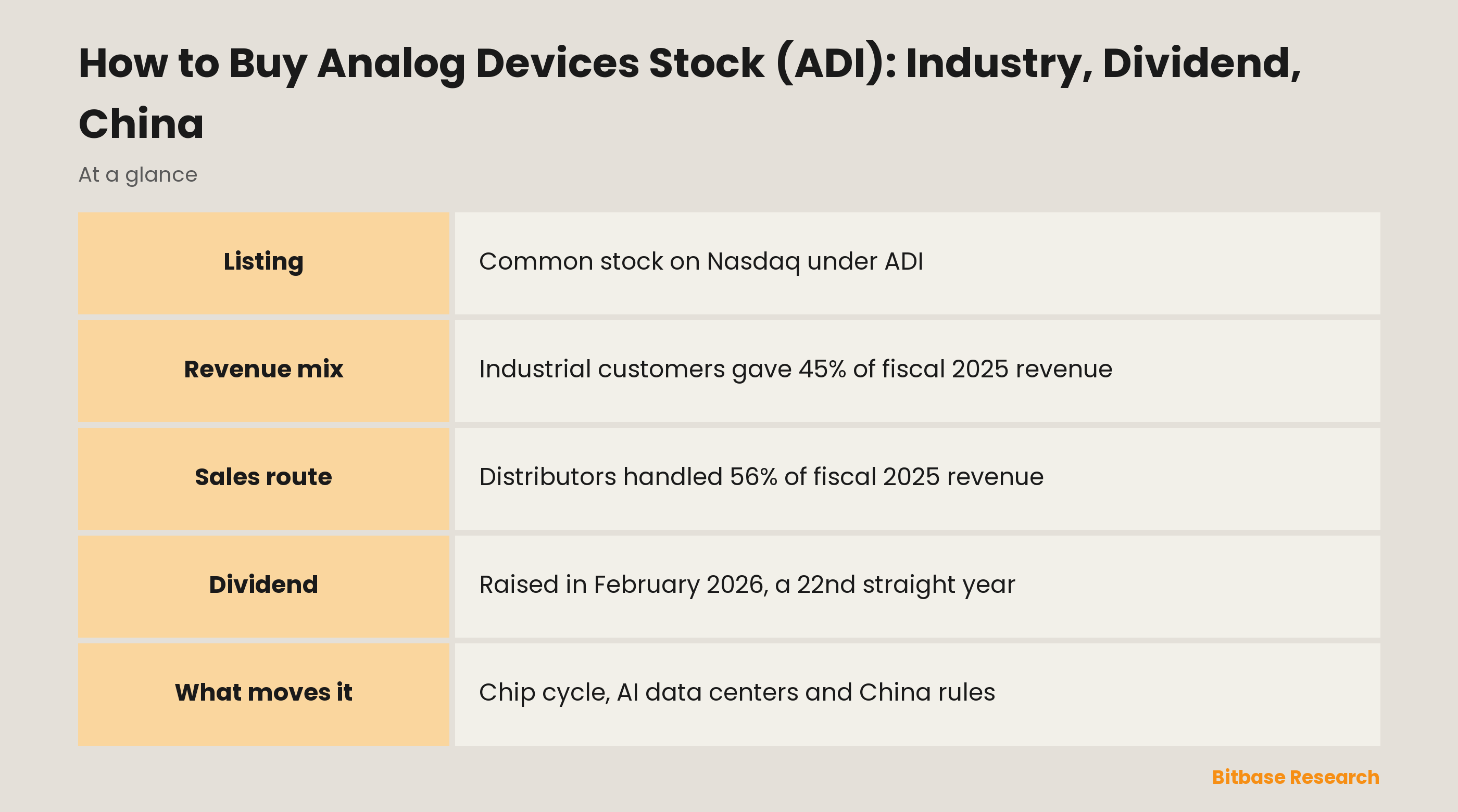
Adding Analog Devices shares to a portfolio works like any other Nasdaq purchase: open an account with a broker that offers US stocks, fund it and place an order for ADI, the ticker of the company's common stock on the Nasdaq Global Select Market. What the order buys is less familiar: a maker of the chips that turn temperature, pressure, sound and motion into data, whose industrial customers brought in 45% of fiscal 2025 revenue, more than any other market. This guide covers where that revenue comes from, how to buy the stock from inside or outside the US, and which risks the company's filings put first.
What Does Analog Devices Do?
Analog Devices, or ADI, designs and makes semiconductors for the point where electronics meet the physical world. Its annual report says the company plays "a critical role at the intersection of the physical and digital worlds by providing the building blocks to sense, measure, interpret, connect and power." It was incorporated in Massachusetts in 1965 and is headquartered in Wilmington, near Boston.
The core of the catalogue is analog and mixed-signal chips. In the 10-K's words, its analog ICs "monitor, condition, amplify or transform continuous analog signals associated with physical properties, such as temperature, pressure, weight, light, sound or motion," and they also regulate voltage and control power. Data converters, which translate real-world signals into digital data and back, remain the company's "largest and most diverse product family." Around them sit power management chips, amplifiers, RF parts, MEMS sensors such as accelerometers, and digital signal processors.
Much of today's ADI was assembled through acquisitions. Hittite Microwave, bought in fiscal 2014, strengthened its RF business; Linear Technology, bought in fiscal 2017, "added high-performance power management and additional precision signal processing"; Maxim Integrated joined on 26 August 2021 in a deal paid in ADI shares. On 9 September 2026 ADI agreed to buy Alif Semiconductor, a maker of low-power microcontrollers and processors with built-in AI acceleration, for cash.
Manufacturing is split between in-house and outside capacity. ADI runs its own wafer fabs in Wilmington, Massachusetts; Camas, Washington; Beaverton, Oregon; and Limerick, Ireland, yet it sources "more than half of our wafer requirements annually" from third-party foundries such as TSMC.
Where Analog Devices' Revenue Comes From
ADI reports a single operating segment, so the useful breakdown is by end market. Fiscal 2025, which ended on 1 November 2025, looked like this:
| End market | Share of fiscal 2025 revenue | Change from fiscal 2024 | Examples named in the 10-K |
|---|---|---|---|
| Industrial | 45% | +15% | Factory automation, test equipment, aerospace and defense, healthcare, energy |
| Automotive | 30% | +16% | Battery management, audio and connectivity, video, power |
| Consumer | 13% | +19% | Smartphones, wearables, hearables, prosumer audio |
| Communications | 13% | +26% | Base stations, broadband, data center power and connectivity |
Shares are rounded, as in the 10-K, so they may not add up exactly.
Total revenue rose 17% in fiscal 2025, after falling about 23% in fiscal 2024. The mix moved too: industrial was 53% of revenue in fiscal 2023 and automotive 24%.
Most chips reach customers through middlemen. Distributors accounted for 56% of fiscal 2025 revenue and direct customers, mainly equipment makers, for 43%. The largest distributor alone represented 24% of revenue and another 13%; no other customer passed 10%. ADI typically has no long-term sales contracts, so orders can shrink quickly when buyers hold too much inventory.
ADI counts revenue by where the distributor or manufacturer that bought the chips is located, not where the finished product ends up. On that basis, about 71% of fiscal 2025 revenue came from outside the United States, and China alone accounted for 25.9%, after growing 34% during the year.
ADI Stock Key Facts
| Item | Detail |
|---|---|
| Exchange | Nasdaq Global Select Market; on the New York Stock Exchange until April 2012 |
| Ticker | ADI |
| Security | Common stock, the only security registered on the 10-K cover |
| Sector | Semiconductors: analog, mixed-signal, power and RF chips |
| Index membership | S&P 500, held by SPY on 16 October 2026 |
| Headquarters | Wilmington, Massachusetts |
| Incorporated | Massachusetts, 1965 |
| Fiscal year | 52 or 53 weeks, ending on the Saturday closest to 31 October |
| Dividend policy | Quarterly cash dividend; the February 2026 increase marked 22 consecutive years of higher dividends |
| Share repurchases | Ongoing program first authorized in 2004 and amended since |
| SEC identifier | CIK 6281 |
Quotes and market value change through every session; the Analog Devices stock page on Bitbase shows them live.
How to Buy Analog Devices Stock
ADI is a US company with a single US listing, so there is no depositary receipt to weigh against a local share. The purchase goes through a broker:
1. Find a broker that can reach Nasdaq. Outside the US, that can be a local firm that routes orders to US markets or an international broker; either way, check who regulates it.
2. Open the account. Expect identity checks and, if you are not a US person, Form W-8BEN, which lets the broker apply your treaty rate to US dividends.
3. Move money in. Funding in a currency other than US dollars adds a conversion cost.
4. Look up ADI and confirm the listing. The match you want is Analog Devices, Inc. common stock on Nasdaq. On an exchange a symbol belongs to one issuer at a time, unlike crypto tickers that two projects can share.
5. Pick the order type. Investor.gov explains that a market order "guarantees that the order will be executed, but does not guarantee the execution price," while a limit order is "an order to buy or sell a security at a specific price or better."
6. Decide how much to buy. Some brokers sell fractional shares, so you can invest a fixed sum, but "not every brokerage firm offers fractional share investing," some take only market orders on fractional quantities, and on a fraction you "may not have voting rights."
7. Keep the paperwork. Trade confirmations and account statements document what you paid and every dividend credited.
Outside the United States, the tax treatment differs. The IRS states: "Most types of U.S. source income received by a foreign person are subject to U.S. tax of 30%." A lower rate, or an exemption, may apply under a tax treaty with your country, which is why brokers collect Form W-8BEN; your own country may tax the dividend again. This is not tax advice.
Through an index fund, you own ADI without choosing it: as an S&P 500 constituent it sits in funds tracking that index, such as State Street's SPY, as one small position among hundreds.
What Drives the ADI Share Price
Inventory cycles at industrial customers. Equipment makers cut orders when their component stocks run high. The 10-K says ADI has experienced "periods of customer inventory adjustments," and the numbers show the swing: revenue fell about 23% in fiscal 2024, then rose 17% in fiscal 2025 as customer inventories normalized. In the quarter ended 1 August 2026, revenue was 40% higher than a year earlier and industrial revenue 53% higher, led by test equipment and aerospace and defense.
AI data centers. Communications, one of ADI's two smallest markets in fiscal 2025, has grown fastest of late: up 26% that year and 84% in the quarter ended August 2026, when the 10-Q said "the strongest growth within Communications came from the data center sub-market, driven by artificial intelligence-related infrastructure investments." ADI sells power management and high-speed connectivity products into data centers, so the same spending that moves AI infrastructure stocks now reaches its results.
Cars. Automotive rose from 24% of revenue in fiscal 2023 to 30% in fiscal 2025, and the 10-K credits the 2025 gain mainly to connectivity solutions. Battery management systems are among the applications it lists, so vehicle production and electrification feed into this line.
Factory loading and margins. Running its own fabs ties part of ADI's costs to how full they are. Gross margin rose to 61.5% in fiscal 2025 from 57.1%, mainly because of "higher utilization of our factories due to increased customer demand" and lower amortization of acquired intangible assets, and it reached 67.3% in the quarter ended August 2026, against 62.1% a year earlier.
China and trade rules. China was 25.9% of fiscal 2025 revenue by buyer location. The 10-K warns that "export restrictions limit our ability to sell to certain Chinese companies and to third parties that do business with those companies," restrictions that "have continued to expand over the past several years."
Deals and capital return. The Alif purchase was expected to close before the end of calendar 2026, subject to US antitrust clearance, and the quarterly dividend went up 11% in February 2026.
Risks Before You Buy ADI
The risk factor section of the 10-K runs to many pages; these are the points closest to an ADI share.
The chip cycle. "The markets for semiconductor products are cyclical, and increased production may lead to overcapacity and lower prices, and conversely, we may not be able to satisfy unexpected demand for our products."
Reliance on distributors. One distributor alone is 24% of revenue, and the 10-K is direct about the exposure: "Our operating results are dependent on the performance of independent distributors."
Outside foundries and Taiwan. ADI warns that "tensions across the Taiwan Strait or other geopolitical events could disrupt TSMC's operations, which would adversely affect our ability to manufacture certain products."
Cybersecurity. On 23 June 2026 ADI identified unauthorized access to some of its systems and found that certain files had been exfiltrated. It said operations were not interrupted and that, on what it knew, it did not believe the incident was reasonably likely to have a material impact; its July 2026 filing called the investigation ongoing.
The stock itself. The 10-K cautions that "the market price of our common stock may be volatile," and future dividends "remain subject to determination and declaration by our Board of Directors." If your money is in another currency, the exchange rate sits on top of both price and dividend.
Where to Check ADI Facts Yourself
ADI files with the SEC under CIK 6281. The fiscal 2025 10-K was filed on 25 November 2025, a few weeks after the year closed; 10-Qs and 8-K results releases follow during the year, and the investor relations site carries the same documents.
In the 10-K, Item 1 covers products and end markets, Item 1A the risk factors, and Item 7 revenue by end market, channel and region; the shareholder return graph benchmarks ADI against the S&P 500 and the S&P Semiconductors Index.
One detail prevents an easy mistake: fiscal 2024 lasted 53 weeks, with the extra week in its first quarter, so growth rates against that year compare periods of unequal length. For quotes, use the stock page above, or browse Bitbase's pages for other US stocks.
ADI Stock FAQ
Does Analog Devices pay a dividend?
Yes, in cash every quarter. The increase announced on 17 February 2026 raised the quarterly payment by 11% and, in the company's words, marked "22 consecutive years of higher dividends." The board declares each dividend; the current amount and dates are in ADI's latest results release.
Can I buy Analog Devices stock with crypto?
Not directly. ADI shares are bought through a brokerage account with cash, so crypto has to be sold and the money transferred first; depending on your country, that sale may be taxable. A share gives you a registered ownership stake with dividend and voting rights, and a share and a crypto asset differ in more than price.
Is ADI listed on Nasdaq or the NYSE?
Nasdaq. The common stock has traded on the Nasdaq Global Select Market as ADI since April 2012; before that it was listed on the New York Stock Exchange. It is also in the S&P 500, as the 10-K states and SPY's holdings on 16 October 2026 confirm.
When does Analog Devices' fiscal year end?
On the Saturday closest to 31 October; fiscal 2025 ended on 1 November 2025. Most years have 52 weeks, and some, such as fiscal 2024, have 53. The first fiscal quarter runs roughly from November to January, and the company says its sales in that quarter have historically been lower because some customers shut their plants.
Has ADI stock ever split?
Yes. The fiscal 2000 annual report notes a two-for-one split that took effect on 15 March 2000, so per-share prices and dividends from before that date need adjusting before comparison.
Conclusion
Buying ADI takes a broker with Nasdaq access, a check that the order line reads Analog Devices common stock, and a choice of order type. The harder work is understanding the company: an analog chipmaker leaning on industrial equipment, cars and, increasingly, AI data centers, selling largely through distributors and exposed both to China and to an outside foundry in Taiwan. Read the latest 10-K and 10-Q, and the filing on the Alif deal, before deciding how much of a portfolio one chipmaker should be.
Related reading
Other Bitbase articles on this topic:
- How to Buy Applied Materials Stock (AMAT): China Risk and Perps
- How to Buy ASE Technology Stock (ASX): NYSE ADSs and Taipei 3711
- How to Buy KLA Stock (KLAC): Chip Inspection, 10-for-1 Split
- How to Buy SK hynix Stock (SKHY): Nasdaq ADS or Seoul Shares
Disclaimer: This article is educational content from Bitbase Academy, provided for information only. It explains what a company or fund does and how the instruments referenced here differ from one another; it does not constitute investment, trading, tax, or financial advice, and it is neither a recommendation nor an endorsement of any security, token, or trading strategy. A tokenized stock is issued by a third party and is designed to give economic exposure to an underlying asset: it is not a share, it carries no shareholder rights, and it depends on the issuer's structure, eligibility rules, and redemption terms, which the issuer can change. Perpetual futures are leveraged derivatives that hold no underlying asset and can be liquidated, and trading hours, product availability, and eligibility differ by instrument and by jurisdiction and can change at any time. Written as of October 2026; verify everything yourself through company filings, the issuer's own documentation, and the product pages of the venue you trade on.
References
[1] Analog Devices Form 10-K, fiscal 2025: business, revenue by end market, channel and region, risk factors (SEC EDGAR) www.sec.gov
[2] Analog Devices Form 10-Q for the quarter ended 1 August 2026: revenue by end market, gross margin, cybersecurity risk factor (SEC EDGAR) www.sec.gov
[3] Analog Devices press release, 17 February 2026: quarterly dividend raised 11%, 22 consecutive years of higher dividends (Form 8-K exhibit) www.sec.gov
[4] Analog Devices and Alif Semiconductor joint press release, 9 September 2026: agreement for ADI to acquire Alif (Form 8-K exhibit) www.sec.gov
[5] Analog Devices Form 8-K, 29 July 2026: cybersecurity incident identified on 23 June 2026 (SEC EDGAR) www.sec.gov
[6] Analog Devices Form 10-K, fiscal 2021: acquisitions of Hittite, Linear Technology and Maxim Integrated (SEC EDGAR) www.sec.gov
[7] Analog Devices Form 10-K, fiscal 2012: Nasdaq listing, on the New York Stock Exchange before 2 April 2012 (SEC EDGAR) www.sec.gov
[8] Analog Devices Form 10-K, fiscal 2000: two-for-one stock split effected on 15 March 2000 (SEC EDGAR) www.sec.gov
[9] State Street SPDR S&P 500 ETF Trust (SPY): fund page and daily holdings www.ssga.com
[10] Investor.gov (SEC): Types of Orders www.investor.gov
[11] Investor.gov (SEC): Investor Bulletin on fractional share investing www.investor.gov
[12] IRS: NRA Withholding www.irs.gov





