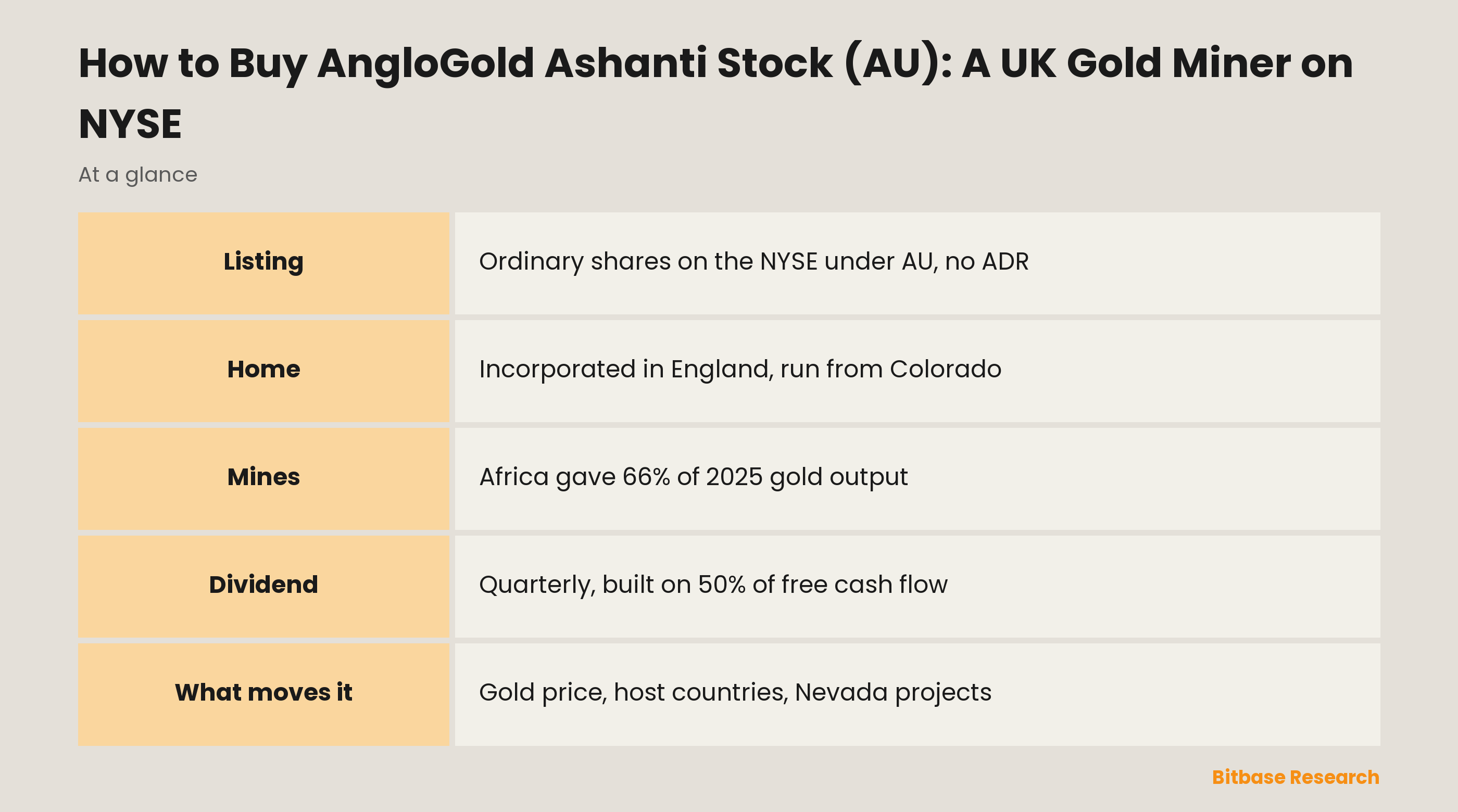
Buying into AngloGold Ashanti works like buying any other New York listing: through a broker with NYSE access, under the ticker AU. What sits behind the ticker is less ordinary. Since a 2023 restructuring, AU has been the ordinary share of a company incorporated in England, run from Colorado and producing gold mainly in Africa, which supplied about 66% of its 2025 output. This guide covers the mines, the order itself, the tax points that differ from a US company, and the forces its filings return to.
What Does AngloGold Ashanti Do?
AngloGold Ashanti mines gold. Its annual report describes it as "an independent, global gold mining company with a diverse portfolio of operations, projects and exploration activities across 10 countries on four continents." In 2025 it produced gold from ten operations in eight countries: Argentina, Australia, Brazil, Egypt, Ghana, Guinea, the Democratic Republic of the Congo and Tanzania, with greenfield projects in the United States and Colombia.
The group took shape in 1998, when Anglo American plc folded its gold mining interests into AngloGold Limited, and it became AngloGold Ashanti in 2004 after combining with Ashanti Goldfields of Ghana. For most of its history the parent company was South African. That changed in September 2023, when the operations were reorganized under a new parent, AngloGold Ashanti plc, "incorporated in England and Wales and tax resident in the United Kingdom," with "a primary listing of its ordinary shares on the New York Stock Exchange." The group is now headquartered in the Denver area of Colorado and keeps a large corporate office in Johannesburg.
The mines fall into three regions:
Africa carries the weight. The company manages five operations there: Sukari in Egypt, which came with the 2024 purchase of Centamin plc; Iduapriem and Obuasi in Ghana; Siguiri in Guinea; and Geita in Tanzania. It also owns 45% of Kibali in the DRC, a joint venture run by Barrick, in which a state-owned company holds 10% for the government. Together these six supplied about 66% of 2025 production.
Australia has two mines in Western Australia: Sunrise Dam, wholly owned, and Tropicana, where AngloGold Ashanti holds 70% and acts as operator, with Regis Resources owning the other 30%. They made up about 18% of output.
The Americas contributed about 16%, from Cerro Vanguardia in Argentina and AGA Mineração in Brazil. A third operation, Serra Grande in Brazil, was sold to Aura Minerals on 1 December 2025.
The pipeline points north. In southern Nevada, near the town of Beatty, the company is developing the Arthur Gold Project and North Bullfrog. A pre-feasibility study reported a first Mineral Reserve for Arthur at the end of 2025 and an initial nine-year mine life. On 3 November 2026 the board approved funding for the execution phase of North Bullfrog, subject to receipt of federal and state permits. In Colombia, by contrast, the company agreed on 7 March 2026 to sell the subsidiary that owns the La Colosa project to Mineros S.A.
How AngloGold Ashanti Makes Money
The business model is simple to describe. Ore is processed into doré, or unrefined bars, at each mine, refined to at least 99.5% purity, and the refined gold is "sold directly to bullion banks." Silver from Argentina and sulphuric acid from Brazil are by-products. The 20-F says "competition for sales" plays no role, since gold sells into a deep global market; companies compete instead for deposits, exploration ground and people.
That leaves two things to drive results: how many ounces come out of the ground, and what each ounce fetches. In 2025 the second did most of the work. Revenue from product sales rose 71%, gold income rose 72%, and the average gold price received per ounce climbed about 45%. The company's remuneration report says free cash flow increased 204% year on year.
| Region | Share of 2025 revenue from product sales | Share of 2025 gold production | Operations |
|---|---|---|---|
| Africa | 62% | 66% | Sukari, Geita, Siguiri, Obuasi, Iduapriem, plus Kibali (45%) |
| Australia | 19% | 18% | Tropicana (70%), Sunrise Dam |
| Americas | 19% | 16% | Cerro Vanguardia, AGA Mineração, Serra Grande until December 2025 |
The bases differ: Kibali is a joint venture, so its sales stay out of group revenue while its attributable ounces count as production.
Two mines stand out. Sukari and Geita each brought in about 18% of 2025 gold income, and Tropicana, counted at the company's 70% share, about 11%.
Not every ounce belongs entirely to shareholders of the plc. When the company defines free cash flow, it subtracts "distributions to non-controlling interests in Sukari (50%), Siguiri (15%) and Cerro Vanguardia (7.5%)." Revenue from Sukari counts in full in the income statement, but half of what it distributes goes to the minority interest. Host governments shape cash flow in other ways too: in June 2025 the company agreed with the Bank of Tanzania to sell 20% of Geita's annual production through the Geita Gold Refinery, a local refiner.
AU Stock at a Glance
| Feature | AU |
|---|---|
| Exchange | New York Stock Exchange (primary listing) |
| Ticker | AU |
| Security | Ordinary shares of AngloGold Ashanti plc; no American Depositary Shares |
| Other listings | Johannesburg Stock Exchange and A2X as ANG; Ghana Stock Exchange as AGA, plus Ghanaian Depositary Shares as AAD |
| Sector | Gold mining |
| Incorporated | England and Wales, tax resident in the United Kingdom |
| Headquarters | Denver area, Colorado; registered office in London |
| Annual report | Form 20-F, financial statements under IFRS |
| Fiscal year | Calendar year, ending 31 December |
| Dividend | Quarterly, under a policy linked to free cash flow |
| SEC identifier | CIK 1973832 |
Price, market value and dividend yield move with every trade, so they are left out here. For live figures, open the AngloGold Ashanti stock page on Bitbase.
How to Buy AngloGold Ashanti Stock
Because AU is an ordinary share listed directly on the NYSE, the purchase looks like buying any US-listed stock:
1. Find a broker that reaches the NYSE. Outside the US, that can be a local broker offering US shares or an international platform. Check which legal entity holds your account and who regulates it.
2. Open and verify the account. Expect identity checks and tax-status forms, which brokers ask for on all US-listed shares.
3. Fund it. If your money is in another currency, the conversion rate matters as much as the commission.
4. Search for AU. Confirm the name reads AngloGold Ashanti plc on the NYSE. Two-letter tickers are easy to mistype, so check the full listing before you confirm.
5. Choose an order type. A market order fills at the next available price; a limit order fills only at your price or better. FINRA's investor guide explains the trade-off.
6. Decide the size. Some brokers sell fractional shares, but not for every stock, and fractional holders may not get every shareholder right; FINRA's fractional-share guide lists the questions to ask.
7. Keep the records. Confirmations and statements show your cost and every dividend received.
Taxes look different from a US company. Since AngloGold Ashanti plc is a UK company, its 20-F says it "is not required to withhold UK tax at source from dividends." For non-US shareholders, it states that dividends "will not be subject to U.S. federal income tax unless the dividends are 'effectively connected'" with a US trade or business. Your broker's own procedures and the tax rules where you live still apply, so read the 20-F's taxation section with your own adviser.
Stamp duty depends on where the shares sit. Shares bought on the NYSE are held in book-entry form through The Depository Trust Company, and the company says such transfers "should not attract a charge to UK stamp duty" or its sister tax, SDRT. Moving shares out of that system, or selling them outside it, can bring a 0.5% charge, and moving shares back in "will likely attract" 1.5%. Buying and selling through a US broker keeps you inside the system.
Johannesburg and Accra are separate routes. The same ordinary shares trade as ANG in South Africa, priced in rand, and in Ghana, where a Ghanaian Depositary Share equals one one-hundredth of an ordinary share. Moving shares between registers can trigger the costs above.
Through a fund. AngloGold Ashanti is not an S&P 500 member: State Street's daily holdings file for SPY, dated 5 November 2026, did not include it. Funds built around gold miners may hold it; check a fund's published holdings before relying on that.
What Moves AU Stock
The gold price. The 20-F says the market price of gold "has been and continues to be significantly volatile and is often subject to sharp, short-term changes," and lists reasons from central bank policy and interest rate expectations to the strength of the US dollar and gold buying by central banks. Because costs do not move one for one with the metal, a change in the gold price can move profits by more in percentage terms, which is why 2025 revenue growth of 71% came with a far larger jump in free cash flow.
Costs that follow the metal. Some costs rise with gold. In the third quarter of 2026, total cash costs per ounce were about 25% higher than a year earlier and all-in sustaining costs about 26% higher. The company attributed 61% of the increase in cash costs to outside, market-driven factors, chiefly royalties linked to the gold price and higher fuel prices.
Mine-by-mine events. With a handful of assets carrying the group, single sites matter. Third-quarter 2026 output fell 43% at Iduapriem after flooding from a neighboring mine, 26% at Obuasi, 21% at Sukari and 15% at Tropicana, while Siguiri rose 49%. Sukari paused underground work for 30 days after a fatal rockfall in August 2026, and Obuasi had a contractor fatality in April. The company still reported EBITDA up 12% for the quarter, supported by a higher gold price received.
Host-country terms. Mining rules, taxes, export arrangements and currency controls set how much cash reaches the parent. The Geita sale agreement with Tanzania's central bank, foreign exchange controls in Argentina since 2019, and cash from the DRC that waits for repatriation all show this at work.
Nevada and the capital cycle. The company planned a 45% rise in third-quarter capital spending as it funds waste stripping, fleet upgrades and the two Nevada projects. Progress on permits for North Bullfrog and the feasibility study at Arthur will affect how investors weigh spending today against future ounces.
Dividends and buybacks. The policy pays 50% of free cash flow, so the payout rises and falls with the gold cycle. At a general meeting on 23 July 2026, shareholders approved an authority to buy back shares off-market, with about 66% of votes in favor.
Country, Cost and Control Risks at AngloGold Ashanti
These risk factors from the 20-F are the most specific to this company:
Rapid policy change. The company says that, "based on the Company's past experience, political, tax and economic laws and policies in countries in which AngloGold Ashanti operates can change rapidly," and that "as mining assets are fixed and largely immovable, the adverse impacts of any such changes may be unavoidable, material and immediate."
Partners in control. Kibali is run by Barrick, and AngloGold Ashanti "cannot ensure that these joint ventures or projects are operated, particularly on a day-to-day basis, in compliance with the standards" it applies elsewhere.
Illegal mining and security. "Artisanal and illegal miners are active on, or adjacent to, at least nine of AngloGold Ashanti's properties, mainly in Guinea, Ghana, Tanzania, Egypt and Brazil," and the most significant security problems have occurred in Guinea, Ghana and Tanzania.
Currencies and trapped cash. Gold is priced in dollars, but costs are partly paid in local currencies, from the Brazilian real and Argentine peso to the Ghanaian cedi, Egyptian pound and South African rand. A weaker dollar raises costs in dollar terms, and limits on moving money across borders can delay dividends from subsidiaries.
Internal controls. Management concluded that its internal control over financial reporting "was not effective" at the end of 2025 because of a material weakness tied to integrating the Centamin business. The same filing corrected an immaterial classification error in Brazilian tax balances.
Mining itself. Tailings storage, mining hazards, safety incidents and the need to keep replacing Mineral Reserve all appear in the risk list, and 2026 has already brought fatalities at two mines.
On top of these, there are the usual risks of a single stock. Under English law a company can only pay dividends out of distributable reserves, and the 20-F warns that "cash dividends may not be paid in the future." The quarterly amount has varied widely because it follows free cash flow.
How to Research AU Yourself
AngloGold Ashanti files as a foreign private issuer. That means an annual report on Form 20-F, not a 10-K, and Form 6-K for everything else: quarterly earnings releases, operating statistics, dividend notices and meeting results. There are no 10-Qs. Everything sits on EDGAR under CIK 1973832. Filings of the South African predecessor, including its years of ADS listing, sit under a separate CIK.
Inside the 20-F, Item 3D holds the risk factors, Item 4 describes each mine and region, Item 5 explains the year's results, Item 8 sets out the dividend policy, Item 10E covers UK and US tax, and Item 15 carries the internal control conclusion. The segment note in the financial statements gives gold income by mine.
Three checks help when reading. First, separate managed operations from Kibali, since the company reports one on a consolidated basis and the other on an attributable basis. Second, cost measures such as all-in sustaining costs are non-GAAP figures defined by the company, so compare them over time rather than across companies without reading the definitions. Third, mine-level production is easiest to follow in the operating statistics filed with each quarterly release.
For context on peers, our guides to Newmont stock and Barrick stock cover two other large producers, including Barrick as the operator of Kibali. Quotes are on the stock page linked above, and Bitbase's list of US stock pages covers other listed companies.
AngloGold Ashanti Stock FAQ
Can I buy AngloGold Ashanti stock with crypto?
Not directly. AU is bought through a brokerage account, usually in US dollars, so crypto has to be sold for cash and moved to the broker first, and that sale may be taxable where you live. A share also gives you rights in a registered company, which is how a share differs from a crypto asset.
Is AU stock an ADR?
No. The 20-F lists ordinary shares as the registered equity on the NYSE and states that American Depositary Shares are "not applicable." Before the 2023 restructuring, the NYSE line was ADSs of the South African parent; today the shares you buy in New York are the same ordinary shares that trade in Johannesburg.
Does AngloGold Ashanti pay a dividend?
Yes. The board declares dividends quarterly under a policy built on a 50% payout of free cash flow, with a minimum base amount, subject to a leverage limit. Dividends are declared in US dollars and paid in US dollars, South African rand and Ghanaian cedis. The amount changes from quarter to quarter.
Is AngloGold Ashanti a South African company?
Not anymore, legally. Since September 2023 the parent has been incorporated in England and Wales and is tax resident in the UK, with its group headquarters in Colorado. Its roots, its secondary listing and a large office remain in Johannesburg, but it no longer runs mines in South Africa.
Is AU in the S&P 500?
No. It is a UK-incorporated company, and the SPY holdings file of 5 November 2026 did not include it.
Conclusion
AngloGold Ashanti is a UK company whose earnings rest on the gold price, a few large African mines, and the partners and host governments around them, and it is also pursuing a costly growth plan in Nevada. That mix means the share can move for reasons that have nothing to do with gold. Read the latest 20-F and the quarterly 6-K releases, follow Sukari, Geita and Kibali in particular, and decide how much exposure to one gold producer fits your portfolio.
Related reading
Other Bitbase articles on this topic:
- How to Buy ArcelorMittal Stock (MT): Real Shares, Not an ADR
- How to Buy Cameco Stock (CCJ): Uranium, Westinghouse, Vote Caps
- How to Buy Corteva Stock (CTVA): After the Vylor Seed Spin-Off
- How to Buy Kinross Gold Stock (KGC): Paracatu, Tasiast and NYSE
Disclaimer: This article is educational content from Bitbase Academy, provided for information only. It explains what a company or fund does and how the instruments referenced here differ from one another; it does not constitute investment, trading, tax, or financial advice, and it is neither a recommendation nor an endorsement of any security, token, or trading strategy. A tokenized stock is issued by a third party and is designed to give economic exposure to an underlying asset: it is not a share, it carries no shareholder rights, and it depends on the issuer's structure, eligibility rules, and redemption terms, which the issuer can change. Perpetual futures are leveraged derivatives that hold no underlying asset and can be liquidated, and trading hours, product availability, and eligibility differ by instrument and by jurisdiction and can change at any time. Written as of November 2026; verify everything yourself through company filings, the issuer's own documentation, and the product pages of the venue you trade on.
References
[1] AngloGold Ashanti Form 20-F for 2025 (SEC EDGAR) www.sec.gov
[2] AngloGold Ashanti 2025 Form 20-F, XBRL cover page (SEC EDGAR) www.sec.gov
[3] AngloGold Ashanti 2025 Form 20-F, XBRL segment data (SEC EDGAR) www.sec.gov
[4] AngloGold Ashanti third-quarter 2026 earnings release, Form 6-K (SEC EDGAR) www.sec.gov
[5] AngloGold Ashanti on the Arthur Gold Project, Form 6-K of March 2026 (SEC EDGAR) www.sec.gov
[6] AngloGold Ashanti general meeting result, July 2026, Form 6-K (SEC EDGAR) www.sec.gov
[7] AngloGold Ashanti Limited 2022 Form 20-F, XBRL cover page (SEC EDGAR) www.sec.gov
[8] State Street SPDR S&P 500 ETF Trust (SPY): fund page and daily holdings www.ssga.com
[9] FINRA: Order Types www.finra.org
[10] FINRA: Investing in Fractional Shares www.finra.org





