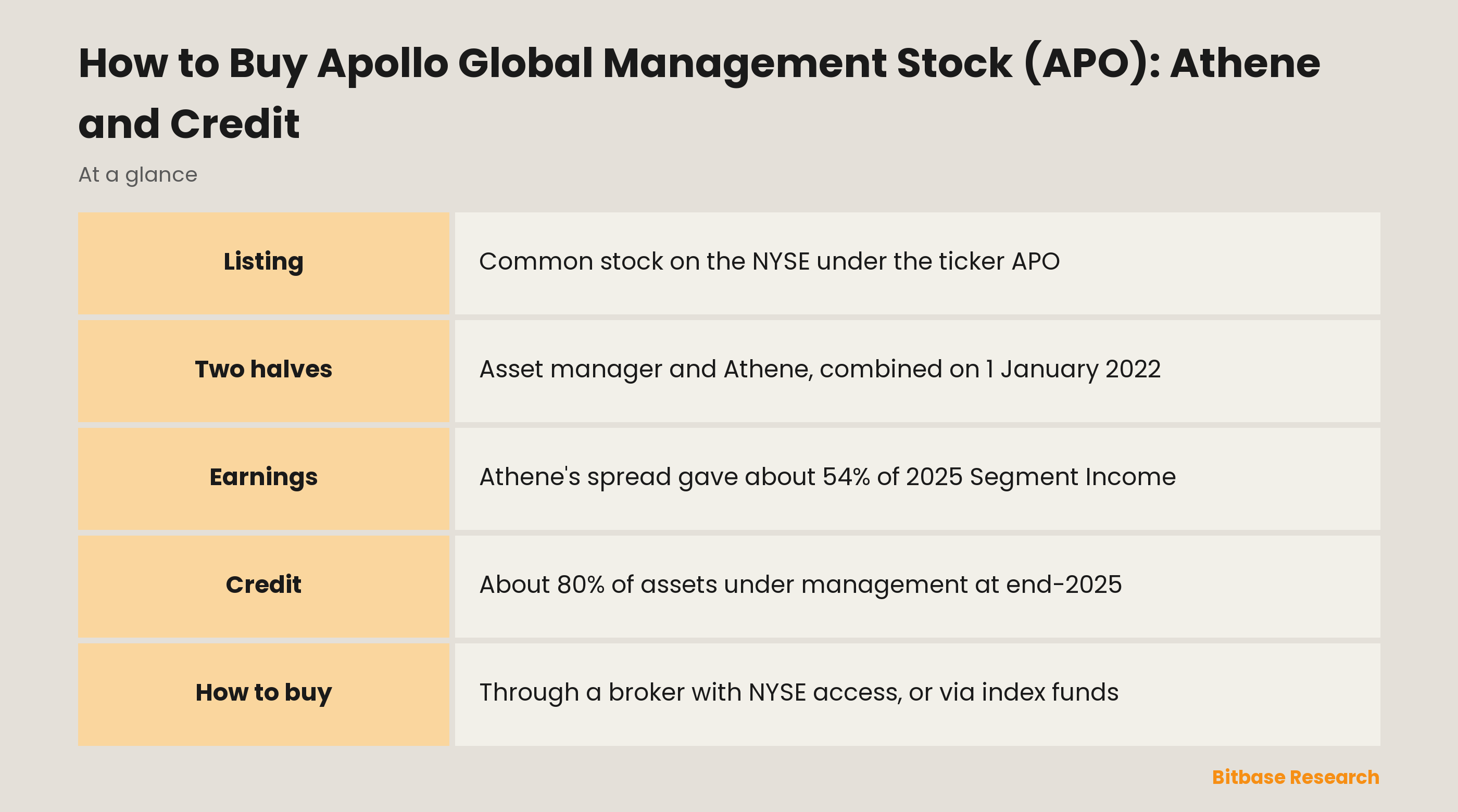
Comparing brokers is about the only choice involved in buying Apollo Global Management stock: the common shares trade on the New York Stock Exchange under the ticker APO, and any broker with NYSE access can take the order. Since a merger on 1 January 2022, one APO share has held two businesses: an alternative asset manager whose largest strategy is credit, and Athene, a retirement services insurer whose spread earnings made up about 54% of Apollo's 2025 Segment Income. Below: how each half earns, how to place the order, and what the filings flag.
What Does Apollo Global Management Do?
Apollo calls itself "a high-growth, global alternative asset manager and a retirement services provider." Founded in 1990, it is incorporated in Delaware, based at 9 West 57th Street in New York, and reports three segments.
Asset Management invests for pension, endowment and sovereign wealth funds, insurers and individuals, and charges fees for it. The 10-K describes a "contrarian, value-oriented" approach that stresses "downside protection, and the preservation of capital." Credit is the largest strategy, about 80% of assets under management at the end of 2025, across direct origination, asset-backed finance, opportunistic credit and multi-credit. Equity covers corporate private equity, hybrid value, the semi-liquid AAA vehicle, real estate and infrastructure. Bridge, a US manager of residential and industrial property funds, was acquired in an all-stock deal on 2 September 2025.
Retirement Services is Athene, based in West Des Moines, Iowa, which "specializes in issuing, reinsuring and acquiring retirement savings products." Its two product lines are annuities and funding agreements, with fixed indexed annuities the largest share of reserve liabilities, and it sells through retail, flow reinsurance, institutional, and acquisitions and block reinsurance channels. Apollo's asset management arm invests the portfolio: accounts tied to Athene made up about 42% of Apollo's total assets under management at the end of 2025.
Principal Investing collects realized performance fees and realized gains on Apollo's own balance-sheet investments, less some corporate costs; the 10-K calls its earnings "inherently more volatile" than the other two segments'.
The current shape is recent. The Class A shares of what was then a limited liability company began trading on the NYSE on 30 March 2011, and the firm became a corporation on 5 September 2019. On 1 January 2022 the old Apollo and Athene Holding became subsidiaries of a new parent, today's Apollo Global Management, Inc., which took over the APO ticker from 3 January 2022 and moved from an Up-C structure to "a C-corporation with a single class of common stock."
How Apollo Global Management Makes Money
Each segment has its own non-GAAP measure, and the three add up to Segment Income:
| Segment | Measure | What goes into it | Share of 2025 Segment Income | Change from 2024 |
|---|---|---|---|---|
| Asset Management | Fee Related Earnings (FRE) | Management, capital solutions and fee-related performance fees, less related costs | 40.6% | +22.5% |
| Retirement Services | Spread Related Earnings (SRE) | Athene's net investment earnings, less cost of funds and operating costs | 54.0% | +4.2% |
| Principal Investing | Principal Investing Income (PII) | Realized performance fees and investment income, less related pay and costs | 5.4% | +24.7% |
Shares are calculated from the segment figures in the fiscal 2025 10-K and rounded to one decimal.
Fees. Management fees are the base of FRE, and credit earned 73% of them in 2025; capital solutions fees come from arranging and syndicating financing for borrowers. Perpetual capital vehicles, which can deploy money continuously, "represent nearly 60% of total AUM and over 70% of total fee-generating AUM," so much of the fee base does not wait on a new closed-end fund. Insurance is what separates this model from how BlackRock earns its revenue.
Spread. Athene invests premiums and deposits mainly in high-grade fixed income and keeps the gap between what the portfolio earns and what it credits policyholders and pays for funding. In 2025 that net investment spread was 1.61%, against 1.78% in 2024, because the cost of funds climbed to 3.69% from 3.29% faster than portfolio yields rose. That is why SRE grew more slowly than FRE.
Performance fees. These depend on fund returns, and Apollo has "increased the proportion of performance fee income we pay to our employees over time." Its traditional private equity funds produced "a 39% gross IRR and a 24% net IRR on a compound annual basis from inception through December 31, 2025," though the same filing warns that "historical performance metrics are unreliable indicators" of future results.
APO Stock at a Glance
| Item | Detail |
|---|---|
| Exchange | New York Stock Exchange (NYSE) |
| Ticker | APO |
| Security | Common stock, one class since the 2022 merger |
| Other NYSE lines | APOS, Apollo's junior subordinated notes due 2053; Athene Holding's preferred shares and debentures under their own symbols |
| Sector | Financials: alternative asset management and retirement services |
| Index membership | S&P 500 (in State Street's SPY on 29 October 2026) |
| Headquarters | New York, New York |
| Incorporated | Delaware |
| Fiscal year | Calendar year, ending 31 December |
| Dividend | Paid quarterly, each payment declared by the board |
| SEC identifier | CIK 1858681 |
Quotes, market value and yield change by the second; the Apollo Global Management stock page on Bitbase shows them live.
How to Buy Apollo Global Management Stock
There is no depositary receipt to weigh: Apollo is a US company and APO on the NYSE is its common stock.
1. Choose a broker that reaches the NYSE, whether a local firm with US access or an international one, and note which entity and regulator stand behind your account.
2. Complete onboarding. Investors who are not US persons generally sign IRS Form W-8BEN, which goes "to the withholding agent or payer," here your broker.
3. Deposit money, and compare the exchange rate the broker applies as well as its commission.
4. Pick the correct security. The order ticket should read Apollo Global Management, Inc. common stock. APOS is debt, and the NYSE-listed Athene preferred shares are claims on Athene Holding, not on Apollo's common equity.
5. Set the order. Market orders take the next available price, while limit orders cap what you pay, useful when liquidity is thin or regular-session and extended-hours quotes part ways. Brokers that offer fractional shares let you invest a cash amount; ask whether a fraction carries votes.
Withholding. According to the IRS, "most types of U.S. source income received by a foreign person are subject to U.S. tax of 30%," with lower rates or exemptions possible under a treaty; your own country may also tax the dividend. This is general information, not tax advice.
Index funds. The holdings files of State Street's SPY and Financial Select Sector SPDR ETF (XLF) for 29 October 2026 both included Apollo, a small slice of each.
Funds are separate. The 10-K says it outright: "An investment in our shares is not an investment in any of the funds we manage, and the assets and revenues of such funds are not directly available to us."
What Moves APO Stock
Athene's spread. SRE, the biggest part of Segment Income, rests on the gap between portfolio returns and the cost of Athene's liabilities. The gap narrowed in 2025, and in the first half of 2026 SRE ran about 1.8% below a year earlier while FRE rose about 27.6%. Rates cut both ways: in 2025 they lifted yields on newly deployed assets and the rates paid on new business.
Alternative investments. Their income feeds SRE directly, and Apollo files an early estimate after each quarter: on 5 October 2026 it put the third quarter at an estimated 10% annualized return on alternative net investments, weeks before full results.
Fee growth. FRE rose 22.5% in 2025. The 10-K credits higher management fees from Athene, Bridge funds and new closes of existing funds, and fees from Athene grew with its inflows, so growth at the insurer enlarges the fee base too.
Realizations. PII tracks realized performance fees, which the 10-K calls cyclical; it is the smallest and most volatile of the three measures.
Equity markets. More of Athene's indexed annuity policies are linked to the S&P 500 than to any other index, and Athene buys index options to hedge them, so stock market swings show up in reported results as well.
Share count. APO.PRA, the mandatory convertible preferred stock, turned into common shares on 31 July 2026, and Bridge was paid for in stock; working the other way, a new buyback program took effect on 9 February 2026.
Two Businesses, Two Sets of Risk for APO
Of the many headings in Item 1A, these touch an APO share most directly.
Uneven earnings. "A portion of our revenues, earnings and cash flow is highly variable, which may make it difficult for us to achieve steady earnings growth on a quarterly basis, which may cause the price of our shares to be volatile."
Insurance ratings. "A financial strength rating downgrade, potential downgrade or any other negative action by a rating agency could make our product offerings less attractive," which matters to an insurer competing on financial strength.
Concentration. Athene's portfolio "may be subject to concentration risk, particularly with respect to single issuers, including Athora, among others; industries, including financial services; and asset classes, including real estate." Athora is a European life insurance platform in which Apollo and Athene hold minority stakes.
Private credit. Some Apollo funds invest in private credit "which may be illiquid, difficult to value and exit prior to maturity, and susceptible to credit deterioration, restructurings or losses."
The share itself. The board can cut or end the dividend, which the holding company funds from subsidiary distributions only after Athene's preferred dividends. The price can drop, and non-dollar investors take currency risk on price and payout.
Where to Check Apollo's Numbers
Apollo's SEC filings sit under CIK 1858681, with copies at ir.apollo.com. In the annual 10-K, Item 1 explains the segments and Item 1A the risks, the MD&A holds the FRE table and the net investment spread, and note 21 reconciles the segment measures, which Apollo cautions "may not be comparable to similarly titled measures used by other companies." 10-Qs follow each quarter and 8-Ks report events.
Two habits help. Watch for the brief 8-K after each quarter end with preliminary alternative income estimates; in 2026 they came on 1 April, 1 July and 5 October. And any filing that mentions Class A shares predates the 2022 merger. Beyond Apollo, browse more US stock pages on Bitbase.
Apollo Global Management Stock FAQ
Can I buy Apollo Global Management stock with crypto?
Not directly. Brokers sell APO shares for US dollars, so crypto must first be sold for cash, which may be taxable where you live, and the cash deposited with the broker. Keep the two decisions apart: an APO share is a stake in Apollo Global Management, Inc. with dividend and voting rights, unlike a crypto asset.
Does Apollo Global Management pay a dividend?
Yes, every quarter. The 10-K expects "an annual dividend on our common stock, with increases based on the growth of the business as determined by our board of directors," but the board approves each payment and can change the policy, even end the dividend. Amounts and dates are in the latest earnings release.
Is Apollo the same company as Athene?
Athene is part of Apollo. Since 1 January 2022, Athene Holding has been a subsidiary of Apollo Global Management, Inc., and its results reach APO holders as Spread Related Earnings. Its NYSE-listed preferred shares are not APO common stock.
Is APO in the S&P 500?
Yes. The holdings file of SPY, an S&P 500 tracker, listed Apollo Global Management on 29 October 2026.
What happened to APO.PRA?
It no longer trades. Apollo's Series A mandatory convertible preferred stock converted automatically into common stock on 31 July 2026, and none of it remains outstanding.
Conclusion
The purchase itself is routine: a broker with NYSE access, the common-stock line rather than the notes, and a market or limit order. What the share holds is not. In 2025 Athene's spread produced more Segment Income than fees, fees grew far faster, and performance fees stayed lumpy. Read the latest 10-K and quarterly 8-Ks before deciding what weight one asset manager and insurer deserves.
Related reading
Other Bitbase articles on this topic:
- How to Buy Blackstone Stock (BX): Fees, Carry and 24/7 Perps
- How to Buy Brookfield Asset Management Stock (BAM): BN Stake, Fees
- How to Buy Interactive Brokers Stock (IBKR): Class A, Rates, Split
- How to Buy S and P Global Stock (SPGI): Index Maker, Not the Index
Disclaimer: This article is educational content from Bitbase Academy, provided for information only. It explains what a company or fund does and how the instruments referenced here differ from one another; it does not constitute investment, trading, tax, or financial advice, and it is neither a recommendation nor an endorsement of any security, token, or trading strategy. A tokenized stock is issued by a third party and is designed to give economic exposure to an underlying asset: it is not a share, it carries no shareholder rights, and it depends on the issuer's structure, eligibility rules, and redemption terms, which the issuer can change. Perpetual futures are leveraged derivatives that hold no underlying asset and can be liquidated, and trading hours, product availability, and eligibility differ by instrument and by jurisdiction and can change at any time. Written as of October 2026; verify everything yourself through company filings, the issuer's own documentation, and the product pages of the venue you trade on.
References
[1] Apollo Global Management Form 10-K for 2025: business, segments, risk factors and dividend policy (SEC EDGAR) www.sec.gov
[2] Apollo Global Management Form 10-Q for the quarter ended 30 June 2026 (SEC EDGAR) www.sec.gov
[3] Apollo Global Management Form 8-K, 3 January 2022: merger with Athene completed (SEC EDGAR) www.sec.gov
[4] Apollo Global Management Form 8-K, 5 September 2019: conversion to a corporation (SEC EDGAR) www.sec.gov
[5] Apollo Global Management, LLC Form 10-K for 2011: start of NYSE trading (SEC EDGAR) www.sec.gov
[6] Apollo Global Management Form 8-K, 5 October 2026: preliminary estimate of alternative investment income (SEC EDGAR) www.sec.gov
[7] Athene Holding Form 10-K for 2025: XBRL cover page with NYSE-listed securities (SEC EDGAR) www.sec.gov
[8] State Street: SPY daily holdings, 29 October 2026 www.ssga.com
[9] State Street: XLF daily holdings, 29 October 2026 www.ssga.com
[10] IRS: NRA withholding www.irs.gov
[11] IRS: About Form W-8 BEN www.irs.gov





