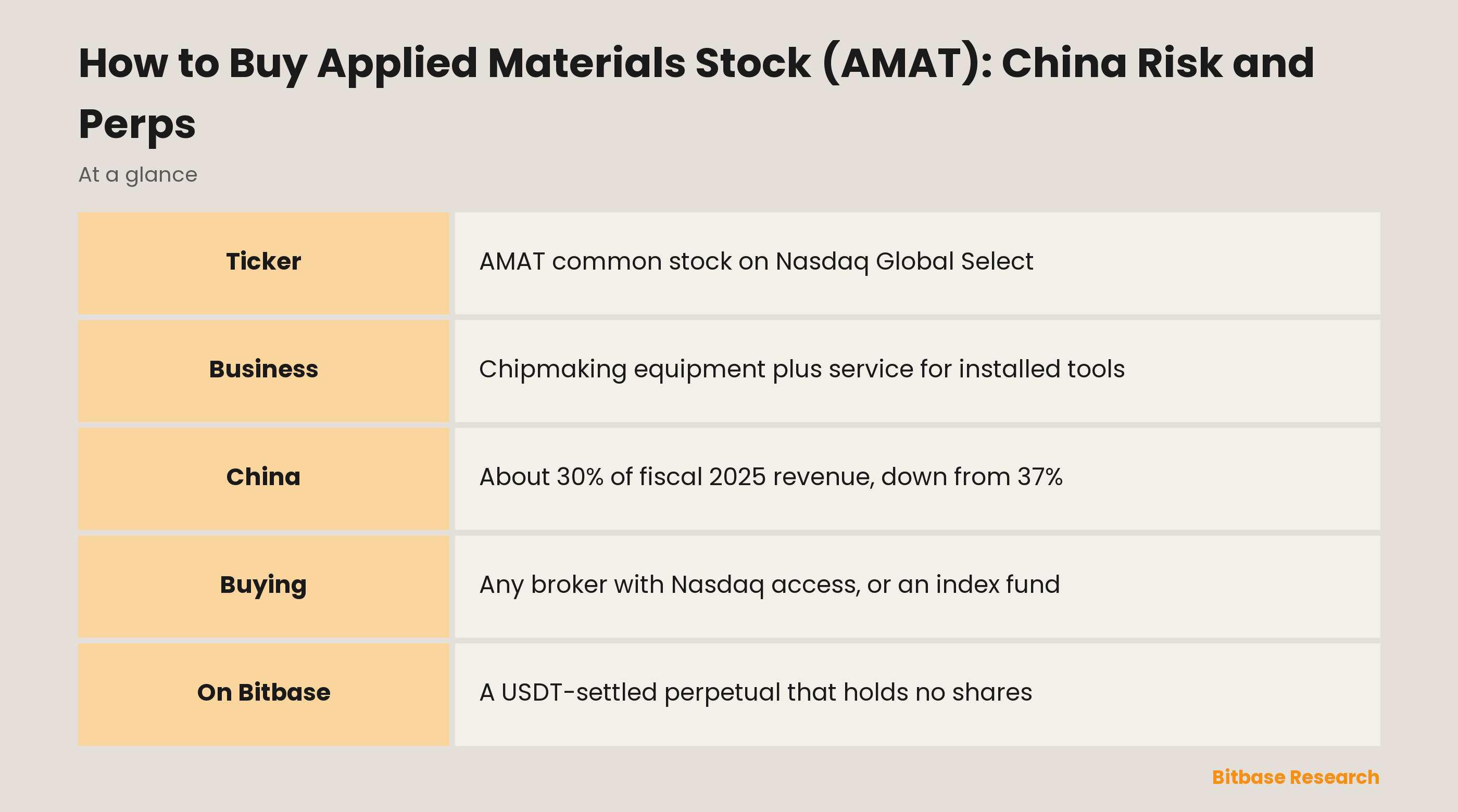
Through any brokerage account that reaches the Nasdaq Global Select Market, you can buy Applied Materials common stock under the ticker AMAT, exactly as you would buy any other US-listed share. Applied itself builds the deposition, etch, implant and inspection machines that chipmakers install in their fabs, and in fiscal 2025 China was its largest region at about 30% of revenue, down from about 37% a year earlier. On Bitbase there are no AMAT shares for sale; what it lists is a perpetual contract that follows the price in USDT and owns no stock.
What Does Applied Materials Do?
Applied Materials sells the equipment that chipmakers use to add, shape, remove and check the thin layers on a silicon wafer, and it services those tools once installed. It calls itself "the leader in the materials engineering solutions used to produce virtually every semiconductor in the world", a claim worth checking against the segment detail below.
Most of that business is Semiconductor Systems, the equipment line. Its segment note lists the process steps it covers: etch, rapid thermal processing, deposition, chemical mechanical planarization, metrology and inspection, wafer packaging and ion implantation. Put simply, the tools turn a printed pattern into physical structures, build transistors and the wiring between them, inspect the result with optical and electron-beam systems, and join finished dies in advanced packages. Its customers fall into three markets: foundry, logic and other; DRAM; and NAND flash. The filing defines the leading edge as nodes of 7 nanometers and smaller.
The second reporting line is Applied Global Services (AGS): service contracts, spare parts and factory automation software for fabs that already run Applied equipment. Through fiscal 2025 it also carried the 200mm equipment sold into older, non-leading-edge factories; from the first quarter of fiscal 2026 that business moved into Semiconductor Systems, with earlier periods recast. Display was a third reportable segment in the fiscal 2024 annual report, but in fiscal 2025 management stopped reporting it separately and folded it into Corporate and Other.
Applied was incorporated in 1967 as a Delaware corporation and is based in Santa Clara, California. It manufactures primarily in the United States, Singapore, Taiwan and Israel, and sells "almost entirely through a direct sales force" because the products are so technical. The annual report names no competitors, though it flags rising competition from domestic equipment makers in China. For how the listed toolmakers divide the wafer process between them, see our guide to semiconductor equipment stocks.
How Applied Materials Makes Money
Nearly all of the money comes from manufacturers buying or maintaining Applied equipment. The fiscal 2025 split by reporting line:
| Reporting line | Share of fiscal 2025 revenue | Change from fiscal 2024 | What it covers |
|---|---|---|---|
| Semiconductor Systems | 73% | Up 4% | Wafer fabrication equipment |
| Applied Global Services | 23% | Up 3% | Services, spare parts, factory software and, that year, 200mm equipment |
| Corporate and Other | 4% | Up 14% | Display and other businesses below the reportable-segment line |
Total net revenue rose about 4% in fiscal 2025, which ended on 26 October 2025. Management credits foundry and logic customers investing at the leading edge and memory customers upgrading NAND equipment; services grew on long-term agreements and spares, partly offset by weaker 200mm sales.
The customer mix has shifted toward memory. Foundry, logic and other customers took 67% of Semiconductor Systems revenue in fiscal 2025, against 77% in fiscal 2023, while DRAM rose from 17% to 26% over the same two years and NAND was 7%. In that report, management expected customer investment to remain strong as high-bandwidth memory and other advanced packaging spread, alongside AI and data centre computing.
Geography matters more than usual here. Revenue is booked by where tools are shipped or service is performed, and in fiscal 2025 China accounted for about 30%, Taiwan about 24% and Korea about 20%. Taiwan revenue rose 71% that year, while China fell from about 37% of the total in fiscal 2024. The United States, Applied's home market, produced about 11%, and the risk factors put sales outside the country at approximately 89%.
A few buyers carry a large share. Two customers accounted for approximately 19% and 15% of fiscal 2025 net revenue, unnamed in that report. The fiscal 2024 report did name the two customers above the 10% line that year: Samsung Electronics and Taiwan Semiconductor Manufacturing Company.
AMAT Stock at a Glance
| Item | Detail |
|---|---|
| Exchange | Nasdaq Global Select Market |
| Ticker | AMAT |
| Share class | Common stock, the only security registered on the 10-K cover |
| Industry | Semiconductor manufacturing equipment and services |
| Index membership | S&P 500 and Nasdaq-100, per SPY and QQQ holdings on 16 October 2026 |
| Headquarters | Santa Clara, California |
| Incorporated | 1967, as a Delaware corporation |
| Fiscal year end | Last Sunday in October |
| Reportable segments | Semiconductor Systems and Applied Global Services |
| Dividend policy | Quarterly cash dividend, first declared in March 2005, each one set by the board |
| Share buybacks | Board authorizations approved in March 2023 and March 2025 |
| SEC identifier | CIK 6951 |
Quotes, charts and market value change with every trade, so they are left to the Applied Materials stock page on Bitbase.
How to Buy Applied Materials Stock
With a broker, the process runs like this:
1. Choose a broker that reaches Nasdaq. Check that it accepts residents of your country and what it charges for US trades.
2. Pass the account checks. Identity verification is standard; an investor who is not a US person files IRS Form W-8BEN with the broker.
3. Fund the account. Money in another currency is converted to US dollars, and the conversion spread is part of your cost.
4. Look up AMAT and pick an order type. A market order takes the next available price; a limit order caps what you pay and may never fill.
5. Choose whole or fractional shares. Some brokers sell slices of a share, others only whole ones.
6. Keep every confirmation. Fills, dividends and tax withheld all belong in your records.
From outside the US, the security itself is the same: AMAT is Applied's own common stock rather than a depositary receipt, so no ADR ratio applies. Tax is what varies. The IRS applies a general 30% rate to most US-source income paid to foreign persons, which a tax treaty may lower, and Form W-8BEN is how a foreign individual establishes that status with the payer, even without claiming a reduced rate. Treat this as background; your own tax position needs a professional.
Through an index fund, you hold Applied indirectly: funds tracking the S&P 500 or the Nasdaq-100 include it, as a small and changing slice of a larger basket.
Trading AMAT on Bitbase
Bitbase lists an AMAT perpetual futures contract, margined and settled in USDT. It follows the price of Applied's shares without holding any, so there is no registered share, no dividend and no vote. In return, a position can be long or short (selling the contract opens a short), it can use leverage, and it keeps trading while Nasdaq is closed.
Periodic funding payments pass between longs and shorts to keep the contract near the share price, with the crowded side paying the other, and a position is liquidated against a mark price, not the last trade, once its margin runs out. News that arrives while US markets are shut, from an earnings release to a new export rule, can be priced by the contract first, and the share may then open somewhere else. The stock perpetual guide walks through these mechanics.
How often funding settles, how margin is tiered, how much leverage is allowed and which price marks the contract when Nasdaq is shut all come from Bitbase's contract rules, and they can change; read them before the first order. Other stock-linked products are on Bitbase's TradFi page.
What Moves AMAT Stock
Fab budgets and the timing of AI spending. Applied is paid when chipmakers add capacity or move to a new process, not when chips sell. Its risk factors call AI "a significant demand driver for the industries we serve" and add: "AI is evolving rapidly and the expected timing and amount of investments related to AI can change significantly."
China and export licences. China fell from about 37% of revenue to about 30% in a year, and the filing explains why that line is fragile: "certain international sales depend on our ability to obtain export licenses," with "no assurance we will be issued licenses on a timely basis or at all." A single rule can reset expectations: on 29 September 2025 the Commerce Department's Bureau of Industry and Security (BIS) widened the set of companies under export restrictions, and Applied said in an 8-K that it expected the rule to reduce its fiscal 2026 net revenue. Some US trade actions have later been followed by "limited exemptions and temporary pauses," in the 10-K's words, so each new 10-Q is worth reading for the current picture.
Which kind of chipmaker is buying. Memory makers took a much bigger share of equipment revenue in fiscal 2025 than two years earlier, and management ties its outlook to high-bandwidth memory and advanced packaging. Each 10-Q repeats the split by market, so a change in that spending shows up there first.
Taiwan and Korea build-outs. China, Taiwan and Korea together made up about 74% of fiscal 2025 revenue, and the 10-K calls the customer base "geographically concentrated, particularly in China, Taiwan and Korea." Regional totals swing hard from one year to the next: Taiwan rose 71% in fiscal 2025 while China fell.
The installed base and quarter-end timing. AGS revenue follows how hard customers run their tools, which the filing ties to "wafer starts and utilization rates," and Applied is moving service toward subscription agreements to steady that line. On the equipment side, supply disruptions can delay production and delivery, which the filing says can leave results "significantly dependent on quarter-end production and delivery schedules"; a short delay can push revenue into the next quarter.
Risks to Weigh
Customer concentration. The heading is blunt, "We are exposed to risks associated with a highly concentrated customer base," and the text adds that "the actions of even a single customer have exposed and can further expose our business and operating results to greater volatility." Two customers made up roughly a third of fiscal 2025 revenue.
Export controls and the BIS settlement. Since 2022, Applied had received subpoenas about certain China customer shipments and export controls compliance. On 11 February 2026 it settled with BIS: a one-time payment, internal audits of its export compliance programme, and continued training and reporting. The Department of Justice and the SEC told the company they had closed their inquiries without enforcement action. The settlement also includes a denial order that is suspended and is waived after three years if the audits are done on time; breaching the terms could cost Applied that suspension, and an active order would bar exports of certain products outside the United States.
Local competition in China. The company sees possible "increased competition from domestic equipment manufacturers in China resulting from local government incentives and funding as well as export controls," so the rules that limit its sales can help rivals they do not cover.
Supply chain and materials. The filing notes that "in 2025 the Chinese government implemented export controls on the export of rare earth minerals that are used in certain of our products," alongside the parts shortages and shipping delays listed under its supply chain risks.
Tax. Conditional reduced tax rates in Singapore "expire beginning in fiscal 2030," and renewal is not assured.
The stock itself. The 10-K calls the industries Applied serves historically cyclical, so the shares can fall hard when equipment orders turn, and one risk factor heading reads: "We may not continue to declare cash dividends or repurchase our shares."
Risks specific to the perpetual. Borrowed exposure enlarges every loss, funding keeps accruing for as long as you hold, and a jump between the Nasdaq close and the next open can push the position past its liquidation price before the share trades again.
How to Research AMAT Yourself
Applied files with the SEC under CIK 6951. In the 10-K, Item 1 describes the segments, Item 1A holds the risk factors, Item 7 carries revenue by segment, customer market and region, and the segment note repeats those tables with three years of history. Each 10-Q updates the risk factors and legal matters, 8-Ks carry quarterly results and one-off events such as the February 2026 settlement, and the annual proxy statement deals with the board. The same reports are posted on appliedmaterials.com.
One habit pays off with this company: compare the segment note across years before comparing numbers. Display left the reportable segments in fiscal 2025 and the 200mm business switched segments in fiscal 2026, so a line with the same name can cover different products from one report to the next.
Applied Materials Stock FAQ
Does Applied Materials pay a dividend?
Yes, quarterly. The first was declared on 23 March 2005 and paid on 8 June 2005, in a press release describing the "initiation of a cash dividend." Applied paid four quarterly dividends in each of fiscal 2024 and fiscal 2025; the board declares each one, so check the latest filing for today's per-share figure.
Does Applied Materials make lithography machines?
No. The 10-K lists lithography among "market segments that we do not serve." Lithography prints the circuit pattern onto the wafer; Applied's patterning tools handle the next stage, turning that pattern into physical structures through deposition, etch and related steps. A chipmaker budget that leans toward lithography is, in the filing's framing, money spent outside Applied's markets.
Who are Applied Materials' biggest customers?
The fiscal 2025 report does not name them, but says two customers accounted for approximately 19% and 15% of net revenue. In the fiscal 2024 report, the two customers above the 10% threshold were Samsung Electronics and TSMC. By shipping location, most revenue comes from China, Taiwan and Korea.
Is Applied Materials in the S&P 500?
Yes. The holdings files of SPY, which tracks the S&P 500, and QQQ, which tracks the Nasdaq-100, both listed Applied Materials on 16 October 2026. Indices are reconstituted from time to time, so treat that as a dated reading.
Can I buy Applied Materials stock with crypto?
Not directly. Shares are bought through a broker and paid for in money, so crypto has to be sold first. On Bitbase, USDT can trade the AMAT perpetual, a derivative that follows Applied's price without being stock: no dividend, no vote, and it can be liquidated. Our guide to buying stocks with crypto compares the routes.
When does Applied Materials report earnings?
Quarterly, with the fiscal year closing on the last Sunday in October. For fiscal 2025, results came by 8-K on 13 February, 15 May, 14 August and 13 November 2025, and the 10-K followed on 12 December 2025. The first three fiscal 2026 releases came on 12 February, 14 May and 13 August 2026.
Conclusion
Buying AMAT is a routine broker order; understanding it takes longer. Revenue comes mostly from wafer fab equipment, a sizable services line rides on the installed base, and both depend on a few chipmakers in China, Taiwan and Korea. Export rules, the 2026 BIS settlement terms and the timing of AI-driven spending are the threads to follow in each filing. A price position on Bitbase is a different thing again: a leveraged contract that owns no part of Applied.
Related reading
Other Bitbase articles on this topic:
- How to Buy Analog Devices Stock (ADI): Industry, Dividend, China
- How to Buy ASE Technology Stock (ASX): NYSE ADSs and Taipei 3711
- How to Buy KLA Stock (KLAC): Chip Inspection, 10-for-1 Split
- How to Buy AVGO: Broadcom Chips, Software and Perpetuals
Disclaimer: This article is educational content from Bitbase Academy, provided for information only. It explains what a company or fund does and how the instruments referenced here differ from one another; it does not constitute investment, trading, tax, or financial advice, and it is neither a recommendation nor an endorsement of any security, token, or trading strategy. A tokenized stock is issued by a third party and is designed to give economic exposure to an underlying asset: it is not a share, it carries no shareholder rights, and it depends on the issuer's structure, eligibility rules, and redemption terms, which the issuer can change. Perpetual futures are leveraged derivatives that hold no underlying asset and can be liquidated, and trading hours, product availability, and eligibility differ by instrument and by jurisdiction and can change at any time. Written as of October 2026; verify everything yourself through company filings, the issuer's own documentation, and the product pages of the venue you trade on.
References
[1] Applied Materials fiscal 2025 Form 10-K (SEC EDGAR) www.sec.gov
[2] Applied Materials fiscal 2024 Form 10-K (SEC EDGAR) www.sec.gov
[3] Applied Materials Form 10-Q for the quarter ended 26 July 2026 (SEC EDGAR) www.sec.gov
[4] Applied Materials Form 8-K, February 2026: settlement with BIS (SEC EDGAR) www.sec.gov
[5] Applied Materials Form 8-K, September 2025: new BIS export rule (SEC EDGAR) www.sec.gov
[6] Applied Materials press release, March 2005: first quarterly cash dividend (SEC EDGAR) www.sec.gov
[7] State Street: SPY daily holdings, 16 October 2026 www.ssga.com
[8] Invesco QQQ: fund overview and holdings (tracks the Nasdaq-100) www.invesco.com
[9] IRS: NRA withholding www.irs.gov
[10] IRS: About Form W-8 BEN www.irs.gov





