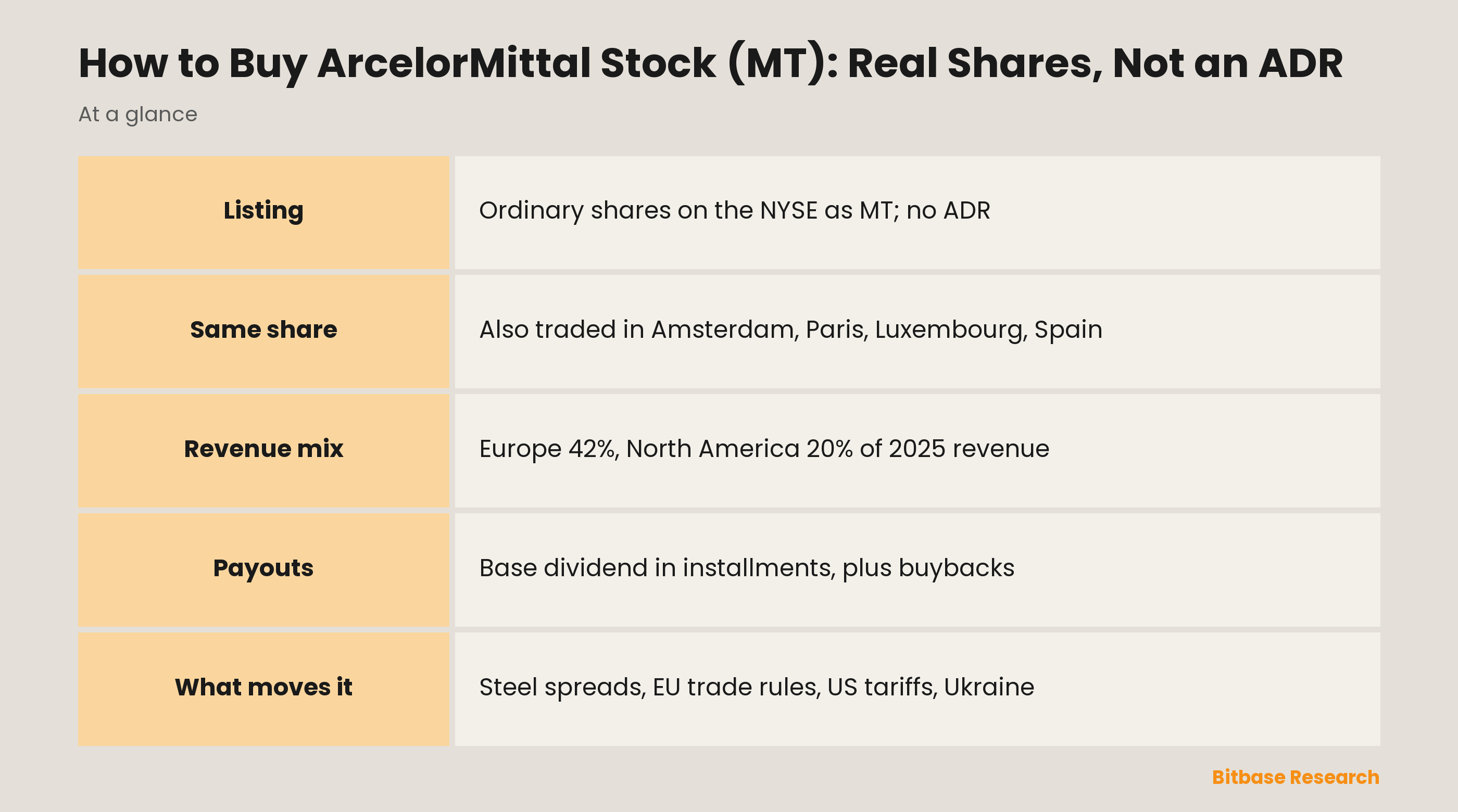
If you want ArcelorMittal shares, any broker with access to the New York Stock Exchange can buy them under the ticker MT, and what lands in your account is the Luxembourg company's ordinary share itself, not a depositary receipt. The same share also trades in Amsterdam, Paris, Luxembourg and Spain, which suits a business where Europe supplied 42% of 2025 revenue. Below: what the company makes, how the New York line works, the steps of an order, Luxembourg withholding on dividends, and the risks its 20-F puts first.
What Does ArcelorMittal Do?
ArcelorMittal makes steel and mines much of the iron ore that goes into it. Its annual report calls the group "one of the world's leading integrated steel and mining companies" and "the largest steel producer in Europe and among the largest in the Americas." It makes steel in 14 countries and sells in about 126 countries; no single customer has exceeded 5% of sales in any year the filing presents.
The group "results from the merger in 2007 of its predecessor companies Mittal Steel Company N.V. and Arcelor." The parent is a Luxembourg société anonyme incorporated on 8 June 2001; it spun off its stainless steel division as Aperam in January 2011 and consolidated every three shares into one on 22 May 2017.
Flat products, such as hot rolled coil, coated sheet, tinplate and plate, go to customers in automotive, packaging, appliances and general industry. Long products, such as rebar, wire rod and structural sections, serve construction among other sectors. In 2025 about 53% of the group's crude steel was made in Europe, 40% in the Americas and 7% elsewhere, such as South Africa and Ukraine.
The 20-F reports six segments. Europe is the largest, shipping 28.4 million tonnes of steel in 2025. North America makes flat, long and tubular products and now includes ArcelorMittal Calvert in Alabama, a finishing plant with 5.3 million tonnes of annual flat-rolled capacity that became wholly owned on 18 June 2025, when the company bought Nippon Steel's 50% stake. Brazil sells flat and long steel to construction, agribusiness and automotive customers. Sustainable Solutions groups "niche capital-light businesses" with a distribution and processing arm. Mining covers seaborne iron ore in Canada and Liberia.
The sixth, India and JVs, holds joint-venture stakes, mainly AMNS India, formed in 2019 with Nippon Steel: ArcelorMittal owns 60%, the partners have equal board representation, and the Hazira plant in Gujarat has an achievable crude steel capacity of 8.8 million tonnes a year. Being equity-accounted, its sales stay out of ArcelorMittal's revenue.
How ArcelorMittal Makes Money
ArcelorMittal earns the gap between what steel sells for and what it costs to make: iron ore, coking coal, scrap, energy and labor. In 2025 revenue split across segments like this:
| Segment | Share of 2025 revenue | What it sells |
|---|---|---|
| Europe | 42% | Flat and long steel for carmakers, industry, packaging and construction |
| North America | 20% | Flat, long and tubular steel, including Calvert's finished sheet |
| Brazil | 16% | Flat and long steel for construction, agribusiness and automotive buyers |
| Sustainable Solutions | 15% | Distribution, processing, renewables and construction products |
| Others | 5% | South Africa, Ukraine, holding and service companies |
| Mining | 2% | Iron ore for outside buyers; more of its sales go to the group's own mills |
| India and JVs | Not in revenue | Share of income from AMNS India and other ventures |
Shares are calculated from each segment's external sales in the 20-F segment note. Revenue fell 1.7% in 2025, mainly because average steel selling prices dropped 2.3% while shipments held almost level at 54.0 million tonnes. By product, flat steel brought in 56% of revenue and long steel 20%; by customer location, Europe accounted for 52%, the Americas for 39%, with the United States alone at 15%, and Asia and Africa for 9%.
Owning mines softens the cost side: the company sourced 72% of its iron ore internally in 2025. The rest, plus coking coal and energy, is bought in, and the 20-F warns that "steel and raw material prices do not always move in tandem, particularly in Europe and North America." One caution on segment profits: North America's 2025 operating income included a one-time "bargain purchase" gain from the Calvert deal, so its year-on-year change overstates the underlying trend.
Cash returns follow a formula. ArcelorMittal "expects to pay a base annual dividend (to be progressively increased over time)" and sends at least 50% of the free cash flow left after that dividend to buybacks, but "If the ratio of net debt to EBITDA is greater than 1.5x, then ArcelorMittal will not carry out any share buyback." The third-quarter 2026 release says the fully diluted share count has fallen by approximately 39% since September 2020.
MT Stock at a Glance
| Feature | MT |
|---|---|
| US exchange | New York Stock Exchange |
| Ticker | MT (MTS on the Spanish exchanges) |
| Security | Ordinary shares on a New York register ("New York Registry Shares"); no ADR program |
| Other listings | Euronext Amsterdam and Paris, Luxembourg Stock Exchange (MT); Spanish exchanges (MTS) |
| Sector | Steel and iron ore mining |
| Index membership | European indices, including the STOXX Europe 600, CAC 40 and Euronext 100, per the 20-F |
| Headquarters | Luxembourg City |
| Incorporated | Luxembourg, 2001 |
| Financial year | Ends 31 December |
| SEC reports | Form 20-F annually; results and updates on Form 6-K |
| Payouts | Base annual dividend in installments, four for 2026, plus buybacks |
| Largest shareholder | A Mittal family trust; 44.68% with the family's direct holdings at the end of 2025 |
| SEC identifier | CIK 1243429 |
The table leaves out anything that changes daily; quotes, market value and yield are on the ArcelorMittal stock page on Bitbase.
How to Buy ArcelorMittal Stock
Many European companies reach US investors through depositary receipts. ArcelorMittal does not: "The Company does not have any American Depositary Receipts." Its NYSE shares sit on a New York share register kept by Citibank, N.A., and the 20-F calls its registered shares "fully fungible," so a share bought in New York and one bought in Paris are the same security. Buying in the US takes six steps:
1. Pick a broker. You need one that reaches the NYSE; from outside the US, check which entity holds your account and who supervises it. A broker connected to Euronext can buy the identical share in euros instead.
2. Open and fund the account. Expect identity checks and a tax residence declaration. Paying in from another currency means a conversion, so the exchange rate matters as much as the fee.
3. Find the right line. Search MT and make sure the listing is ArcelorMittal on the New York Stock Exchange. The 20-F cover registers one class, ordinary shares under MT, while EDGAR's company record also shows two over-the-counter symbols.
4. Set the order. A market order fills at the going price; a limit order names the highest price you will accept, which helps when the stock moves fast.
5. Decide the size. Where your broker offers fractional shares, you can invest a fixed sum; ask whether fractions carry voting rights there.
6. File the paperwork. Keep confirmations and statements: they show your cost and any tax withheld from dividends.
New York or Europe. Shares can move between the New York and European registers. NYSE holders generally pay Citibank no fees, but transactions that cancel or issue New York shares, such as cross-border trades, carry a small charge per 100 shares. Citibank also pays NYSE holders their dividends, which are declared in dollars and payable in dollars or euros.
Taxes for investors abroad. Because the issuer is Luxembourgish, dividends "will in principle be subject to Luxembourg withholding tax at the rate of 15%," and holders in a country with a tax treaty with Luxembourg "may claim for a reduced withholding tax rate or a withholding tax relief." Your home country may tax the dividend again.
Through funds. ArcelorMittal sits in about 105 indices, mostly European; funds tracking them are an indirect route, but check a fund's holdings before assuming it owns MT.
What Moves MT Stock
Steel prices and spreads. "ArcelorMittal's profitability is highly sensitive to volatile steel and iron ore prices," the 20-F says; since the second quarter of 2024, weaker Chinese demand without matching output cuts has pushed more Chinese exports into its core regions.
Europe's trade defenses. The EU steel safeguards were due to expire on 30 June 2026; the European Commission presented a tariff rate quota mechanism on 7 October 2025, and the Carbon Border Adjustment Mechanism entered its definitive phase on 1 January 2026. In the third quarter of 2026 the company said that after the new quota it had brought all its European blast furnaces back into operation and that European flat shipments rose "counter to normal seasonal patterns," while higher energy costs were a temporary headwind.
US tariffs. Section 232 measures imposed "a 50% tariff on all steel imports as from June 2025," which the 20-F says hurt North America through costs and Canadian and Mexican pricing, and also Brazil's exports. Calvert sits inside the US market, and the company plans a line there for electrical steel used in electric motors, with capacity of up to 150,000 tonnes a year.
Iron ore and Liberia. In the third quarter of 2026, lower iron ore prices and higher freight costs cut Mining's profit. Liberia extended its mineral development agreement with the company to 2050 in January 2026; heavy rains cut expected 2026 shipments there to about 16 million tonnes, and the company expects fourth-quarter output to reach annualized rates in line with the 20-million-tonne design capacity.
Ukraine. On 25 September 2026 ArcelorMittal said it could no longer safely and sustainably operate ArcelorMittal Kryvyi Rih "following multiple missile strikes," and idled it. The charges produced a reported third-quarter net loss, though adjusted net income rose.
Steel Gluts, Italian Claims and Other MT Risks
The 20-F sorts its risks into six groups. These bear most directly on an MT share:
Overcapacity. "Persistent global overcapacity—particularly in long products— continues to pressure the industry," and weak periods bring "increased exports, and lower prices."
Inputs and trade. Energy, coking coal and the 28% of iron ore bought from others can rise faster than steel, and compressed spreads have led the company to idle plants before. Tariffs that shield one market can hurt exports from another.
Decarbonization. Carbon targets, including net zero by 2050, are "contingent on supportive economics," and the medium-term objective is under review.
Italy. On 29 January 2026 the extraordinary commissioners of Acciaierie d'Italia served ArcelorMittal with a claim before the Court of Milan, alleging mismanagement and a transfer of value to ArcelorMittal. The company says it "will defend its position vigorously" and in June 2025 began international arbitration against the Italian Republic.
Joint ventures and currency. A venture in difficulty may require cash, loans or guarantees from the company, and a substantial portion of assets, costs and earnings is in currencies other than the dollar, with Argentina, Brazil, India, South Africa and Ukraine named as high devaluation risks.
A family near half. The Mittal trust and the family's direct holdings came to 44.68% at the end of 2025, and the 20-F says this holder "could exercise significant influence over the outcome of shareholder votes." A standstill agreed in 2006 caps the stake at 45%, and a March 2026 agreement has the family sell shares in proportion when the company buys back stock.
The share carries its own risks. As a holding company, ArcelorMittal is "dependent on the industrial franchise fees from, earnings and cash flows of, and dividends and distributions from, its operating subsidiaries" to pay dividends or buy back shares; Luxembourg law adds reserve tests; and a single cyclical stock concentrates your money in one company's fortunes.
How to Research MT Yourself
As a foreign private issuer, ArcelorMittal files a Form 20-F each year instead of a 10-K, with quarterly results, the half-year report and other announcements on Form 6-K. All sit on EDGAR under CIK 1243429: the 2025 annual report was filed on 6 March 2026, the half-year report on 31 July 2026 and third-quarter results on 5 November 2026. The same documents are on arcelormittal.com under Investors.
In the 20-F, the segment note gives each segment's sales and operating income, "Shareholders and markets" explains the New York Registry Shares, and the taxation section covers Luxembourg withholding.
Two checks help: adjust per-share history before May 2017 for the one-for-three consolidation, and in quarters with large charges, such as the third quarter of 2026, read the reconciliation between reported and adjusted earnings. For a US-based steelmaker to compare, see our Nucor stock guide; other companies appear in Bitbase's directory of US stock pages.
ArcelorMittal Stock FAQ
Can I buy ArcelorMittal stock with crypto?
Not directly. Brokers sell MT shares for dollars on the NYSE or euros on Euronext, so you would first convert crypto into cash, possibly a taxable event in your country, and transfer it. The share then gives you dividends and votes in a registered company, one of the points covered in how stocks and crypto differ.
Is MT an ADR?
No. The company states that it has no American depositary receipts. MT on the NYSE is the ordinary share, held on a New York register kept by Citibank and interchangeable with the shares traded in Europe.
Does ArcelorMittal pay a dividend?
Yes. It pays a base annual dividend that it intends to raise over time; the dividend approved on 5 May 2026 is paid in four equal quarterly installments during the year. Luxembourg withholding tax applies, in principle at 15%.
Is ArcelorMittal in the S&P 500?
The 20-F does not list it there. The indices it names are European, among them the STOXX Europe 600, the S&P Europe 350, the CAC 40 and the Euronext 100.
Has ArcelorMittal stock ever split?
Yes, in reverse. On 22 May 2017 the company consolidated every three shares into one, so older per-share prices and dividends must be adjusted before comparing them with recent ones.
Conclusion
Buying MT is simple once you know what the ticker is: an ordinary share of a Luxembourg company, bought on the NYSE through any broker that reaches it, with no depositary receipt in between. Understanding it takes longer: a steelmaker tied to European mills, trade protection and steel spreads, with an idled Ukrainian plant, an Italian lawsuit and a family holding just under half. Read the latest 20-F and quarterly 6-K, compare reported with adjusted results, and size any position for a business that swings with the steel cycle.
Related reading
Other Bitbase articles on this topic:
- How to Buy AngloGold Ashanti Stock (AU): A UK Gold Miner on NYSE
- How to Buy Cameco Stock (CCJ): Uranium, Westinghouse, Vote Caps
- How to Buy Corteva Stock (CTVA): After the Vylor Seed Spin-Off
- How to Buy Martin Marietta Stock (MLM): Quarries, Lime and Lhoist
Disclaimer: This article is educational content from Bitbase Academy, provided for information only. It explains what a company or fund does and how the instruments referenced here differ from one another; it does not constitute investment, trading, tax, or financial advice, and it is neither a recommendation nor an endorsement of any security, token, or trading strategy. A tokenized stock is issued by a third party and is designed to give economic exposure to an underlying asset: it is not a share, it carries no shareholder rights, and it depends on the issuer's structure, eligibility rules, and redemption terms, which the issuer can change. Perpetual futures are leveraged derivatives that hold no underlying asset and can be liquidated, and trading hours, product availability, and eligibility differ by instrument and by jurisdiction and can change at any time. Written as of November 2026; verify everything yourself through company filings, the issuer's own documentation, and the product pages of the venue you trade on.
References
[1] ArcelorMittal Form 20-F for 2025 (SEC EDGAR) www.sec.gov
[2] ArcelorMittal 2025 Form 20-F, XBRL cover page (SEC EDGAR) www.sec.gov
[3] ArcelorMittal 2025 Form 20-F, XBRL segment data (SEC EDGAR) www.sec.gov
[4] ArcelorMittal 2025 Form 20-F, XBRL sales by region (SEC EDGAR) www.sec.gov
[5] ArcelorMittal 2025 Form 20-F, XBRL sales by product (SEC EDGAR) www.sec.gov
[6] ArcelorMittal third-quarter 2026 results, filed on Form 6-K (SEC EDGAR) www.sec.gov
[7] ArcelorMittal half-year 2026 report, filed on Form 6-K (SEC EDGAR) www.sec.gov
[8] ArcelorMittal Form 20-F for 2017: share consolidation (SEC EDGAR) www.sec.gov
[9] ArcelorMittal filings index, CIK 1243429 (SEC EDGAR) www.sec.gov





