
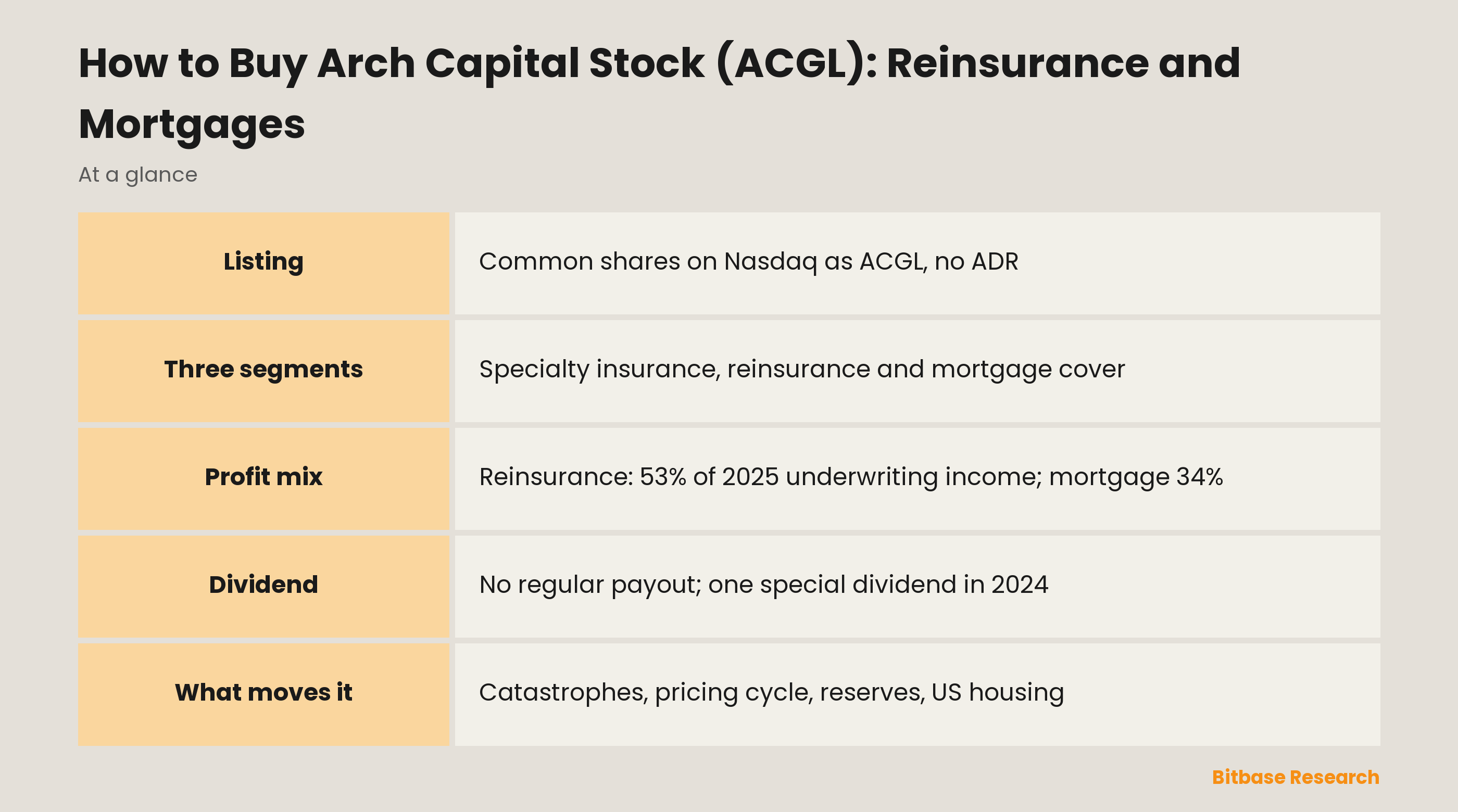
You buy Arch Capital stock much as you would any Nasdaq share, even though the company is incorporated in Bermuda: through a brokerage account, under the ticker ACGL, with no depositary receipt in between. The mix behind that ticker is what sets it apart. In 2025 the reinsurance segment wrote 46% of Arch's net premiums and earned 53% of its underwriting income, while mortgage insurance, with only 6% of premiums, contributed 34%. This guide covers what the company sells, how an order works, the two preferred listings that share the ACGL prefix, and the risks its filings describe.
What Does Arch Capital Do?
Arch Capital Group Ltd. is a holding company whose subsidiaries write insurance, reinsurance and mortgage insurance around the world. Its annual report calls it "a publicly listed Bermuda exempted company" and says "we focus on writing specialty lines of insurance and reinsurance." The principal offices are in Pembroke, Bermuda, and the operations run through Bermuda, the United States, the United Kingdom, Europe, Canada and Australia.
The present company dates from September 2000; in October 2001 it raised fresh equity and recruited new teams, creating a capital base the 10-K calls "unencumbered by significant pre-2002 risks." The platform then grew in steps: a UK carrier in 2004, Canada in 2005, a syndicate at Lloyd's in 2009 and the Barbican group in London in 2019. The US mortgage business started in 2014 and "expanded greatly" in 2016 with the purchase of United Guaranty Corporation. On 1 August 2024 Arch bought Allianz's US middle market and entertainment property and casualty business, which its filings call the MCE Acquisition.
The work is split into three underwriting segments.
Insurance sells mainly commercial specialty cover: in North America commercial auto, multiperil, workers' compensation, property, excess and surplus casualty, and professional and financial lines; elsewhere property and casualty. North America produced 73% of the segment's 2025 net premiums written.
Reinsurance insures other insurers across casualty, marine and aviation, specialty, property catastrophe and other property. Specialty was the largest line, at 33% of the segment's 2025 net premiums written, and business underwritten in Bermuda accounted for 48%.
Mortgage covers lenders against borrower default. Most of it is US primary mortgage insurance on loans sold to Fannie Mae and Freddie Mac, which approve Arch as an eligible insurer; the rest is credit risk transfer with those agencies and cover in Australia and Europe. US primary insurance was 85% of the segment's risk in force at the end of 2025.
Arch also owns 30% of Greysbridge, parent of the Bermuda reinsurer Somers Re, and in 2021 bought 29.5% of Coface, a French trade credit insurer. Rivals named in the 10-K include AIG, Berkshire Hathaway, Munich Re, Swiss Re and two companies covered in our Chubb stock guide and Travelers stock guide; in US mortgage insurance they are Essent, Enact, MGIC, NMI Holdings and Radian.
How Arch Capital Makes Money
An insurer collects premiums first and pays claims later, so it earns twice: from underwriting and from investing the money it holds meanwhile. The combined ratio, claims and expenses as a share of earned premiums, measures the first; below 100% means a profit.
Arch measures each segment by underwriting income, and in 2025 the three contributed very unevenly:
| Segment | Share of 2025 net premiums written | Share of 2025 underwriting income | 2025 combined ratio |
|---|---|---|---|
| Insurance | 47% | 13% | 95.2% |
| Reinsurance | 46% | 53% | 80.8% |
| Mortgage | 6% | 34% | 14.6% |
Shares are calculated from the segment note of the 2025 10-K; premium shares add to 99% because of rounding.
The mortgage loss ratio was below zero in 2025 because releases of reserves set aside in earlier years, mainly on US first-lien loans from 2023 and 2024, outweighed the claims booked for new defaults. All three segments released reserves for earlier years, so part of the year's underwriting profit came from past estimates proving too cautious.
Net premiums written rose 4.7% overall. Insurance grew 13.4%, which the 10-K attributes primarily to the MCE Acquisition; reinsurance slipped 1.7% on non-renewals and smaller shares in specialty, and mortgage fell 4.7%.
Net investment income rose 8.7% and equaled about 55% of underwriting income, on top of income from investment funds and from operating affiliates, mainly Somers and Coface. Income tax expense more than doubled in the first year of Bermuda's new corporate income tax, yet net income available to common shareholders edged up about 2% and book value per share grew about 23%. "Management uses growth in book value per share as a key measure of the value generated for our common shareholders each period," its 10-Q says.
ACGL Stock at a Glance
| Feature | ACGL |
|---|---|
| Exchange | Nasdaq (The Nasdaq Stock Market) |
| Ticker | ACGL, the common shares |
| Other Nasdaq listings | ACGLO and ACGLN, depositary shares in the 5.45% Series F and 4.55% Series G preferred shares |
| Depositary receipt | None; the common shares themselves are listed |
| Annual report | Form 10-K, with 10-Qs and 8-Ks |
| Sector | Specialty insurance, reinsurance and mortgage insurance |
| Index membership | S&P 500 |
| Incorporated | Bermuda, as an exempted company |
| Principal offices | Pembroke, Bermuda |
| Fiscal year | Calendar year, ending 31 December |
| Common dividend | No regular dividend; a special cash dividend was paid in 2024 |
| Share splits | Three-for-one in 2011 and again in 2018 |
| SEC identifier | CIK 947484 |
Price, market value and valuation ratios change all day, so the table leaves them out; the Arch Capital stock page on Bitbase shows them live.
How to Buy Arch Capital Stock
A Bermuda address changes little. The shares quoted on Nasdaq are Arch's common shares, held through your broker like any US listing, and the company files 10-K, 10-Q and 8-K reports. Six steps:
1. Find a broker that reaches Nasdaq. Outside the US this can be a local firm with access to American markets or an international one; check which entity holds your account and who regulates it.
2. Pass the account checks. Non-US residents are usually asked for IRS Form W-8BEN, which the IRS says to submit "when requested by the withholding agent or payer."
3. Fund it. Money sent in another currency is converted, so compare the exchange rate as well as the commission.
4. Search for ACGL and check the name. You want Arch Capital Group Ltd. common shares. ACGLO and ACGLN are preferred depositary shares, a different security.
5. Choose an order type. A market order fills at the best price available when it arrives; a limit order sets the worst price you accept and may not fill. FINRA explains both on its investor pages.
6. Decide the size. Many brokers sell fractional shares, but coverage varies, some offer none, and a fractional holding may carry no voting rights.
Bermuda ownership rules. Because Arch owns regulated insurers, anyone whose holding reaches 10%, 20%, 33% or 50% of the common shares must notify the Bermuda Monetary Authority within 45 days, and the regulator can object. Those thresholds concern large holders, not a typical brokerage order.
Taxes. The 10-K says Bermuda's corporate income tax imposes no withholding tax, "so there will continue to be no such taxes payable by us or by our shareholders in respect of our shares." The IRS states that "most types of U.S. source income received by a foreign person are subject to U.S. tax of 30%," with lower treaty rates possible. How any payment from Arch is treated, and how your country taxes gains, is a question for your broker or a tax adviser.
Through index funds. Arch is in the S&P 500, and SPY, State Street's S&P 500 fund, listed it among its holdings on 6 November 2026, so any tracker of that index holds a small slice.
What Moves ACGL Stock
Catastrophe seasons. Catastrophes added 8.5 points to the reinsurance loss ratio in 2025, mainly from the California wildfires, after 11.8 points in 2024, when Hurricanes Milton and Helene hit. In the third quarter of 2026 they added 7.5 points in reinsurance, against 1.3 a year earlier, and 5.7 points in insurance, which the 10-Q says includes losses related to the Iran conflict.
The pricing cycle. Premiums written fell 4.6% in the first nine months of 2026, with reinsurance down 8.4%. The 10-Q says competitive conditions "have increased across portions of the insurance and reinsurance markets," though it calls the market "constructive," and Arch is letting part of the program business bought from Allianz lapse. Watch whether margins hold as volume shrinks.
Reserve releases. Favorable development on older claims has padded every segment, but it is an estimate and can shrink. In mortgage, releases were worth 16.8 points of premiums in the first nine months of 2026, down from 20.4, while the current-year loss ratio rose to 23.0% from 20.2% on "slightly higher new delinquencies." The segment's combined ratio went from 14.9% to 23.4%.
US housing and the agencies. Mortgage income depends on how many low down payment loans are made and how borrowers repay. In 2025, 91% of new US coverage was on purchase loans and 77% went to borrowers with credit scores of 740 or more. Any change in the role of Fannie Mae and Freddie Mac, or in their rules for mortgage insurers, reaches this segment directly.
Buybacks. Arch returns capital through share repurchases, which the 10-K says it will consider "on an opportunistic basis." The common share count fell 8.5% between 23 February and 29 October 2026, and the board enlarged the authorization on 19 April and 5 November 2026. Fewer shares lift per-share earnings and book value even when total profit does not grow.
Deals. On 30 October 2026 Arch's North American insurance arm agreed to buy Premier Dealer Holding Corp., an Ohio provider of automotive finance and insurance products, subject to regulatory approval.
Storms, Reserves and Housing in Arch's 10-K
From Item 1A of the 2025 annual report:
Catastrophes. "Claims for natural catastrophic events could cause large losses and substantial volatility in our results of operations," and "we have large aggregate exposures to natural catastrophic events."
The underwriting cycle. "The insurance and reinsurance industry is highly cyclical, and we may at times experience periods characterized by excess underwriting capacity and unfavorable premium rates."
Reserving. "Underwriting risks and reserving for losses are based on probabilities and related modeling, which are subject to inherent uncertainties."
Mortgage credit. "The ultimate performance of our mortgage insurance portfolios remains uncertain," and changes to the agencies' role or eligibility requirements "could negatively impact our results of operations."
Holding company structure. "Arch Capital is a holding company and is dependent on dividends and other distributions from its operating subsidiaries," whose payouts regulators limit. Buybacks draw on the same source.
Tax and ratings. Bermuda's 15% tax took effect on 1 January 2025, and the OECD's minimum tax rules could raise taxes elsewhere. A rating downgrade "may adversely affect our relationships with clients and brokers."
Two risks sit at the level of the share. Arch's bye-laws and the approvals required for a change of control may hinder an unsolicited takeover. And no payout is promised: the 10-K says "there is no assurance that any dividend will be declared and paid in the future."
How to Research ACGL Yourself
Arch's filings sit on EDGAR under CIK 947484. Quarterly results arrive by 8-K with a financial supplement; in 2026 they came on 9 February, 28 April, 28 July and 27 October. Arch also posts its filings on archgroup.com at no charge.
In the 10-K, Item 1 describes the segments and competitors, Item 1A the risks, and the MD&A each segment's catastrophe points and prior-year development. Note 4 is the segment table behind the figures above; note 5 shows which lines released or added reserves.
Two checks help. Split each loss ratio into the current-year figure and the release from earlier years before comparing periods, since the mortgage margin leans on releases. And make sure the quote you read belongs to ACGL, not to a preferred listing. For prices, use the ACGL page linked in the table section, or browse the full list of US stock pages on Bitbase.
Arch Capital Stock FAQ
Can I buy Arch Capital stock with crypto?
No, not as a direct swap. Brokers settle ACGL purchases in dollars, which means converting coins to cash first and transferring that cash, and the conversion can count as a taxable disposal in many countries. What you end up with is a registered ownership stake in Arch, and our explainer on how a share differs from a crypto asset covers why that matters.
Does Arch Capital pay a dividend?
Not on a regular schedule. The board paid a special cash dividend to common shareholders in 2024, and in 2025 capital went back through share repurchases. Only the preferred shares are paid on a schedule, when the board declares it.
What are ACGLO and ACGLN?
Depositary shares, each representing one-thousandth of a preferred share: ACGLO in the 5.45% Series F, ACGLN in the 4.55% Series G. Their dividends are non-cumulative, so an undeclared dividend is never owed, and their voting rights are limited. They trade beside ACGL but are not common stock.
Is ACGL in the S&P 500?
Yes. The 10-K calls Arch "part of the S&P 500 index," and SPY's holdings listed it on 6 November 2026.
Has Arch Capital stock ever split?
Yes, three-for-one twice: in May 2011, with two extra shares for each one held on the 6 May record date, and on 18 June 2018. Per-share figures in later reports are adjusted for both.
Conclusion
Arch Capital's 2025 profit leaned less on the segment that wrote the most premiums than on reinsurance and US mortgage insurance, two businesses whose margins depend on catastrophe seasons, reserve releases and the housing market. The decision rests on reading those engines. Compare segment combined ratios over several years, separate current-year losses from reserve releases, follow the share count, and decide how much one specialty insurer should weigh in your portfolio.
Related reading
Other Bitbase articles on this topic:
- How to Buy AIG Stock (AIG): Commercial Insurance After Corebridge
- How to Buy Cincinnati Financial Stock (CINF): Insurer and Investor
- How to Buy Prudential Financial Stock (PRU): Not Prudential plc
- How to Buy Microchip Stock (MCHP): MCUs, Analog and MCHPP
Disclaimer: This article is educational content from Bitbase Academy, provided for information only. It explains what a company or fund does and how the instruments referenced here differ from one another; it does not constitute investment, trading, tax, or financial advice, and it is neither a recommendation nor an endorsement of any security, token, or trading strategy. A tokenized stock is issued by a third party and is designed to give economic exposure to an underlying asset: it is not a share, it carries no shareholder rights, and it depends on the issuer's structure, eligibility rules, and redemption terms, which the issuer can change. Perpetual futures are leveraged derivatives that hold no underlying asset and can be liquidated, and trading hours, product availability, and eligibility differ by instrument and by jurisdiction and can change at any time. Written as of November 2026; verify everything yourself through company filings, the issuer's own documentation, and the product pages of the venue you trade on.
References
[1] Arch Capital Form 10-K for 2025 (SEC EDGAR) www.sec.gov
[2] Arch Capital 2025 Form 10-K, XBRL cover page (SEC EDGAR) www.sec.gov
[3] Arch Capital Form 10-Q for the third quarter of 2026 (SEC EDGAR) www.sec.gov
[4] Arch Capital third-quarter 2026 Form 10-Q, XBRL cover page (SEC EDGAR) www.sec.gov
[5] Arch Capital Form 8-K, 5 November 2026: share repurchase authorization (SEC EDGAR) www.sec.gov
[6] Arch Capital Form 8-K, 20 April 2026: share repurchase authorization (SEC EDGAR) www.sec.gov
[7] Arch Capital Form 8-K, 30 October 2026: Premier Dealer agreement (SEC EDGAR) www.sec.gov
[8] Arch Capital press release, 9 May 2011: three-for-one share split (SEC EDGAR) www.sec.gov
[9] Arch Capital Form 8-K, May 2018: three-for-one share split (SEC EDGAR) www.sec.gov
[10] SEC EDGAR: Arch Capital Group filing list www.sec.gov
[11] State Street: SPY daily holdings www.ssga.com
[12] IRS: NRA Withholding www.irs.gov
[13] IRS: About Form W-8 BEN www.irs.gov
[14] FINRA: Order Types www.finra.org
[15] FINRA: Investing in Fractional Shares www.finra.org





