
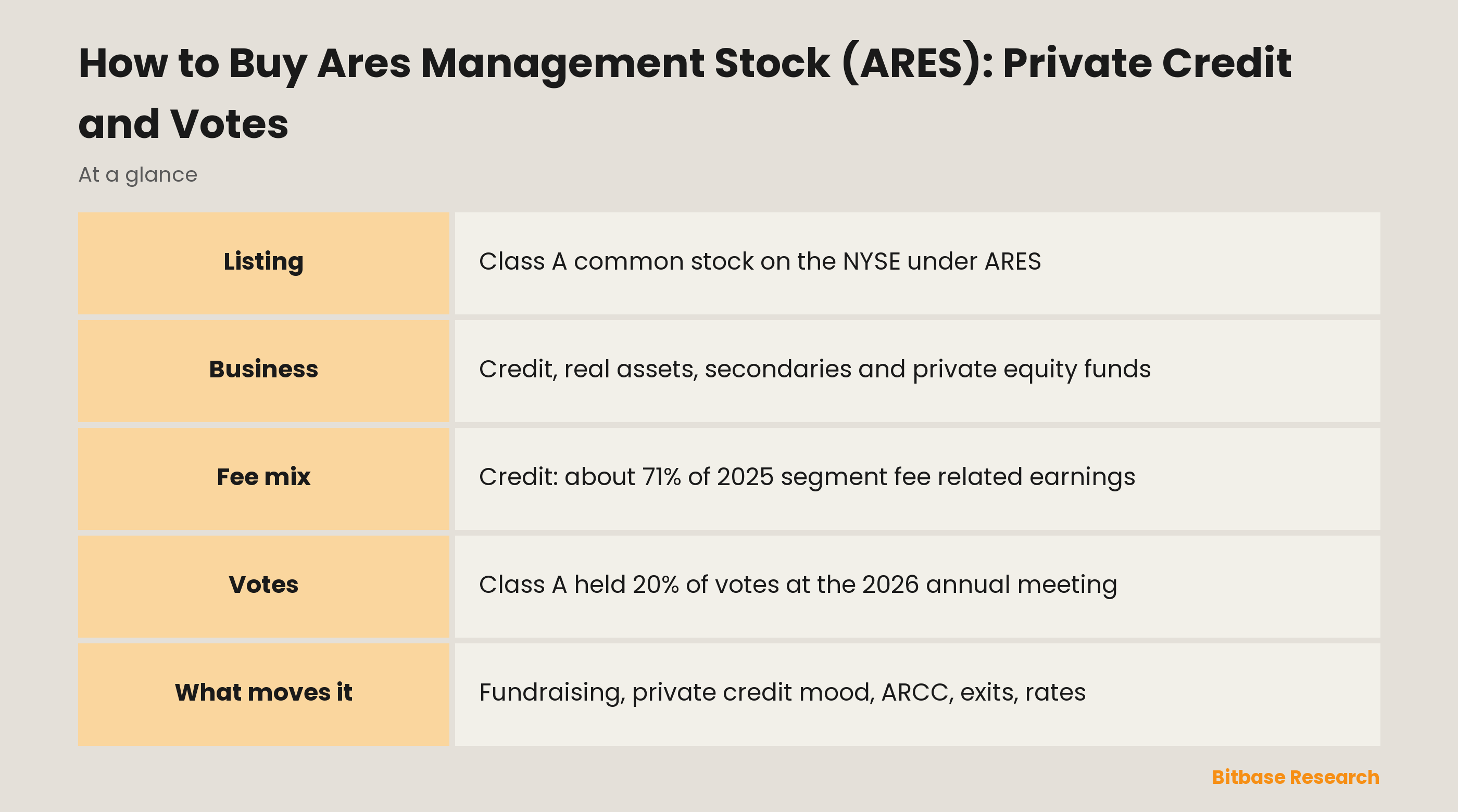
Your Ares Management order goes through any broker that reaches the New York Stock Exchange, where the Class A common stock trades under the ticker ARES. That share gives you a slice of a firm built mainly on credit, since the Credit Group produced about 71% of segment fee related earnings in 2025, but only a thin slice of the vote: Class A shares carried 20% of the votes cast at the 2026 annual meeting.
What Does Ares Management Do?
Ares Management Corporation describes itself as "a leading global alternative investment manager." Since its inception in 1997 it has managed capital on behalf of pension plans, insurance companies, sovereign funds, banks and endowments, and it now reaches more individuals through the wealth channel too. Antony Ressler is Executive Chairman and a Co-Founder; Michael Arougheti, also a Co-Founder, is Chief Executive Officer. Institutional clients dominate: at the end of 2025, 76% of assets under management came from direct institutional relationships.
The firm runs four investment groups. Credit, by far the largest, lends to companies and buys credit assets: syndicated loans and high-yield bonds, asset-based finance and other alternative credit, and direct loans that Ares originates itself. The 10-K calls Ares "one of the largest self-originating direct lenders to the U.S. and European middle markets."
Real Assets invests in the equity and debt of real estate and infrastructure. On 1 March 2025 Ares bought GCP International, the business of GLP Capital Partners outside Greater China, which added logistics and digital infrastructure.
Secondaries buys stakes in existing private equity, real estate, infrastructure and credit funds from investors who want to sell, and restructures funds that need more time or capital.
Private Equity backs companies directly and is the smallest of the four groups by fees.
Around these sit other businesses, chiefly Ares Insurance Solutions, the dedicated investment manager for the life and annuity insurer Aspida. Ares also manages several listed vehicles that are separate companies: Ares Capital Corporation (ARCC on Nasdaq), a business development company that lends to mid-sized firms, Ares Commercial Real Estate (ACRE) and the closed-end Ares Dynamic Credit Allocation Fund (ARDC), both on the NYSE. In February 2026 Ares completed its purchase of BlueCove, a London manager of systematic bond strategies, adding it to the Credit Group.
How Ares Management Makes Money
Ares earns three kinds of income. Management fees are charged as a percentage of the capital or assets in each fund; for some listed and perpetual vehicles they include a quarterly fee on net investment income. Fee related performance revenues come from perpetual vehicles that pay incentive fees on a recurring basis. Carried interest and incentive fees are paid when funds sell investments at a profit, so they arrive in lumps.
The firm's preferred yardstick is fee related earnings (FRE), a non-GAAP figure: management fees, other fees and fee related performance revenues, minus compensation and administrative costs. The shares below come from the segment table of the fiscal 2025 10-K, before the costs of the shared operations group are allocated:
| Group | What it manages | Share of 2025 management fees | Share of 2025 segment FRE |
|---|---|---|---|
| Credit | Liquid credit, alternative credit, direct lending | 68.7% | 70.6% |
| Real Assets | Real estate and infrastructure equity and debt | 18.4% | 18.0% |
| Secondaries | Stakes in existing private funds | 7.5% | 8.1% |
| Private Equity | Corporate buyouts and growth investments | 3.8% | 2.3% |
| Other businesses | Insurance solutions and other initiatives | 1.6% | 1.1% |
Management fees made up 77.4% of segment revenues in 2025, while realized performance income contributed 11.1%. Management fees rose 24.5% that year and company-wide FRE rose 30.4%; Real Assets fees jumped 68.8% in the year GCP International arrived. One client matters more than the rest: ARCC contributed about 31% of the Credit Group's management fees in 2025.
Assets under management grew 28.5% during 2025, and roughly a third of that increase came from acquisitions rather than new money or market gains. At year-end Credit held 65.4% of AUM.
The GAAP picture is noisier, because it also takes in consolidated funds and unrealized gains, and it can point the other way: in 2025 net income attributable to Class A and non-voting common stockholders fell 3.4% even as FRE climbed.
ARES Stock at a Glance
| Feature | ARES |
|---|---|
| Market and symbol | New York Stock Exchange (NYSE), ARES |
| What ARES is | Class A common stock of Ares Management Corporation, one vote per share |
| Other NYSE-listed Ares security | 6.75% Series B mandatory convertible preferred stock (ARES.PRB), due to convert into Class A on 1 October 2027 |
| Unlisted classes | Non-voting common stock held only by SMBC, with the same economic rights as Class A; Class B and Class C voting stock held by entities owned by Ares Partners Holdco |
| Held by index funds | SPY (S&P 500) and XLF (financial sector), per their 6 November 2026 holdings files |
| Headquarters | 1800 Avenue of the Stars, Los Angeles; incorporated in Delaware |
| History | NYSE-listed since 2 May 2014 as Ares Management, L.P.; a corporation since 26 November 2018 |
| Fiscal year | Ends 31 December |
| Dividend | Fixed quarterly amount, reset each year from expected FRE |
| SEC identifier | CIK 1176948 |
The quote moves through every session; current prices sit on the Ares Management stock page on Bitbase.
How to Buy Ares Management Stock
Ares is a US company, so there is no depositary receipt to think about; the NYSE line is the Class A common stock itself.
1. Pick a broker with NYSE access. Confirm which firm keeps custody of your shares and who regulates it.
2. Pass the account checks. If you live outside the US, expect to complete IRS Form W-8BEN; the IRS says to submit it "when requested by the withholding agent or payer."
3. Add money. If your money is not in US dollars, the conversion rate is a cost alongside any commission.
4. Choose the right line. Search results for "Ares" can show ARES.PRB, ARCC, ACRE and ARDC as well. Only ARES is Ares Management Corporation's Class A common stock.
5. Set the order type. FINRA says a market order "provides the most certainty that your order will be executed," while a limit order trades only "at or better than a specified price." A limit order protects you when the gap between regular-session and extended-hours prices is wide.
6. Decide the size. Some brokers sell fractional shares and some do not; ask before assuming you can buy less than one share.
7. Keep the records. Trade confirmations and dividend statements are what you will need at tax time.
Withholding for non-US holders. According to the IRS, "most types of U.S. source income received by a foreign person are subject to U.S. tax of 30%," and a tax treaty can reduce that. Dividends may also be taxed where you live.
Owning it indirectly. On 6 November 2026 Ares appeared in the holdings of State Street's SPY and XLF, where it is a small slice of a much larger basket.
What Moves ARES Stock
Fundraising and deployment. Most revenue is fees on capital, so the share follows how fast Ares raises and invests money. In 2025, 79% of fundraising from direct institutional investors came from existing clients, either backing a new product or a later fund in the same strategy.
Sentiment toward private credit. The 10-K notes that high-profile defaults and bankruptcies at other firms have brought "increased negative publicity with respect to the private credit industry," and warns that such concerns "could create pressure on the trading price of our Class A common stock" even where Ares was not involved.
ARCC. Because ARCC pays base fees on its total assets and quarterly fees on its net investment income, its size and results feed straight into Ares's revenue. On 26 October 2026 ARCC agreed to acquire MidCap Financial Investment Corporation, with a subsidiary of Ares supplying the cash part of the price; the deal was still expected rather than completed when Ares filed its third-quarter 10-Q.
Realizations. Performance income depends on fund exits, so it swings. In the first nine months of 2026 realized performance income was 87.4% higher than a year earlier while management fees rose 15.3%, and on 10 July 2026 Ares filed an 8-K in advance to say that second-quarter realized net performance income would beat the year-earlier figure.
Interest rates. The 10-K says rate changes "could negatively impact the values of certain assets or investments and the ability of our funds and their portfolio companies to access the debt markets on attractive terms," which in turn can hold back new investments and exits.
Share count. Employees hold AOG Units, partnership units in Ares Holdings, the operating group, which they can swap one-for-one for Class A shares up to four times a year. The Series B preferred converts into Class A on 1 October 2027. Both add to the Class A share count.
Voting Power, ARCC and Other Ares Risks
Of the risk factors in the fiscal 2025 10-K, these matter most to a Class A holder:
Limited say. "Holders of our Class A common stock will generally have no influence over matters on which holders of our common stock vote." The 10-K adds that board rules give Antony Ressler, as the only Class I director, what "effectively provides Mr. Ressler a veto right over all actions taken by our board of directors." Ares is a controlled company under NYSE rules and can skip some governance requirements.
Fee concentration. "The management fees we receive from ARCC … comprise a significant percentage of our management fees."
Raising capital. "Our business depends in large part on our ability to raise capital from investors."
Redemptions. Perpetual wealth vehicles "often conduct share redemption programs or tender offers to provide liquidity," and the 10-K links bad publicity about private credit to "increased repurchase requests from certain fund investors."
The tax receivable agreement. Exchanges of AOG Units trigger payments under this agreement, and the 10-K warns they may be accelerated and "could significantly exceed the actual tax benefits we realize."
The stock itself. "There can be no assurance that any dividends, whether quarterly or otherwise, can or will be paid," and Series B preferred dividends must be paid before any Class A dividend. A single stock can fall hard, and if you count your money in another currency, exchange rates add a second source of gains or losses.
How to Research Ares Management Yourself
Ares files on SEC EDGAR under CIK 1176948. The fiscal 2025 10-K went in on 25 February 2026, quarterly 10-Qs follow, and earnings arrive as 8-Ks, in 2026 on 5 February, 1 May, 31 July and 29 October.
In the 10-K, read the business description for the four groups, the risk factors for the voting structure and ARCC, and the segment note for FRE by group. Compare FRE with GAAP net income, since the two can move in opposite directions. The 8-K filed after each annual meeting shows how many votes each class held, and the AUM rollforward in each 10-Q separates new capital from acquisitions and market moves.
For peers with different structures, see our KKR walkthrough and Blackstone walkthrough. Other names are in Bitbase's index of US stock pages.
Ares Management Stock FAQ
Can I buy Ares Management stock with crypto?
Not directly. Brokers settle ARES trades in dollars, so you would first convert crypto into cash, which can count as a taxable sale where you live. What you end up with is ownership in Ares Management Corporation, one of the points in what separates shares from crypto assets.
Does Ares Management pay a dividend?
Yes. Ares sets a fixed quarterly dividend for each calendar year based on expected FRE, and the 2026 quarterly rate is about 21% above the 2025 rate. Each payment still needs board approval, and Series B preferred dividends come first.
Is ARES in the S&P 500?
Yes. Ares Management Corp Class A appeared in the 6 November 2026 holdings file of SPY, a fund that tracks the S&P 500.
Is Ares Capital (ARCC) the same as Ares Management stock?
No. ARCC is a separate Nasdaq-listed business development company that Ares manages for a fee. Owning ARCC gives you a share of its loan portfolio, not of Ares Management Corporation.
What is the difference between ARES and ARES.PRB?
ARES is the Class A common stock. ARES.PRB is a 6.75% mandatory convertible preferred that pays a fixed dividend and converts into a variable number of Class A shares on 1 October 2027.
Who controls the votes at Ares Management?
Entities owned by five of the firm's founders and senior leaders, the Holdco Members, hold the Class B and Class C stock, which together carried about four votes for every Class A vote at the 2026 annual meeting.
Conclusion
Holding ARES gives you little voting power in a fee business built mostly on credit, one tied closely to ARCC and to how private credit is regarded. The purchase itself needs nothing more than an NYSE-capable broker. Go through the newest 10-K, 10-Q and 8-Ks before you size a position in a single asset manager.
Related reading
Other Bitbase articles on this topic:
- How to Buy Ameriprise Stock (AMP): Advisors, Funds and Annuities
- How to Buy Nomura Stock (NMR): NYSE ADSs or Tokyo Code 8604
- How to Buy ORIX Stock (IX): One-Share ADS and a PFIC Warning
- How to Buy Raymond James Stock (RJF): Advisors, Cash Sweeps, Rates
Disclaimer: This article is educational content from Bitbase Academy, provided for information only. It explains what a company or fund does and how the instruments referenced here differ from one another; it does not constitute investment, trading, tax, or financial advice, and it is neither a recommendation nor an endorsement of any security, token, or trading strategy. A tokenized stock is issued by a third party and is designed to give economic exposure to an underlying asset: it is not a share, it carries no shareholder rights, and it depends on the issuer's structure, eligibility rules, and redemption terms, which the issuer can change. Perpetual futures are leveraged derivatives that hold no underlying asset and can be liquidated, and trading hours, product availability, and eligibility differ by instrument and by jurisdiction and can change at any time. Written as of November 2026; verify everything yourself through company filings, the issuer's own documentation, and the product pages of the venue you trade on.
References
[1] Ares Management Form 10-K for 2025 (SEC EDGAR) www.sec.gov
[2] Ares Management Form 10-Q, third quarter 2026 (SEC EDGAR) www.sec.gov
[3] Ares Management Form 8-K, June 2026: annual meeting vote results (SEC EDGAR) www.sec.gov
[4] Ares Management Form 8-K, 29 October 2026: third-quarter results and dividend (SEC EDGAR) www.sec.gov
[5] Ares Management Form 8-K, 10 July 2026: preliminary second-quarter performance income (SEC EDGAR) www.sec.gov
[6] Ares Management Form 8-K, November 2018: conversion to a corporation (SEC EDGAR) www.sec.gov
[7] State Street: SPY daily holdings, 6 November 2026 www.ssga.com
[8] State Street: XLF daily holdings, 6 November 2026 www.ssga.com
[9] IRS: NRA Withholding www.irs.gov
[10] IRS: About Form W-8 BEN www.irs.gov
[11] FINRA: Types of Orders www.finra.org





