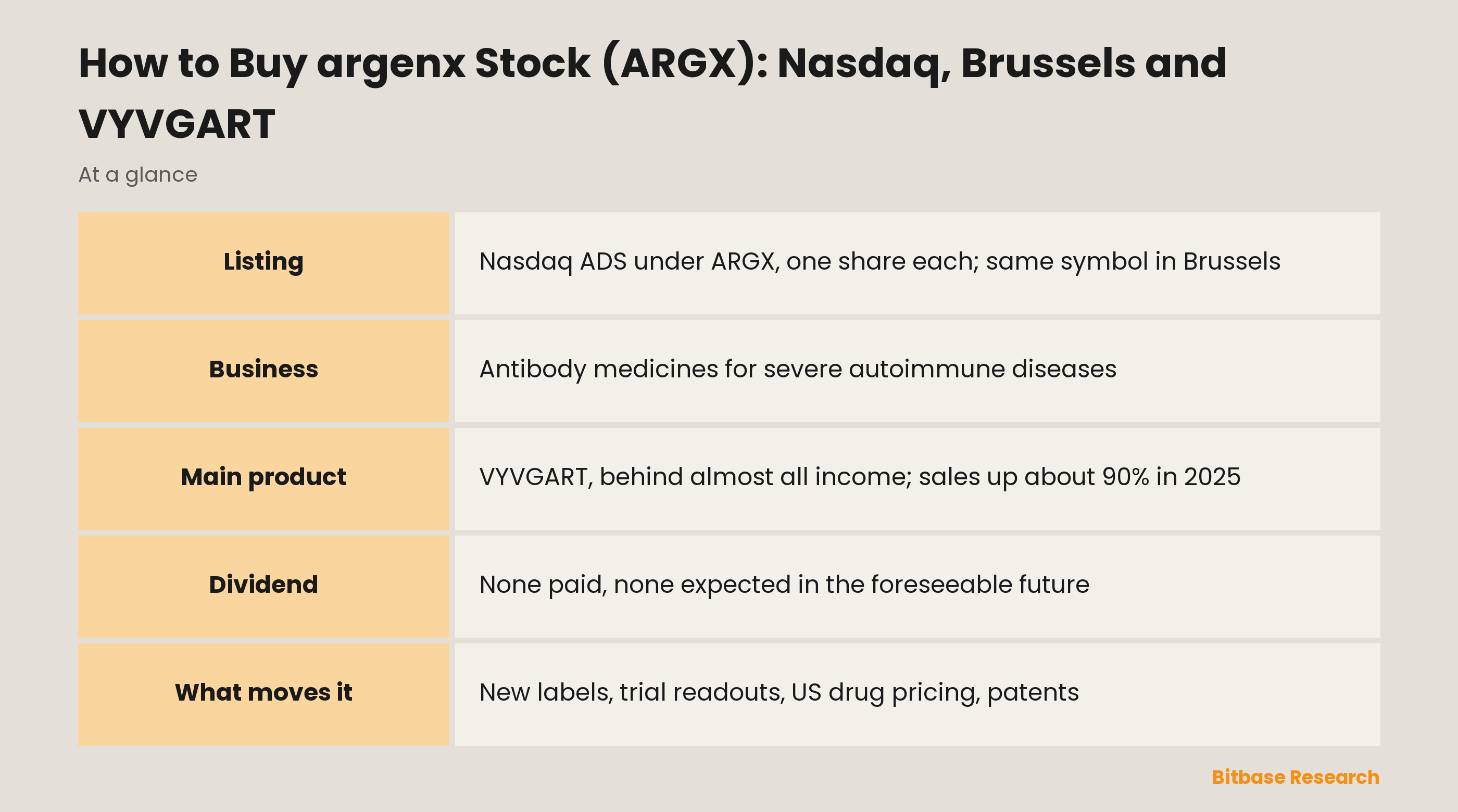
An argenx ADS trades on the Nasdaq Global Select Market under ARGX, available through any broker with access to US shares; each one stands for exactly one ordinary share, which is itself listed on Euronext Brussels under the same symbol. The company is registered in the Netherlands, does its research through a Belgian subsidiary and earns almost everything from one medicine family, VYVGART, whose product net sales rose about 90% in 2025.
What Does argenx Do?
argenx develops antibody medicines for severe autoimmune diseases, in which the body's own IgG antibodies attack healthy tissue. Its Form 20-F annual report describes VYVGART as "a first-and-only immunoglobulin G (IgG) Fc-antibody fragment that targets the FcRn," the receptor that recycles IgG in the blood; blocking it lowers IgG levels "without impacting antibody production."
It comes as an intravenous infusion, as a subcutaneous version sold in the US as VYVGART Hytrulo, which uses Halozyme's ENHANZE delivery technology under licence, and, in the US since April 2025, as a prefilled syringe for self-injection. By February 2026 it was approved in more than 30 countries for generalized myasthenia gravis (gMG), which causes fluctuating muscle weakness, for chronic inflammatory demyelinating polyneuropathy (CIDP), which damages the insulation of peripheral nerves, and, in Japan only, for primary immune thrombocytopenia (ITP). About 19,000 patients were treated in 2025, and in May 2026 the US Food and Drug Administration widened the gMG label to adults of every antibody serotype.
argenx was incorporated under Dutch law in 2008; since 2009 its research has been done by argenx BV, its only direct subsidiary, based in Belgium. The shares were listed in Brussels in 2014, and in 2017 the company became a European company (Societas Europaea, hence SE) just before the Nasdaq listing. Co-founder Tim Van Hauwermeiren ran it until May 2026, when Karen Massey, chief operating officer since 2023, became chief executive and he became chair.
In August 2026 the Phase 3 ALKIVIA trial of efgartigimod in autoimmune myositis met its primary endpoint; in October 2026 the Phase 3 UNITY trial in Sjögren's disease was stopped for futility. Empasiprubart, which blocks the complement protein C2, is in Phase 3 in multifocal motor neuropathy (MMN) and CIDP, and FB102, acquired with Forte Biosciences in August 2026, is heading into Phase 3 in celiac disease. Under Vision 2030, argenx aims to treat 50,000 patients, hold 10 labelled indications and have five pipeline candidates in Phase 3 by 2030.
How argenx Makes Money
The 20-F puts it plainly: "Currently, our commercial revenue is generated by VYVGART and VYVGART SC in gMG, CIDP and ITP (Japan only)." In 2025 product net sales made up 97.7% of total operating income; the other 2.3% came mostly from research and development tax incentives and payroll tax rebates. argenx reports one segment, in US dollars under IFRS, and splits product net sales by the country of the entity that books them:
| Country of sale | Share of 2025 product net sales |
|---|---|
| United States | 85.1% |
| Japan | 5.0% |
| China | 1.6% |
| Rest of the world | 8.3% |
Calculated from the segment note of the 20-F.
Customers are concentrated too: four US customers, which the filing does not name, took about 78% of 2025 product net sales, after five took 87% in 2024. In Greater China the medicine is developed and sold by Zai Lab under an exclusive licence signed in January 2021, which entitles argenx to a sales-based milestone and tiered royalties.
Research and development expenses grew about 39% in 2025, to the equivalent of 32.9% of product net sales. In the third quarter of 2026, product net sales rose 54% from a year earlier and 13% from the second quarter.
ARGX Stock at a Glance
| Item | Detail |
|---|---|
| Issuer | argenx SE, a European company registered in the Netherlands |
| Nasdaq listing | ADSs on the Nasdaq Global Select Market, symbol ARGX, since 18 May 2017 |
| ADS ratio | One ADS represents one ordinary share |
| Home listing | Ordinary shares on Euronext Brussels, symbol ARGX, since July 2014 |
| Depositary and custodian | The Bank of New York Mellon holds the shares through ING Bank N.V. |
| Sector | Biotechnology: antibody medicines for autoimmune diseases |
| Seat and base | Official seat in Amsterdam; business contact address in Ghent, Belgium |
| Financial year | Calendar year; IFRS accounts in US dollars |
| Dividend policy | No cash dividend paid; none expected in the foreseeable future |
| SEC filings | CIK 1697862; Form 20-F each year, Form 6-K in between |
Live quotes, market value and trading volume are on the argenx stock page on Bitbase.
How to Buy argenx Stock
On Nasdaq the ordinary shares are registered "not for trading, but only in connection with the registration of the American Depositary Shares," so a US broker sells the ADS. In Brussels the ordinary share itself trades, in euros. The steps:
1. Pick the market. Brokers with US access sell the dollar-priced ADS; the ordinary share needs access to Euronext Brussels.
2. Open and verify the account, including a tax-residence declaration.
3. Fund it. Paying in another currency adds a conversion spread to the commission.
4. Check the listing. Both venues use ARGX, so check the exchange and the description: on Nasdaq, American depositary shares of argenx SE.
5. Decide how to price the order. A market order executes at whatever price is available; a limit order executes only at your price or better.
6. Size the position. With one ADS equal to one share, the dollar and euro prices are linked through the exchange rate. Whether you can buy a fraction of an ADS depends on your broker.
7. Keep the records of each trade for tax time.
ADS or Brussels share. The 20-F is direct: "Holders of our ADSs have fewer rights than our ordinary shareholders." The depositary holds the shares, so an ADS owner votes by instructing it, possibly too late; ADS holders cannot join a pre-emptive rights offering unless the company arranges it, and the depositary charges fees.
Tax. With no dividend paid, withholding is theoretical for now. If one were paid, the 20-F says the Netherlands would generally withhold 15%, and for investors in Belgium a Belgian intermediary would normally levy a 30% Belgian withholding tax as well. For US taxpayers, the company does not believe it was a passive foreign investment company (PFIC) in its latest tax year. Ask a tax adviser about gains.
Through a fund. argenx can also be held indirectly through a fund that owns it; check the fund's holdings list.
What Moves ARGX Stock
VYVGART's label. Each new population widens the market. After May 2026, an application for ocular myasthenia gravis has been submitted in the US, one for paediatric gMG has a target action date in February 2027, and a filing in immune-mediated necrotizing myopathy, a form of myositis, is planned by the end of 2026. An autoinjector is expected in the second half of 2027.
Trial readouts. Phase 3 results can go either way, as UNITY showed. Next come EMPASSION, empasiprubart in MMN, expected in December 2026, ADVANCE-NEXT in primary ITP in early 2027 and two empasiprubart trials in CIDP in late 2027.
US drug pricing. With 85.1% of product net sales booked in the US, American rules weigh most. The 20-F cites the Inflation Reduction Act, which "authorizes Medicare drug price negotiation," and warns that lower prices in the EU "may, in turn, contribute to downward price pressure in the U.S. because of MFN initiatives," the most-favoured-nation pricing proposals.
Competition and exclusivity. The large drugmakers the 20-F names as competitors in autoimmune disease include AstraZeneca and Novartis, and it warns of products "in the same class as VYVGART." Key efgartigimod patents are expected to expire in 2036 in the US and 2037 in Europe, with a base expiry of 2034 in many other countries; the FDA may not approve a biosimilar until 12 years after a reference product's approval.
Currencies. Accounts and most sales are in dollars, the Brussels line in euros; the 20-F notes that exchange-rate moves can open price gaps that traders try to exploit.
What Stands Between argenx and Vision 2030
Of the risk factors in Item 3.D of the 20-F, these bear most on an ARGX holder:
One product family. "The commercial success of our products and product candidates, including in new indications or methods of administration, will depend on the degree of market acceptance." With VYVGART behind almost all income, one setback reaches the whole company.
Biosimilars. The company's biologics "may face biosimilar competition," and issued patents "could be found invalid, not infringed, or unenforceable if challenged."
Supply. Contract manufacturers make the drug substance, Lonza at sites in the UK, the US, Singapore and Switzerland and Fujifilm in Denmark, and "for some of our raw materials, we rely on a single source of supply."
Concentrated buyers. Four unnamed US customers took about 78% of 2025 product net sales.
Status as a foreign filer. The 20-F says argenx believed at least 50% of its ordinary shares were held by US residents, counting every share behind an ADS as US-held. If it lost foreign private issuer status, or the SEC changed the definition it began reviewing in June 2025, it could have to meet US domestic rules "in a very compressed timeframe."
On top come the general risks of holding one stock: the result hangs on one company, no dividend softens a fall, and "the price of our ADSs may be volatile."
Reading argenx's 20-F and 6-K Reports
argenx files with the SEC under CIK 1697862: a Form 20-F for each calendar year, most recently on 19 March 2026, and Form 6-K for everything else, from quarterly results (the third quarter on 22 October 2026) to trial readouts, approvals and meeting results. As of October 2026 it had not moved to the domestic Forms 10-K and 10-Q.
In the 20-F, risk factors sit in Item 3.D, the business, pipeline and patents in Item 4.B, results in Item 5, Dutch, Belgian and US tax in Item 10.E and the depositary's charges in Item 12.D. Three habits help: separate product net sales from total operating income; treat 6-K quarterly figures as unaudited; and check which ARGX venue a quote refers to. Other listed companies have their own pages in Bitbase's stock directory.
argenx Stock FAQ
Does one ARGX ADS equal one argenx share?
Yes. Each ADS represents one ordinary share, held by ING Bank N.V. as custodian for the depositary, The Bank of New York Mellon. Both lines track the same unit, apart from currency and ADS fees.
Does argenx pay a dividend?
No. Apart from small technical distributions used to pay up shares issued under its employee equity plan, the 20-F says "we have not paid or declared any cash dividends on our ordinary shares, and we do not anticipate paying any cash dividends in the foreseeable future." In May 2026 shareholders added the 2025 profit to retained earnings.
Can I buy argenx stock with crypto?
No exchange takes crypto for ARGX: the Nasdaq line is paid in dollars and the Brussels line in euros. You would first sell the crypto, possibly a taxable disposal, and move the cash to a broker. This blog's guide to buying stocks with crypto covers the steps in between.
Is argenx a Dutch or a Belgian company?
Legally Dutch: argenx SE was incorporated under Dutch law, has its official seat in Amsterdam and calls its sales and long-term assets in the Netherlands "not material." Much of the business sits in Belgium: argenx BV is based there, the business contact address is in Ghent, and 94.6% of non-current assets were in Belgium at the end of 2025.
Is argenx profitable?
Yes, on its IFRS accounts for 2024 and 2025. The 2024 profit came mostly from an income tax benefit; the 20-F calls 2025 "the Company's first year of operational profitability," and the first nine months of 2026 were profitable too.
Conclusion
Buying ARGX is simple once the two lines are clear: a dollar ADS on Nasdaq equal to one share, or the ordinary share in euros in Brussels, both under the same symbol. What remains uncertain is the business: how far VYVGART's label extends, what EMPASSION shows in December 2026, how US pricing policy moves and how long exclusivity lasts. Read the latest 20-F and later 6-Ks, and decide how heavily one product family should weigh in your holdings.
Related reading
Other Bitbase articles on this topic:
- How to Buy AbbVie Stock (ABBV): Skyrizi and Rinvoq After Humira
- How to Buy Amgen Stock (AMGN): Repatha, Prolia and MariTide
- How to Buy Bristol Myers Squibb Stock (BMY): Eliquis and Opdivo
Disclaimer: This article is educational content from Bitbase Academy, provided for information only. It explains what a company or fund does and how the instruments referenced here differ from one another; it does not constitute investment, trading, tax, or financial advice, and it is neither a recommendation nor an endorsement of any security, token, or trading strategy. A tokenized stock is issued by a third party and is designed to give economic exposure to an underlying asset: it is not a share, it carries no shareholder rights, and it depends on the issuer's structure, eligibility rules, and redemption terms, which the issuer can change. Perpetual futures are leveraged derivatives that hold no underlying asset and can be liquidated, and trading hours, product availability, and eligibility differ by instrument and by jurisdiction and can change at any time. Written as of October 2026; verify everything yourself through company filings, the issuer's own documentation, and the product pages of the venue you trade on.
References
[1] argenx SE, Form 20-F for the year ended 31 December 2025 (SEC EDGAR) www.sec.gov
[2] argenx, Form 6-K of 22 October 2026: third-quarter 2026 results www.sec.gov
[3] argenx, Form 6-K of 11 May 2026: FDA approval for all adult gMG serotypes www.sec.gov
[4] argenx, Form 6-K of 6 May 2026: general meeting results and new chief executive www.sec.gov
[5] argenx, Form 6-K of 17 August 2026: Phase 3 ALKIVIA topline results www.sec.gov
[6] argenx, Form 6-K of 8 October 2026: update on the Phase 3 UNITY study www.sec.gov
[7] argenx, Form 6-K of 27 August 2026: completed acquisition of Forte Biosciences www.sec.gov





