
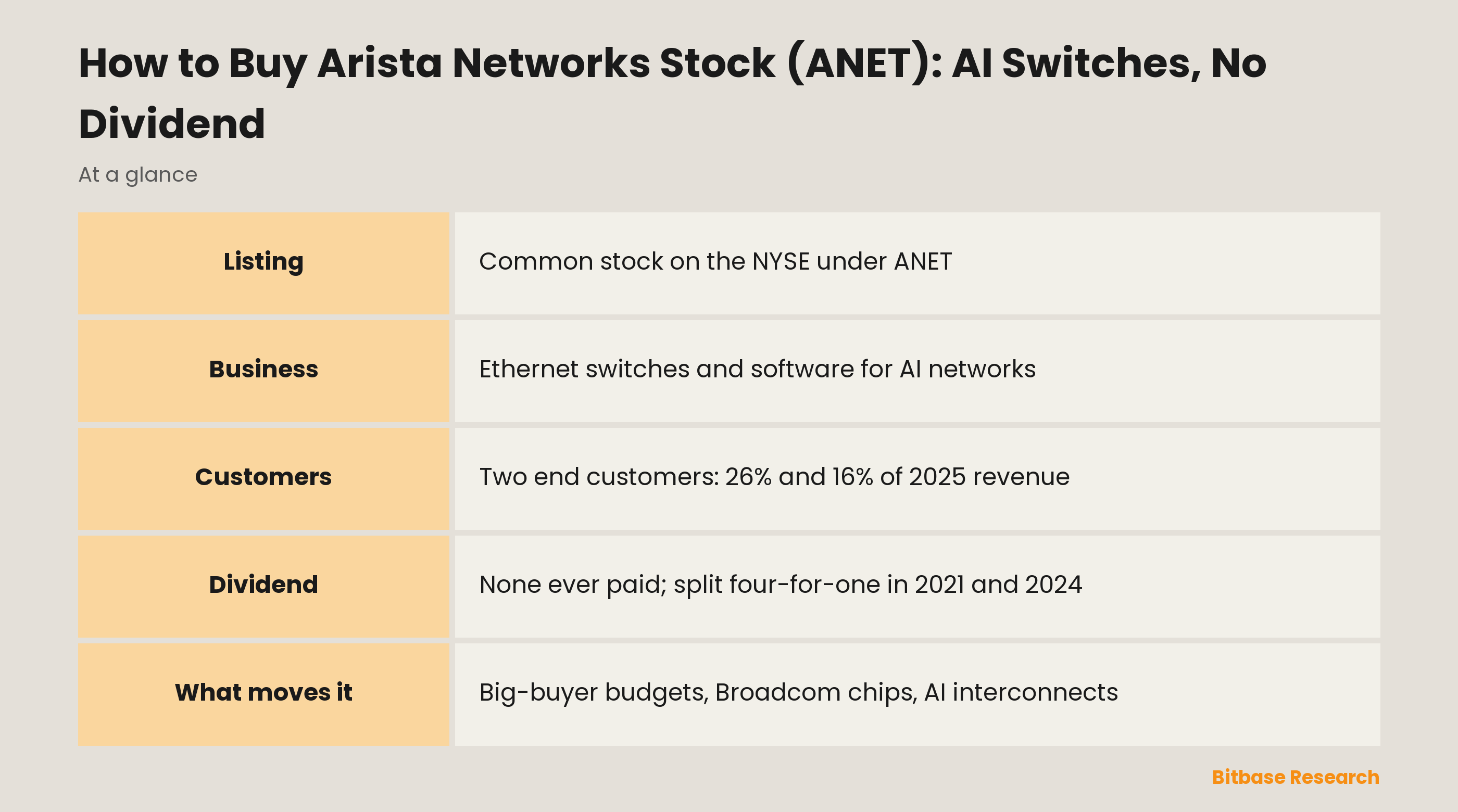
Each share of Arista Networks is bought the ordinary way: through a broker that can route orders to the New York Stock Exchange, where the common stock trades under the ticker ANET. Arista sells the Ethernet switches and software that tie AI accelerators together inside cloud data centers, and two end customers alone made up 26% and 16% of its fiscal 2025 revenue. It has never paid a cash dividend, and it split its stock four-for-one in 2021 and again in 2024. This guide covers what Arista sells, how the order works and what its filings flag: customer concentration, dependence on Broadcom chips and the contest between Ethernet and rival AI interconnects.
What Does Arista Networks Do?
Arista Networks designs and sells networking equipment and the software that runs it: Ethernet switches and routers for data centers, switching and Wi-Fi for campuses, wide-area networking for branch sites, and management tools on top. Its annual report calls the strategy "Centers of Data," with the network as "a service that interconnects four primary domains: AI Centers, Data Centers, Campus Centers, and WAN Centers." Every product runs one operating system, EOS (Extensible Operating System), which sits on top of standard Linux.
The company was founded in 2004 and incorporated in California as Arastra, Inc.; it shipped its first products in 2008 and took the Arista Networks name that October. Its founders included Andy Bechtolsheim, who had co-founded Sun Microsystems in 1982, and Kenneth Duda. Jayshree Ullal, previously head of Cisco's data center business, was chief executive when Arista reincorporated in Delaware in March 2014 and listed on the New York Stock Exchange that June; she is now chief executive and chairperson. Headquarters are in Santa Clara, California.
The 10-K sorts the portfolio into three categories. Core is AI, cloud and data center networking, including the Etherlink family of "over twenty products" for AI clusters, among them 800G switches. Cognitive Adjacencies is campus and routing: campus switches, Wi-Fi access points, routing platforms and the VeloCloud SD-WAN line, which Arista bought from Broadcom on 30 June 2025. Cognitive Networks is software and services: the CloudVision management platform, security tools and A-Care support.
AI is where the company points that portfolio, and it divides AI networking into three jobs. Scale out links accelerators across many racks into one training or inference cluster. Scale across joins clusters spread over long distances. Scale up covers the links between accelerators inside a single rack; the filing calls that domain "currently dominated by proprietary technologies" and treats it as a future opportunity if the market moves to open Ethernet standards.
Arista does not run its own factories. Contract manufacturers build the majority of its products, chiefly Jabil, Sanmina and Foxconn Hon Hai, in Malaysia, Vietnam, Mexico and other countries. Sales run through a direct sales force and channel partners such as distributors, resellers and system integrators.
How Arista Networks Makes Money
Hardware with software inside it brings in most of the money. In fiscal 2025, which matched the calendar year, product sales made up 84.1% of revenue and services 15.9%. Product revenue is mainly switching and routing platforms; service revenue is mainly support contracts, bought with the hardware and renewed afterwards.
The 10-K cuts the same revenue two ways:
| Breakdown | Category | Share of 2025 revenue |
|---|---|---|
| Product category | Core: AI, cloud and data center networking | 65% |
| Product category | Cognitive Adjacencies: campus and routing | 18% |
| Product category | Cognitive Networks: software and services | 17% |
| Customer type | Cloud and AI Titans | 48% |
| Customer type | Enterprise, including financial firms and government agencies | 32% |
| Customer type | AI and Specialty Providers, including AI Neoclouds | 20% |
The shares are the company's own rounded figures.
The customer column understates how concentrated the business is. Two end customers accounted for 26% and 16% of fiscal 2025 revenue, 42% between them. The fiscal 2024 report named the two companies above the 10% line: Microsoft, at 20% of 2024 revenue, and Meta Platforms, at 15%. The fiscal 2025 report gives the percentages without names. Big orders carry a price too: the discounts they require, the company says, "often reduce gross margins in the periods when the sales occur."
Growth has been fast and uneven. Item 1A records annual revenue growth of 48.6% in 2022, 33.8% in 2023, 19.5% in 2024 and 28.6% in 2025, and first-half revenue in 2026 ran 36.5% above the same period a year earlier. Gross margin held at 64.1% in both 2024 and 2025. Research and development took about 14% of 2025 revenue, more than sales, marketing and administration combined.
The Americas supplied 79.1% of 2025 revenue. Sales elsewhere rose from 18.2% of the total in 2024 to 20.9% in 2025, a change the company attributes mainly to the geographic mix of sales to its large global customers.
ANET Stock at a Glance
| Item | Detail |
|---|---|
| Exchange | New York Stock Exchange (NYSE) |
| Ticker | ANET |
| Security | Common stock, the only security with a trading symbol on the 10-K cover |
| Industry | Networking equipment and software for AI, cloud, data center and campus |
| Index membership | S&P 500, per SPY holdings on 16 October 2026 |
| Headquarters | Santa Clara, California |
| Incorporated | Delaware since March 2014; first incorporated in California in 2004 |
| Public since | June 2014 |
| Fiscal year | Calendar year, ending 31 December |
| Dividend policy | None: no cash dividend has ever been declared or paid |
| Stock splits | Four-for-one in November 2021 and four-for-one in December 2024 |
| Share buybacks | Program authorized in May 2025; it can be suspended at any time |
| SEC identifier | CIK 1596532 |
Price, market value and volume change with every trade; for the live quote and chart, open the Arista Networks stock page on Bitbase.
How to Buy Arista Networks Stock
Arista is a Delaware company whose common stock trades directly on the NYSE, so there is no depositary receipt to consider and no second share class to choose between. At a broker the route looks like this:
1. Choose a broker with NYSE access. Outside the US, look for a local firm with US market access or an international broker, and check which entity holds your account and which regulator supervises it.
2. Open and verify the account. If you are not a US person, the broker will ask for IRS Form W-8BEN, the certificate of foreign status used for US tax withholding.
3. Fund it. Depositing in another currency adds a conversion cost, so compare the conversion rate and not only the commission.
4. Search for ANET. Confirm that the result reads Arista Networks common stock on the NYSE.
5. Pick an order type. FINRA says a market order "provides the most certainty that your order will be executed," but "you might not get the price you saw or were originally quoted, especially in fast-moving markets." A limit order buys "at or better than a specified price," with the catch that "there's a chance your order doesn't get executed at all."
6. Size the position. FINRA notes: "The availability of fractional share trading varies by brokerage firm." It adds: "As a fractional share owner, you might not have shareholder voting rights."
7. Keep the records. With no dividends arriving, the trade confirmations are your record of cost basis for the day you sell.
If your broker offers trading before or after the regular session, FINRA warns that "news events or other factors might significantly impact the price of the security when the market opens again." In those thinner hours, a limit order sets the most you will pay.
Outside the United States, the tax picture is narrower than for a dividend payer. The IRS states that "Most types of U.S. source income received by a foreign person are subject to U.S. tax of 30%," with a reduced rate or exemption possible under a tax treaty. Arista has never paid a dividend, so there is currently no dividend for that rate to apply to. Brokers still ask for Form W-8BEN, and how your home country taxes a gain when you sell is a separate question. This is general information, not tax advice.
Through a fund, you can hold Arista without picking it. On 16 October 2026 it appeared in the daily holdings files State Street publishes for SPY, its S&P 500 ETF Trust, and for its Technology Select Sector SPDR ETF (XLK), as one holding among many at a weight that changes daily.
What Moves ANET Stock
The budgets of a few large buyers. With two end customers at 42% of revenue, Arista's results track the capital plans of a small group of cloud and AI operators. The 10-K says the company has "experienced unpredictability in the timing of orders from our high-volume customers," and ties that to spending cycles and "the extensive periods required for evaluation, testing, and qualification." The June 2026 quarterly report added: "Volatility and uncertainty in the demand for AI models underlying network systems could increase this unpredictability from our large customers."
Acceptance terms and deferred revenue. New AI products bring more customer trials and contracts with acceptance periods, so a shipment does not always become revenue in the quarter it leaves. The 10-K says this has produced "an increase in the volatility and magnitude of our product deferred revenue balances," which "may create variability in our revenue results on a quarterly and annual basis." Quarterly revenue can therefore trail the deployments behind it.
Ethernet against rival AI interconnects. In back-end AI clusters, the 10-K says, Ethernet competes with InfiniBand and NVLink, which "are often sold as part of a vertical solution along with the GPUs from Nvidia." Arista sees the shift from proprietary links to open Ethernet, as defined by the Ultra Ethernet Consortium, as its chance to gain share. Core, the product category this contest touches, was 65% of 2025 revenue.
Margins and the customer mix. In the second quarter of 2026 gross margin fell to 62.9% from 65.2% a year earlier, which the 10-Q attributes "primarily" to "an increased proportion of our sales to large end customers who generally receive higher discounts." Supply is the other pressure: tightening supply in the memory and silicon markets has "continued to put pressure on our gross margin," and Arista has raised its purchase commitments in response.
Broadcom and the supply chain. Arista is "primarily reliant upon our predominant merchant silicon vendor, Broadcom, for our switching chips," and generally has no written agreement guaranteeing supply of key components. With assembly in Malaysia, Vietnam and Mexico, tariffs and export controls reach both cost and delivery; the 10-K singles out US export controls "targeting trade with China."
Competition and consolidation. The 10-K says data center and campus networking have "historically been dominated by Cisco," and also names Dell/EMC, Extreme Networks, Hewlett Packard Enterprise, Huawei, Juniper Networks, Nvidia and white-box vendors. It notes that Hewlett Packard Enterprise has acquired Juniper and that Nvidia has invested in several AI Neoclouds, deals it says are used "to influence buying decisions." For how other suppliers to AI data centers report their exposure, see this overview of listed AI infrastructure companies.
Risks Named in Arista's Filings
Item 1A of the 10-K is long; these entries bear most directly on an ANET share:
Customer concentration. "Large purchases by a relatively limited number of customers have accounted for a significant portion of our revenue," and any change in them "could result in material quarter-to-quarter fluctuations of our revenue."
Single-source components. "Some of the key components in our products come from sole or limited sources of supply," with Broadcom named for the switching chips.
Competition. "We face intense competition, especially from larger, well-established companies and industry consolidation may lead to increased competition."
Margins. The company warns that "the gross margins we have achieved in recent years may not be sustainable," citing among other things bundling by "more fully integrated competitors."
Trade policy. US tariffs and the countermeasures of other countries "may have a negative effect on global economic conditions, financial markets and our business."
Two more sit at the level of the stock. The share price "has historically been and is likely to continue to be volatile," and directors, executive officers and holders of more than 10% together owned about 17.3% of the shares at the end of 2025 and, acting together, "could exercise a significant level of influence" over shareholder votes. Because Arista pays no dividend, the company spells out the consequence: "you may only receive a return on your investment in our common stock if the market price of our common stock increases." For a holder outside the US, that return also passes through an exchange rate.
How to Research ANET Yourself
Arista's SEC filings sit under CIK 1596532. Its annual report is the 10-K, quarterly reports are 10-Qs, and 8-Ks carry the quarterly earnings releases and other events in between. The investor relations site, investors.arista.com, posts the filings and webcasts of the earnings calls.
In the 10-K, Item 1 describes the products and customer types and Item 1A the risks, while the overview of the management discussion carries the customer-concentration paragraph. That paragraph is worth rereading every year: the fiscal 2024 report named the two largest customers, and the fiscal 2025 report did not.
Two checks save confusion. Later filings restate per-share figures for both splits, but older articles and charts may still show the original numbers; one share held before November 2021 has become 16. And the shareholder return graph in Item 5 measures ANET against the NYSE Composite Index and the S&P 500, the benchmarks the company chose for itself. The live quote sits on the stock page linked above, and Bitbase's US stock pages cover other listed companies.
Arista Networks Stock FAQ
Does Arista Networks pay a dividend?
No. The 10-K states: "We have never declared nor paid any cash dividends on our common stock, and we do not anticipate paying any cash dividends in the foreseeable future." The company does buy back stock: its board authorized the current repurchase program on 2 May 2025, and the program does not oblige Arista to buy any shares and can be suspended at any time.
Can I buy Arista Networks stock with crypto?
Only indirectly. A broker sells ANET for US dollars, so the crypto has to be converted to cash first and the cash moved into the brokerage account; depending on where you live, that conversion can be a taxable sale. What you end up holding is common stock with a vote at shareholder meetings, a different kind of asset from the coin you sold; this explainer sets out how a share and a token differ.
Has Arista Networks stock ever split?
Yes. The filings record a four-for-one split in November 2021, paid as a stock dividend, and another four-for-one split effected on 3 December 2024. Together they turn one share held before the first split into 16, so per-share figures from before either date need adjusting before you compare them.
Is ANET in the S&P 500?
Yes. State Street's daily holdings file for its S&P 500 ETF Trust (SPY) listed Arista Networks on 16 October 2026, and so did the file for XLK. ANET trades on the NYSE rather than Nasdaq, and index weights change daily.
Who are Arista Networks' biggest customers?
Cloud and AI Titans, the label Arista uses for its large cloud customers, made up about 48% of fiscal 2025 revenue. The fiscal 2024 10-K named Microsoft and Meta Platforms as the two end customers each above 10% of revenue in 2023 and 2024. The fiscal 2025 report lists two end customers at 26% and 16% of revenue without naming them.
Conclusion
The order itself is routine: an account that reaches the NYSE, the ANET symbol, a market or limit order. Judging the share takes longer, because Arista's revenue rests on the spending plans of a few cloud and AI operators, on Broadcom's chips and on how Ethernet fares against rival AI interconnects. There is no dividend to soften a weak year, so the return comes from the share price alone. The current 10-K and the latest 10-Q, starting with the customer-concentration paragraph, are the documents to read before deciding how much of a portfolio belongs in one networking stock.
Related reading
Other Bitbase articles on this topic:
- How to Buy Corning Stock (GLW): Gorilla Glass and AI Fiber
- How to Buy Dell Technologies (DELL) Stock: Trading Methods, Costs and Risks
- How to Buy Fortinet Stock (FTNT): FortiGate, ASICs, No Dividend
- How to Buy Western Digital Stock (WDC): Hard Drives After Sandisk
Disclaimer: This article is educational content from Bitbase Academy, provided for information only. It explains what a company or fund does and how the instruments referenced here differ from one another; it does not constitute investment, trading, tax, or financial advice, and it is neither a recommendation nor an endorsement of any security, token, or trading strategy. A tokenized stock is issued by a third party and is designed to give economic exposure to an underlying asset: it is not a share, it carries no shareholder rights, and it depends on the issuer's structure, eligibility rules, and redemption terms, which the issuer can change. Perpetual futures are leveraged derivatives that hold no underlying asset and can be liquidated, and trading hours, product availability, and eligibility differ by instrument and by jurisdiction and can change at any time. Written as of October 2026; verify everything yourself through company filings, the issuer's own documentation, and the product pages of the venue you trade on.
References
[1] Arista Networks Form 10-K, fiscal 2025: business, revenue mix, customer concentration and risk factors (SEC EDGAR) www.sec.gov
[2] Arista Networks Form 10-Q for the quarter ended 30 June 2026: results, gross margin and supply conditions (SEC EDGAR) www.sec.gov
[3] Arista Networks Form 10-K, fiscal 2024: Microsoft and Meta Platforms named as its largest end customers (SEC EDGAR) www.sec.gov
[4] Arista Networks Form 10-K, fiscal 2022: note on the four-for-one stock split of November 2021 (SEC EDGAR) www.sec.gov
[5] Arista Networks IPO prospectus, June 2014: NYSE listing under ANET and corporate history (SEC EDGAR) www.sec.gov
[6] State Street: SPY daily holdings, 16 October 2026 www.ssga.com
[7] State Street: XLK daily holdings, 16 October 2026 www.ssga.com
[8] FINRA: Order Types www.finra.org
[9] FINRA: Investing in Fractional Shares www.finra.org
[10] IRS: NRA Withholding www.irs.gov





