
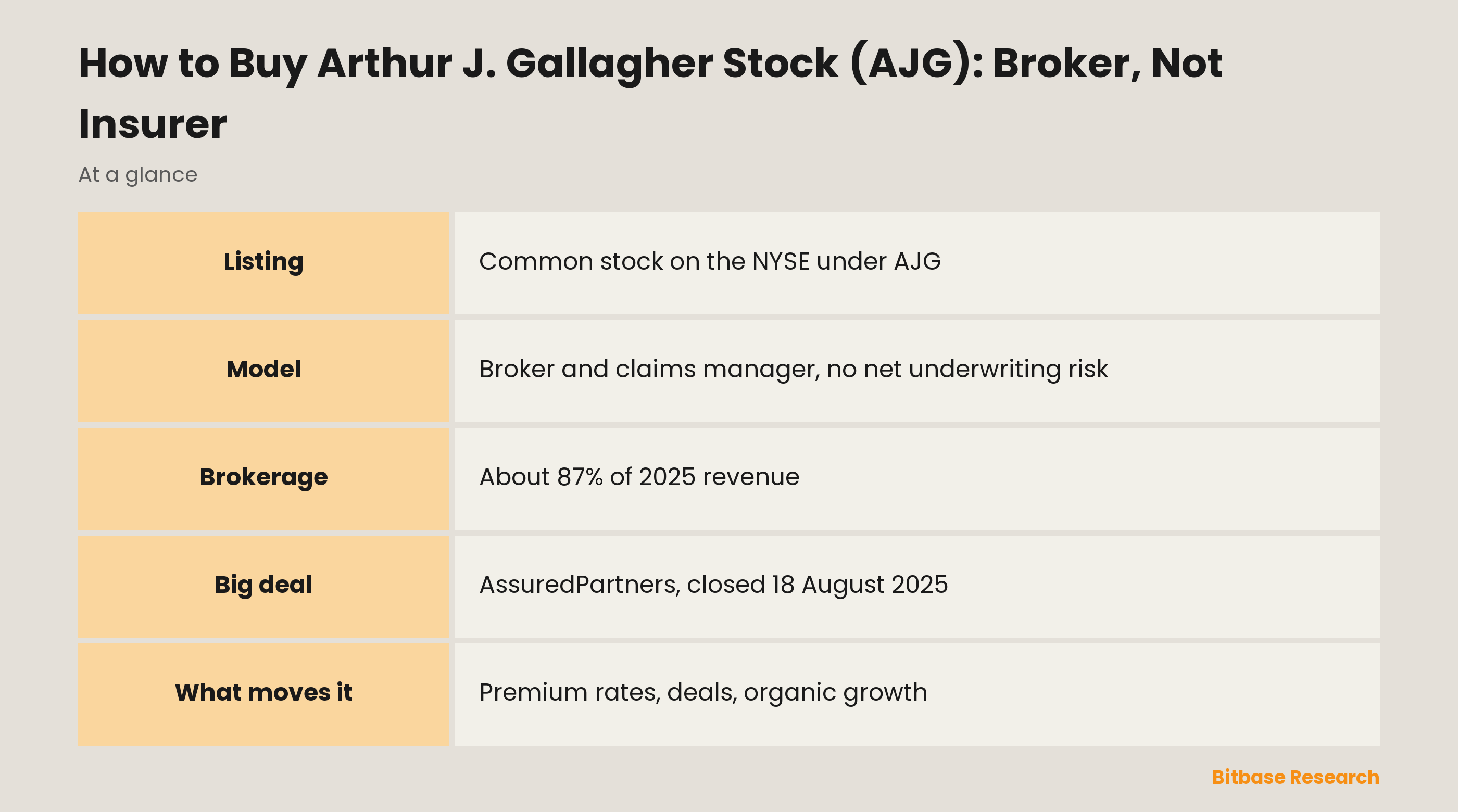
Many brokerage platforms with access to the New York Stock Exchange can fill an order for Arthur J. Gallagher & Co., whose common shares trade there under the ticker AJG. The harder question is what the share represents. Gallagher arranges insurance, reinsurance and benefits and administers claims for others, yet its annual report states: "We do not assume underwriting risk on a net basis." Brokerage produced about 87% of 2025 revenue, and in August 2025 it closed what it calls "the largest acquisition in our history."
What Does Arthur J. Gallagher Do?
Gallagher sells the work of an intermediary: its 10-K lists "insurance brokerage, reinsurance brokerage, consulting, and third-party property/casualty claims settlement and administration services." That means finding coverage for businesses and benefit plans, helping insurers buy reinsurance, and handling claims for organizations that self-insure.
Founded in 1927 as "a one-person insurance agency" and reincorporated in Delaware in 1972, the company is based in Rolling Meadows, Illinois; J. Patrick Gallagher, Jr. has been chief executive since 1995 and chairman since 2006.
A broker, not a risk-taker. The capital that pays claims comes from what Gallagher calls "underwriting enterprises": insurers, reinsurers and other risk-takers it does not own or control. Beyond de minimis amounts used to set up captives and similar vehicles, it takes no underwriting risk on a net basis. Storm and liability losses fall on the insurers; Gallagher feels them only through the premiums those insurers charge, since commissions are generally a percentage of premium.
Brokerage, about 87% of 2025 revenue, is the core. Retail broking made up 75% of the segment, and niche and practice groups (construction, healthcare and energy among them) account for about 74% of retail brokerage revenue. Gallagher Re, the reinsurance broker, contributed 12%, and wholesale 13%, placing "specialized and hard-to-place insurance" for Gallagher's retail brokers and for unaffiliated ones.
Risk management, about 13%, is a third-party claims administrator. In 2025 about 59% of its revenue related to workers' compensation claims, 34% to general and commercial auto liability and 7% to property, and about 95% came from clients not affiliated with the brokerage operations. A third segment, corporate, holds the debt, acquisition costs and legacy clean energy investments and produces no significant revenue.
About 67% of brokerage and risk management revenue came from the United States in 2025 and 33% from abroad, mainly Australia, Canada, New Zealand and the UK.
How Arthur J. Gallagher Makes Money
The income statement splits a broker's pay into several lines. Shares of total 2025 revenue, calculated from that statement and rounded to one decimal:
| Revenue line | Share of 2025 revenue | How it is earned |
|---|---|---|
| Commissions | 57.6% | A percentage of premium, or of headcount for benefit plans, fixed when the contract takes effect |
| Fees | 30.1% | Charged for an agreed level of service, including risk management claims work |
| Supplemental revenues | 3.3% | Paid by insurers above the base commission, set in advance each year |
| Contingent revenues | 2.3% | Paid by insurers after the policy period, based on the growth or profitability of business placed |
| Interest, premium finance and other | 5.5% | Interest on own cash and on fiduciary funds held for clients, premium financing and other income |
| Reimbursements | 1.2% | Third-party claims costs passed through to clients |
The lines behave differently. Commissions follow premium levels that Gallagher does not set, while fees "are most often based on an expected level of effort." Contingent payments arrive "generally in the first or second quarter," one reason the 10-K calls the brokerage business "subject to seasonal fluctuations."
The interest line needs care for 2025. Gallagher raised the money for AssuredPartners in December 2024 and held it until the deal closed, and interest on those proceeds made up about 47% of that line in 2025. The third-quarter 2026 release cites its absence as a reason interest income was lower.
Total revenue rose about 21% in 2025, more of it from acquired businesses than from existing ones. Organic growth, a non-GAAP measure that strips out acquisitions, divestitures and currency effects, was 6% for brokerage base commissions and fees, after 7% in 2024, and 6% for risk management fees. No client is large: the biggest represented about 1% of brokerage and risk management revenue in 2025, the ten largest about 3%.
AJG Stock at a Glance
| Item | Detail |
|---|---|
| Exchange | New York Stock Exchange (NYSE) |
| Ticker | AJG |
| Security | Common stock, the only security registered on the 10-K cover |
| Sector | Financials: insurance brokerage and claims administration |
| Index membership | S&P 500; also held by the Financial Select Sector SPDR fund (XLF) |
| Headquarters | Rolling Meadows, Illinois |
| Incorporated | Delaware (reincorporated in 1972); founded in 1927 |
| Fiscal year | Calendar year, ending 31 December |
| Dividend policy | Quarterly cash dividend, decided by the board each quarter |
| SEC identifier | CIK 354190 |
Live prices and valuation figures are on the Arthur J. Gallagher stock page on Bitbase, which updates as the shares trade.
How to Buy Arthur J. Gallagher Stock
Gallagher is a Delaware company with a single registered security, so there is no depositary receipt to sort out: what trades on the NYSE is the common stock.
1. Find a broker that trades NYSE stocks. Outside the US this may be a local firm with US market access or an international broker; confirm the legal entity behind your account and its regulator.
2. Open and verify the account. Non-US individuals generally file IRS Form W-8BEN with the broker; the IRS tells a foreign person to give it "to the withholding agent or payer."
3. Fund it. Paying in from a non-dollar account means a currency conversion, so compare the exchange spread as well as the commission.
4. Search the ticker. Enter AJG and confirm the result reads Arthur J. Gallagher & Co. common stock on the NYSE.
5. Pick an order type. A market order fills at the best available price on arrival, which can differ from the last quote in a fast market (see how market orders execute and fill); a limit order caps the price and may not fill.
6. Decide the size. FINRA notes that "the availability of fractional share trading varies by brokerage firm" and that a fractional owner "might not have shareholder voting rights."
7. Keep the paperwork. Trade confirmations and account statements record your cost basis and dividends.
Tax on dividends paid abroad. For a non-US holder, AJG dividends are US-source income, taxed by default at 30% under IRS rules unless a treaty or a specific Code provision lowers the rate; that is what the W-8BEN is for. Your own country may tax the dividend again.
Indirectly, through funds. SPY, State Street's S&P 500 trust, and XLF, its Financial Select Sector fund, both held AJG in their 29 October 2026 holdings files. Such a fund gives you a small slice of Gallagher at a weight set by the index, not by you.
What Moves AJG Stock
The premium cycle. The 10-K calls premiums "cyclical in nature," and for its 2025 property/casualty broking it reported "continued renewal premiums increases (premium rates and exposures)." When insurers compete harder and rates soften, the same clients generate less commission; fees are not tied to premium amounts.
Organic against bought growth. The chairman describes a "two-pronged growth strategy," organic plus acquisitions. In the third quarter of 2026, revenue in the brokerage and risk management segments rose 18% while organic growth was 5%; brokerage base commissions and fees grew 4% organically and risk management fees 10%. The gap is largely the contribution of acquired businesses.
AssuredPartners. Gallagher signed the purchase agreement in December 2024 and completed the deal on 18 August 2025, adding a US broker across commercial property/casualty, specialty, employee benefits and personal lines, with offices in the UK and Ireland. The 10-K budgets integration spending over about three years and says integrating larger deals is "more complex, including with respect to technology systems." Organic figures for 2026 exclude all AssuredPartners revenue, even after the first anniversary, so they do not show how the acquired business itself is growing.
Tuck-in deals. Most of the roughly 780 acquisitions completed from 2002 through 2025 were smaller regional or local brokers, agencies and benefit consultants; 33 closed in 2025. The 10-K says interest from private equity firms, private-equity-backed consolidators and newly public brokers has in some cases made targets "more difficult to identify and more expensive."
Interest rates and jobs. Lower rates cut interest on Gallagher's own and fiduciary cash and on premium financing, and the 10-K adds that lower inflation "may reduce our revenue growth by slowing the increase in insurable asset values." In risk management, weaker conditions or fewer people in work "could cause fewer new liability and core workers' compensation claims to arise."
Risks Outside and Inside Gallagher's Control
Of the many Item 1A headings, these bear most directly on a Gallagher share.
Premiums it does not set. "Volatility or declines in premiums or other adverse trends in the insurance industry may seriously undermine our profitability," and insurers "may seek to minimize their expenses by reducing the commission rates payable to agents or brokers."
Insurer payments. Contingent and supplemental revenue is "less predictable than standard commission revenues," and contingent revenue already booked can be reversed if targets are missed or insurers raise loss reserve estimates.
Acquisitions. The company "may not be able to continue such acquisition strategy in the future," and bought firms that fall short can lead to goodwill impairment charges.
Professional liability. Gallagher faces claims that its people "improperly failed to procure coverage" or mishandled client claims, and the damages claimed "are or may be substantial." Broker pay itself "has received substantial scrutiny in the past because of the potential for conflicts of interest."
Debt and dilution. Debt, including notes issued for AssuredPartners, "could adversely affect our financial flexibility." The share count rose about 19% between the end of 2023 and the end of 2025, mostly from the offering behind that deal, and an at-the-market program set up in March 2024 covers up to 3,000,000 shares. The filing warns that "future sales or other dilution of our equity could adversely affect the market price of our common stock."
Legacy and foreign exposures. Clean energy investments tied to IRC Section 45 tax credits still carry tax and environmental risks, and with a third of revenue earned abroad, exchange rates move reported results.
And generally, a single stock ties your money to one company's results, and dividends come with "no assurances regarding the amount of any future dividend payments."
How to Research AJG on EDGAR and the IR Site
Gallagher's SEC filings sit under CIK 354190, and the same documents are posted at investor.ajg.com: the 10-K yearly, 10-Qs quarterly, and 8-Ks for events such as the AssuredPartners closing and each earnings release.
Three habits help. Separate reported from adjusted results: in 2025 diluted earnings per share fell 12% as reported but rose 6% on the adjusted, non-GAAP basis, mainly because adjustments add back amortization of acquired intangibles and integration costs. Check what "organic" excludes in the period, which in 2026 means all of AssuredPartners. And compare each quarter with the same quarter a year earlier, because contingent payments cluster early in the year.
The XBRL cover page of the 2025 10-K (R1.htm) lists one registered security, the common stock trading as AJG; for other companies, try the US stock directory on Bitbase.
Arthur J. Gallagher Stock FAQ
Does Arthur J. Gallagher pay a dividend?
Yes, every quarter. The board sets each payment after weighing cash from earnings, expected cash needs and economic conditions. Dividends declared per share rose in both 2024 and 2025, and the quarterly dividend announced in January 2026 was about 8% above the previous quarter's. The company makes no assurances about future amounts.
Can I buy Arthur J. Gallagher stock with crypto?
Not as a direct swap. A broker sells you AJG for US dollars, so crypto must first be converted to cash and sent to the brokerage account, and the sale may be taxable where you live. The share you get is equity, carrying dividends and votes, which is how a stock differs from a crypto asset.
Is AJG in the S&P 500?
Yes. On 29 October 2026, AJG appeared in the daily holdings of State Street's SPY, which tracks the S&P 500, and of its Financial Select Sector SPDR fund (XLF). Weights change daily, so none is quoted here.
Does Gallagher carry the risk on the policies it places?
No. Insurers and reinsurers provide the capital that pays claims, and Gallagher takes no underwriting risk on a net basis beyond small amounts for captives and similar vehicles. Its exposure is to the volume and price of the business it places, plus liability claims over its own advice and service.
What did Gallagher get from buying AssuredPartners?
A US insurance broker covering commercial property/casualty, specialty, employee benefits and personal lines, with offices in the UK and Ireland. The deal closed on 18 August 2025, funded mainly by a share offering and senior notes issued in December 2024.
Conclusion
Owning AJG needs only an account that reaches the NYSE and one order for the right ticker. Understanding it takes more: Gallagher earns commissions and fees for placing risk that insurers carry, so premium rates, the pace of acquisitions and the integration of AssuredPartners matter to the share in a way that claims costs, borne by insurers, do not. Before deciding how much of a portfolio belongs in it, read the latest 10-K and quarterly release, and keep organic and reported growth apart.
Related reading
Other Bitbase articles on this topic:
- How to Buy Aflac Stock (AFL): Japan, the Yen and Ten-Vote Shares
- How to Buy Allstate Stock (ALL): Auto Rates, Storms and Buybacks
- How to Buy Aon Stock (AON): Dublin plc, NYSE Shares, USI Deal
- How to Buy MetLife Stock (MET): Benefits, Pensions and Japan
Disclaimer: This article is educational content from Bitbase Academy, provided for information only. It explains what a company or fund does and how the instruments referenced here differ from one another; it does not constitute investment, trading, tax, or financial advice, and it is neither a recommendation nor an endorsement of any security, token, or trading strategy. A tokenized stock is issued by a third party and is designed to give economic exposure to an underlying asset: it is not a share, it carries no shareholder rights, and it depends on the issuer's structure, eligibility rules, and redemption terms, which the issuer can change. Perpetual futures are leveraged derivatives that hold no underlying asset and can be liquidated, and trading hours, product availability, and eligibility differ by instrument and by jurisdiction and can change at any time. Written as of October 2026; verify everything yourself through company filings, the issuer's own documentation, and the product pages of the venue you trade on.
References
[1] Arthur J. Gallagher Form 10-K for 2025: business, segments, revenue, risk factors (SEC EDGAR) www.sec.gov
[2] Arthur J. Gallagher Form 8-K, 18 August 2025: AssuredPartners acquisition completed www.sec.gov
[3] Arthur J. Gallagher third-quarter 2026 earnings release, 29 October 2026 (Form 8-K) www.sec.gov
[4] State Street: SPY daily holdings, 29 October 2026 www.ssga.com
[5] State Street: XLF daily holdings, 29 October 2026 www.ssga.com
[6] IRS: NRA Withholding www.irs.gov
[7] IRS: About Form W-8 BEN www.irs.gov
[8] FINRA: Investing in Fractional Shares www.finra.org





