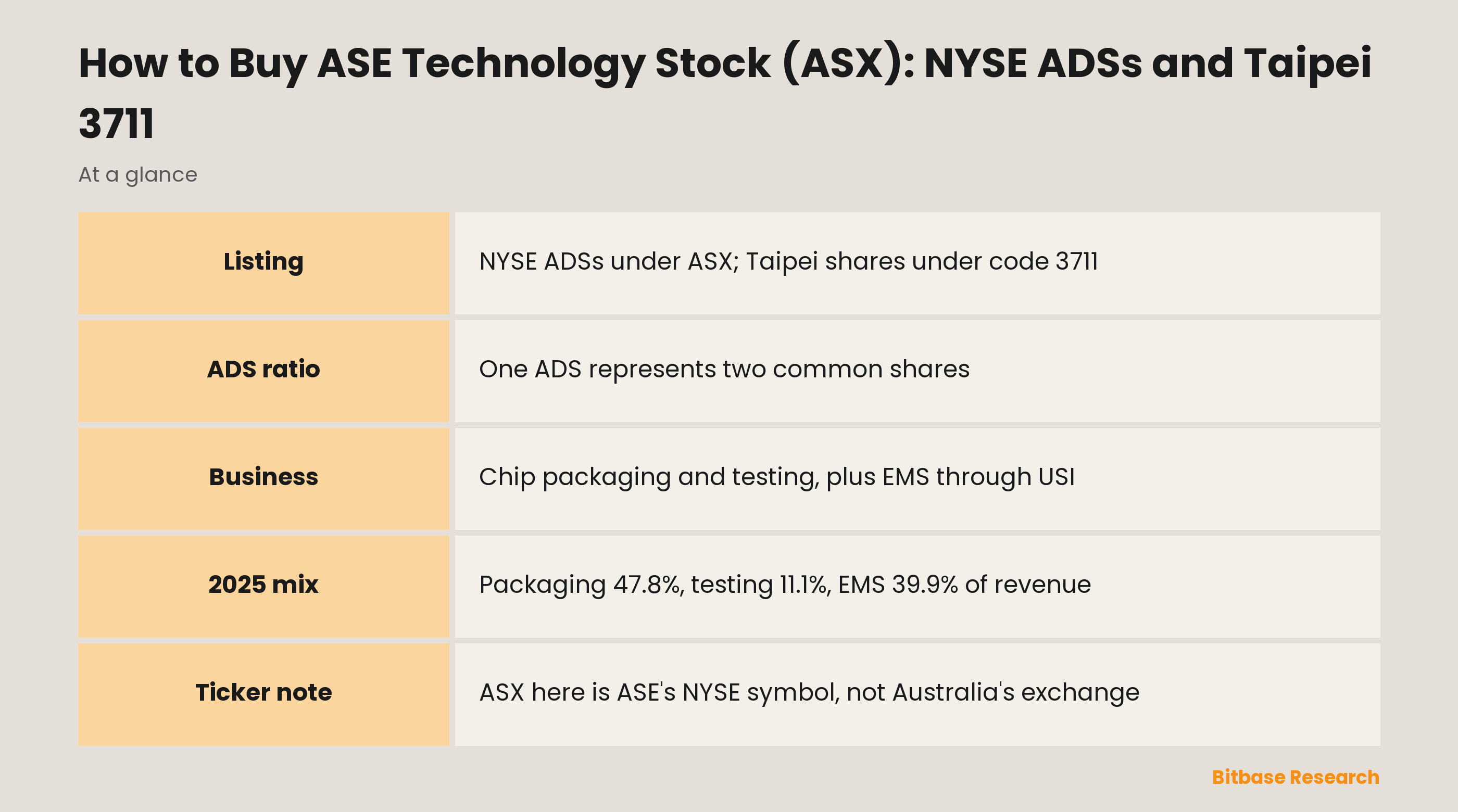
Its New York ticker is ASX: to buy ASE Technology stock, open a brokerage account with access to the New York Stock Exchange (NYSE) and order the American depositary shares (ADSs) listed there, each representing two common shares that trade in Taipei under code 3711. The three letters are ASE's NYSE symbol, unrelated to the Australian Securities Exchange that shares the abbreviation. Behind them is a Kaohsiung-based holding company formed in 2018 when ASE combined with Siliconware Precision Industries (SPIL); in 2025 it took 47.8% of its operating revenues from packaging chips, 11.1% from testing them and 39.9% from electronics manufacturing.
What Does ASE Technology Do?
ASE works on the back end of chipmaking. After a foundry has etched circuits onto a wafer, ASE's plants probe each die, package the ones that pass and run the final tests; its annual report says it is "involved in all stages of the semiconductor manufacturing process except circuit design and wafer fabrication." The industry calls this outsourced semiconductor assembly and test, or OSAT. A second business, run through USI, builds modules, boards and systems for other brands, which the filing calls electronic manufacturing services (EMS).
The holding company is younger than its businesses. ASE Inc. was founded on 23 March 1984 and SPIL that May. On 30 April 2018 a statutory share exchange created ASE Technology Holding, first named ASE Industrial Holding: it took every ASE share in exchange for its own shares and bought every SPIL share for cash. The old ASE's ADSs had traded on the NYSE as ASX since September 2000; the holding company's ADSs have carried the symbol since the day of the combination.
Since 1997 ASE has had a strategic alliance with TSMC, the foundry, which names it a non-exclusive preferred provider of packaging and testing for chips TSMC makes.
How ASE Technology Makes Money
ASE reports three segments. Packaging is the largest, and testing grew fastest in 2025:
| Segment | What it sells | Share of 2025 operating revenues | 2025 revenue change |
|---|---|---|---|
| Packaging | Flip chip, wire bonding, fan-out and other packages | 47.8% | Up 17.8% |
| Testing | Wafer probing and final testing | 11.1% | Up 31.8% |
| EMS | Modules, boards and systems built through USI | 39.9% | Down 5.2% |
Total operating revenues rose 8.4%. The 20-F credits demand for leading-edge advanced packaging and for testing, and blames the EMS decline on "the slow recovery of general communication and automotive products."
The two halves earn very different margins: 23.8% gross margin on packaging and testing in 2025, against 9.2% on EMS, where raw materials alone cost 78.7% of revenue. Group gross margin rose to 17.7% from 16.3%, mainly, the company says, because packaging and testing took a larger share and factories ran fuller, partly offset by a stronger New Taiwan dollar. Net profit attributable to owners rose 23.6%.
Customers are concentrated. The five largest took 46.5% of 2025 operating revenues, and one customer, counted together with companies for which ASE did OEM work on its behalf, accounted for about 25.0% across packaging and EMS. By customer headquarters, about 56.7% of revenue came from US-based companies.
ASX Stock at a Glance
| Item | Detail |
|---|---|
| Exchanges | NYSE (ADSs) and Taiwan Stock Exchange (common shares) |
| Tickers | ASX in New York, 3711 in Taipei |
| ADS ratio | One ADS represents two common shares |
| Depositary | Citibank, N.A. |
| Sector | Semiconductor packaging and testing, plus EMS |
| Index membership | FTSE TWSE Taiwan 50, through the Taipei line |
| Headquarters | Kaohsiung, Taiwan |
| Fiscal year | Calendar year |
| Dividend policy | One cash dividend a year from 2021 to 2025; the articles set cash at no less than 30% of the total dividend |
| SEC identifier | CIK 1122411 |
Quotes, market value and yield change by the minute, so they belong on the ASE Technology stock page on Bitbase.
How to Buy ASE Technology Stock
The ADSs trade in US dollars in New York; the common shares trade in New Taiwan dollars in Taipei. The steps below follow the New York route:
1. Decide which line you can hold. The 20-F says that, with limited exceptions, holders who are not R.O.C. persons "are required to hold their Common Shares through a brokerage account in the R.O.C." The NYSE ADS avoids that.
2. Pick a broker with NYSE access, then open and fund the account. Check who regulates it and what currency conversion costs.
3. Search ASX and read the name. It should say ASE Technology Holding on the NYSE (ADS CUSIP 00215W100), not anything tied to the Australian exchange.
4. Set the order. A limit order caps the price you pay; a market order fills at whatever the market offers.
ADSs versus Taipei shares. Voting is collective: if holders of at least 51% of outstanding ADSs give the same instruction, Citibank votes all deposited shares that way; otherwise they are voted at the discretion of ASE's chairman or his designee. Converting ADSs into shares requires a non-R.O.C. holder to appoint a tax guarantor, local agent and custodian in Taiwan and register with the exchange.
Taxes. Dividends paid to non-R.O.C. holders are subject to Taiwanese withholding tax at 21% unless a tax treaty gives a lower rate. Transfers of ADSs escape Taiwan's securities transaction tax, levied at 0.3% on sales of the common shares, and gains on them are not currently taxed in Taiwan for non-R.O.C. holders. Your home country may tax both.
Through a fund. The Taipei line belongs to the FTSE TWSE Taiwan 50 Index; Yuanta's Taiwan Top 50 ETF (0050), which replicates it, listed 3711 among its holdings on 30 October 2026.
What Moves ASX Stock
AI packaging demand. The 20-F says that "a significant portion of our recent growth and anticipated future revenue is tied to the rapid expansion of AI applications." Its leading-edge packages, built on redistribution layers, include fan-out and 3D designs used for advanced ASIC and high-bandwidth memory products. That makes ASE one link in the AI infrastructure chain.
Utilization. Testing and leading-edge packaging carry "relatively high fixed costs," so profit swings with how busy the equipment is. Spending on segment assets rose 78.4% in 2025, which feeds into future depreciation.
The New Taiwan dollar. Much of the revenue is in US dollars while many costs are not, and the stronger Taiwanese currency already trimmed 2025 margins.
Trade policy. The filing points to semiconductor-specific US tariffs, which the US government intends to raise over time, and to licensing rules on exports of advanced computing and AI items to mainland China.
Monthly numbers. To meet Taiwanese rules, ASE publishes unaudited net revenues every month in a 6-K, for the group and for its assembly, testing and material (ATM) business. The gap between the two lines gives a rough read on EMS.
Cycles, Customers and Taiwan: ASE's Main Risks
Industry cycles. ASE depends on "the highly cyclical semiconductor and electronics industries," so its "revenues and net income may fluctuate significantly."
Key customers and the TSMC alliance. "The loss of a large customer or disruption of our strategic alliance" with foundries such as TSMC "may result in a decline in our revenues and profitability." TSMC is also a competitor of sorts: the filing notes that it offers advanced packaging such as InFO.
Taiwan. About 58.9% of 2025 operating revenues came from operations in Taiwan. The filing flags strained relations between Taipei and Beijing and "natural disasters including earthquakes, typhoons, droughts, as well as power outages and other industrial incidents."
The ADS itself. ASE warns that "the market for our Common Shares and ADSs may not be liquid" and that "we may not continue to declare cash dividends in any particular amount."
Add the ordinary risk of a single stock: one company's results drive the whole position.
Reading ASE's Filings: 20-F, 6-K and Monthly Revenue
ASE files with the SEC as a foreign private issuer under CIK 1122411. The annual 20-F for 2025 was filed on 1 April 2026; between annual reports, Form 6-K carries the monthly revenue releases, quarterly earnings and announcements such as bond offerings.
Two traps catch readers. First, the accounting basis: the 20-F uses IFRS as issued by the International Accounting Standards Board, while ASE's quarterly releases follow Taiwan-IFRS, the version endorsed by Taiwan's Financial Supervisory Commission, and are unaudited. Second, per-ADS earnings are calculated on half the share count, so they are double the per-share figure. Live prices for other listings sit on Bitbase's list of US stock pages.
ASE Technology Stock FAQ
Is ASX stock listed on the Australian Securities Exchange?
No. ASX is the NYSE ticker of ASE Technology Holding's ADSs, and its common shares trade in Taipei as 3711. The Australian exchange merely shares the abbreviation; symbols are unique only within a venue, as with crypto tickers and stock symbols.
How many ASE shares does one ASX ADS represent?
Two common shares, held by Citibank, N.A. as depositary. Each ADS therefore carries the dividend on two shares.
Does ASE Technology pay a dividend?
Yes. The 20-F shows one cash dividend in each year from 2021 to 2025, and on 27 March 2026 the board resolved another; ADS holders receive it through the depositary, net of Taiwanese withholding tax.
Can I buy ASE Technology stock with crypto?
Not directly. ASX trades settle in US dollars through a broker, so the crypto has to be sold for cash first, and that sale may itself be taxable where you live.
Is ASE Technology in the Taiwan 50 index?
Yes, through its Taipei shares: Yuanta's Taiwan Top 50 ETF, which fully replicates the FTSE TWSE Taiwan 50 Index, listed 3711 among its holdings on 30 October 2026.
Conclusion
Buying ASE Technology comes down to one choice: dollar-priced ASX ADSs in New York, each worth two shares, or 3711 shares in Taipei, which need a Taiwanese brokerage account. Either way, you own a chip packager and tester whose growth is tied to AI, beside a thinner-margin EMS arm and one customer worth about a quarter of revenue. Read the latest 20-F and monthly 6-Ks before deciding how much one chip supplier deserves in your portfolio.
Related reading
Other Bitbase articles on this topic:
- How to Buy Analog Devices Stock (ADI): Industry, Dividend, China
- How to Buy Applied Materials Stock (AMAT): China Risk and Perps
- How to Buy KLA Stock (KLAC): Chip Inspection, 10-for-1 Split
- How to Buy INTC: A Chip Designer That Owns Its Factories
Disclaimer: This article is educational content from Bitbase Academy, provided for information only. It explains what a company or fund does and how the instruments referenced here differ from one another; it does not constitute investment, trading, tax, or financial advice, and it is neither a recommendation nor an endorsement of any security, token, or trading strategy. A tokenized stock is issued by a third party and is designed to give economic exposure to an underlying asset: it is not a share, it carries no shareholder rights, and it depends on the issuer's structure, eligibility rules, and redemption terms, which the issuer can change. Perpetual futures are leveraged derivatives that hold no underlying asset and can be liquidated, and trading hours, product availability, and eligibility differ by instrument and by jurisdiction and can change at any time. Written as of October 2026; verify everything yourself through company filings, the issuer's own documentation, and the product pages of the venue you trade on.
References
[1] ASE Technology Holding, Form 20-F for the year ended 31 December 2025 (SEC EDGAR) www.sec.gov
[2] ASE Technology Holding, monthly net revenues for September 2026 (Form 6-K, 12 October 2026) www.sec.gov
[3] ASE Technology Holding, unaudited third-quarter 2026 results (Form 6-K, 29 October 2026) www.sec.gov
[4] Yuanta Taiwan Top 50 ETF (0050), holdings as of 30 October 2026 www.yuantaetfs.com





