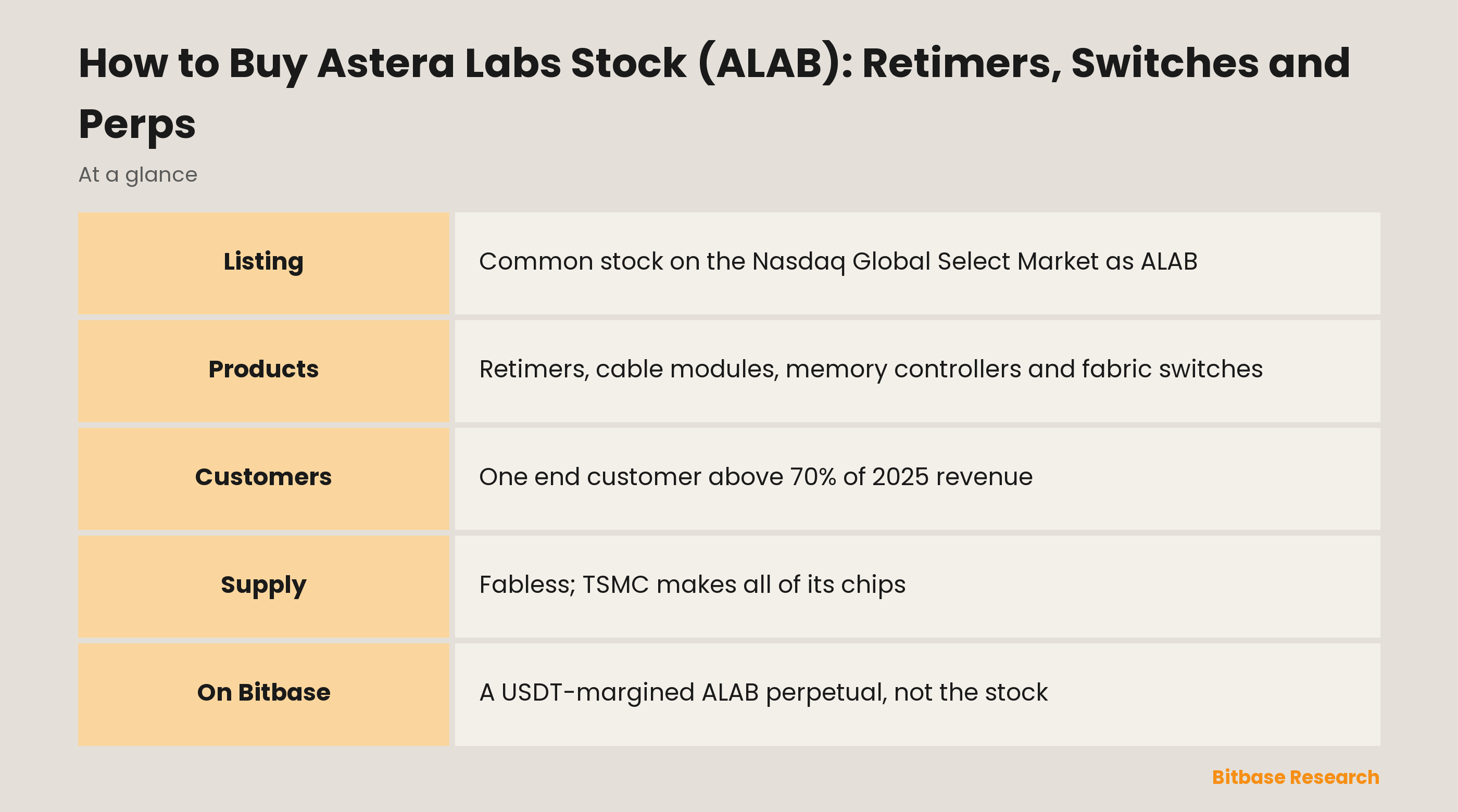
A single class of Astera Labs common stock trades on the Nasdaq Global Select Market under ALAB, listed since 20 March 2024, so any broker that offers US shares can place the order. The San Jose company designs the chips and modules that carry data between GPUs, CPUs, memory and switches inside AI servers, and its 2025 annual report says one end customer accounted for more than 70% of revenue. Bitbase also lists an ALAB perpetual margined in USDT, which follows the share price without holding a single share.
What Does Astera Labs Do?
Astera Labs sells connectivity hardware for data centers built around AI accelerators. Inside an AI server, GPUs or custom accelerators, host CPUs, network cards, storage and memory all exchange data over high-speed links, and those signals degrade quickly over copper. The company's products sit on those links. They clean up and retransmit signals, extend how far a link can run, switch traffic between many devices, and attach extra memory to processors that would otherwise run short of it.
The 10-K describes four revenue-generating product families, delivered as integrated circuits, boards or modules.
Aries covers PCIe and CXL Smart DSP Retimers and Smart Cable Modules. A retimer, in the filing's words, "digitally recovers degraded high-speed signals and retransmits a clean copy of the data," which lets a server builder keep using cheaper interconnects at higher speeds. The cable modules put an Aries chip on a small paddle card inside active electrical cables.
Taurus Ethernet Smart Cable Modules do a similar job for Ethernet, lengthening copper links between servers and switches within a rack.
Leo CXL Memory Connectivity Controllers let customers expand, share and pool standard DRAM over serial links, aimed at memory-hungry workloads on accelerators and CPUs.
Scorpio Smart Fabric Switches come in two lines: the P-Series for PCIe 6 head-node connectivity across a mix of hosts and endpoints, and the X-Series for back-end traffic between GPUs, customised for each platform.
Running through all four is COSMOS, a software suite embedded in the hardware and in the customer's systems. It handles link management, fleet management and what the industry calls RAS (reliability, availability, serviceability), so that customers can configure, monitor and troubleshoot the parts once they are deployed.
The history is short. Astera Labs was incorporated in Delaware in October 2017. Its co-founders are Jitendra Mohan, the chief executive, Sanjay Gajendra, now president and chief operating officer, and Casey Morrison; according to the IPO prospectus, Mohan and Gajendra both ran product lines at Texas Instruments before starting the company. Aries reached commercial launch in 2020, and the 10-K dates the company's rapid growth from that launch. The initial public offering followed in March 2024.
Since then the product list has kept widening. In November 2025 the company completed its acquisition of aiXscale Photonics GmbH, a private firm specialising in fiber-chip coupling, which the deal announcement tied to building photonic scale-up products. The press release for the third quarter of 2026 reported that Scorpio had become the largest product family by revenue, led by volume production of the 320-lane Scorpio X-Series switch. The same release introduced Aries 7 for PCIe 7 signal conditioning, expected to begin sampling to selected customers in the fourth quarter of 2026, and Orion, a rack-scale reference design that partners are expected to start offering in the first quarter of 2027.
How Astera Labs Makes Money
Almost all revenue comes from product sales; engineering services make up an immaterial slice. Orders arrive through standard purchase orders rather than long-term supply contracts, and revenue is booked when products ship. Astera Labs reports a single operating segment, so the 10-K does not split sales by product family.
Growth has been steep. Revenue rose 115% in 2025, which the company attributed to higher unit shipments of Aries, Scorpio and Taurus products and to higher average selling prices as the mix moved toward hardware modules and Scorpio. That same mix shift explains why gross margin edged down, from 76.4% in 2024 to 75.7% in 2025; the 10-K attributes the dip to shipping more hardware modules. Spending on research and development climbed 51% on a larger engineering headcount, and 2025 ended with net income after net losses in 2023 and 2024.
The customer list is narrow, and that shapes everything else about the stock. Hyperscalers and system OEMs often dictate which connectivity parts go into their servers, but most invoices go to their contract manufacturers and to distributors. The 10-K therefore reports concentration two ways. By end customer, meaning the companies whose servers use the parts, in 2025 one end customer represented more than 70% of revenue, and the top three together about 86%. By invoiced customer, meaning the manufacturers and distributors, five of them each crossed the 10% threshold in 2025, the largest two at 20% apiece.
None of the end customers is named in the 10-K. Amazon is the one that has been disclosed as a customer, through the warrant agreements described below, but the filings do not say which end customer passed the 70% mark.
Geography follows the same logic. The 10-K assigns revenue by the billing address of the invoiced customer, not by where the hardware ends up. On that basis, about 32% of 2025 revenue was billed to Singapore, 30% to China and 29% to Taiwan, with only about 3% billed to the United States.
One accounting detail shapes the top line. In October 2022, Astera Labs issued Amazon a warrant to buy up to about 1.5 million shares, enlarged a year later by roughly 0.8 million more, vesting in tranches as Amazon and its affiliates make specified payments to the company. Because the warrant counts as consideration paid to a customer, its value is recorded as a reduction of revenue. A third warrant followed in February 2026, covering up to about 3.3 million shares and exercisable until February 2033, with vesting tied to Amazon's purchases of fabric switch, signal conditioning and optical engine products. A shelf registration filed in March 2026 covers the resale of every share the three grants could produce.
ALAB Stock at a Glance
| Item | Detail |
|---|---|
| Exchange | Nasdaq Global Select Market |
| Ticker | ALAB |
| Share class | Common stock, one vote per share; the only class registered on an exchange |
| Listed since | 20 March 2024, first trading day after the IPO |
| Sector | Semiconductors and related devices (connectivity for AI and cloud infrastructure) |
| Incorporated in | Delaware, October 2017 |
| Headquarters | San Jose, California |
| Fiscal year end | 31 December |
| Reportable segments | One |
| Manufacturing | Fabless; TSMC fabricates all of its chips |
| Annual report | Form 10-K; quarterly Form 10-Q; current reports on Form 8-K |
| Filer status | Large accelerated filer; no longer an emerging growth company |
| Dividend policy | Has never paid a cash dividend and does not expect to in the foreseeable future |
For live quotes and charts, open the Astera Labs stock page on Bitbase.
How to Buy Astera Labs Stock
A brokerage purchase takes five steps:
1. Pick a broker that reaches Nasdaq and accepts residents of your country.
2. Open and verify the account. Non-US residents normally complete a Form W-8BEN so the broker can apply the right withholding treatment.
3. Deposit funds. If your account currency is not the US dollar, expect a conversion spread or fee before you can buy.
4. Look up ALAB and confirm the name reads Astera Labs, Inc. common stock.
5. Choose an order type. A market order fills at the prevailing price; a limit order caps what you pay and might not fill at all. Many brokers also sell fractional shares if a whole share costs more than you want to commit.
There is no ADR or second share class to choose between. Astera Labs is a Delaware corporation, files 10-K and 10-Q reports like any domestic issuer, and has a single class of common stock on Nasdaq, priced in dollars. Because the company pays no dividend, the dividend withholding tax that non-US holders face on many US stocks has little practical effect here today; capital gains treatment depends on where you live. Treat this as general information, not tax advice.
Funds offer indirect exposure, but index and ETF membership changes, so check a fund's latest holdings file for Astera Labs first.
Trading ALAB on Bitbase
Bitbase lists an ALAB perpetual futures contract, margined and settled in USDT, that tracks the price of Astera Labs common stock. Holding it does not put a share in your name: there is no vote and no claim on the company. The contract never expires. You can buy to go long or sell first to go short, choose whether to add leverage, and keep trading overnight and at weekends when Nasdaq is closed.
Two features separate it from owning the stock. Long and short holders exchange periodic funding payments, with the side that has more demand paying the other; this is what keeps the perpetual close to the share price, and the cost compounds the longer a position stays open. Positions are also liquidated once their margin runs out, with the mark price rather than the last trade deciding the moment. Earnings and other company news published outside Nasdaq hours can move the perpetual before the shares trade again. The stock perpetuals guide explains these mechanics in more depth.
This article deliberately leaves out the funding interval and formula, margin tiers, maximum leverage, and how mark price and funding are handled while the stock market is shut; check those in the ALAB contract rules before trading. Contracts on other listed companies are gathered on the TradFi page.
What Moves ALAB Stock
Hyperscaler spending plans. With most revenue tied to one end customer, a change in that customer's AI server build-out, or a shift to a different design, reaches Astera Labs almost immediately. Purchase orders, not multi-year contracts, govern most sales.
Design wins and product transitions. Each new accelerator platform is a fresh contest. The 10-K warns that missing a design win can cost sales "for a significant period of time," and that customers put parts through a "lengthy and expensive qualification process" that does not guarantee volume orders. The move from PCIe 6 to PCIe 7 and the ramp of Scorpio X-Series are the transitions to watch.
Standards bets. The company builds on PCIe, Ethernet and CXL, and is also pursuing UALink connectivity. The 10-K says CXL connectivity and UALink "are in the early stages of market adoption"; if larger players back different standards, part of the roadmap loses its market.
Product mix and pricing. Modules and Scorpio raise average selling prices but dilute gross margin, and the filing notes that pricing for a current product generation "often decreases over time."
Competition. The 10-K names Broadcom, Credo, Marvell, Microchip, Montage, Parade and Rambus as principal competitors, adding that most compete with it on some of its solutions rather than all of them. The Marvell stock guide covers one of those rivals.
Trade policy and Asia. China is one of the largest billing locations, and the company states that restrictions on trade with China "have reduced the demand for our products and damaged our business."
Where Astera Labs Could Stumble
Dependence on one buyer. The 10-K is direct: losing, or seeing a significant reduction in demand from, "one or a few of our top end customers would adversely affect our operations and financial condition."
One foundry, one island. TSMC makes all of the company's chips, and both TSMC's foundry and the company's primary distributor are in Taiwan. The filing flags earthquake risk and cross-strait tensions, and Astera Labs has no long-term supply contracts with its manufacturing partners.
Growth that may not repeat. Management writes that "we may not achieve similar growth rates in future periods." Net income arrived only in 2025, and the company has "a limited history of generating net income."
Controls and management turnover. Two material weaknesses in internal control reported at the end of 2024 were remediated in 2025, and management concluded controls were effective at the end of 2025. The leadership bench has also changed: a new chief financial officer, Desmond Lynch from Rambus, took over in March 2026, a new chief accounting officer joined in January 2026, the chief executive was serving as interim chief information security officer when the 10-K was filed, and a director resigned in November 2026, citing no disagreement with the company.
Concentrated ownership. Executive officers, directors and holders of more than 5% beneficially owned about 38% of the common stock at the end of 2025, enough to "control or significantly influence" shareholder votes if they act together.
Perpetual-specific risk. Leverage magnifies losses, funding accumulates while a position is open, and a gap at the Nasdaq open after earnings can carry the price through your liquidation level before you can react.
How to Research ALAB Yourself
All of the company's filings sit on SEC EDGAR under CIK 1736297. The 10-K for 2025 was filed on 20 February 2026. Item 1 lays out the product families and competitors, Item 1A the risk factors, and the notes to the financial statements carry the customer concentration table, revenue by billing location and the warrant details. Quarterly 10-Q reports update the concentration table every three months: the third-quarter 2026 report was filed on 4 November 2026, a day after the earnings release.
Quarterly results arrive as a press release attached to a Form 8-K. The highlights section covers product ramps; other 8-Ks are worth scanning too, since the Amazon warrant and the 2026 changes of chief financial officer and director were first disclosed there. The company says it uses its investor relations news page to meet Regulation FD disclosure obligations.
Insider sales show up on Form 4, and the 10-K lists the trading plans that the chief executive, the president and some directors adopted under Rule 10b5-1 in December 2025. For a wider view of the sector, the US stocks list on Bitbase shows other chip companies next to ALAB.
Astera Labs Stock FAQ
Who are Astera Labs' biggest customers?
The 10-K does not name them. It says one end customer accounted for more than 70% of 2025 revenue and the top three for about 86%. Amazon is disclosed as a customer through its warrant agreements, but the filings do not say which end customer is the largest.
Does Astera Labs make its own chips?
No. The company is fabless: it designs the products, TSMC fabricates all of its integrated circuits, and Advanced Semiconductor Engineering and Amkor assemble, package and test them. A small number of other partners make the modules, boards and substrates.
When did Astera Labs go public?
The registration statement for the IPO was declared effective on 19 March 2024, and the common stock began trading on the Nasdaq Global Select Market under ALAB on 20 March 2024. There was no public market for the shares before that date.
Does Astera Labs pay a dividend?
No. The 10-K says the company has never declared or paid a cash dividend and intends to retain its earnings to fund the business for the foreseeable future.
Can I buy Astera Labs stock with crypto?
Not directly. Brokers settle trades in cash, so crypto has to be converted into dollars or another currency before you can buy ALAB shares. On Bitbase, USDT can be used to trade the ALAB perpetual, which offers price exposure only: no share is held, no vote comes with it, and the position can be liquidated. The guide to buying stocks with crypto walks through the routes from coins to real shares.
Conclusion
Astera Labs grew from a 2017 start-up into a supplier of the links inside AI racks, and its numbers carry the strengths and weaknesses of that position at once: revenue more than doubled in 2025, while one end customer supplied more than 70% of it and a single foundry in Taiwan made every chip. Anyone weighing ALAB is mostly weighing whether Scorpio, Aries 7 and the next generation of design wins can widen that customer base before pricing on older products erodes. The shares trade on Nasdaq like any US stock, and the Bitbase perpetual tracks the same price with funding and liquidation risk in place of ownership.
Related reading
Other Bitbase articles on this topic:
- How to Buy Coherent Stock (COHR): From II-VI to AI Optics
- How to Buy Microchip Stock (MCHP): MCUs, Analog and MCHPP
- How to Buy STMicroelectronics Stock (STM): SiC, Sensors and Perps
- How to Buy Nomura Stock (NMR): NYSE ADSs or Tokyo Code 8604
Disclaimer: This article is educational content from Bitbase Academy, provided for information only. It explains what a company or fund does and how the instruments referenced here differ from one another; it does not constitute investment, trading, tax, or financial advice, and it is neither a recommendation nor an endorsement of any security, token, or trading strategy. A tokenized stock is issued by a third party and is designed to give economic exposure to an underlying asset: it is not a share, it carries no shareholder rights, and it depends on the issuer's structure, eligibility rules, and redemption terms, which the issuer can change. Perpetual futures are leveraged derivatives that hold no underlying asset and can be liquidated, and trading hours, product availability, and eligibility differ by instrument and by jurisdiction and can change at any time. Written as of November 2026; verify everything yourself through company filings, the issuer's own documentation, and the product pages of the venue you trade on.
References
[1] Astera Labs Form 10-K for 2025 (SEC EDGAR) www.sec.gov
[2] Astera Labs IPO prospectus, March 2024 (SEC EDGAR) www.sec.gov
[3] Astera Labs Form 8-K, February 2026: Amazon warrant (SEC EDGAR) www.sec.gov
[4] Astera Labs Form S-3ASR, March 2026 (SEC EDGAR) www.sec.gov
[5] Astera Labs press release on aiXscale, October 2025 (SEC EDGAR) www.sec.gov
[6] Astera Labs Q3 2026 results press release (SEC EDGAR) www.sec.gov
[7] Astera Labs Form 8-K, February 2026: CFO change (SEC EDGAR) www.sec.gov
[8] Astera Labs Form 8-K, November 2026: director resignation (SEC EDGAR) www.sec.gov





