
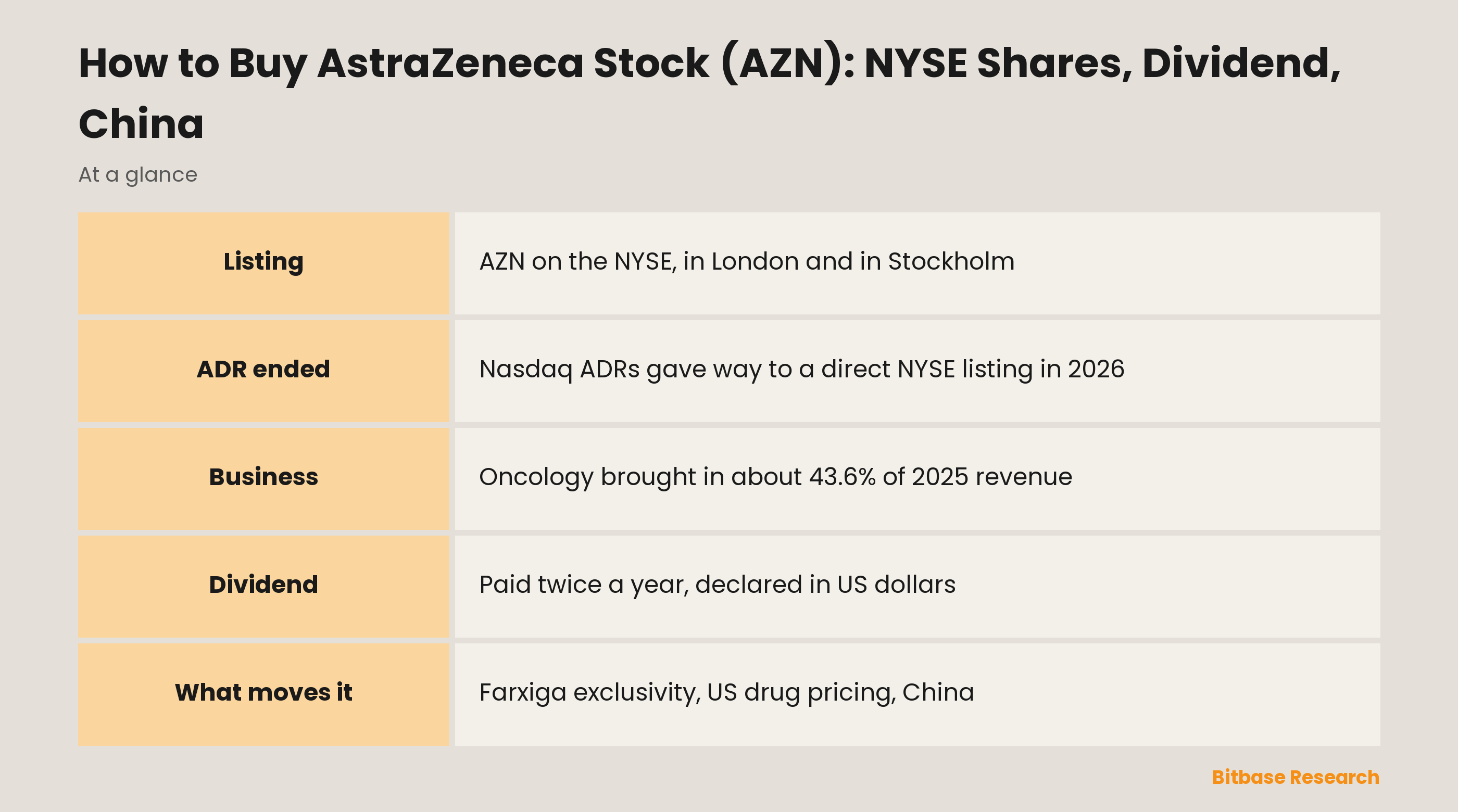
New York, London and Stockholm all quote the same AstraZeneca ordinary share under the ticker AZN, so a broker with access to any of those exchanges can fill your order; on the New York Stock Exchange it trades in US dollars. That New York line dates from 2 February 2026, when the company ended its American depositary receipt programme and listed the shares themselves. Behind the ticker is a Cambridge-based drugmaker that took about 43.6% of its 2025 Total Revenue from oncology. This guide covers the business, the order, dividends and tax, and what moves the stock, from US drug pricing to China.
What Does AstraZeneca Do?
AstraZeneca discovers, develops and sells prescription medicines. It calls itself "a global, science-led biopharmaceutical company" working in oncology, rare diseases and BioPharmaceuticals, the last covering cardiovascular, renal and metabolism (CVRM) and respiratory and immunology. It sells in more than 125 countries and reports a single operating segment.
The company is British by registration and Anglo-Swedish by descent. AstraZeneca PLC was incorporated in England and Wales in 1992 and, as Zeneca Group PLC, took over the pharmaceutical, agrochemical and specialty chemical businesses that Imperial Chemical Industries demerged in 1993. In 1999 it merged with Astra of Sweden and took its present name. Two US purchases followed: MedImmune (biologics and vaccines) in 2007 and Alexion (rare diseases) in 2021.
Tagrisso treats non-small cell lung cancer with EGFR mutations; Imfinzi, an immunotherapy, is approved in lung, liver, bladder and other cancers; Calquence treats chronic lymphocytic leukaemia. Farxiga is used in type 2 diabetes, heart failure and chronic kidney disease. Soliris treats rare diseases such as paroxysmal nocturnal haemoglobinuria, and patients have been moving to its successor, Ultomiris. Some are shared: Enhertu and Datroway with Daiichi Sankyo, Lynparza with Merck & Co. and Tezspire with Amgen.
How AstraZeneca Makes Money
Total Revenue rose 9% in 2025, or 8% at constant exchange rates (CER). Product Sales made up about 94.6% of it; most of the rest was Alliance Revenue, the company's share of gross profits and royalties on partnered medicines, which climbed 39%, mainly on Enhertu. By therapy area:
| Therapy area | Share of 2025 Product Sales | Main products |
|---|---|---|
| Oncology | 42.6% | Tagrisso, Imfinzi, Calquence, Lynparza |
| CVRM | 23.0% | Farxiga, Crestor, Brilinta, Lokelma |
| Rare Disease | 16.4% | Ultomiris, Soliris, Strensiq, Koselugo |
| Respiratory and immunology | 14.7% | Symbicort, Fasenra, Breztri, Saphnelo |
| Vaccines and immune therapies | 1.5% | Synagis, Beyfortus, FluMist |
| Other medicines | 1.7% | Nexium |
Shares are calculated from Product Sales in the 20-F's structured data, rounded to one decimal.
Five medicines carry over half the load: Farxiga made up 15.1% of 2025 Product Sales, Tagrisso 13.1%, Imfinzi 10.9%, Ultomiris 8.5% and Calquence 6.3%, together 53.9%. Growth leaned on oncology, where Total Revenue rose 15%; Imfinzi sales grew 29% on new bladder and lung cancer uses.
By region, the US took 42.2% of Product Sales, Emerging Markets 27.1%, Europe 21.6% and the established rest of the world 9.1%.
AZN Stock at a Glance
| Item | Detail |
|---|---|
| Exchanges | NYSE (US dollars), London Stock Exchange (pounds sterling), Nasdaq Stockholm (Swedish krona) |
| Ticker | AZN on all three |
| Security | Ordinary shares, nominal value 25 US cents; no ADR since 2 February 2026 |
| Index membership | FTSE 100 and OMX Stockholm 30 |
| Headquarters | Cambridge, United Kingdom |
| Incorporated | England and Wales, 1992 |
| Reporting | Calendar year; IFRS, in US dollars |
| Dividend policy | Two payments a year, declared in US dollars; progressive policy |
| SEC filings | Form 20-F and Form 6-K; CIK 901832 |
For the live price and chart across three time zones, open the AstraZeneca stock page on Bitbase.
How to Buy AstraZeneca Stock
Whichever exchange you use, you hold the same ordinary share. On the NYSE:
1. Choose a broker with NYSE access and check who regulates it; one that reaches London or Stockholm works too, in that market's currency.
2. Open and verify the account, declaring your tax residence accurately.
3. Fund it, comparing the currency conversion rate as well as the commission.
4. Find the right line. Search AZN and confirm the result is AstraZeneca PLC ordinary shares; symbols such as AZN 28 belong to the company's NYSE-listed notes.
5. Pick an order type. A market order fills at the going price; a limit order fills only at your price or better.
6. Size the order. Not every broker offers fractional shares, some take only market orders for them, and a fraction may carry no vote.
The three markets open at different hours and in different currencies, so their quotes rarely line up exactly; why session prices differ explains the gaps.
What happened to the ADRs. Until 30 January 2026, US investors traded American depositary shares on Nasdaq, each representing one half of an ordinary share, so an old ADS quote was the price of half a share. Outstanding ADSs were then cancelled in exchange for the shares they represented, which the 20-F says generally should not be a taxable event for US holders. The shares now settle primarily through DTC in the US; London holders in CREST hold depositary interests, one per share.
Dividends and UK tax. "The Company is not required to withhold UK tax when paying a dividend," the 20-F states, though your home country may tax the income. Transfers within DTC generally avoid UK stamp duty and stamp duty reserve tax; outside it, the filing describes a 0.5% charge on agreements to transfer.
Through an index fund. AstraZeneca belongs to the FTSE 100 and the OMX Stockholm 30, so a fund that fully replicates either index holds it among the other constituents.
What Moves AZN Stock
Patent expiries. Generic entry in the US and Europe in the first half of 2025 cut Brilinta sales by 38%. Farxiga, the largest product, is next: the annual report expects it to lose US market exclusivity in 2026, the year its negotiated Medicare price took effect, and the first-half 2026 results named that loss as a headwind.
US pricing and tariffs. Under the Inflation Reduction Act, Farxiga was in the first round of Medicare price negotiation and Calquence in the second, with its price due in 2027. In October 2025 it agreed with the US administration to sell directly to eligible patients at up to 80% off list prices and to join TrumpRx.gov, with Section 232 tariffs delayed three years while it moves production of medicines sold in America onshore. It expects 50% of its 2030 Total Revenue target to come from the US.
China. Group companies in China booked about 11.3% of 2025 Total Revenue. The first-half 2026 results cited volume-based procurement there as a headwind, and a case is open: in November 2025 Shenzhen prosecutors indicted the local subsidiary and two former employees for unlawful collection of personal information and illegal trade, with no trial date set when the 20-F was filed.
Pipeline. The company aims to launch at least 20 new medicines by 2030, and in May 2026 the hypertension drug Baxfendy was approved in the US; each approval is a test of whether newer products can fill the gaps generics leave.
Risks AstraZeneca Itself Flags
Of the annual report's Principal Risks, these sit closest to the share, starting with "failure or delay in the delivery of our pipeline or launch of new medicines."
Pricing. "Pricing, affordability, access and competitive pressures," tied in the report to economic, political and social pressures.
Intellectual property. "If we are unable to obtain, defend and enforce our IP, we may experience accelerated and intensified competition."
Litigation and investigations. "Adverse outcome of litigation and/or governmental investigations," a heading the China case makes concrete.
Currency. "Significant changes to exchange rates may adversely impact our business."
Two more sit with you: one company's shares concentrate your money, and with dividends declared in dollars, exchange rates shape what reaches you at home.
Researching AZN in the Filings
AstraZeneca files with the SEC as a foreign private issuer under CIK 901832: the annual report on Form 20-F, results and announcements on Form 6-K. Most of the substance sits in an exhibit to the 20-F, the "Annual Report and Form 20-F Information," where the Financial Review breaks down sales, the Risk Overview lists the Principal Risks and Note 30 covers legal proceedings, China included.
Two habits prevent misreadings. Core figures and CER growth are what the company calls non-GAAP measures, so compare like with like. And the patent expiry table for key marketed products is a separate supplement on the company's website. For other companies, browse the US stock pages on Bitbase.
AstraZeneca Stock FAQ
Is AZN an ADR?
No longer. The ADR programme ended on 2 February 2026, the day the ordinary shares began trading on the NYSE. Before that, the US line was a Nasdaq-listed depositary share worth half an ordinary share.
Does AstraZeneca pay a dividend?
Yes, twice a year, declared in US dollars, usually paid around September and March. Under its progressive policy the Board "intends to maintain or grow the dividend each year"; the 2025 total rose 3%, and the first interim for 2026 was raised again.
Can I buy AstraZeneca stock with crypto?
Not directly. AZN is bought through a brokerage account and NYSE trades settle in US dollars, so you would sell the crypto first and move the money to your broker. In many countries that sale is itself a taxable disposal of crypto.
Is AstraZeneca in the S&P 500?
No. The daily holdings file of State Street's S&P 500 trust (SPY), dated 16 October 2026, does not include it. AstraZeneca sits in the FTSE 100 and the OMX Stockholm 30.
Is AstraZeneca a British or a Swedish company?
British: incorporated in England and Wales and headquartered in Cambridge, it said the NYSE listing would not change its UK tax residence. The Swedish side dates from the 1999 merger with Astra.
Conclusion
Buying AZN takes a broker that reaches New York, London or Stockholm and a check that the line you pick is the ordinary share, not a bond; since February 2026 no depositary sits in between. Behind it is a drugmaker leaning on oncology as Farxiga loses US exclusivity, with US pricing and a court case in China in play. Read the latest 20-F and 6-K reports before deciding how much belongs in one pharmaceutical stock.
Related reading
Other Bitbase articles on this topic:
- How to Buy AbbVie Stock (ABBV): Skyrizi and Rinvoq After Humira
- How to Buy Amgen Stock (AMGN): Repatha, Prolia and MariTide
- How to Buy argenx Stock (ARGX): Nasdaq, Brussels and VYVGART
Disclaimer: This article is educational content from Bitbase Academy, provided for information only. It explains what a company or fund does and how the instruments referenced here differ from one another; it does not constitute investment, trading, tax, or financial advice, and it is neither a recommendation nor an endorsement of any security, token, or trading strategy. A tokenized stock is issued by a third party and is designed to give economic exposure to an underlying asset: it is not a share, it carries no shareholder rights, and it depends on the issuer's structure, eligibility rules, and redemption terms, which the issuer can change. Perpetual futures are leveraged derivatives that hold no underlying asset and can be liquidated, and trading hours, product availability, and eligibility differ by instrument and by jurisdiction and can change at any time. Written as of October 2026; verify everything yourself through company filings, the issuer's own documentation, and the product pages of the venue you trade on.
References
[1] AstraZeneca PLC Form 20-F, fiscal 2025: history, termination of the ADR programme, direct NYSE listing and taxation (SEC EDGAR) www.sec.gov
[2] AstraZeneca Annual Report and Form 20-F Information 2025 (exhibit to the 20-F): revenue, therapy areas, Principal Risks, dividends and legal proceedings www.sec.gov
[3] AstraZeneca announcement, 2 February 2026: ordinary shares begin trading on the NYSE under AZN (Form 6-K) www.sec.gov
[4] AstraZeneca circular on the Harmonised Listing Structure, 29 September 2025: trading currencies, ADS cancellation and settlement through DTC (Form 6-K) www.sec.gov
[5] AstraZeneca Form 25, 30 January 2026: removal from Nasdaq of the ADSs, each representing one half of an ordinary share (SEC EDGAR) www.sec.gov
[6] AstraZeneca announcement, 13 October 2025: agreement with the US Government on medicine prices and Section 232 tariffs (Form 6-K) www.sec.gov
[7] AstraZeneca H1 and Q2 2026 results, 27 July 2026: revenue growth, Farxiga US loss of exclusivity and China procurement (Form 6-K) www.sec.gov
[8] AstraZeneca announcement, 18 May 2026: Baxfendy approved in the US for hypertension (Form 6-K) www.sec.gov
[9] State Street: SPDR S&P 500 ETF Trust (SPY), daily holdings as of 16 October 2026 www.ssga.com
[10] Investor.gov (SEC): Types of Orders www.investor.gov
[11] Investor.gov (SEC): Investor Bulletin, Fractional Share Investing www.investor.gov





