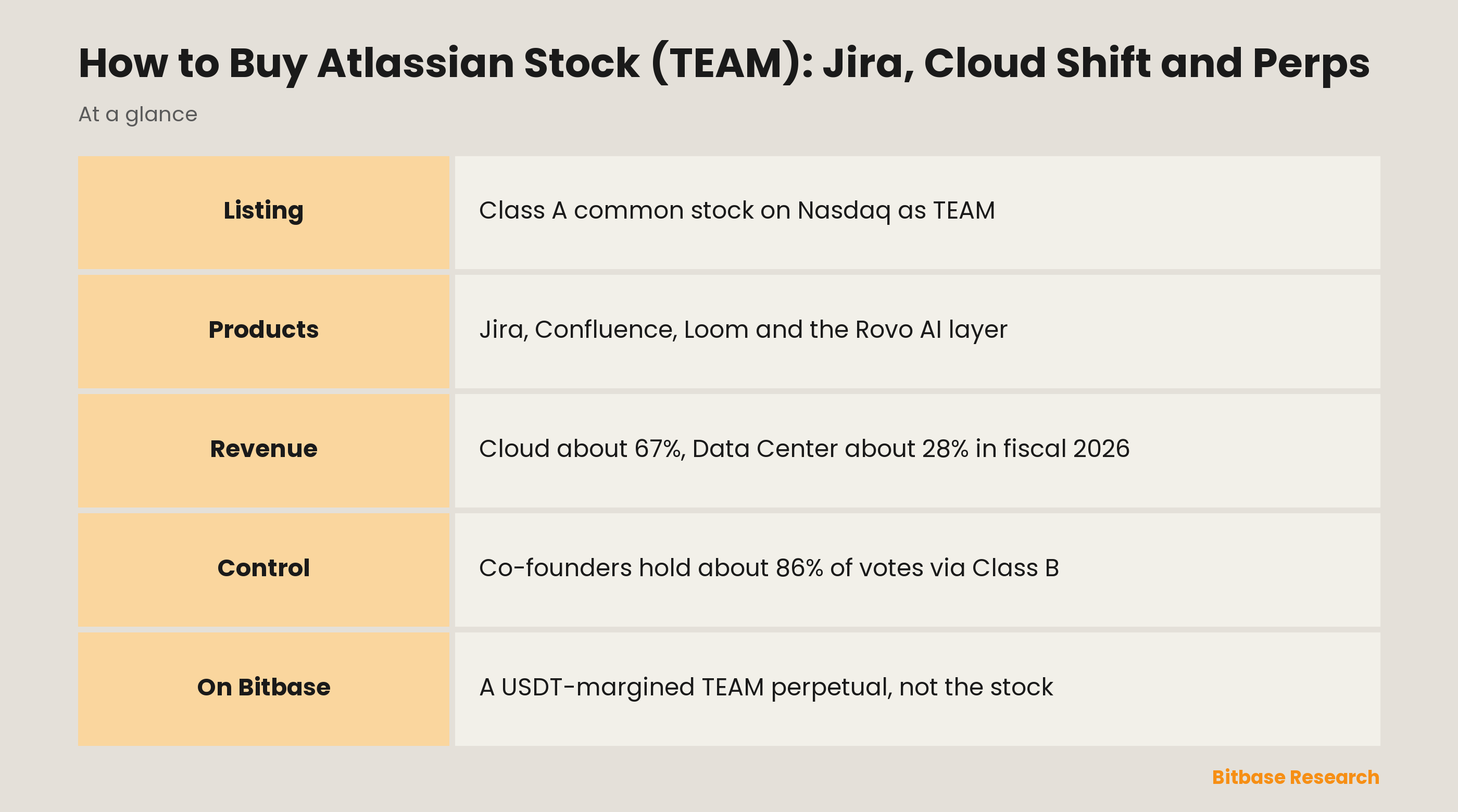
Atlassian's Class A common stock trades under the symbol TEAM and can be bought through almost any broker that reaches Nasdaq; it is the only one of its two share classes that is listed. The maker of Jira and Confluence started in Sydney in 2002, listed in 2015 as a UK-registered company and became a Delaware corporation in 2022, yet its two co-founders still hold roughly 86% of the votes through unlisted ten-vote shares. Bitbase also offers a TEAM perpetual settled in USDT, a contract that follows the share price without any stock behind it.
What Does Atlassian Do?
Atlassian sells software that teams use to plan, track and document shared work. Its annual report sums up the mission as "to unleash the potential of every team." The best-known app is Jira, built for software teams to plan, build and ship code and now also used by thousands of business teams for jobs such as legal document review and supply-chain management. Confluence holds shared pages and organizational knowledge, Jira Service Management handles IT and support tickets, Loom lets teams communicate through async video, and developers use Bitbucket to manage code changes. Trello, Compass and Jira Product Discovery round out the list.
Rovo is the AI layer across all of these: enterprise search, a chat interface and AI agents that draw context from the Teamwork Graph, Atlassian's map of how people, projects, goals and documents connect. Products are increasingly sold as bundles the company calls Collections: the Teamwork Collection packages Jira, Confluence, Loom and Rovo, while the Software Collection groups Rovo Dev, DX, Bitbucket, Pipelines and Compass.
Atlassian reports more than 350,000 customers in over 200 countries and territories, including more than 85% of the Fortune 500, and says that over half of the users of its core apps now sit on business teams rather than technical ones. Its Marketplace lists more than 6,000 third-party apps and integrations.
The corporate history can confuse first-time buyers. Registered in Australia in 2002 and reorganized into the United Kingdom in 2014, Atlassian Corporation Plc listed on the Nasdaq Global Select Market under TEAM in December 2015 and reported as a foreign private issuer. A UK court-approved scheme of arrangement took effect after the close on 30 September 2022, making Atlassian Corporation, a Delaware company, the new parent; its Class A common stock began trading on 3 October 2022 under the same symbol.
Mike Cannon-Brookes, a co-founder, is chief executive; fellow co-founder Scott Farquhar sits on the board. The principal offices are in Sydney and the San Francisco Bay Area, and most of the 13,301 full-time employees counted on 30 June 2026 can choose where to work under a remote-first policy called "Team Anywhere." In the quarter to December 2025 Atlassian bought The Browser Company of New York, maker of the Arc and Dia browsers, on 20 October and DX, an engineering-intelligence business, on 10 November.
How Atlassian Makes Money
Almost everything is recurring: in the fiscal year to 30 June 2026, subscriptions produced 95% of revenue. Atlassian reports a single segment but splits revenue by how customers run the software. Cloud, hosted by Atlassian and recognized evenly over the subscription, contributed about 67%. Data Center, the self-managed version installed on customers' own infrastructure, contributed about 28%, and Marketplace and other revenue the remaining 5%. Two years earlier Cloud had been 62% of the total, and the older Server line still provided about 4%; a year later it was gone from the figures.
Total revenue rose 26% in fiscal 2026 after climbing 20% the year before, with Cloud up 28% and Data Center up 25%. The 10-K attributes subscription growth mainly to "paid seat expansion from our existing customers and price increases," and notes that over 90% of the year's revenue came from customer accounts that existed a year earlier. By region, the Americas supplied about 48%, EMEA about 41% and Asia Pacific about 11%.
New customers mostly arrive through the website and buy online, while a direct sales force widens relationships with large accounts; more than 50% of fiscal 2026 revenue came from channel partners' sales efforts. Research and development absorbed about 50% of revenue and marketing and sales about 24%, against a gross margin of 85%.
Profit under US accounting rules is thin. Stock-based compensation equalled roughly 24% of revenue. The GAAP operating loss, about 2% of revenue in fiscal 2025, became a small operating profit in fiscal 2026, while the bottom line was still a net loss of about 1% of revenue.
TEAM Stock at a Glance
| Item | Detail |
|---|---|
| Exchange | Nasdaq Global Select Market |
| Ticker | TEAM |
| Listed class | Class A common stock, one vote per share |
| Unlisted class | Class B common stock, ten votes per share, held mainly by the co-founders |
| Industry | Team collaboration and work-management software |
| Incorporated in | Delaware (since the 2022 US domestication) |
| Founded | Sydney, Australia, 2002 |
| Listed on Nasdaq since | December 2015, first as Atlassian Corporation Plc |
| Principal offices | Sydney and the San Francisco Bay Area |
| Fiscal year end | 30 June |
| Reportable segments | One |
| Dividend policy | No present or future plan to pay dividends |
| Share buybacks | Class A repurchase program authorized in October 2025 |
| S&P 500 | Not among the holdings of SPY, an S&P 500 fund, on 6 November 2026 |
Live quotes, charts and trading volume are on the Atlassian stock page on Bitbase.
How to Buy Atlassian Stock
Most brokers follow the same path:
1. Pick a broker that offers Nasdaq-listed shares and accepts clients from your country.
2. Complete the account checks. Expect identity verification; non-US residents usually sign Form W-8BEN so the broker can apply the right US tax treatment.
3. Deposit money. If your account currency is not the US dollar, the conversion carries a spread or fee.
4. Search for TEAM and make sure the listing reads Atlassian Corporation Class A common stock.
5. Choose an order type. A market order fills at the prevailing price; a limit order sets the most you will pay and may not execute. Many brokers let you buy a fraction of a share.
The Australian origin does not make TEAM a depositary receipt. Since October 2022 the listed security has been Delaware-issued Class A common stock, so there is no ADR ratio to convert and no foreign ordinary share sitting behind it. Because Atlassian has no plan to pay dividends, US withholding tax on dividends rarely comes into play for foreign holders, although how any gain is taxed depends on where you live. Treat this as general information, not tax advice.
You can also own TEAM indirectly through a fund that tracks a broad US or technology index. Index membership changes, so open the fund's current holdings list and search for Atlassian before assuming it is included. If you are weighing several enterprise software listings, the ServiceNow buying guide covers a company whose platform also targets IT service management.
Trading TEAM on Bitbase
On Bitbase, the TEAM perpetual futures contract is margined and settled in USDT and tracks the price of Atlassian's Class A shares. Holding it gives you price exposure only: no share is bought for you, so there is no proxy vote, no buyback participation and no claim on the company. The contract never expires. You can go long, or open a short by selling first, use leverage if you wish, and trade around the clock, including nights and weekends when Nasdaq is shut.
Two features separate it from owning the stock. Funding payments pass between longs and shorts at regular intervals, flowing from whichever side is more crowded to the other; this keeps the contract close to the share price, and the running cost adds up the longer you hold. Positions are liquidated when margin runs out, and the trigger is the mark price rather than the last trade. Since the perpetual keeps trading while Nasdaq is closed, news released after the bell can move it hours before the shares can respond. The guide to stock perpetuals walks through these mechanics.
This article does not give the funding interval or formula, the margin tiers, the maximum leverage, or how the mark price and funding behave while Nasdaq is closed; the TEAM contract specifications are the place to check those. Contracts on other listed companies are gathered on the TradFi page.
What Moves TEAM Stock
The Data Center wind-down. On 8 September 2025 Atlassian announced, through an initiative it calls Atlassian Ascend, that its self-managed Data Center products will be retired. New customers could no longer buy them from March 2026, existing customers lose the ability to buy term licenses and expansions in March 2028, and maintenance and support end in March 2029, with some customers offered roughly three more years of extended maintenance. The 10-K says Cloud revenue is "typically lower in the initial year" than Data Center revenue, and the company expects to offer migration incentives similar to the discounts it gave when Server products were retired.
Whether Rovo earns its keep. Atlassian bundles Rovo at no additional cost into the standard, premium and enterprise editions of Jira, Confluence, Jira Service Management and the Teamwork Collection. That choice may help retention and upgrades, but the company says its AI spending is expected "to negatively impact our operating margins in the near term," and hosting fees paid to third-party providers were the largest single driver of higher cost of revenue in fiscal 2026.
Seats and prices. Because growth comes mostly from existing customers adding paid users and from price increases, hiring trends inside customer companies and the reception of each price change show up quickly in subscription revenue.
Cost discipline and dilution. The March 2026 restructuring cut about 10% of the workforce to free money for AI and enterprise sales, and James Chuong, previously finance chief at LinkedIn, became chief financial officer on 30 March 2026. With stock-based pay equal to roughly a quarter of revenue, the pace of buybacks under the October 2025 authorization affects how much dilution existing holders absorb. In August 2026 Cannon-Brookes also said he intended to set up a trading plan to buy Class A shares on the open market.
Currencies and the calendar. Atlassian sells mostly in US dollars but pays a large share of its costs in Australian dollars, Indian rupees, euros and pounds, so exchange rates move margins. Sales also bunch into the second and fourth fiscal quarters, the three months to December and to June.
Where Atlassian's Cloud and AI Bets Could Misfire
Growth that slows. The first risk the 10-K lists is that Atlassian "may not be able to sustain our revenue growth rate or achieve long-term profitability in the future." GAAP operating income in fiscal 2026 was only just above zero, so a slowdown would land on a thin margin.
AI that cannibalizes rather than adds. Competitors now include AI-native development platforms and general-purpose AI assistants and agents whose functions overlap with Atlassian's. The filing warns that the company "may be unable to effectively monetize our AI offerings" and that wider use of AI could change how the teams it sells to actually work, which would shrink the market it is counting on.
A migration that loses customers. Moving the remaining Data Center base to Cloud is a forced decision for those customers, and some may renew smaller deployments or pick a rival instead of upgrading. Cloud pricing also faces more competition than self-managed licenses, the company adds.
Security and outages. Atlassian's cloud holds customers' plans, code, documents and support tickets. A breach or prolonged outage could hurt its reputation and lead to lost customers and legal liability.
Founder control. Holders of Class B shares had about 86% of the voting power at 30 June 2026, and entities tied to Cannon-Brookes and Farquhar own substantially all of them. They keep majority control as long as Class B makes up at least 10% of all Class A and Class B shares outstanding, so buyers of TEAM have little say over a sale of the company or board decisions.
What the perpetual adds. Leverage magnifies losses, funding costs accumulate while the position is open, and a gap at the Nasdaq open after earnings can carry the price through a liquidation level before you can react.
Following Atlassian's Fiscal Year Through EDGAR
Atlassian's SEC central index key is 1650372, and its fiscal year runs from July to June. The fiscal 2026 Form 10-K was filed on 14 August 2026, eight days after the results release; first-quarter fiscal 2027 results arrived in an 8-K with a shareholder letter on 5 November 2026, and the 10-Q a day later. For fiscal 2022 and earlier, look for Form 20-F and 6-K reports, filed while the parent was incorporated in England and Wales.
Inside the 10-K, the revenue note splits Cloud, Data Center and Marketplace over three years, the cleanest way to track the migration, and the risk factors cover the dual-class structure in detail. The same filings are posted under SEC filings at investors.atlassian.com. For day-to-day price moves, the Bitbase stock page linked in the table section keeps the chart and volume in one place.
Atlassian Stock FAQ
Does Atlassian pay a dividend?
No. The 10-K says that although Atlassian has in the past paid limited dividends, it does not have "any present or future plan to pay dividends on our shares." Any future decision rests with the board. The company returns cash through Class A share repurchases instead.
Is Atlassian an Australian company?
It began as one. Atlassian was founded in Sydney in 2002 and was registered in Australia before reorganizing into the United Kingdom in 2014. Since the US domestication completed on 30 September 2022, the parent has been Atlassian Corporation, incorporated in Delaware, and it reports to the SEC as a domestic filer. Sydney remains one of its two principal office locations.
What happens to Jira Data Center?
Atlassian stopped selling Data Center products to new customers in March 2026. Existing customers can keep buying term licenses and expansions until March 2028, and maintenance and support end in March 2029, apart from limited exceptions and an extended maintenance period for some customers. The company is steering customers to its Cloud platform.
Can I buy Atlassian stock with crypto?
Not directly. To own TEAM shares you need a broker, and brokers take cash, so any crypto must first be sold and the proceeds deposited. With USDT you can trade the TEAM perpetual on Bitbase, but that is a derivative with no shares behind it, no voting rights and a risk of liquidation. The routes from coins to real shares are covered in buying stocks with crypto.
Conclusion
Atlassian's next few years hinge on two transitions running at once: moving its last self-managed customers onto Cloud before Data Center support ends in 2029, and turning Rovo from a free add-on into something that lifts seats, prices or retention. Shareholders take part in that story with almost no say in it, because the co-founders hold most of the votes. TEAM is an ordinary Nasdaq listing of Delaware common stock, not a depositary receipt, and the Bitbase perpetual tracks its price without conveying any of those shares.
Related reading
Other Bitbase articles on this topic:
- How to Buy Autodesk Stock (ADSK): AutoCAD, Revit and MaintainX
- How to Buy Baidu Stock (BIDU): Search, AI Cloud and Apollo Go
- How to Buy Bending Spoons Stock (BSP): Evernote, AOL and Vimeo
- How to Buy Nebius Stock (NBIS): AI Cloud, Ex-Yandex and Perps
Disclaimer: This article is educational content from Bitbase Academy, provided for information only. It explains what a company or fund does and how the instruments referenced here differ from one another; it does not constitute investment, trading, tax, or financial advice, and it is neither a recommendation nor an endorsement of any security, token, or trading strategy. A tokenized stock is issued by a third party and is designed to give economic exposure to an underlying asset: it is not a share, it carries no shareholder rights, and it depends on the issuer's structure, eligibility rules, and redemption terms, which the issuer can change. Perpetual futures are leveraged derivatives that hold no underlying asset and can be liquidated, and trading hours, product availability, and eligibility differ by instrument and by jurisdiction and can change at any time. Written as of November 2026; verify everything yourself through company filings, the issuer's own documentation, and the product pages of the venue you trade on.
References
[1] Atlassian Form 10-K for fiscal 2026 (SEC EDGAR) www.sec.gov
[2] Atlassian Form 8-K, October 2022: US domestication completed (SEC EDGAR) www.sec.gov
[3] Atlassian Corporation Plc IPO prospectus, December 2015 (SEC EDGAR) www.sec.gov
[4] Atlassian Form 8-K, March 2026: restructuring (SEC EDGAR) www.sec.gov
[5] Atlassian Form 8-K, February 2026: new chief financial officer (SEC EDGAR) www.sec.gov
[6] Atlassian Form 8-K, August 2026: fiscal 2026 results and CEO trading plan (SEC EDGAR) www.sec.gov
[7] Atlassian Form 8-K, November 2026: first-quarter fiscal 2027 results (SEC EDGAR) www.sec.gov
[8] State Street: SPY daily holdings, 6 November 2026 www.ssga.com





