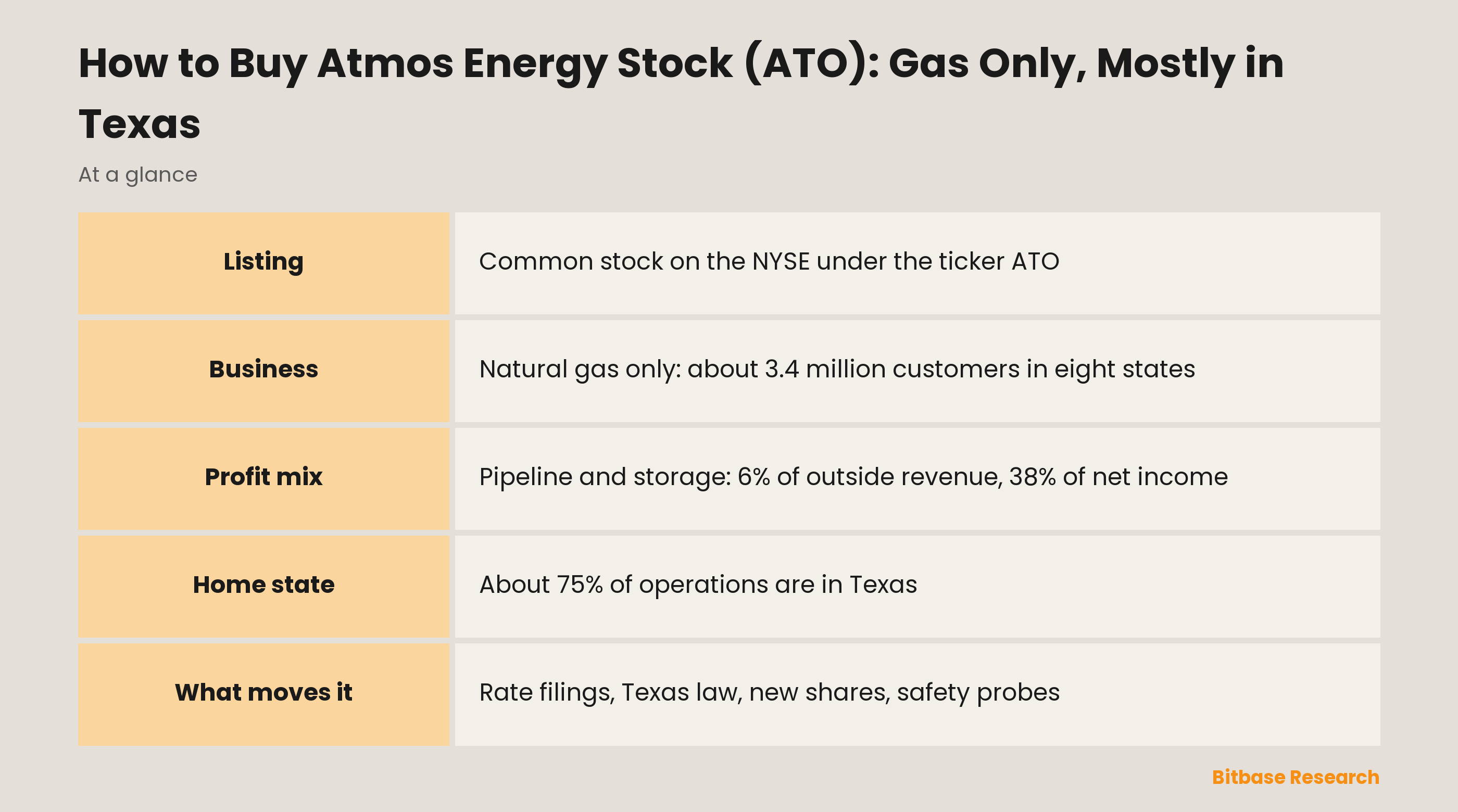
Buying an Atmos Energy share takes a brokerage account that reaches the New York Stock Exchange, where the common shares trade under the ticker ATO. The Dallas company sells only natural gas service, to about 3.4 million customers in eight states, yet its Texas pipeline and storage arm, with about 6% of fiscal 2025 revenue from outside customers, earned about 38% of net income. Below: the two businesses, the order itself, and what the filings say moves the share, from annual rate filings to federal safety investigations.
What Does Atmos Energy Do?
Atmos Energy delivers natural gas through pipes it owns, and nothing else. Its annual report calls it "a natural gas-only distributor," an S&P 500 company headquartered in Dallas and incorporated in Texas and Virginia. It does not generate or sell electricity; electric utilities are, in its words, a "rival energy source" for heating, water heating and cooking.
Its customers are homes, businesses, public authorities and industrial plants in eight states, mainly in the South: Texas, Louisiana, Mississippi, Kentucky, Tennessee, Virginia, Colorado and Kansas. They are served by six distribution divisions. Mid-Tex, which covers about 550 communities including the Dallas/Fort Worth Metroplex, has more than half of all customer meters on its own. West Texas serves Amarillo, Lubbock and Midland; Kentucky/Mid-States runs the systems in Kentucky, Tennessee and Virginia; and Louisiana, Mississippi and Colorado-Kansas complete the list. It operates under 1,010 non-exclusive franchises granted by the cities and towns it serves, a number of which come up for renewal every year.
The second business is the pipeline that feeds much of the first. Atmos Pipeline-Texas, known in the filings as APT, is "one of the largest intrastate pipeline operations in Texas," concentrated in the gas-producing areas of central, northern and eastern Texas and reaching into or near the Barnett Shale, the Texas Gulf Coast and the Permian Basin. APT moves and stores gas for the Mid-Tex division, other local distribution companies, industrial and electric generation customers, marketers and producers, and it operates five underground storage facilities in Texas. A 21-mile pipeline near New Orleans that gathers supply for the Louisiana division completes the segment.
The 10-K counts about 76,000 miles of mains on the distribution side and about 5,700 miles of transmission lines on the pipeline side. Atmos does not drill for gas: it buys supply from producers and marketers through competitive bidding and draws on its own and contracted storage when the weather turns cold. On its fiscal 2025 peak day, 19 February 2025, customers took about 4.2 Bcf, against an estimated peak-day supply of about 5.4 Bcf.
How Atmos Energy Makes Money
Atmos earns a regulated return on the pipes it has built. State commissions and city regulators set rates meant to cover "the costs of conducting business, including a reasonable return on invested capital." The gas itself passes through: purchased gas cost adjustment mechanisms give "a dollar-for-dollar offset" to changes in gas prices, so "although substantially all of our distribution operating revenues fluctuate with the cost of gas that we purchase, distribution operating income is generally not affected."
The fiscal 2025 segment note shows how differently the two businesses look on revenue and on profit:
| Segment | Share of 2025 revenue from outside customers | Share of 2025 net income | What it does |
|---|---|---|---|
| Distribution | 94% | 62% | Gas delivery to homes and businesses in eight states |
| Pipeline and storage | 6% | 38% | APT's Texas pipeline and storage, plus the Louisiana line |
Shares are calculated from the 10-K segment note. About 74% of the pipeline segment's own revenue was billed to the distribution segment, mostly Mid-Tex, and that internal revenue is eliminated in the consolidated total.
Households dominate distribution: residential gas sales made up about 62% of consolidated fiscal 2025 revenue and commercial sales about 25%; industrial sales were under 3%. For the year, revenue rose 12.9% and net income 14.9%, while earnings per diluted share grew 9.2% because the share count rose too. Operating income rose 12.8% in distribution and 19.1% in pipeline and storage, mainly on rate adjustments.
Those rate adjustments are the business model. Atmos has formula rate mechanisms in four states that reset rates every year without a full rate case, and infrastructure programs in all eight that adjust rates annually for qualifying capital spending. The company says it can "begin recovering approximately 95 percent of our capital expenditures within six months and substantially all of our capital expenditures within twelve months." APT uses Texas's Gas Reliability Infrastructure Program (GRIP) to add approved capital to its rate base each year, provided it files a complete rate case at least once every five years; the latest was completed in December 2023.
The spending behind them is heavy. About 87% of fiscal 2025 capital expenditures went to safety and reliability, and the 10-K says more than 80% of the plan for fiscal 2026 through 2030 is dedicated to the same purpose.
ATO Stock at a Glance
| Feature | ATO |
|---|---|
| Exchange | New York Stock Exchange (NYSE) |
| Ticker | ATO |
| Security | Common stock, no par value; the only class registered under Section 12(b) |
| Sector | Utilities: natural gas distribution, pipeline and storage |
| Service area | Eight states, mainly in the South; about 3.4 million customers |
| Index membership | S&P 500 |
| Headquarters | Dallas, Texas |
| Incorporated | Texas and Virginia |
| Fiscal year | Ends 30 September |
| Dividend policy | Quarterly cash dividend, at the board's discretion |
| SEC identifier | CIK 731802 |
Price, market value and dividend yield change every trading day; for live figures, open the Atmos Energy stock page on Bitbase.
How to Buy Atmos Energy Stock
Atmos Energy is a US company and its common stock is listed directly on the NYSE, so no depositary receipt is involved. The purchase runs in six steps:
1. Pick a broker with NYSE access. Investors outside the US can use a local firm that offers US shares or an international broker. Check which legal entity holds your account and which regulator supervises it.
2. Open the account and confirm your tax status. Non-US individuals are usually asked for IRS Form W-8BEN, the certificate of foreign status that lets the broker withhold US tax at the right rate.
3. Fund it. If your money is not in US dollars, the conversion has its own cost; compare the exchange rate as well as the commission.
4. Find the right line. Search ATO and check that the result reads Atmos Energy Corporation common stock on the NYSE. The 10-K cover registers no other security.
5. Choose an order type. FINRA explains that a market order "provides the most certainty that your order will be executed," but not at a known price. With a limit order, "you're guaranteed to get your limit price or a better price if your order is executed. However, there's a chance your order doesn't get executed at all."
6. Decide on the size. Fractional shares let you invest a fixed amount, but FINRA notes that "the availability of fractional share trading varies by brokerage firm," that you may be unable to "transfer fractional shares to another brokerage firm," and that "you might not have shareholder voting rights."
Keep the trade confirmations and statements; they record your cost basis and each dividend received.
Withholding on dividends. For investors outside the US, Atmos dividends are US-source income. The IRS states that "most types of U.S. source income received by a foreign person are subject to U.S. tax of 30%," and that a reduced rate, including exemption, may apply under a tax treaty. Your home country may tax the same payment again.
Holding it through a fund. On 9 November 2026, State Street's daily holdings files listed Atmos Energy in both SPY, which tracks the S&P 500, and XLU, the Utilities Select Sector fund. Its weight in each changes daily.
What Moves ATO Stock
Rate filings, year after year. Management names three "primary drivers" of financial performance: executing the capital spending program, recovering that spending in a timely way, and access to the capital markets. The rate calendar is where the second one shows up. At 30 September 2025 Atmos still had filings pending in Kansas, Kentucky, Virginia, Mississippi and the Mid-Tex cities; the Mississippi Public Service Commission issued its rate order on 4 November 2025, with new rates expected in the first quarter of fiscal 2026.
Texas law. Roughly 75% of consolidated operations sit in Texas, so its legislature and Railroad Commission carry the most weight. Texas legislation on infrastructure spending that took effect in the third quarter of fiscal 2025 lifted results in that year, and the company's report for the nine months to June 2026 again credited it with a favourable effect.
Capital spending and new shares. Atmos funds its pipe replacement with operating cash flow, debt and new equity, including an at-the-market program and forward sale agreements. In the quarter to June 2026, diluted weighted average shares were about 5% higher than a year earlier. That is why the 9.2% rise in diluted earnings per share for fiscal 2025 trailed the 14.9% rise in net income. In October 2026 the company also sold new senior notes due 2036.
Gas prices, indirectly. Gas costs flow through to customers, but a spike still reaches the company. The 10-K warns that rapid increases in purchased gas costs would lead to "a significant increase in short-term or long-term debt," slower collections and higher bad debt expense. Winter Storm Uri showed the pattern: Kansas passed a securitization law in 2021, and Atmos formed a special-purpose entity that issued bonds in June 2023 to recover the storm's extraordinary gas costs. In Texas, a state finance corporation issued customer rate relief bonds in March 2023 that are "not an obligation of Atmos Energy."
Safety events. Incidents bring federal investigations and can bring legal and regulatory costs. The National Transportation Safety Board (NTSB) issued final reports in 2026 on two incidents in Jackson, Mississippi, in January 2024 and one in Avondale, Louisiana, in December 2024, each investigation involving one fatality. On 1 July 2026 it issued a preliminary report on an incident in Dallas on 28 May 2026 that resulted in three fatalities.
Leadership change. On 3 November 2026 the board decided to combine the roles of chairman and chief executive. Chairman Kim R. Cocklin, who has reached the mandatory retirement age, is expected to step down at the 2027 annual meeting, after which President and CEO Kevin Akers is to become chairman, subject to his re-election as a director.
Pipeline Safety and Regulatory Lag at Atmos Energy
These are the risk factors in the fiscal 2025 10-K that bear most directly on an ATO share:
Regulatory lag. Atmos often has to place assets in service before rates reflect them, and the company warns that "regulatory lag could significantly increase if the regulatory authorities modify or terminate these rate mechanisms."
Accidents. "Operating issues such as leaks, accidents, equipment problems, and incidents, including explosions and fire, could result in legal liability, repair, and remediation costs," as well as fines and "a loss of customer confidence." Because some facilities are near populated areas, losses not fully covered by insurance "could be large."
Pipeline integrity rules. The Pipeline and Hazardous Materials Safety Administration (PHMSA) requires integrity management programs, and stricter standards "could require a potentially significant increase in operating costs." Atmos expects to recover such costs in rates, though not always right away.
Texas concentration. About 75% of operations are in Texas, so results "may be significantly affected by changes in the Texas economy in general, weather patterns, and regulatory decisions" there.
Policy on gas itself. Six of the eight states have passed laws stopping local governments from limiting the types of energy available to customers. Federal, regional or state measures could still restrict greenhouse gas emissions or "limit our ability to serve new or existing customers," and climate change could reduce demand for gas.
Weather. Weather normalization adjustment mechanisms in seven states cover about 97% of residential and commercial distribution revenue, but "there is no assurance that we will continue to receive such regulatory protection."
Funding. Long-term debt is rated investment grade by S&P and Moody's, and the company depends on "continued access to the credit and capital markets."
Two risks sit outside the business. A single stock ties your outcome to one company and, here, largely to one state's regulators. And the dividend is not guaranteed: the 10-K says future payments "will depend on our financial condition, results of operations, capital requirements, and other factors."
Reading Atmos Energy's Filings and Rate Tables
Atmos files with the SEC under CIK 731802. Its fiscal year ends on 30 September, so in recent years the 10-K has been filed in November, covering the twelve months to the previous September; the 10-Qs cover the quarters ending in December, March and June. Results for fiscal 2026 were released on 4 November 2026 with an 8-K, and the full-year 10-K follows separately. Earnings calls are webcast on its investor relations site.
Three tables in the 10-K do most of the work. The jurisdictional rate summary gives, for each division and state, the last rate action, the approved rate base, the authorized return on equity and the debt-to-equity ratio. The ratemaking tables show which filings were completed and which are pending. The segment note sets revenue, intersegment revenue and net income for both segments side by side.
Two cautions. The rate table is labelled "for regulatory purposes only," so it does not reconcile to reported earnings. And rate outcomes are shown both with and without the refund of excess deferred income taxes, so compare like with like. The performance graph sets Atmos's total return against the S&P 500 and the S&P 500 Utilities index; for another utility, read our Sempra stock guide, whose SoCalGas unit is also a gas distributor, or browse the full list of US stock pages on Bitbase.
Atmos Energy Stock FAQ
Can I buy Atmos Energy stock with crypto?
Not directly. Brokers sell ATO shares for US dollars, so crypto has to be sold for cash and moved to the brokerage first, and in many countries that sale is a taxable event. Treat the two as separate decisions: a share is a registered stake in a company with dividend and voting rights, which is how a share differs from a crypto asset.
Does Atmos Energy pay a dividend?
Yes, quarterly. The board typically declares each dividend in the same fiscal quarter in which it is paid. The dividend rate rose 8.1% in fiscal 2025, and with its fiscal 2026 results the company set an indicated annual dividend for fiscal 2027 that is 9.0% above fiscal 2026. Payments remain at the board's discretion.
Is ATO in the S&P 500?
Yes. Atmos describes itself as an S&P 500 company, and on 9 November 2026 it appeared in the daily holdings of SPY, which tracks that index, and of the utilities sector fund XLU.
Does Atmos Energy sell electricity?
No. It calls itself "a natural gas-only distributor." Electricity is its main competitor for heating, water heating and cooking in homes and businesses.
Which states does Atmos Energy serve?
Eight: Texas, Louisiana, Mississippi, Kentucky, Tennessee, Virginia, Colorado and Kansas. Texas accounts for about 75% of its operations, and the Mid-Tex division around Dallas and Fort Worth is the largest by rate base.
Conclusion
Atmos Energy is a concentrated business: one fuel, two regulated businesses and a home state that holds about three-quarters of its operations. Its earnings grow when it replaces pipe and regulators let it earn on that pipe quickly, and the same pipes carry the safety risk that recent NTSB investigations put on the record. Read the latest 10-K's rate tables and the pending filings alongside the fiscal 2026 results, and weigh how much one Texas-centred gas utility should represent in your portfolio.
Related reading
Other Bitbase articles on this topic:
- How to Buy Ameren Stock (AEE): Callaway, DRPlus, Data Centers
- How to Buy American Water Works Stock (AWK): Rates, PFAS, Merger
- How to Buy Brookfield Infrastructure Stock (BIP): Units to Shares
- How to Buy FirstEnergy Stock (FE): Wires, Rate Cases and HB 6
Disclaimer: This article is educational content from Bitbase Academy, provided for information only. It explains what a company or fund does and how the instruments referenced here differ from one another; it does not constitute investment, trading, tax, or financial advice, and it is neither a recommendation nor an endorsement of any security, token, or trading strategy. A tokenized stock is issued by a third party and is designed to give economic exposure to an underlying asset: it is not a share, it carries no shareholder rights, and it depends on the issuer's structure, eligibility rules, and redemption terms, which the issuer can change. Perpetual futures are leveraged derivatives that hold no underlying asset and can be liquidated, and trading hours, product availability, and eligibility differ by instrument and by jurisdiction and can change at any time. Written as of November 2026; verify everything yourself through company filings, the issuer's own documentation, and the product pages of the venue you trade on.
References
[1] Atmos Energy Form 10-K for fiscal 2025 (SEC EDGAR) www.sec.gov
[2] Atmos Energy fiscal 2025 Form 10-K, XBRL cover page (SEC EDGAR) www.sec.gov
[3] Atmos Energy Form 10-Q for the quarter ended 30 June 2026 (SEC EDGAR) www.sec.gov
[4] Atmos Energy fiscal 2026 results release, filed with Form 8-K on 4 November 2026 (SEC EDGAR) www.sec.gov
[5] Atmos Energy Form 8-K, 4 November 2026: chairman retirement and combined chairman and CEO role (SEC EDGAR) www.sec.gov
[6] Atmos Energy Form 8-K, 9 October 2026: senior notes due 2036 (SEC EDGAR) www.sec.gov
[7] State Street SPDR S&P 500 ETF Trust (SPY): daily holdings file www.ssga.com
[8] State Street Utilities Select Sector SPDR ETF (XLU): daily holdings file www.ssga.com
[9] FINRA: Order Types www.finra.org
[10] FINRA: Investing in Fractional Shares www.finra.org
[11] IRS: NRA Withholding, including Form W-8BEN www.irs.gov





