
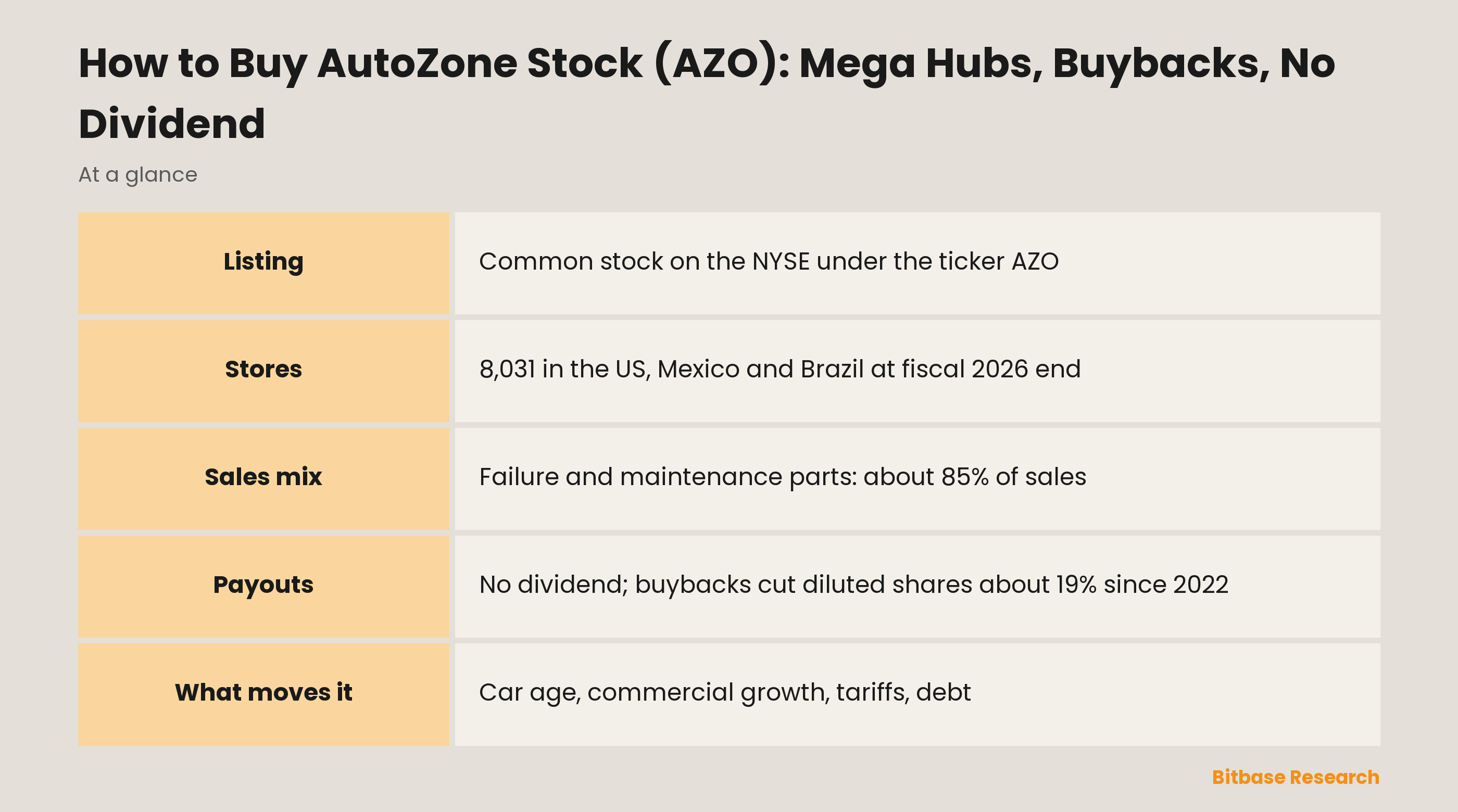
With an account at any broker that offers US shares, you can buy AutoZone stock on the New York Stock Exchange under the ticker AZO, though the company's own buybacks in fiscal 2026 were made at a four-digit average price per share, so a fractional order is often the practical way in. The parts retailer, in business since 1979, ended that year on 29 August 2026 with 8,031 stores in the United States, Mexico and Brazil; it pays no dividend and has cut its diluted share count by about 19% since fiscal 2022 through buybacks.
What Does AutoZone Do?
AutoZone sells replacement parts for cars, sport utility vehicles, vans and light duty trucks. Its 10-K calls it "a leading retailer and distributor of automotive replacement parts and accessories in the Americas," with a range that runs from new and remanufactured hard parts such as starters, calipers and water pumps to oil, filters, wipers and floor mats. The company is incorporated in Nevada and run from Memphis, Tennessee.
At 29 August 2026 it had 6,863 stores in the United States, 1,001 in Mexico and 167 in Brazil, after opening 374 during fiscal 2026 and closing none. A typical store carries about 20,000 to 25,000 unique items, a hub 40,000 to 50,000 and a mega hub 80,000 to 110,000, and ordinary stores usually have same-day access to a nearby hub's range. At year end 172 US stores were mega hubs, 39 more than a year earlier, and Mexico had another 11.
The same buildings serve two kinds of customer. Do-it-yourself (DIY) drivers buy at the counter or on autozone.com, with pickup in store or home delivery. Professional buyers, meaning repair garages, dealers, service stations and fleet owners, use the commercial program, which offers prompt delivery and trade credit; it ran in 6,443 US stores and in the vast majority of stores in Mexico and Brazil.
Beside the stores sit ALLDATA, a repair and shop management software business based in Elk Grove, California, and in-house brands led by Duralast; many products come in good, better and best price tiers. What AutoZone does not do is fix cars: "we do not derive revenue from automotive repair or installation services," the 10-K says. It offers free services instead, such as the Loan-A-Tool program and battery, starter and alternator testing.
How AutoZone Makes Money
AutoZone earns the gap between what it pays suppliers and what it charges at the counter or on delivery. Since the fourth quarter of fiscal 2025 it has reported a single operating segment, so the 10-K breaks sales down by product group and by country rather than by business line:
| Product group | Share of fiscal 2026 net sales | Examples from the 10-K |
|---|---|---|
| Failure | 48.9% | Starters and alternators, calipers, fuel and water pumps, radiators |
| Maintenance items | 36.5% | Oil and filters, brake pads and rotors, spark plugs, wipers |
| Accessories and other | 14.6% | Floor mats, phone accessories, tools, wash and wax |
Shares are calculated from the 10-K segment note. Failure and maintenance together made up about 85% of sales, and the company says it has "not experienced any fundamental shifts in our category sales mix." Most of what it sells replaces something that wore out or broke.
Net sales grew 7.4% in fiscal 2026. Same store sales, for stores open at least a year, rose 3.3% in the US. Abroad they rose 13.5% in dollars but only 2.2% at constant exchange rates, so currencies did most of the work. The US produced about 86.6% of sales, and stores outside it 13.4%, up from 12.0% a year earlier.
Professional customers drove the US business. Domestic commercial sales rose 10.6%, faster than total sales, and made up 33.1% of US sales, and the 10-K ties the hub network to that customer: hubs and mega hubs "offer a larger assortment than our satellite stores of parts and products desired by professional technicians."
Profit grew more slowly. Gross margin slipped to 52.3% from 52.6%, as a non-cash LIFO inventory charge took off 61 basis points, partly offset by 48 basis points from tariff refunds. Operating expenses rose to 34.0% of sales from 33.6% on growth investments. Operating profit rose 3.1% and net income 3.0%, while diluted earnings per share rose 5.3%, because the profit was divided among fewer shares.
AZO Stock at a Glance
| Feature | AZO |
|---|---|
| Exchange | New York Stock Exchange |
| Ticker | AZO |
| Security | Common stock, the only class registered under Section 12(b) |
| Sector | Auto parts retail and distribution |
| Index membership | S&P 500 |
| Headquarters | Memphis, Tennessee |
| Incorporated | Nevada |
| Fiscal year | 52 or 53 weeks, ending on the last Saturday in August |
| Payouts | No dividend; cash returned through share buybacks, a program running since 1998 |
| Shares outstanding | About 16.1 million on 19 October 2026 |
| SEC identifier | CIK 866787 |
None of the above includes the share price, which moves all session long; quotes and charts are on the AutoZone stock page on Bitbase.
How to Buy AutoZone Stock
Because AutoZone is an American company with an American listing, the NYSE line is the ordinary share itself, with no receipt or overseas class in between. At a broker, the order goes like this:
1. Pick a broker that reaches the NYSE. Outside America, look for a home broker with US market access or a global platform, and check who supervises it.
2. Open and verify the account. Non-US individuals usually confirm their status on IRS Form W-8BEN, which the IRS says to submit "when requested by the withholding agent or payer."
3. Fund it. Money sent in euros, pesos or any other currency gets converted to dollars, and that spread can cost more than the commission.
4. Find the right line. Search for AZO and check that the result reads AutoZone, Inc. common stock on the New York Stock Exchange.
5. Choose the order type. FINRA says a market order "provides the most certainty that your order will be executed," while a limit order fills only "at or better than a specified price."
6. Decide the size. Because a whole share has cost a four-digit sum, a fractional order lets you invest a set amount instead. FINRA notes that some brokers offer fractions only for "large-cap stocks or ETFs" or not at all, and that "as a fractional share owner, you might not have shareholder voting rights."
7. Keep the records. Save every confirmation; your tax office may ask what you paid.
Taxes for investors abroad. The IRS says "most types of U.S. source income received by a foreign person are subject to U.S. tax of 30%," with lower rates possible under a tax treaty. For shareholders that rule mostly bites on dividends, and AutoZone currently pays none. A gain on selling can still be taxable where you live.
Through an index fund. AZO is part of the S&P 500, and State Street listed it in the daily holdings of its SPY fund on 5 November 2026, so funds tracking that index hold it as one position among hundreds.
What Moves AZO Stock
Old cars and miles driven. AutoZone names the two statistics with "the closest correlation to our market growth over the long-term": miles driven and the number of cars seven years old or older, which are usually out of warranty. The 10-K puts the average age of US light vehicles at 12.9 years, citing S&P Global Mobility, while US miles driven rose only 0.8% in the twelve months to July 2026.
The professional customer. Among its risks the 10-K lists that "if we cannot profitably increase our market share in the commercial automotive parts business, our sales growth may be limited." Each quarterly release reports domestic commercial growth.
The store build-out. AutoZone opened 374 stores in fiscal 2026 against 305 a year earlier, and for fiscal 2027 it expects to "slightly increase the investment in our business," mainly on new stores and hub and mega hub expansion.
Buybacks and the balance sheet. The stated order is to invest in the business first and "utilize the remaining funds to repurchase shares, while maintaining debt levels that support our investment grade credit ratings." The board raised the repurchase authorization again on 16 June 2026, and the diluted share count has fallen every year since fiscal 2022. The 10-K shows a stockholders' deficit, meaning negative book equity, at every year-end from fiscal 2022 to 2026, and borrowing is managed against a target ratio of adjusted debt to EBITDAR, 2.5 in each of the last three years. Earnings per share depend on buybacks and borrowing costs, not only on profit.
Tariffs. About 12% of fiscal 2026 purchases were imported directly, and many US suppliers import too. In February 2026 the US Supreme Court invalidated tariffs imposed under the International Emergency Economic Powers Act; AutoZone filed for refunds on 20 April 2026 and received substantially all of them within the year, adding 145 basis points to fourth-quarter gross margin. Replacement tariffs under Section 122 of the Trade Act of 1974 took effect on 24 February 2026 for 150 days, and the company calls the outlook "unclear."
Weather and the calendar. Sales usually peak from February through September and are lowest in December and January. The fourth quarter runs 16 weeks against 12 for each of the others, and in fiscal 2026 it produced 32.4% of annual sales and 36.2% of net income. Chief executive Phil Daniele described "a difficult selling environment the first eight weeks of our quarter" before sales strengthened; domestic same store sales rose 1.6% for that quarter.
Electric Cars, Rivals and Debt at AutoZone
These items from the 10-K risk factors bear most directly on an AZO share:
Changing vehicles. Better parts design can make repairs less frequent, and "the increased prevalence of electric vehicles" can mean "less frequent parts failures and a reduced need for parts." Carmakers' limits on telematics, diagnostic tools and repair information "may cause vehicle owners to rely on dealers to perform maintenance and repairs."
Competition and cost. Online and multi-channel sellers "often have lower operating costs," and because AutoZone's model rests on in-store service, "our cost structure is higher than some of our competitors." Its filing names no rivals, but O'Reilly Automotive's 10-K lists AutoZone among the national parts chains it competes with, as our O'Reilly Automotive stock guide explains.
Growth that may slow. "We may not be able to sustain our historic rate of sales growth," the 10-K says. Revenue grew about 7% a year from fiscal 2021 to fiscal 2026 and the store count about 3% a year.
Labor. "Our workforce costs represent our largest operating expense," across about 132,000 employees.
Debt and ratings. A ratings downgrade "could make it more difficult for us to access funds" and could make banks less willing to support the supplier financing arrangements behind its accounts payable to inventory ratio of 111.1% at the end of fiscal 2026.
The stock itself. Owning AZO alone concentrates your money in one retailer, and no dividend arrives while you wait out a slump. Leadership is also changing: chief financial officer Jamere Jackson resigned effective 25 November 2026 to become chief financial officer of FedEx, and AutoZone has started an external search for a successor.
Reading AutoZone's Filings Before You Buy
AutoZone files with the SEC under CIK 866787: a 10-K after each fiscal year (the fiscal 2026 one on 26 October 2026), 10-Qs for the first three quarters, and 8-Ks for events, including the earnings releases of 9 December 2025 and 3 March, 26 May and 22 September 2026. The same documents are free on autozone.com.
In the 10-K, Item 1 gives the store counts, hubs and product range, Item 1A the risks, and Item 5 the buyback table and a performance graph comparing AZO with the S&P 500 and the S&P Retail Index. The five-year table in the MD&A sets same store sales, store counts, return on invested capital and the diluted share count side by side, the quickest way to see the buyback effect.
Two habits help: compare a fourth quarter only with the previous fourth quarter, and read international growth at constant currency as well as in dollars. For current prices go back to the AZO page above, or browse the full list of US stock pages on Bitbase to look up other names.
AutoZone Stock FAQ
Can I buy AutoZone stock with crypto?
Not directly. A broker settles AZO purchases in dollars, so you would first sell the coins on an exchange, withdraw the cash and wire it across, and selling crypto can itself trigger tax in many countries. A share makes you a part-owner of a registered company, with voting rights, one of the main points in how stocks differ from crypto.
Does AutoZone pay a dividend?
No. The 10-K says "we currently do not pay a dividend on our common stock," and any future dividend would depend on its financial condition, capital requirements, earnings and cash flow; Nevada law also limits payouts. The company returns cash through buybacks instead.
Can I buy less than one AZO share?
Yes, if your broker offers fractional shares in AZO. The company's own repurchases in the fourth quarter of fiscal 2026 averaged a four-digit price per share. Ask whether the broker passes on voting rights for fractions.
Is AZO in the S&P 500?
Yes. AutoZone appeared in State Street's daily holdings file for SPY, the fund that tracks the S&P 500, on 5 November 2026.
When does AutoZone's fiscal year end?
On the last Saturday in August. Fiscal 2026 ended on 29 August 2026 after 52 weeks; some years have 53. The first three quarters run 12 weeks each and the fourth 16 or 17, which is why fourth-quarter results look much larger.
Conclusion
Buying AZO is simple: a broker with NYSE access, the AutoZone, Inc. common stock line, a market or limit order, and quite possibly a fractional amount. Knowing what you hold takes longer: a retailer whose growth leans on professional customers and bigger hub stores, which pays no dividend, carries negative book equity and turns most of its spare cash into buybacks. Read the latest 10-K, follow commercial growth and the mega hub count each quarter, and decide how much one retailer should weigh in your portfolio.
Related reading
Other Bitbase articles on this topic:
- How to Buy Carnival Stock (CCL): One Listing, Eight Cruise Lines
- How to Buy Chipotle Stock (CMG): No Dividend, a 50-for-1 Split
- How to Buy Copart Stock (CPRT): Salvage Auctions, ACV and Splits
- How to Buy IHG Stock (IHG): Holiday Inn Fees and a One-Share ADS
Disclaimer: This article is educational content from Bitbase Academy, provided for information only. It explains what a company or fund does and how the instruments referenced here differ from one another; it does not constitute investment, trading, tax, or financial advice, and it is neither a recommendation nor an endorsement of any security, token, or trading strategy. A tokenized stock is issued by a third party and is designed to give economic exposure to an underlying asset: it is not a share, it carries no shareholder rights, and it depends on the issuer's structure, eligibility rules, and redemption terms, which the issuer can change. Perpetual futures are leveraged derivatives that hold no underlying asset and can be liquidated, and trading hours, product availability, and eligibility differ by instrument and by jurisdiction and can change at any time. Written as of November 2026; verify everything yourself through company filings, the issuer's own documentation, and the product pages of the venue you trade on.
References
[1] AutoZone Form 10-K for fiscal 2026 (SEC EDGAR) www.sec.gov
[2] AutoZone fiscal 2026 Form 10-K, XBRL cover page (SEC EDGAR) www.sec.gov
[3] AutoZone fiscal 2026 Form 10-K, XBRL segment note (SEC EDGAR) www.sec.gov
[4] AutoZone fourth-quarter fiscal 2026 earnings release, filed with Form 8-K (SEC EDGAR) www.sec.gov
[5] AutoZone press release on the chief financial officer's departure, filed with Form 8-K, 26 October 2026 (SEC EDGAR) www.sec.gov
[6] AutoZone press release on an additional share repurchase authorization, filed with Form 8-K, 16 June 2026 (SEC EDGAR) www.sec.gov
[7] O'Reilly Automotive Form 10-K for fiscal 2025: competition (SEC EDGAR) www.sec.gov
[8] State Street SPDR S&P 500 ETF Trust (SPY): fund page and daily holdings www.ssga.com
[9] FINRA: Order Types www.finra.org
[10] FINRA: Investing in Fractional Shares www.finra.org
[11] IRS: NRA Withholding www.irs.gov
[12] IRS: About Form W-8 BEN www.irs.gov





