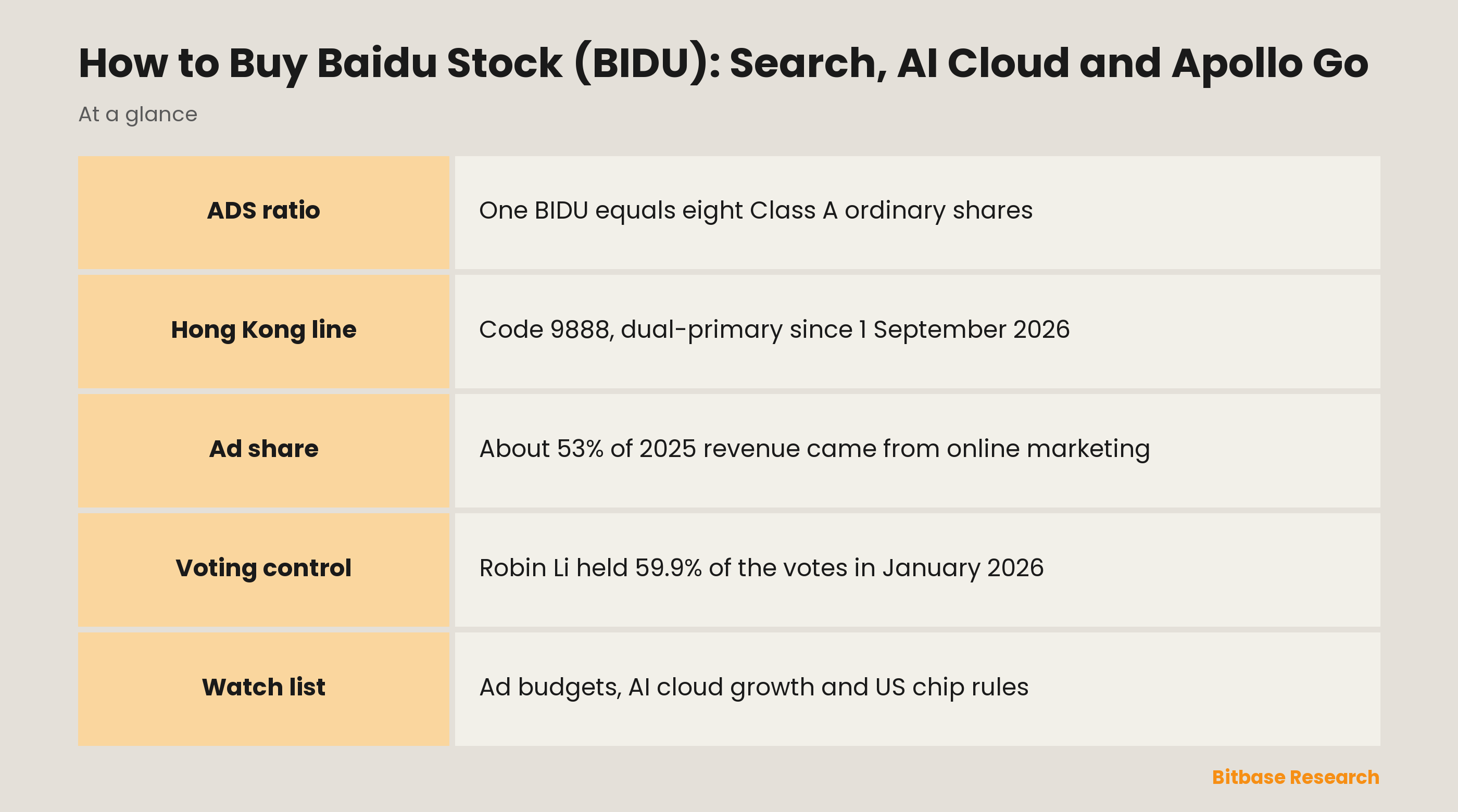
Your route into Baidu is any brokerage account that reaches Nasdaq, where each BIDU American depositary share (ADS) stands for eight Class A ordinary shares; the same shares also trade in Hong Kong as 9888. The business is in mid-switch: online marketing still brought in about 53% of 2025 revenue, yet by the second quarter of 2026 its AI cloud, AI applications and AI-native ads made up half of Baidu General Business revenue.
What Does Baidu Do?
Baidu started in 2000 as a Chinese search engine and still runs Baidu App, which the 20-F calls "the leading search-plus-feed app in China" and which had 679 million monthly active users in December 2025. The holding company, Baidu, Inc., was incorporated in the Cayman Islands in January 2000. Robin Yanhong Li, a co-founder, is chairman and chief executive.
Since the fourth quarter of 2025 the company reports two segments. Baidu General Business, the old "Baidu Core", spans three areas. The Mobile Ecosystem is more than a dozen apps, Baidu App, ERNIE Bot and Haokan among them, where Baidu sells its online marketing. AI Cloud sells computing infrastructure to companies and the public sector, plus AI applications such as Baidu Wenku and Baidu Drive. Intelligent Driving and other growth initiatives holds Apollo Go, the robotaxi service, and the DuerOS smart assistant.
The second segment is iQIYI, a video streaming service listed on Nasdaq as IQ since March 2018. Baidu has controlled it since 2012 and consolidates its results.
The annual report says Baidu has invested in AI since 2010 and offers "a full AI stack of four layers," from cloud infrastructure to applications. The ERNIE model it released in November 2025 is its "first native omni-modal foundation model." Apollo Go had given more than 20 million rides to the public by February 2026 and has run fully driverless in every mainland Chinese city it serves since February 2025; by the second quarter of 2026 it reached 28 cities worldwide, Dubai among them.
How Baidu Makes Money
Advertising still pays most of the bills, though less each year. The 20-F splits 2025 revenue into two lines:
| Revenue line | Share of 2025 revenue | Change from 2024 | What is in it |
|---|---|---|---|
| Online marketing services | 53% | −13.7% | Search and feed ads across Baidu's apps |
| Others | 47% | +12.2% | Mainly cloud services and iQIYI memberships |
Shares and changes are calculated from the 20-F revenue table. In 2024, online marketing had been 59% of revenue.
Total revenue fell 3% in 2025. The 20-F traces the ad decline to "the impact of our ongoing AI transformation on monetization" and to weak advertiser budgets, partly offset by cloud growth from "accelerating enterprise AI adoption." Research and development equalled 16% of revenue, and a large impairment charge on core-business assets produced an operating loss.
The company groups its newer lines as "AI-powered Business": AI cloud infrastructure, AI applications and AI-native marketing services. Its unaudited management accounts show AI cloud infrastructure revenue up 34% in 2025. In the second quarter of 2026 those lines made up 50% of Baidu General Business revenue, against 38% a year earlier, while online marketing services fell 19%.
BIDU Stock at a Glance
| Field | BIDU |
|---|---|
| Legal name | Baidu, Inc., a Cayman Islands company |
| US listing | Nasdaq Global Select Market, ticker BIDU, since 5 August 2005 |
| ADS ratio | One ADS represents eight Class A ordinary shares |
| ADS depositary | The Bank of New York Mellon |
| Hong Kong listing | Code 9888 since 23 March 2021; RMB counter 89888; dual-primary since 1 September 2026 |
| Share classes | Class A: one vote per share; Class B: ten votes per share |
| Stock Connect | Shanghai and Shenzhen links since 7 September 2026 |
| S&P 500 | Not in SPY's holdings file dated 10 November 2026 |
| Accounts | Calendar-year, US GAAP, in renminbi |
| Payouts | First dividend policy adopted in 2026; buyback programme through 2028 |
| SEC identifier | CIK 1329099 |
For the current price and chart, open the Baidu stock page on Bitbase.
How to Buy Baidu Stock
1. Decide where to buy. BIDU is quoted in US dollars on Nasdaq; in Hong Kong, 9888 is quoted in Hong Kong dollars and 89888 in renminbi.
2. Open an account with a broker that serves that market and accepts residents of your country.
3. Fund the account, comparing the currency conversion rate as well as the commission.
4. Search for BIDU or 9888 and check that the result names Baidu, Inc.
5. Choose an order type and size. A market order fills at the going price, a limit order only at your price or better. Some brokers sell part of an ADS.
ADS or Hong Kong shares. One BIDU equals eight Hong Kong shares, so convert the currency and multiply by eight before setting the two prices side by side. The 20-F describes ADSs and Class A shares as "fully fungible": for a fee, the depositary turns deposited shares into ADSs or cancels ADSs and releases shares. Buyers and sellers of 9888 each pay 0.1% Hong Kong stamp duty.
Why eight. One ADS was one share at the 2005 listing; a 2010 ratio change acted as a ten-for-one ADS split, and a 1-to-80 share subdivision in March 2021 produced today's ratio.
Tax. According to the 20-F, the Cayman Islands do not tax income or gains. Withholding on any future dividend depends on where you live and on treaty rules.
What Moves BIDU Stock
Advertising budgets. Online marketing is still about half of revenue, and its fall reflects both Baidu's own search overhaul and weak spending; for 2024 the 20-F named healthcare, real estate and home furnishing as soft sectors.
The pace of the AI shift. Each quarter tests whether the AI-powered lines grow fast enough to offset shrinking legacy ads.
Robotaxi rollout. Apollo Go has moved beyond China to Dubai and Abu Dhabi, with road tests in London and Switzerland. The 20-F lists winning testing and then commercial permits in each new market among its challenges.
Corporate moves. In January 2026 Baidu proposed a separate Hong Kong listing for its AI chip subsidiary, Kunlunxin, which would stay a subsidiary, though "there is no assurance" it will happen. In February the board approved a buyback programme to 31 December 2028 and a first-ever dividend policy, with a first payment expected in 2026.
Hong Kong access. Dual-primary status from 1 September 2026 and Stock Connect inclusion on 7 September opened 9888 to eligible mainland investors.
Contracts, Chips and Control: Risks for BIDU Holders
Contract control. "Investors in our ADSs are not purchasing equity interest in the variable interest entities in Chinese mainland but instead are purchasing equity interest in a holding company incorporated in the Cayman Islands." The VIEs contributed 50% of 2025 external revenue, the contracts "have not been tested in a court of law," and losing them could see the securities "diminish substantially or even become worthless." Alibaba is built the same way.
Chip supply. US export controls "could potentially impose limitations on our access to advanced semiconductor technologies," and shortages would mean "capacity constraints, increased costs and reduced performance" for its cloud.
Ad customers. Advertisers "are not subject to fixed-term contracts" and leave if spending stops producing sales leads.
US listing and US lists. In April 2022 the SEC named Baidu a Commission-Identified Issuer under the Holding Foreign Companies Accountable Act; the PCAOB's December 2022 reversal lifted that status, but two straight years of such findings would bar US trading. In June 2026 the US Department of Defense added Baidu to its list of Chinese military companies; Baidu rejected the designation and noted the list "does not restrict transacting in the securities of the Company."
One-person voting control. Through Class B shares and employee proxies, Robin Li held 59.9% of the voting power on 31 January 2026 while owning 18.6% of the shares. ADS holders vote only by instructing the depositary.
There is also currency: revenue is in renminbi, the ADS price in dollars.
Tracking Baidu Through Its 20-F and Hong Kong Filings
Baidu's SEC filer number (CIK) is 1329099. Its 20-F for 2025 came on 17 March 2026; quarterly results and Hong Kong announcements follow on Form 6-K. The 20-F opens with the VIE description, then the risk factors; segment revenue sits in the operating review and the split by revenue type in the notes. The same notices appear on HKEXnews under 9888, and ir.baidu.com collects releases and webcasts.
When reading a release, separate audited figures from those labelled internal management accounts, as the AI-powered Business split is. Our NetEase stock guide covers another company with a Nasdaq ADS and a Hong Kong line.
Baidu Stock FAQ
Can I buy Baidu stock with crypto?
Not directly. You need a broker for BIDU or 9888, and they settle in US dollars, Hong Kong dollars or renminbi, so the crypto has to be sold for cash and transferred first; that sale can itself be taxable. Our guide to buying stocks with crypto sets out the steps.
Is BIDU the same as Baidu's Hong Kong stock 9888?
They represent the same Class A shares in different wrappers. BIDU is an ADS worth eight of them, priced in dollars on Nasdaq; 9888 is the share itself, priced in Hong Kong dollars, with 89888 as the renminbi counter. Trading hours differ, so prices do not always match after conversion.
Does Baidu pay a dividend?
Not yet. The 20-F says Baidu had never declared or paid a dividend on its ordinary shares. The board adopted a dividend policy in early 2026 and expects a first payment during the year, with timing and amount at its discretion.
Who controls Baidu?
Robin Li. His Class B shares carry ten votes each, so on 31 January 2026 he held 59.9% of the votes with 18.6% of the shares.
Is iQIYI part of Baidu?
Yes. iQIYI is a Baidu-controlled subsidiary with its own Nasdaq listing, IQ, and Baidu consolidates its results. iQIYI's revenue fell 7% in 2025.
Conclusion
Baidu is a search advertiser trying to become an AI company before its ad revenue shrinks much further. Its filings show both sides: ad sales down two years running, AI cloud growing and a large impairment charge in 2025, inside a VIE structure exposed to US chip rules and one shareholder's voting control. Read the latest quarterly release and 20-F before deciding how much weight it deserves.
Related reading
Other Bitbase articles on this topic:
- How to Buy Atlassian Stock (TEAM): Jira, Cloud Shift and Perps
- How to Buy Autodesk Stock (ADSK): AutoCAD, Revit and MaintainX
- How to Buy Bending Spoons Stock (BSP): Evernote, AOL and Vimeo
- How to Buy PayPal Stock (PYPL): Venmo, Braintree and a Dividend
Disclaimer: This article is educational content from Bitbase Academy, provided for information only. It explains what a company or fund does and how the instruments referenced here differ from one another; it does not constitute investment, trading, tax, or financial advice, and it is neither a recommendation nor an endorsement of any security, token, or trading strategy. A tokenized stock is issued by a third party and is designed to give economic exposure to an underlying asset: it is not a share, it carries no shareholder rights, and it depends on the issuer's structure, eligibility rules, and redemption terms, which the issuer can change. Perpetual futures are leveraged derivatives that hold no underlying asset and can be liquidated, and trading hours, product availability, and eligibility differ by instrument and by jurisdiction and can change at any time. Written as of November 2026; verify everything yourself through company filings, the issuer's own documentation, and the product pages of the venue you trade on.
References
[1] Baidu, Inc., Form 20-F for 2025 (SEC EDGAR) www.sec.gov
[2] Baidu second-quarter 2026 results, Form 6-K, 18 August 2026 www.sec.gov
[3] Baidu fourth-quarter and fiscal 2025 results, Form 6-K, 26 February 2026 www.sec.gov
[4] Baidu announces new share repurchase program and dividend policy, Form 6-K, 5 February 2026 www.sec.gov
[5] Baidu announces proposed spin-off and separate listing of Kunlunxin, Form 6-K, 2 January 2026 www.sec.gov
[6] Baidu announces dual-primary listing in Hong Kong, Form 6-K, 1 September 2026 www.sec.gov
[7] Baidu announces inclusion in the Shenzhen and Shanghai Stock Connect programs, Form 6-K, 8 September 2026 www.sec.gov
[8] Baidu responds to inclusion on U.S. CMC list, Form 6-K, 9 June 2026 www.sec.gov
[9] State Street: SPY daily holdings, 10 November 2026 www.ssga.com





