
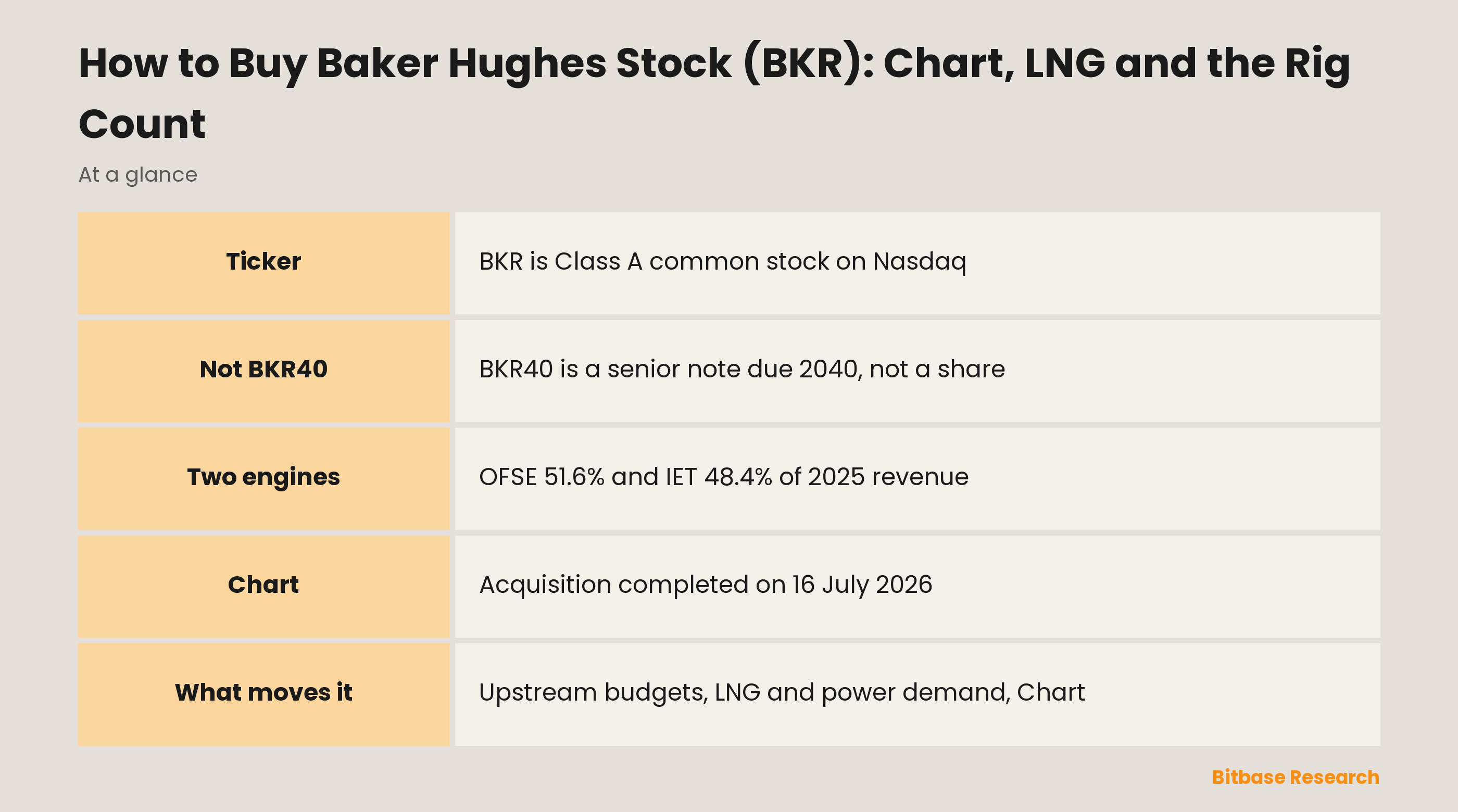
Baker Hughes is listed on the Nasdaq Global Select Market under the ticker BKR, so any brokerage account with access to US stocks can buy its shares. The company is not an oil producer: it sells drilling services, gas turbines, compressors and LNG equipment to the companies that produce, move and burn energy, and on 16 July 2026 it completed its acquisition of Chart Industries. It also publishes the rig counts the drilling industry watches. This guide covers how it earns its revenue, how to place the order and what its filings flag, from oil and gas budgets to its reliance on GE Vernova.
What Does Baker Hughes Do?
Baker Hughes Company, incorporated in Delaware and based in Houston, describes itself as "an energy technology company with a diversified portfolio of technologies and services that span the energy and industrial value chain." It claims a business "built on a century of experience" in more than 120 countries, and at the end of 2025 it had about 56,000 employees, more than 45,000 of them outside the United States.
The listed company is younger than the name. It was formed in July 2017 by combining Baker Hughes Incorporated with General Electric's oil and gas business, leaving GE with about 62.5% and the shares trading as Baker Hughes, a GE company, under BHGE. GE announced in June 2018 that it would separate over time; the name became Baker Hughes Company on 17 October 2019 and the ticker changed to BKR the next day, still on the New York Stock Exchange. GE exchanged the last of its Class B shares in the fourth quarter of 2022, and no Class B stock has been outstanding since.
Through 2025 the company reported two segments. Oilfield Services & Equipment (OFSE) works on oil and gas wells "across the life cycle of an asset, ranging from exploration, appraisal, and development to production, rejuvenation, and decommissioning." Its four product lines cover drilling, well completions and wireline, artificial lift and oilfield chemicals, and subsea equipment from trees to flexible pipe.
Industrial & Energy Technology (IET) builds and services the machines that compress gas, liquefy it and turn it into power: aeroderivative and heavy-duty gas turbines, compressors, power generation modules and modular liquefaction plants. It also sells valves, inspection equipment and machine monitoring, plus climate technology for carbon capture, hydrogen and geothermal.
A third segment arrived in 2026. On 28 July 2025 Baker Hughes agreed to buy Chart Industries, a maker of process technology and equipment "for gas and liquid molecule handling," for cash. The deal closed on 16 July 2026 after a European Commission review, and to win that approval Baker Hughes committed to sell a Chart business in small-scale LNG process technology, a sale it expected to complete in the first quarter of 2027. Chart now reports on its own, with two product lines: original equipment and aftermarket.
Smaller deals trimmed the edges. Continental Disc Corporation, a maker of rupture discs, joined in August 2025. On 1 January 2026 the precision sensors business (PSI) went to Crane Company, and surface pressure control moved into a joint venture with a Cactus subsidiary in which Baker Hughes kept 35%. In April 2026 it agreed to sell Waygate Technologies, its inspection business, to Hexagon, a sale the third-quarter 10-Q expected to complete in the fourth quarter of 2026.
How Baker Hughes Makes Money
Almost equally from its two original segments, which are moving in opposite directions. In fiscal 2025 OFSE brought in 51.6% of revenue and IET 48.4%, but IET revenue grew 9.9% while OFSE's fell 8.3%. Profit shifted faster: IET's share of segment EBITDA, the profit measure the company uses for its segments, rose from 37.1% in 2023 to 48.7% in 2025.
| Product line | Segment | Share of 2025 revenue | What it covers |
|---|---|---|---|
| Gas Technology Equipment | IET | 23.9% | Gas turbines, compressors, LNG and power modules |
| Production Solutions | OFSE | 13.7% | Artificial lift, oilfield chemicals |
| Completions, Intervention and Measurements | OFSE | 13.5% | Completions, pressure pumping, wireline |
| Well Construction | OFSE | 13.1% | Drilling services, drill bits, fluids |
| Subsea & Surface Pressure Systems | OFSE | 11.3% | Subsea production systems, flexible pipe |
| Gas Technology Services | IET | 10.9% | Maintenance, spare parts, upgrades |
| Industrial Products | IET | 7.2% | Inspection, valves, pipeline services, gears |
| Industrial Solutions | IET | 4.0% | Cordant software, Bently Nevada monitoring |
| Climate Technology Solutions | IET | 2.3% | Carbon capture, hydrogen, geothermal, clean power |
Shares are calculated from the 10-K's revenue by product line and rounded to one decimal.
Gas Technology Equipment, the largest line, grew 16.3% in 2025. Gas Technology Services then maintains those machines "through every stage of our customers' equipment and plant life cycle."
The backlog is lopsided. About 90% of remaining performance obligations (RPO), unfilled orders that customers cannot cancel without a substantive penalty, sat in IET at the end of 2025, and the company expected to recognize about 59% of the total within two years. OFSE work, by contrast, is "generally provided on a well-by-well basis," so its revenue depends on how much customers drill in the current year.
Most of the money is earned abroad. The United States supplied 27.8% of 2025 revenue, and no other country exceeded 10%. Within OFSE, the Middle East and Asia region accounted for 39.6% of revenue, North America 26.3%, Europe, the CIS and Sub-Saharan Africa 17.1% and Latin America 16.9%.
OFSE sells to "large integrated major and super-major oil and natural gas companies," independents and national oil companies, and names SLB, Halliburton, NOV, Weatherford and TechnipFMC as competitors. IET serves LNG plants, pipeline operators, utilities and data centers, against rivals such as Siemens Energy, Mitsubishi Heavy Industries and Solar, a Caterpillar company. Unlike producers such as ExxonMobil or Chevron, Baker Hughes owns no oil and gas fields; it earns from what producers spend.
The first quarter with Chart shows the new mix. In the third quarter of 2026 Chart contributed 11.1% of segment revenue, total revenue rose 14% from a year earlier, mostly thanks to Chart, and OFSE revenue was "broadly flat." Orders were up 31%.
BKR Stock at a Glance
| Item | Detail |
|---|---|
| Exchange | Nasdaq Global Select Market (moved from the NYSE at the end of 2021) |
| Ticker | BKR |
| Security | Class A common stock; no Class B shares outstanding since 2022 |
| Other listed security | BKR40: 5.125% senior notes due 2040 of the operating subsidiary, a bond |
| Sector | Oilfield services and energy equipment |
| Index membership | S&P 500 and Nasdaq-100 (see FAQ) |
| Headquarters | Houston, Texas |
| Incorporated | Delaware |
| Formed | July 2017, from Baker Hughes Incorporated and GE Oil & Gas |
| Fiscal year | Calendar year, ending 31 December |
| Dividend policy | Quarterly cash dividend, raised in 2024 and 2025 |
| SEC identifier | CIK 1701605 |
Nothing in the table moves with the share price. For the live quote and chart, open the Baker Hughes stock page on Bitbase.
How to Buy Baker Hughes Stock
BKR is the Class A common stock of a US company, so no depositary receipt stands in between. The route runs through a broker:
1. Choose a broker with access to Nasdaq-listed shares. Outside the US, confirm which company holds your account and which regulator supervises it.
2. Open the account. Non-US individuals usually document their status on IRS Form W-8BEN, which the IRS says to submit "when requested by the withholding agent or payer."
3. Fund it. Converting from another currency has a cost of its own, so look at the exchange rate, not just the commission.
4. Search for BKR and read the line. You want Baker Hughes Company Class A common stock. The 10-K cover registers one more Nasdaq symbol, BKR40, which belongs to a senior note due 2040: a bond, not a share.
5. Pick an order type. FINRA says a market order "provides the most certainty that your order will be executed," while a limit order is "an order to buy or sell a security at or better than a specified price."
6. Decide between whole and fractional shares. "The availability of fractional share trading varies by brokerage firm," FINRA notes. Fractions often cannot be traded outside regular hours, you "might not have shareholder voting rights," and for now they cannot be transferred to another broker.
Dividend tax outside the US. The IRS states that "most types of U.S. source income received by a foreign person are subject to U.S. tax of 30%," and that a tax treaty can lower the rate. Your home country may tax the same dividend again.
Through a fund. State Street's daily holdings files for SPY, its S&P 500 fund, and XLE, its energy sector fund, listed BKR on 29 October 2026, and Invesco QQQ, which tracks the Nasdaq-100, reported holding it on 30 June 2026. In each it is one holding among many.
What Moves BKR Stock
Upstream budgets. The 10-K warns that "volatility in oil and natural gas prices can impact our customers' activity levels and spending for our products and services," and 2025 showed it. The average Brent price fell 14.1%, the worldwide rig count averaged 6.7% lower, and OFSE revenue declined in every region, with Europe, the CIS and Sub-Saharan Africa down 24.5%.
Gas, LNG and power demand. IET grows when customers build LNG plants, pipelines and gas-fired power. The 10-K says AI and data center expansion is "adding a new structural layer of power demand," and the third-quarter 2026 release listed an order for 1.1 gigawatts of gas turbine power for "a major U.S. technology company" and LNG equipment for Venture Global's Plaquemines expansion, as IET's backlog reached a record. Equipment orders take years to become revenue, so each release's orders and RPO show what is already contracted.
The Middle East. OFSE's largest region is the Middle East and Asia. The third-quarter 2026 10-Q said the uncertainty from disruption across energy corridors, "including the Strait of Hormuz, has now become a structural feature of oil and gas markets," and that the company expected "a decline in upstream spending in the Middle East this year."
Chart integration and borrowing. Baker Hughes paid for Chart with senior notes issued in March 2026, other borrowings and cash on hand. In the third quarter of 2026 attributable net income fell 33% from a year earlier, which the 10-Q put down mainly to amortization of acquired intangibles, an inventory fair-value step-up, higher interest expense and deal costs. Management has set a cost-synergy target for the third year after closing.
Disposals that change the comparison. The PSI sale, the Cactus joint venture and the pending Waygate sale take revenue out while Chart adds it; the third-quarter 10-Q already tied lower Industrial Solutions revenue to the PSI sale.
Baker Hughes Risks, From Drilling Budgets to Chart
The third-quarter 2026 10-Q says the risk factors of the 2025 annual report still apply. Five bear most directly on a BKR share:
Customer spending. "Demand for our products and services is subject to factors beyond our control and depends substantially on expenditures by our customers." Customers ride the same price cycle, which also concentrates credit risk: the primary customer in Mexico made up 4% of gross receivables in 2025, against 9% in 2023.
Dependence on GE Vernova and GE Aerospace. The 10-K warns that "the partial or complete loss of GE Vernova or GE Aerospace as suppliers, as well as contracts with our Aero JV with GE Vernova, may adversely affect our business." Baker Hughes and GE Vernova each own 50% of the aeroderivative turbine joint venture, and Baker Hughes' purchases from it rose 54.7% between 2023 and 2025.
Integrating Chart. The Chart risk factor, written before closing, lists "our ability to successfully integrate Chart into our businesses and related operations," the risk that integration costs or dis-synergies are "greater than expected," and "our ability to maintain our current credit rating."
Fixed-price work. Integrated or turnkey contracts "may be fixed price contracts that do not allow us to recover for cost over-runs unless they are directly caused by the customer."
Trade and geopolitics. The 10-K cites "significant increases in tariffs on goods imported into the U.S., particularly tariffs on products manufactured in Europe, Mexico and China," and says conflicts involving Russia and Ukraine, the Middle East and Venezuela can heighten its other risks.
Above the business sits the stock, whose price "may be highly volatile," the 10-K says. One company is a concentrated position, and a non-US investor also carries the dollar's exchange rate.
BKR in the Filings: Where Each Number Lives
Baker Hughes files under CIK 1701605: an annual 10-K, quarterly 10-Qs and 8-Ks for events such as the Chart closing and each earnings release. In the 2025 10-K, Item 1 describes the segments, Item 1A lists the risks, Note 16 splits revenue by product line and OFSE revenue by region, and Note 17 gives segment EBITDA. The third-quarter 2026 10-Q adds Note 2 on the Chart acquisition and Note 21 on disposals and businesses held for sale. The structured XBRL cover page (R1.htm) shows both registered securities, BKR and BKR40.
Item 5 compares BKR's total return with the S&P 500 and two oilfield services indexes; of one, the Philadelphia Oil Service Index, it notes that "the Company is not a component of the OSX." The proxy statement names holders of 5% or more, bakerhughes.com posts the same filings next to the rig counts, and other companies are listed among more US stock pages on Bitbase.
Baker Hughes Stock FAQ
Does Baker Hughes pay a dividend?
Yes, quarterly. The board raised it in 2024 and again in the first quarter of 2025. A buyback authorization from 2021, enlarged in 2022, has no set expiry, though no shares were repurchased in the fourth quarter of 2025 or the third quarter of 2026. Amounts and dates are in each quarterly release.
Can I buy Baker Hughes stock with crypto?
Not directly. A broker settles BKR purchases in US dollars, which means converting crypto into cash and transferring it to the brokerage account first, and that conversion can count as a taxable sale depending on where you live. You end up with ordinary Class A common stock, dividend and voting rights included.
Does GE still own part of Baker Hughes?
Not according to the filings. GE started selling in 2018, held an 11.4% economic interest in the operating company at the end of 2021 and exchanged its last Class B shares in the fourth quarter of 2022; the 2023 10-K refers to "GE exiting its ownership position in us." The 2026 proxy lists Vanguard, JPMorgan Chase, BlackRock and State Street as the holders of 5% or more. What remains is commercial: GE Vernova and GE Aerospace supply turbine technology.
Is BKR in the S&P 500 and the Nasdaq-100?
Yes, in the holdings checked. SPY's daily holdings file for 29 October 2026 lists Baker Hughes, and Invesco QQQ reported holding it on 30 June 2026. Index membership can change, so confirm with a current holdings file.
Is Baker Hughes the company behind the rig count?
Yes. The 10-K calls rig counts "an important business barometer for the drilling industry and its suppliers," compiled weekly for the US and Canada and monthly for international rigs, and its own analysis uses "our published rig counts." International counts leave out some locations, such as onshore China.
Conclusion
Buying BKR takes a broker with Nasdaq access, the BKR line rather than the BKR40 note, and an order type you understand. What the share represents has changed: gas turbines, LNG equipment and now Chart weigh more than they did in 2023, and drilling activity weighs less. Before deciding how much of a portfolio one energy-equipment stock should take, read the latest 10-Q and results release for orders, the Chart integration and upstream spending.
Related reading
Other Bitbase articles on this topic:
- How to Buy BP Stock (BP): Six Shares per ADS and the Dividend
- How to Buy Canadian Natural Resources Stock (CNQ): Oil Sands Owner
- How to Buy Cenovus Energy Stock (CVE): Oil Sands Without Mines
- How to Buy Marathon Petroleum Stock (MPC): 13 Refineries and MPLX
Disclaimer: This article is educational content from Bitbase Academy, provided for information only. It explains what a company or fund does and how the instruments referenced here differ from one another; it does not constitute investment, trading, tax, or financial advice, and it is neither a recommendation nor an endorsement of any security, token, or trading strategy. A tokenized stock is issued by a third party and is designed to give economic exposure to an underlying asset: it is not a share, it carries no shareholder rights, and it depends on the issuer's structure, eligibility rules, and redemption terms, which the issuer can change. Perpetual futures are leveraged derivatives that hold no underlying asset and can be liquidated, and trading hours, product availability, and eligibility differ by instrument and by jurisdiction and can change at any time. Written as of October 2026; verify everything yourself through company filings, the issuer's own documentation, and the product pages of the venue you trade on.
References
[1] Baker Hughes Form 10-K, fiscal 2025 (SEC EDGAR) www.sec.gov
[2] Baker Hughes 10-K, fiscal 2025: XBRL cover page www.sec.gov
[3] Baker Hughes Form 10-Q, third quarter 2026 www.sec.gov
[4] Baker Hughes third-quarter 2026 results, 27 October 2026 www.sec.gov
[5] Baker Hughes Form 8-K, 16 July 2026: Chart acquisition completed www.sec.gov
[6] Baker Hughes Form 10-K, fiscal 2023 www.sec.gov
[7] Baker Hughes Form 10-K, fiscal 2022 www.sec.gov
[8] Baker Hughes Form 10-K, fiscal 2019 www.sec.gov
[9] Baker Hughes Form 8-K, 27 October 2021: listing transfer to Nasdaq www.sec.gov
[10] Baker Hughes 2026 proxy statement www.sec.gov
[11] State Street, SPY daily holdings, 29 October 2026 www.ssga.com
[12] State Street, XLE daily holdings, 29 October 2026 www.ssga.com
[13] Invesco QQQ Trust Form N-PORT, holdings at 30 June 2026 www.sec.gov
[14] Invesco QQQ Trust summary prospectus, December 2025 www.sec.gov
[15] FINRA: Order Types www.finra.org
[16] FINRA: Investing in Fractional Shares www.finra.org
[17] IRS: NRA Withholding www.irs.gov
[18] IRS: About Form W-8 BEN www.irs.gov





