
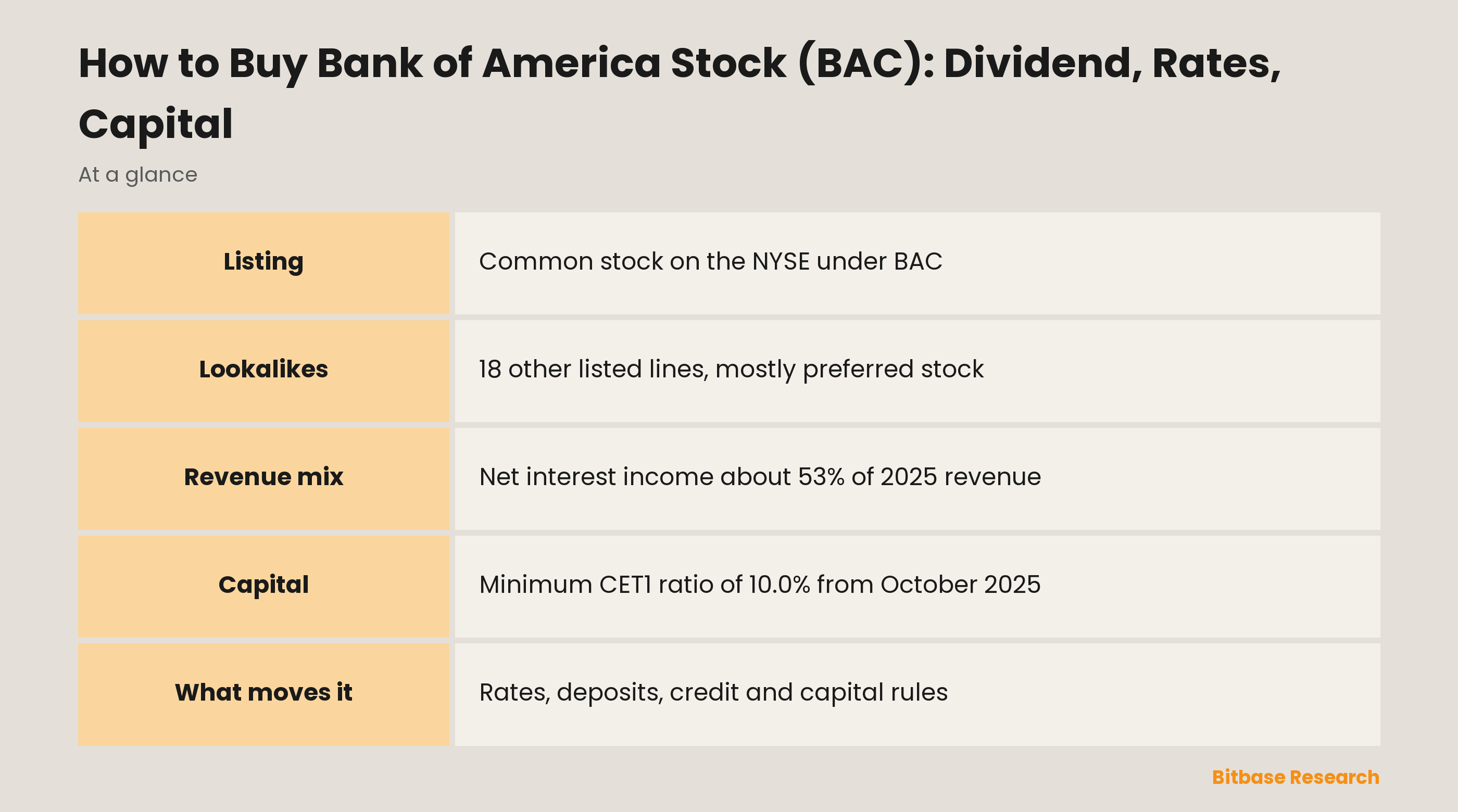
Your order for Bank of America stock can go through any broker that reaches the New York Stock Exchange, where the common shares trade as BAC, and the first thing to check is that it lands on that line: 18 other securities registered by the company, mostly preferred stock, list on the same exchange under symbols that start the same way. Behind the common stock sits a bank holding company that earned about 53% of its 2025 revenue as net interest income and that needs room under the Federal Reserve's capital rules before it pays dividends or buys back shares. This guide covers the four businesses, the order itself, and what the annual report says moves the stock.
What Does Bank of America Do?
Bank of America Corporation is a bank holding company and a financial holding company, incorporated in Delaware and run from Charlotte, North Carolina. It takes deposits, lends to households and companies, manages wealth, underwrites and advises on deals, and makes markets for institutional investors. Most of the banking sits under one national bank charter, Bank of America, National Association, and the 2025 annual report describes operations across the US, its territories and more than 35 countries and jurisdictions.
The company in its present form dates from 30 September 1998, when BankAmerica Corporation, then headquartered in San Francisco, merged into NationsBank Corporation; NationsBank was the surviving company and the combined group took the BankAmerica name. Two acquisitions completed in 2008 and 2009 still show in the structure: Countrywide Financial on 1 July 2008 and Merrill Lynch on 1 January 2009, whose name lives on in the wealth business.
Results are reported through four segments, with the remainder recorded in All Other.
Consumer Banking serves individuals and small businesses: checking and savings accounts, CDs and IRAs, credit and debit cards, residential mortgages, home equity loans and other loans, through financial centers in 38 states and the District of Columbia. The 2025 report counts about 69 million consumer and small business clients.
Global Wealth & Investment Management (GWIM) combines Merrill Wealth Management, which works through a network of financial advisors, and Bank of America Private Bank, which serves high-net-worth and ultra-high-net-worth clients.
Global Banking lends to companies, from mid-sized US businesses to large global corporations, runs their payments and cash management, and houses the investment bank that underwrites debt and equity and advises on mergers.
Global Markets sells, trades and researches fixed income, credit, currencies, commodities and equities for institutional clients, and provides financing, clearing, settlement and custody around those trades.
All Other is mostly asset and liability management for the whole balance sheet, plus liquidating businesses and some costs not charged to a segment. Fees from certain underwriting and advisory work are split between Global Banking and Global Markets under an internal revenue-sharing arrangement, so neither segment's figure covers the whole investment bank.
How Bank of America Makes Money
The revenue comes from two sources of similar size. Net interest income, the gap between interest earned on loans and securities and interest paid on deposits and borrowings, was about 53% of 2025 revenue; fees, commissions and trading income made up the other 47%. Deposits are the base of that model: at the end of 2025 they accounted for about 65% of total liabilities.
The four segments earn in very different mixes:
| Segment | Share of 2025 segment revenue | Net interest income within the segment | Main income besides interest |
|---|---|---|---|
| Consumer Banking | 37.4% | 80.8% | Card income, service charges |
| Global Wealth & Investment Management | 21.3% | 28.9% | Investment and brokerage services |
| Global Banking | 20.6% | 52.3% | Service charges, investment banking fees |
| Global Markets | 20.6% | 23.6% | Market making, investment banking fees |
Shares are of the four segments' combined 2025 revenue on the fully taxable-equivalent basis the 10-K uses for segments; All Other reported negative revenue for the year and is left out.
Consumer Banking is the largest contributor and the one most tied to interest: it gathers deposits and earns a spread on them. Wealth management runs the other way, collecting mostly fees on client assets, and Merrill Wealth Management brought in about 83% of that segment's 2025 revenue. Global Banking sits near the middle, while Global Markets earns chiefly from making markets for clients.
One caution: the net interest income assigned to each business comes out of an internal funds transfer pricing process, so the split between segments is a management allocation, not a market price.
BAC Stock at a Glance
| Fact | BAC |
|---|---|
| Exchange | New York Stock Exchange (NYSE) |
| Ticker | BAC |
| Security | Common stock |
| Other listed securities | 18 more on the NYSE, mostly preferred stock, with symbols such as BAC PrL and BML PrG |
| Sector | Financials: consumer and commercial banking, wealth management, investment banking and trading |
| Index membership | S&P 500; not in the Dow Jones Industrial Average (fund holdings, October 2026) |
| Headquarters | Charlotte, North Carolina |
| Incorporated | Delaware |
| Main supervisor | Federal Reserve, as bank holding company and financial holding company |
| Dividend policy | Cash dividend each quarter, declared by the board; buybacks under a board-authorized program |
| Stock split | Two-for-one, effective 27 August 2004 |
| Fiscal year | Calendar year |
| SEC identifier | CIK 70858 |
Price, market value and dividend yield change through every session; the Bank of America stock page on Bitbase shows them live.
How to Buy Bank of America Stock
Bank of America is a US company listed in New York, so no depositary receipt stands in the way: the NYSE line is the common stock itself. The steps:
1. Find a broker that offers NYSE stocks. Outside the US, that is either a local firm with US market access or an international one; check which legal entity holds your account and which regulator covers it.
2. Complete the account checks. Non-US residents are normally asked for IRS Form W-8BEN, the certificate of foreign status that lets the broker withhold at a lower treaty rate where one applies.
3. Fund it. Converting from another currency costs money as well, so compare the exchange rate the broker applies, not only its commission.
4. Pick the common stock, not a preferred. Search for BAC and confirm the result reads Bank of America Corporation common stock. The other listed lines are preferred stock, trust preferred securities and notes, and their symbols are written differently from one system to the next: the 10-K cover shows BAC PrL, while the SEC's own ticker records list the same security as BAC-PL.
5. Choose an order type. A market order fills at the price available, and Investor.gov notes that it "does not guarantee the execution price"; a buy limit order "can only be executed at the limit price or lower."
6. Size the position. Fractional shares let you invest a set cash amount, but "not every brokerage firm offers fractional share investing," some firms accept only market orders for them, and you "may not have voting rights" on a fraction.
7. Keep the records. Trade confirmations and statements document your cost basis and the dividends you receive.
Outside the United States, dividends from a US company are taxed at source. The IRS applies a default rate of 30% to most US-source income paid to foreign persons, and a tax treaty can reduce it; your country of residence may tax the dividend again.
Through funds, you can hold BAC without choosing it. In State Street's holdings files dated 16 October 2026, Bank of America appears in both SPY, which tracks the S&P 500, and XLF, the Financial Select Sector fund, as one holding among many.
What Moves BAC Stock
Interest rates, short ones above all. The 10-K estimates how banking-book net interest income would change over the next 12 months if rates jumped instantly and management did nothing. At the end of 2025, a parallel rise of 100 basis points added an amount equal to about 1.2% of the year's net interest income, while a parallel fall of the same size took away about 3.3%. The company's own summary: "We continue to be asset sensitive to a parallel move in interest rates, with the majority of that impact coming from the short end of the yield curve." Higher rates cut the other way on capital, because they lower the value of debt securities held as available for sale. For the quarter-to-quarter levers inside that income line, see this profile of BAC's revenue drivers.
Where savers keep their cash. Deposit spreads in Consumer Banking widened to 2.92% in 2025 from 2.77% the year before. Among its liquidity risks, the 10-K lists clients "moving balances into digital assets (e.g., stablecoin) or other alternative non-bank financial platforms." Because deposits fund most of the balance sheet, a shift in where people hold money reaches both revenue and funding.
Credit quality. Net charge-offs fell to 0.50% of average loans in 2025 from 0.57%, a drop the company attributed mainly to lower losses on commercial real estate offices, and Consumer Banking's provision fell on better credit card quality. A recession would push both the other way, and provisions come out of earnings before anything reaches shareholders.
Capital rules. For a bank, capital decides how much can be returned. After the 2025 stress test, Bank of America's minimum common equity tier 1 (CET1) ratio became 10.0% from 1 October 2025, built from a 4.5% floor, a 3.0% surcharge for a global systemically important bank and a 2.5% stress capital buffer. Its CET1 ratio was 11.4% at the end of 2025. The buffer stays at 2.5% through 30 September 2027, but under the current framework the surcharge rises to 3.5% on 1 January 2027, lifting the minimum; the June 2026 quarterly report repeated both points. The 10-K is direct about the consequence: if the Federal Reserve raises those buffers, "our returns of capital to shareholders, including dividends and common stock repurchases, could decrease."
Financial markets. Asset management fees in GWIM rose 12% in 2025 on higher market valuations and client inflows, and Global Markets revenue grew on sales and trading. A long slide in stock prices would show up in fees as well as in trading.
Risks to Weigh Before Buying BAC
Of the many headings in Item 1A of the 10-K, these bear most directly on a holder of the common stock.
The parent depends on its banks. "Bank of America Corporation is a holding company, is dependent on its subsidiaries for liquidity and may be restricted from transferring funds from subsidiaries." The company's cash distributions to shareholders come mainly from dividends its banking subsidiaries pay up to it, and regulators can limit those.
Shareholders come last in a failure. Federal bank regulation, the 10-K notes, "is intended primarily for the protection of depositors and the Deposit Insurance Fund (DIF) rather than for the protection of shareholders and creditors." In a resolution, it warns, "security holders of Bank of America Corporation could face significant or complete losses."
Credit losses. "Economic or market disruptions and insufficient credit loss reserves may result in a higher provision for credit losses."
Funding. Sustained net deposit outflows appear among the company's liquidity risks, and episodes of banking stress show how fast confidence in a lender can move.
Capital requirements. "U.S. federal banking agencies may require increased capital and liquidity levels, which could adversely impact the Corporation."
Litigation and regulation. The company warns of "significant financial and reputational harm from potential liability arising from lawsuits and regulatory and government action," and names matters such as fraud against clients using electronic payments, including Zelle.
Competition. Beyond other banks, the 10-K lists firms "utilizing emerging technologies, such as digital assets."
Two more apply to any bank stock. Results follow the economic cycle, so a strong year says little about the next downturn. And a common dividend is declared one quarter at a time: the board decides each payment, and preferred holders are paid first.
How to Research BAC Yourself
Its filings sit on EDGAR under CIK 70858: the annual 10-K, a 10-Q for each of the first three quarters, and 8-Ks for events in between. Each quarter's results are furnished on Form 8-K with the press release attached, most recently on 14 October 2026 for the third quarter.
Inside the 10-K, four places answer most questions about the stock: Item 1A for risks, the business segment note for revenue by segment, the section titled "Interest Rate Risk Management for the Banking Book" for the rate-shock table used above, and "Capital Management" for the CET1 requirement, the stress capital buffer and the buyback authorization. The structured cover page, R1.htm, lists all 19 NYSE securities with their symbols, the quickest way to tell the common stock from the preferreds.
The investor relations site, investor.bankofamerica.com, carries the same filings, and the company says it uses that site to disclose material information. The Federal Reserve released its 2026 stress test results on 24 June 2026; those results feed into the stress capital buffer. For quotes on this name and other US stocks on Bitbase, use the stock pages.
Bank of America Stock FAQ
Does Bank of America pay a dividend?
Yes, a quarterly cash dividend on the common stock, declared by the board each time. The board raised it in July 2026, according to an 8-K filed that month. Payouts depend on the bank staying above its capital minimums, and every series of preferred stock is paid before common shareholders.
Can I buy Bank of America stock with crypto?
Not directly. BAC is bought through a brokerage account, and NYSE trades settle in dollars, so any crypto has to be converted to cash and sent to the broker first; that sale may itself be taxable where you live. Treat it as two separate decisions, since a share and a coin carry different rights and risks, as this guide to how a share differs from a coin sets out.
Is BAC in the S&P 500 or the Dow?
It is in the S&P 500 but not in the Dow Jones Industrial Average. State Street's holdings files dated 16 October 2026 list Bank of America in its S&P 500 trust (SPY) and its financial sector fund (XLF), and not in its Dow trust (DIA).
What is the difference between BAC common stock and BAC preferred shares?
They are different claims on the same company. The preferred stock ranks ahead of the common for dividends and in a liquidation, and most series carry no general voting rights; series B and series 1 to 5 are the exceptions. Most listed preferreds trade as depositary shares, each a fraction of one preferred share, and each share of the 7.25% series L can be converted by its holder into 20 common shares. When this guide says BAC, it means the common stock.
Has Bank of America stock ever split?
Yes. A two-for-one split, paid as a stock dividend, took effect on 27 August 2004, according to the company's 2004 annual report. Per-share figures from before that date need adjusting before any comparison.
Conclusion
Placing the order is the easy part: a broker with NYSE access, the line marked as Bank of America common stock, and a market or limit order. Owning it means owning a balance sheet whose income leans on interest rates and whose payouts wait on capital rules, with fee businesses alongside that follow financial markets. The 10-K puts numbers on both, from the rate-shock table to the 2027 surcharge increase; read it, and the latest 8-K, before deciding how much of a portfolio one bank should hold.
Related reading
Other Bitbase articles on this topic:
- How to Buy Barclays Stock (BCS): ADS Ratio and the Ring-Fence
- How to Buy BBVA Stock (BBVA): Spanish ADS, Mexican Profits
- How to Buy BMO Stock (BMO): Canada's First Chartered Bank
- How to Buy Mizuho Stock (MFG): Five ADSs Equal One Share
Disclaimer: This article is educational content from Bitbase Academy, provided for information only. It explains what a company or fund does and how the instruments referenced here differ from one another; it does not constitute investment, trading, tax, or financial advice, and it is neither a recommendation nor an endorsement of any security, token, or trading strategy. A tokenized stock is issued by a third party and is designed to give economic exposure to an underlying asset: it is not a share, it carries no shareholder rights, and it depends on the issuer's structure, eligibility rules, and redemption terms, which the issuer can change. Perpetual futures are leveraged derivatives that hold no underlying asset and can be liquidated, and trading hours, product availability, and eligibility differ by instrument and by jurisdiction and can change at any time. Written as of October 2026; verify everything yourself through company filings, the issuer's own documentation, and the product pages of the venue you trade on.
References
[1] Bank of America Form 10-K, fiscal 2025: business, segments, interest rate risk, capital and risk factors (SEC EDGAR) www.sec.gov
[2] Bank of America 10-K for 2025, structured cover page (R1): registered securities and trading symbols www.sec.gov
[3] Bank of America Form 10-Q for the quarter ended 30 June 2026: stress capital buffer and G-SIB surcharge (SEC EDGAR) www.sec.gov
[4] Bank of America Form 8-K, 24 July 2026: quarterly common stock dividend increase (SEC EDGAR) www.sec.gov
[5] Bank of America third-quarter 2026 results, 14 October 2026 (Form 8-K, Exhibit 99.1) www.sec.gov
[6] BankAmerica Corporation Form 10-K for 1998: the 30 September 1998 merger of BankAmerica into NationsBank (SEC EDGAR) www.sec.gov
[7] Bank of America Form 10-K for 2004: two-for-one stock split effective 27 August 2004 (SEC EDGAR) www.sec.gov
[8] Bank of America Form 10-K for 2008: Countrywide and Merrill Lynch acquisitions (SEC EDGAR) www.sec.gov
[9] SEC company tickers and exchanges file: symbols on record for Bank of America (CIK 70858) www.sec.gov
[10] State Street SPDR S&P 500 ETF Trust (SPY): daily holdings, as of 16 October 2026 www.ssga.com
[11] State Street Financial Select Sector SPDR ETF (XLF): daily holdings, as of 16 October 2026 www.ssga.com
[12] State Street SPDR Dow Jones Industrial Average ETF Trust (DIA): daily holdings, as of 16 October 2026 www.ssga.com
[13] Investor.gov (SEC): Types of Orders www.investor.gov
[14] Investor.gov (SEC) investor bulletin: Fractional Share Investing www.investor.gov
[15] IRS: NRA Withholding (tax withheld on US-source income of foreign persons) www.irs.gov





