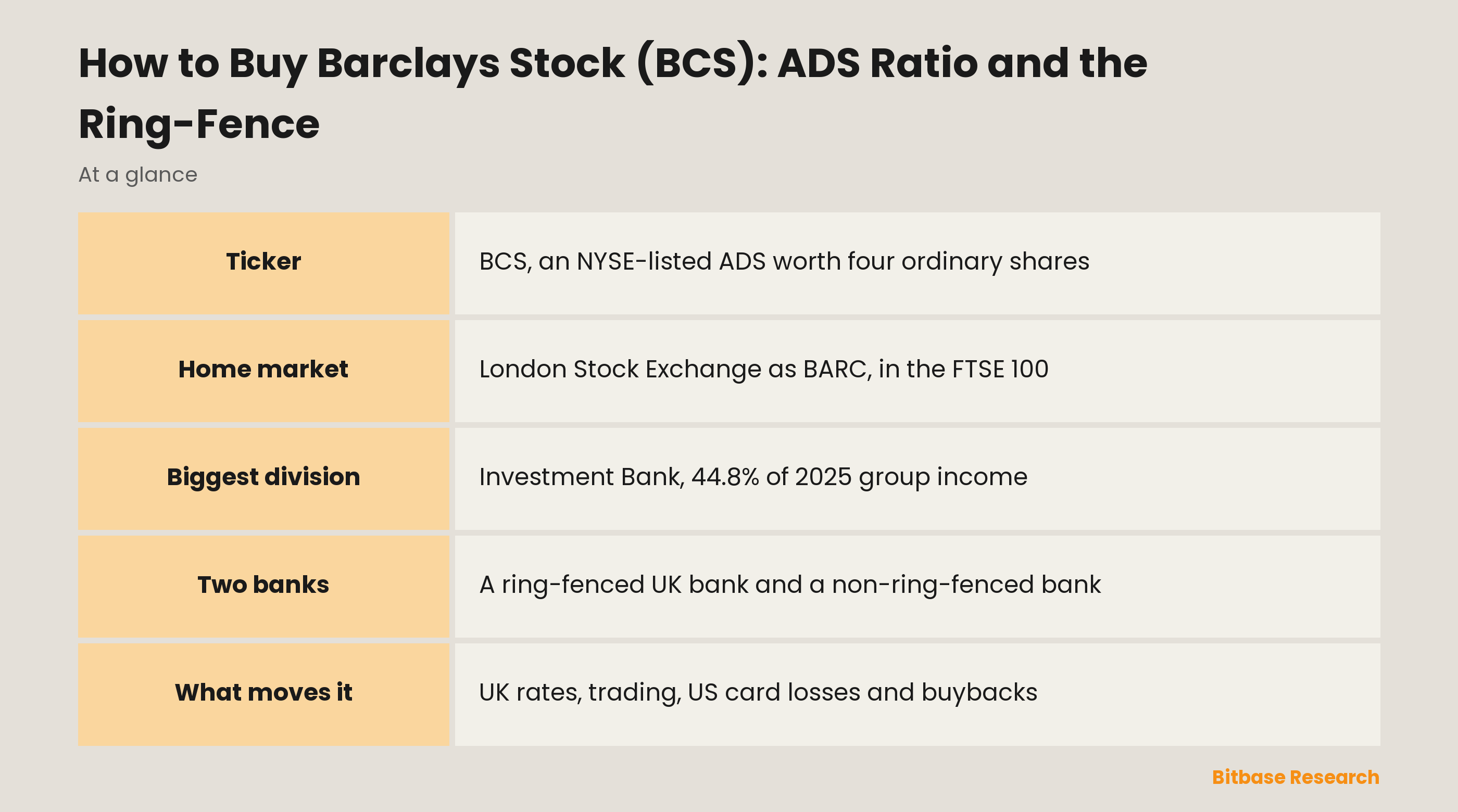
Reading what the ticker stands for does most of the work: in the US, Barclays trades on the New York Stock Exchange as BCS, an American depositary share (ADS) equal to four ordinary shares of Barclays PLC, and any broker that offers US-listed shares can place the trade. Behind that one ticker sit two banks, because UK law keeps Barclays' ring-fenced retail bank apart from the rest of the group, including the Investment Bank that produced 44.8% of 2025 income. This guide covers how Barclays earns its money, how BCS differs from the shares traded in London and what its annual report on Form 20-F flags as the main risks.
What Does Barclays Do?
Barclays PLC is the holding company of what its 20-F calls "a British universal bank diversified by business, geography and income type." C.S. Venkatakrishnan, formerly head of Global Markets and group chief risk officer, has been Group Chief Executive since November 2021. Since a 2024 restructuring the group has reported five operating divisions, plus Head Office:
Barclays UK is the high-street bank: current accounts, savings, mortgages, cards and loans under brands including Barclaycard, Tesco Bank and Kensington Mortgages, plus banking for start-ups and small firms. Barclays UK Corporate Bank provides lending, payments, trade finance and foreign exchange to UK companies outside the FTSE 350. Barclays Private Bank and Wealth Management serves private banking clients in the UK and abroad and runs UK wealth management and digital investing. Barclays Investment Bank combines Global Markets, which trades rates, currencies, credit, securitised products and equities for clients, with advisory, underwriting and International Corporate Banking for FTSE 350 companies, multinationals and financial institutions. Barclays US Consumer Bank is a co-branded credit card issuer for travel, entertainment, retail and affinity partners. Head Office holds central functions, treasury and the Payment Acceptance business.
The ring-fence explains why one listed company owns two banks. The Financial Services (Banking Reform) Act 2013 makes large UK banks place retail and SME deposit-taking in "a legally distinct, operationally separate and economically independent entity." At Barclays that is Barclays Bank UK PLC, which broadly matches the Barclays UK division; Barclays Bank PLC is the non-ring-fenced bank. Both sit under Barclays PLC, the company whose shares you buy, which the Prudential Regulation Authority (PRA) has approved as a financial holding company. Reforms to the regime took effect in February 2025, and the 20-F said a further HM Treasury review was expected to report by early 2026.
The company itself was incorporated on 20 July 1896 as Barclay & Company Limited and took the name Barclays PLC on 1 January 1985. Recent deals have reshaped the edges: Barclays completed its acquisition of Tesco Bank on 1 November 2024, sold its German consumer finance business in February 2025 and, in 2026, left its American Airlines card partnership, bought the US personal loan platform Best Egg and acquired GoHenry, a UK money management platform for children and young people.
How Barclays Makes Money
A bank's top line is income, not sales. Barclays' total income rose 9% in 2025, which the 20-F credits to higher structural hedge income, stronger Global Markets results, Tesco Bank and lending growth. Net interest income, what loans and investments earn above the cost of deposits and wholesale funding, accounted for 49.8%; fees, trading and other income supplied 50.2%.
The split by division shows how much rests on the Investment Bank:
| Division | What it sells | Share of 2025 group income | Change vs 2024 |
|---|---|---|---|
| Barclays Investment Bank | Trading, advisory and underwriting, international corporate banking | 44.8% | +10.6% |
| Barclays UK | Current accounts, mortgages, cards and loans, small-business banking | 29.9% | +5.2% |
| Barclays US Consumer Bank | Co-branded and private-label credit cards, loans, online savings | 12.6% | +10.7% |
| Barclays UK Corporate Bank | Lending, payments, trade finance and foreign exchange for UK companies | 7.1% | +16.0% |
| Barclays Private Bank and Wealth Management | Private banking, wealth management, digital investing | 4.7% | +5.4% |
| Head Office | Treasury, Payment Acceptance, legacy items | 0.9% | −14.3% |
Percentages calculated from the segment note in the 2025 20-F, in sterling.
Profit splits differently. The Investment Bank produced 50.5% of 2025 profit before tax and Barclays UK 37.3%. The US Consumer Bank is the contrast: 12.6% of income but 66.7% of the group's credit impairment charges, leaving it with 5.6% of profit before tax.
Inside the Investment Bank, Global Markets supplied 66.3% of the division's income. The 20-F reports FICC, which Barclays defines as macro (rates and currencies), credit and securitised products, up 16% in 2025 and Equities up 12%. By location, the UK booked 54.3% of group income and the US 32.2%. Management wants the mix to tilt towards the UK: the Investment Bank used 55% of the group's risk-weighted assets (RWAs) in 2025, and the plan published with those results aims for about 50% by 2028.
BCS Stock at a Glance
| Topic | What applies to BCS |
|---|---|
| What BCS is | An American depositary share of Barclays PLC, representing four ordinary shares |
| New York listing | NYSE since 9 September 1986, traded as ADSs |
| Depositary | JPMorgan Chase Bank, N.A. |
| Primary market | London Stock Exchange, symbol BARC |
| ADS share of capital | Roughly 8.63% of Barclays' ordinary shares sat in the ADS programme at the end of 2025 |
| Index membership | FTSE 100 |
| Other NYSE lines | 40 note issues on the 2025 20-F cover, such as BCS28 and BCS45 |
| Incorporation | England and Wales, as a public limited company; head office at 1 Churchill Place, London |
| Accounts | Year to 31 December, prepared under IFRS in sterling |
| Dividend policy | A half-year and a full-year dividend, alongside share buybacks |
| US filings | Annual 20-F and interim 6-Ks under CIK 312069 |
Quotes, market capitalisation and dividend yield move all day, so they are not in the table; for live figures and a chart, open Bitbase's Barclays stock page.
How to Buy Barclays Stock
There are two lines: BCS trades in dollars during New York hours, BARC in pence on the London Stock Exchange. For investors in the US, BCS is the simpler route.
1. Pick the line, then the broker. Any broker offering NYSE stocks can buy BCS; BARC needs access to London.
2. Get through account opening. Each broker sets its own residency rules and checks your identity before you can trade.
3. Add money. Converting another currency into dollars has a price, often hidden in the exchange rate rather than the commission.
4. Confirm the security. Search BCS and check that the listing is described as Barclays PLC American depositary shares. BCS28 or BCS45 are Barclays PLC notes. A search for "Barclays" can also return iPath exchange-traded notes such as VXX, issued by Barclays Bank PLC, listed on Cboe BZX and tied to volatility futures indexes; they are not shares. SEC records also show an over-the-counter symbol for Barclays PLC, BCLYF.
5. Set the order. Market orders take the next price on offer; limit orders name a maximum and can sit unfilled.
6. Decide on size. One BCS carries four London shares, so it costs about four times the BARC price after currency conversion. Fractional ADSs depend on the broker.
ADS or London share. JPMorgan Chase Bank, N.A. holds the shares behind BCS under a deposit agreement dated 11 August 2008, amended several times since. According to the description of the ADSs filed with the 20-F, holders "will not be entitled to vote ordinary shares directly"; the depositary "shall endeavor, insofar as practical," to vote as instructed. Dividends arrive in dollars, after a small capped depositary fee per ADS, and qualifying ADR holders can join a dividend reinvestment plan through Shareowner Services. The 20-F also says no UK stamp duty arises on transferring an ADS if any instrument of transfer is executed and kept outside the UK, while dealings in the ordinary shares generally cost 0.5%.
UK tax on dividends. The 20-F states that "Barclays PLC pays dividends on the Shares without any deduction or withholding" for UK taxes and that dividends paid to US holders "will not be subject to UK withholding tax." Barclays says it does not believe it was a PFIC (passive foreign investment company) in 2024 or 2025, which, with the NYSE listing, can let US individuals treat the dividends as qualified dividend income if other conditions are met. Your own country taxes the income its own way; ask your broker or a tax adviser. This is a summary, not tax advice.
Via an index fund. UK large-cap funds hold Barclays through the London line: the iShares MSCI United Kingdom ETF's holdings file dated 29 October 2026 lists Barclays PLC under BARC.
What Moves BCS Stock
UK rates and the structural hedge. Since roughly half of income is net interest income, the Bank of England's rate path matters directly. Barclays smooths it with a structural hedge: interest rate swaps on stable balances such as non-interest-bearing current accounts and equity, with a small slice maturing and being reinvested at market rates every month. Barclays UK's net interest income rose 15% in 2025, helped by that hedge and Tesco Bank. The risk factors spell out the reverse: if rates fall, maturing hedges "will be replenished at lower rates."
Trading conditions. Global Markets income follows how actively clients trade and hedge. The third-quarter 2026 results showed both directions at once: Equities income was up 47% on a year earlier, while FICC was 19% lower in what Barclays called "a challenging environment."
US card credit. Because the US Consumer Bank carries most of the group's credit losses, US household finances feed straight into impairment charges. Its partner list moves too: in 2025 Barclays launched a co-branded card with General Motors, and in 2026 it exited the American Airlines partnership on 24 April and completed the Best Egg purchase on 1 May.
Capital and buybacks. Barclays' CET1 ratio, common equity tier 1 capital divided by RWAs, decides how much it can return. At 31 December 2025 it stood at 14.3%, against a target range of 13% to 14% and an overall requirement of 12.2%: a 4.5% Pillar 1 minimum, a 2.5% conservation buffer, a 1.5% buffer for global systemically important banks, a 2.7% Pillar 2A add-on and a 1.0% countercyclical buffer. The ratio was 14.2% at 30 September 2026, and Barclays announced a new buyback with each of its four results releases in 2026. From 1 January 2027, Basel 3.1 is expected to raise RWAs while a lower Pillar 2A requirement should cut the threshold for distribution restrictions from 12.2% to 11.6%.
UK motor finance. Clydesdale Financial Services, a Barclays subsidiary, provided car finance in the UK from 2003 to late 2019, which exposes the group to redress for commission paid by lenders to brokers. The FCA published final rules for an industry-wide compensation scheme in the first quarter of 2026; the Upper Tribunal then suspended parts of it after four legal challenges, due to be heard in the first quarter of 2027. Barclays calls the outcome uncertain.
Sterling against the dollar. Barclays reports in pounds, and in 2025 the stronger average pound reduced reported income. A BCS holder has a second layer: the ADS is priced in dollars and dividends are converted from sterling, so the exchange rate moves both the price and the payout.
How a BCS Investment Could Lose Value
The 20-F lists many material and emerging risks. Five matter most to someone holding the shares:
Bail-in. Under the UK Banking Act 2009, authorities can transfer a failing bank's business, write down its capital instruments or cancel and dilute its shares. The Bank of England's preferred approach for Barclays is "a bail-in strategy with a single point of entry at Barclays PLC," the company BCS represents, and the 20-F warns this "could lead to shareholders losing some or all of their investment."
Dependence on subsidiaries. Barclays PLC relies on "distributions (in the form of dividends and interest payments) from operating subsidiaries," and laws, capital rules and regulators can limit what those subsidiaries pass up.
Capital shortfalls. Missing capital requirements could bring "restrictions on distributions," including on its shares, and the ratios are "sensitive to foreign currency movements."
US exposure. "A significant proportion of the Group's portfolio is located in the US, including a major credit card portfolio and a range of corporate and investment banking exposures," and losing or failing to renew card partnerships is listed as a risk of its own.
Conduct and litigation. Ombudsman rulings can require Barclays to consider redress even for customers who never complained, and motor finance is only one of the legal matters in the notes.
Concentration in a single stock is a risk in itself, and sector-wide shocks are another: bank stress episodes tend to drag on all bank shares together. Holding the ADS rather than the share adds three frictions: your vote travels through the depositary, its fee is taken from each dividend, and no dividend is guaranteed until the board declares it.
Tracking Barclays Through Its SEC Reports
Barclays PLC's SEC file number is CIK 312069. Its annual report on Form 20-F last arrived on 10 February 2026, with the full-year results, and other news comes on Form 6-K. In 2026 those included quarterly results on 28 April and 22 October, half-year results on 28 July, buyback notices and directors' share dealings.
In the 20-F, the segment note gives income and profit by division and region, the risk review lists material risks, the treasury and capital risk section covers CET1, and the shareholder information pages cover ADS fees and tax. Legal matters, including motor finance, are in note 25.
Two traps. Barclays Bank PLC is a separate SEC registrant with its own 20-F and note prospectuses, so check that a document names Barclays PLC. And segment figures before 2024 follow the old structure. For another London-based bank on Form 20-F, see how to buy HSBC stock; for other quotes, browse Bitbase's stock pages.
Barclays Stock FAQ
How many Barclays shares does one BCS ADS represent?
Four. Each BCS ADS represents four ordinary shares of Barclays PLC, held by JPMorgan Chase Bank, N.A. as depositary; the ordinary shares trade in London as BARC. At the end of 2025 the ADS programme accounted for about 8.63% of the ordinary shares outstanding. To compare prices, convert the London price into dollars and multiply by four.
Can I buy Barclays stock with crypto?
Not directly. BCS settles in dollars and BARC in sterling, so you would first sell the crypto, then transfer the proceeds to a brokerage account. That sale can be a taxable disposal; the rules depend on where you live, as our overview of crypto taxes by country explains.
Does Barclays pay a dividend?
Yes, twice a year. For 2025, the half-year dividend was paid in September 2025 and the full-year dividend on 31 March 2026. Dividends are declared in pence, and ADS holders get dollars, less the depositary fee. Barclays also buys back and cancels shares, and says its distribution plans remain subject to supervisory and board approval and its 13% to 14% CET1 range.
What is the difference between Barclays PLC, Barclays Bank PLC and Barclays Bank UK PLC?
Barclays PLC is the listed parent; BARC and BCS are its shares. Barclays Bank UK PLC is the ring-fenced bank behind the Barclays UK division. Barclays Bank PLC is the non-ring-fenced bank, which issues notes such as VXX and files its own 20-F. Buying BCS makes you a shareholder of the parent of both, not a holder of either bank's securities.
Is Barclays in the FTSE 100?
Yes. The 20-F benchmarks Barclays' shareholder return against the FTSE 100, an index "of which Barclays is a long-standing constituent." Weights change daily, so check the index provider for the current figure.
Conclusion
For an investor in the US, buying Barclays usually means buying BCS: an NYSE-listed ADS worth four London shares, paid in dollars and free of UK withholding tax on dividends. The bigger decision is the business inside it, a UK-centred bank whose Investment Bank produced 44.8% of 2025 income and whose capital, buybacks and US card losses all feed the share price. Read the latest 20-F and the quarterly 6-Ks before deciding how much one bank should weigh in your portfolio.
Related reading
Other Bitbase articles on this topic:
- How to Buy BBVA Stock (BBVA): Spanish ADS, Mexican Profits
- How to Buy BMO Stock (BMO): Canada's First Chartered Bank
- How to Buy BNY Stock (BNY): Custody Bank Formerly Traded as BK
- How to Buy NatWest Stock (NWG): Two Shares per ADS, No State Stake
Disclaimer: This article is educational content from Bitbase Academy, provided for information only. It explains what a company or fund does and how the instruments referenced here differ from one another; it does not constitute investment, trading, tax, or financial advice, and it is neither a recommendation nor an endorsement of any security, token, or trading strategy. A tokenized stock is issued by a third party and is designed to give economic exposure to an underlying asset: it is not a share, it carries no shareholder rights, and it depends on the issuer's structure, eligibility rules, and redemption terms, which the issuer can change. Perpetual futures are leveraged derivatives that hold no underlying asset and can be liquidated, and trading hours, product availability, and eligibility differ by instrument and by jurisdiction and can change at any time. Written as of October 2026; verify everything yourself through company filings, the issuer's own documentation, and the product pages of the venue you trade on.
References
[1] Barclays PLC, Form 20-F for 2025 (SEC EDGAR) www.sec.gov
[2] Barclays PLC 2025 Form 20-F, XBRL cover page www.sec.gov
[3] Barclays PLC 2025 Form 20-F, XBRL results by business www.sec.gov
[4] Barclays PLC, description of registered securities and ADSs, filed with the 2025 Form 20-F www.sec.gov
[5] Barclays PLC, third-quarter 2026 results, 22 October 2026 (Form 6-K) www.sec.gov
[6] Barclays PLC, new share buy-back, 23 October 2026 (Form 6-K) www.sec.gov
[7] SEC EDGAR company data for Barclays PLC, CIK 312069 data.sec.gov
[8] Barclays Bank PLC, pricing supplement for the iPath VXX and VXZ ETNs, 13 February 2026 www.sec.gov
[9] iShares MSCI United Kingdom ETF, fund page and holdings file (BlackRock) www.ishares.com





