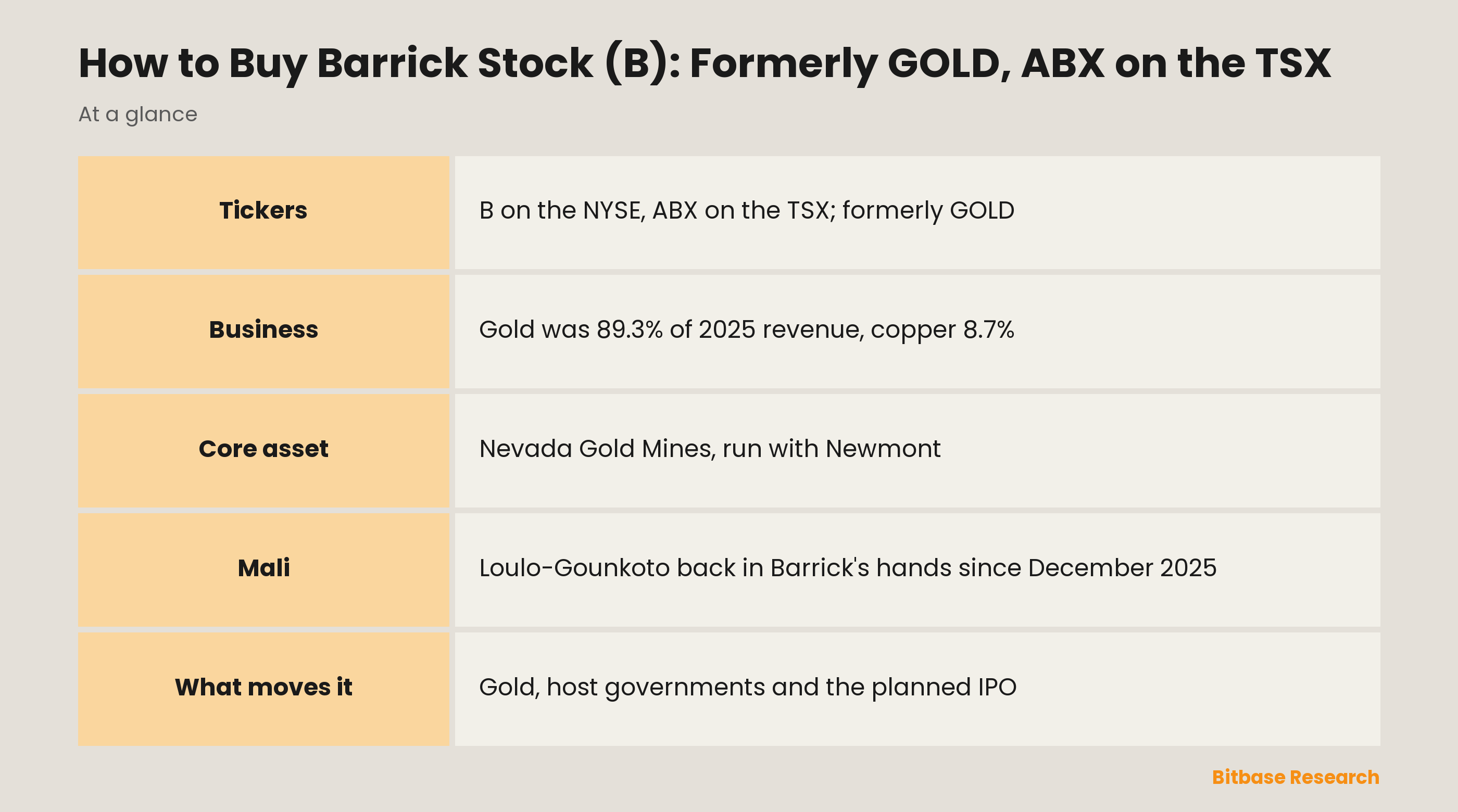
Typing B into the order screen of a broker with New York Stock Exchange access is how you buy Barrick stock: since 9 May 2025 that single letter has been the NYSE ticker for the common shares that used to trade as GOLD, and the Toronto Stock Exchange lists the same class as ABX. The renaming from Barrick Gold to Barrick Mining took effect three days earlier, yet gold still made up 89.3% of 2025 revenue and copper 8.7%. This guide covers the mines behind the shares, the buying steps in either market, and what the filings flag: Mali, the Nevada partnership with Newmont and a planned listing of the North American gold assets.
What Does Barrick Do?
Barrick Mining Corporation finds, develops and operates gold and copper mines; its annual information form (AIF), the business overview Canadian companies publish each year, calls the two metals its "principal products and sources of earnings." The company entered gold mining in 1983, and its name has changed three times since the 1984 amalgamation that formed it: American Barrick Resources in 1985, Barrick Gold in 1995 and Barrick Mining on 6 May 2025. It moved its corporate home from Ontario to British Columbia in November 2018 and runs its principal offices from Toronto and Salt Lake City.
The business is organized into fourteen minesites, nine of them reported separately. Eight are gold mines: Carlin, Cortez and Turquoise Ridge in Nevada, Pueblo Viejo in the Dominican Republic, Loulo-Gounkoto in Mali, Kibali in the Democratic Republic of the Congo, and North Mara and Bulyanhulu in Tanzania. The ninth is Lumwana, a copper mine in Zambia.
Much of the map is shared. Barrick operates Nevada Gold Mines, the joint venture formed on 1 July 2019 when it combined its Nevada properties with Newmont's, and owns 61.5% against Newmont's 38.5%. It also operates Pueblo Viejo, holding 60% to Newmont's 40%. It owns 80% of Loulo-Gounkoto and 84% of the Tanzanian mines, where the government holds a free-carried 16%, and 45% of Kibali, which came with the 2019 merger with Randgold and is shared with AngloGold Ashanti and SOKIMO. Lumwana is wholly owned, while Zaldívar in Chile, Jabal Sayid in Saudi Arabia and the Reko Diq project in Pakistan are held 50%.
In 2025 Barrick sold its half of the Donlin project in Alaska, the Alturas project in Chile, the Hemlo mine in Ontario and its stake in Tongon in Côte d'Ivoire. Mark Bristow, chief executive since the Randgold merger, stepped down on 29 September 2025; Mark Hill, acting in the role since, was named president and CEO on 4 February 2026.
How Barrick Makes Money
Barrick sells metal at market prices. Its gold mines pour doré, unrefined bars "usually consisting of 90% gold" that are refined before sale, and two of them also make gold concentrate; the gold goes to bullion dealers or refiners, while Lumwana produces copper concentrate and cathodes. In 2025 gold sales made up 89.3% of revenue and copper 8.7%, with by-products such as silver accounting for the rest.
Revenue rose 31.2% in 2025, which the AIF attributes "primarily" to a higher realized gold price, "partially offset by a decrease in sales volumes." The volume side is easy to trace: attributable gold production fell 16.8%, and about 84% of that decline came from Loulo-Gounkoto, shut for most of the year. Copper output rose 12.8%, led by Lumwana. Unlike a copper-led producer such as Southern Copper, Barrick still rests mainly on gold, although both the Lumwana expansion and Reko Diq are copper projects.
Revenue by mine, from the segment note of the 2025 financial statements:
| Mine | Country | Barrick's interest | Share of 2025 segment revenue |
|---|---|---|---|
| Carlin | United States (Nevada) | 61.5% | 23.6% |
| Cortez | United States (Nevada) | 61.5% | 15.7% |
| Pueblo Viejo | Dominican Republic | 60% | 13.5% |
| Turquoise Ridge | United States (Nevada) | 61.5% | 11.6% |
| Lumwana (copper) | Zambia | Wholly owned | 8.7% |
| North Mara | Tanzania | 84% | 6.0% |
| Bulyanhulu | Tanzania | 84% | 3.9% |
| Loulo-Gounkoto | Mali | 80% | 3.0% |
| Other mines | Several countries | Various | 14.0% |
The segment total counts the mines Barrick controls at 100%, partners' shares included, and leaves out Kibali, which is accounted for as an equity investment. Shares are rounded.
The three Nevada mines supplied just over half of that total, and by location of the mine the United States accounted for 56.0% of consolidated revenue. Sales look concentrated, with three customers taking about 26%, 12% and 11%, but the statements note that gold trades through a large number of dealers and financial institutions worldwide, so it is not economically dependent on a handful of buyers.
B Stock at a Glance
| Item | Detail |
|---|---|
| Exchanges and tickers | New York Stock Exchange (B) and Toronto Stock Exchange (ABX) |
| Former NYSE ticker | GOLD, until 9 May 2025 |
| Security | Common shares, a single class carrying one vote each |
| Legal name | Barrick Mining Corporation, formerly Barrick Gold Corporation |
| Governing law | Business Corporations Act (British Columbia) |
| Principal offices | Toronto, Ontario and Salt Lake City, Utah |
| Sector | Gold and copper mining; filed under SEC industry code 1040 |
| Index funds | Held by an S&P/TSX 60 fund; absent from an S&P 500 fund (29 October 2026 files) |
| Fiscal year | Calendar year, closing 31 December |
| Reporting | Annual Form 40-F and interim Form 6-K; IFRS figures in US dollars |
| Dividend policy | Fixed quarterly base plus a year-end top-up, targeting 50% of attributable free cash flow |
| SEC identifier | CIK 756894 |
Price, market value and yield change by the minute and are left out here; the Barrick stock page on Bitbase carries the live quote.
How to Buy Barrick Stock
There is no depositary receipt to think about. New York and Toronto trade a single class of common shares, quoted under two tickers, B in US dollars and ABX in Canadian dollars, so the real decision is which market your broker reaches and which currency you want to hold.
1. Pick the market. An account with NYSE access buys B; one with TSX access buys ABX. Confirm which legal entity keeps your account and which regulator supervises it.
2. Complete the account checks. Where you say you are tax-resident shapes how dividends are handled later.
3. Deposit the currency you will trade in. A conversion from a third currency has a spread of its own, sometimes larger than the commission.
4. Check the listing. A one-letter search returns plenty of near matches, so check that the result reads Barrick Mining Corporation common shares on the NYSE, or ABX on the TSX. Older watchlists and research may still show GOLD.
5. Choose the order type. A market order executes at the prevailing price; a limit order executes only at the price you set or a better one.
6. Set the size. Whether you can buy a fraction of a share, and whether that fraction votes, depends on the broker.
7. Keep the confirmations. They record what you paid and any tax withheld from dividends.
Dividend tax. Barrick declares its dividends in US dollars. Its 40-F and the documents filed with it are silent on how much is withheld for shareholders resident outside Canada; your broker can tell you the deduction, whether a treaty reduces it and what paperwork it wants. Your own country may tax the payment again.
Via index funds. On 29 October 2026 Barrick was among the holdings of XIU, BlackRock's iShares fund tracking the S&P/TSX 60; State Street's SPY, which tracks the S&P 500, did not hold it that day.
What Moves Barrick Stock
Gold, partly collared. "Barrick's business is strongly affected by the world market price of gold and copper," the AIF says, and 2025 showed it, with revenue rising on price while volume fell. Not all of that exposure is left to the spot market, though. In the third quarter of 2025 Barrick put on zero-cost collars, pairing purchased puts with sold calls, on a fixed amount of gold maturing each month from September 2025 to August 2028. On that slice a floor limits losses below one price and a ceiling gives up gains above another; the rest of production moves with the market.
Costs that climb with the metal. Royalties rise with the value of what is sold, and the AIF cites "higher royalties from the higher realized gold price" behind several 2025 cost increases in Nevada, along with consumables pushed up partly by tariffs. Metal is sold in US dollars, while part of the costs is paid in local currencies, from Argentine pesos to Zambian kwacha.
Host-government terms. Mali is the clearest case. After a review of mining conventions that began in 2023, gold exports from Loulo-Gounkoto were restricted in November 2024 and four employees were detained; operations stopped on 14 January 2025, and in June a court placed the complex under provisional administration. A settlement announced on 24 November 2025 dropped the charges, freed the employees, renewed the Somilo exploitation permit for 10 years and brought the mines under Mali's 2023 Mining Code, and control returned on 16 December 2025. A court dismissed the criminal case on 25 March 2026, while a tax reconciliation was still in progress in the August 2026 report.
Copper projects. The Lumwana Super Pit Expansion "remains on schedule," the August 2026 report says, with first copper targeted for the end of the first quarter of 2028. Reko Diq has gone the other way: Barrick began a full review on 5 February 2026 as security risks in Balochistan escalated, and on 2 April 2026 decided to slow development and extend that review.
Nevada and the planned IPO. In February 2026 Newmont sent Barrick a notice of default under the Nevada Gold Mines agreement, which Barrick disputed. An agreement reached in August 2026 resolves "all outstanding disputes related to NGM," brings Barrick's Fourmile discovery and Newmont's Mike and Fiberline properties into the joint venture early, and gives Newmont's consent to Barrick's IPO plan: the sale of a minority stake in a new company, North American Barrick, holding the Nevada Gold Mines and Pueblo Viejo interests, Fourmile and other North American properties, with a primary listing in New York and a secondary one in Toronto. Barrick still expected completion by the end of 2026, "subject to market and other conditions and necessary approvals," and intends to keep "a significant controlling interest." Price, stake size and ticker had not been published.
Cash returns. Since the fourth quarter of 2025 the dividend policy targets a payout of 50% of attributable free cash flow a year, through a fixed quarterly base and a year-end top-up, so the total follows cash flow. Buybacks cut the share count by about 3% during 2025, and the board approved a new 12-month program on 8 May 2026.
When Host Countries, Partners or Prices Turn Against Barrick
The AIF lists dozens of risk headings. Five bear most directly on a B share:
Metal prices. If realized gold or copper prices "were to decrease significantly and remain at such a level for any substantial period," profitability and cash flow would suffer, and the collars cover only part of output.
Foreign operations. The country risks begin with "renegotiation, cancellation or forced modification of existing contracts" and "expropriation or nationalization of property." In Mali that list became a shutdown for most of 2025.
Partners. Joint ventures bring the risk of "disagreement with joint venture partners" and an "inability to exert influence over certain strategic decisions"; the AIF used the Newmont dispute, since settled, as its example.
The IPO itself. The filing warns of "diversion of management's time and attention" and of "significant transaction costs, including taxes and dyssynergy costs, which may be incurred even if such strategic transaction fails to close."
Reserves and ground conditions. Reserves "are estimates," they "must be replaced to maintain production levels over the long-term," and older operations face "the need to mine deeper pits and more complex deposits."
Two more apply to any holder. A single mining stock concentrates your money in one company, however many countries it works in, and Barrick itself warns that its share price at any moment "may not accurately reflect Barrick's long-term value." Dividends also depend on the board and, outside the US dollar, on an exchange rate.
Reading Barrick's 40-F and 6-K Reports
Barrick's SEC filings sit under CIK 756894. The multi-jurisdictional disclosure system lets a Canadian company meet its US annual-report duty with a Form 40-F instead of a 10-K, and Barrick's 40-F packages the AIF, the audited financial statements and the yearly MD&A; quarterly results and documents such as the August 2026 Nevada agreement arrive on Form 6-K, and the same filings sit on SEDAR+, Canada's filing system.
The AIF covers mines, ownership, legal proceedings, including Mali, and risk factors; the revenue and segment notes split revenue by metal, mine and country; the MD&A explains changes in prices, costs and output. Two checks save confusion. EDGAR keeps every filing under one CIK, with Barrick Gold Corp listed as the former name. And reserves follow Canada's NI 43-101 standard, which the AIF says "may not be directly comparable" to disclosures by US domestic issuers. Quotes for other listed companies are on Bitbase's stock pages.
Barrick Stock FAQ
Why did Barrick's ticker change from GOLD to B?
It came with the new name. Shareholders approved Barrick Mining Corporation on 6 May 2025, and on 9 May the NYSE ticker became B, which the MD&A says better reflects "our mission to achieve sustainable and profitable gold and copper growth." The Toronto ticker, ABX, stayed the same. On an exchange, a symbol is reserved for one listed security, which is how stock symbols differ from crypto tickers.
Can I buy Barrick stock with crypto?
Not directly. B and ABX shares are bought through a brokerage account and paid for in US or Canadian dollars, so you would first sell the crypto, move the proceeds to the broker and then place the order; depending on where you live, that sale may be taxable. Keep the two choices apart: a common share gives a vote and a claim on declared dividends, part of how shares and crypto assets differ.
Are B and ABX the same shares?
Yes, one class with two tickers. A Toronto quote is in Canadian dollars and a New York quote in US dollars, so convert both at the same moment before comparing them.
Does Barrick pay a dividend?
Yes, quarterly. The policy pairs a fixed base dividend each quarter with a performance top-up at year-end, aiming for 50% of attributable free cash flow over the year; the AIF says a year's payout "may be higher or lower" than that target. The board declares each dividend, in US dollars, at its discretion; amounts and dates are in the quarterly 6-K releases.
Is Barrick still mining in Mali?
Yes. Operational control of Loulo-Gounkoto returned on 16 December 2025 under the November settlement, and the complex resumed producing gold. The 10-year permit renewal was granted on 13 February 2026 under Mali's 2023 Mining Code.
Conclusion
Buying Barrick is a routine order once you know the letters: B in New York, ABX in Toronto, and GOLD only in older records. What the share holds is a gold miner with a growing copper side, and 2025 showed how much depends on governments and partners as well as on metal prices. Before deciding what weight a single miner should carry in your portfolio, read the newest 40-F and quarterly 6-K reports, the legal proceedings and segment note first.
Related reading
Other Bitbase articles on this topic:
- How to Buy Agnico Eagle Stock (AEM): Unhedged Gold, NYSE and TSX
- How to Buy Air Products Stock (APD): Hydrogen Exits and NEOM
- How to Buy CRH Stock (CRH): Aggregates, Arcosa and the NYSE Move
- How to Buy Nucor Stock (NUE): Scrap Steel, Tariffs and Dividends
Disclaimer: This article is educational content from Bitbase Academy, provided for information only. It explains what a company or fund does and how the instruments referenced here differ from one another; it does not constitute investment, trading, tax, or financial advice, and it is neither a recommendation nor an endorsement of any security, token, or trading strategy. A tokenized stock is issued by a third party and is designed to give economic exposure to an underlying asset: it is not a share, it carries no shareholder rights, and it depends on the issuer's structure, eligibility rules, and redemption terms, which the issuer can change. Perpetual futures are leveraged derivatives that hold no underlying asset and can be liquidated, and trading hours, product availability, and eligibility differ by instrument and by jurisdiction and can change at any time. Written as of October 2026; verify everything yourself through company filings, the issuer's own documentation, and the product pages of the venue you trade on.
References
[1] Barrick Mining Corporation Form 40-F, fiscal 2025: cover page and registered securities (SEC EDGAR) www.sec.gov
[2] Barrick Mining Corporation, fiscal 2025 Form 40-F XBRL cover page, R1.htm (SEC EDGAR) www.sec.gov
[3] Barrick Mining Corporation 2025 annual information form: history, mines, Mali, dividends and risk factors (SEC EDGAR) www.sec.gov
[4] Barrick Mining Corporation 2025 audited financial statements: revenue by metal, mine, country and customer (SEC EDGAR) www.sec.gov
[5] Barrick Mining Corporation 2025 annual MD&A: name and ticker change (SEC EDGAR) www.sec.gov
[6] Barrick Mining Corporation second-quarter 2026 results: Newmont agreement, IPO, Lumwana and dividend (Form 6-K, SEC EDGAR) www.sec.gov
[7] Barrick Mining Corporation second-quarter 2026 MD&A and financial statements: Reko Diq, Mali and buyback (Form 6-K, SEC EDGAR) www.sec.gov
[8] BlackRock Canada, iShares S&P/TSX 60 Index ETF (XIU): holdings as of 29 October 2026 www.blackrock.com
[9] State Street, SPDR S&P 500 ETF Trust (SPY): daily holdings as of 29 October 2026 www.ssga.com





