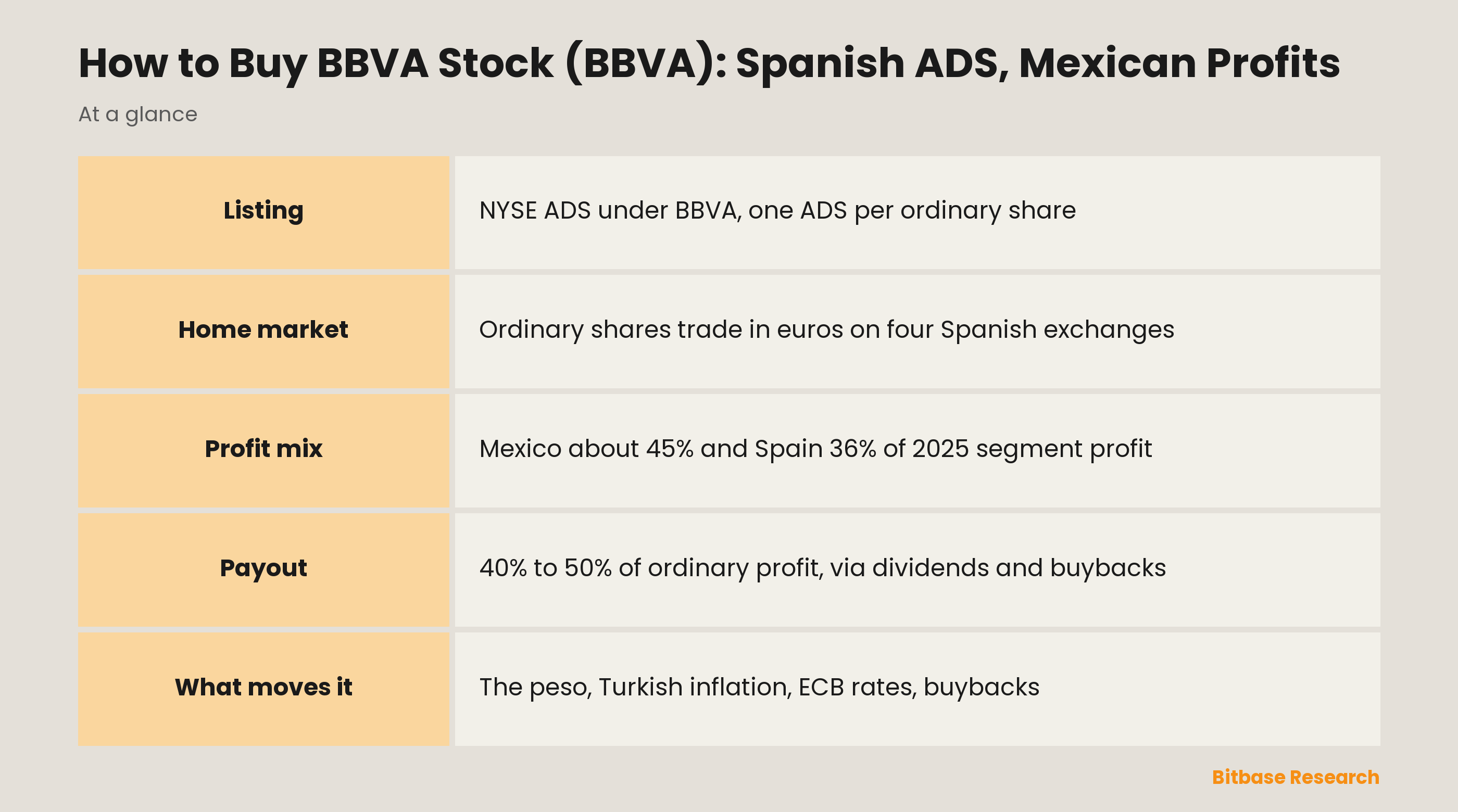
One American depositary share of BBVA, listed on the New York Stock Exchange under the symbol BBVA, carries the right to one ordinary share of the Spanish bank, so any broker with NYSE access can buy it in dollars; the same shares trade in euros in Madrid. The profits come from further afield than the name suggests: in 2025 Mexico supplied about 45% of the profit of BBVA's operating segments and Spain 36%. This guide covers how the group earns, which line to buy, how Spanish tax reaches the dividend and what the failed bid for Banco Sabadell left behind.
What Does BBVA Do?
BBVA, short for Banco Bilbao Vizcaya Argentaria, S.A., describes itself as a global financial services group founded in 1857, strong in retail banking, asset management and wholesale banking. Its present form dates from 1999, when shareholders approved merging Argentaria into Banco Bilbao Vizcaya.
It reports five operating segments, drawn by geography rather than product. Spain covers banking, insurance and asset management at home, where the 20-F names CaixaBank and Banco Santander as its main competitors. Mexico is the wholly owned BBVA Mexico, whose share of all credit balances in the Mexican banking system rose from 25.4% to 25.6% between December 2024 and October 2025. Turkey reports the Garanti BBVA group, 85.97% owned, with smaller operations in Romania and the Netherlands. South America gathers banks in Argentina, Chile, Colombia, Peru, Uruguay and Venezuela. Rest of Business is mainly wholesale banking in Europe outside Spain, the United States and Asia, plus digital banks in Italy and Germany. A loss-making Corporate Center holds head-office costs, currency hedging and goodwill.
How BBVA Makes Money
BBVA is a lender first. In 2025 net interest income, which is what the bank earns on loans and securities minus what it pays for deposits and other funding, accounted for about 71% of gross income, and net fees and commissions for about 22%.
| Operating segment | Share of 2025 gross income | Share of 2025 attributable profit |
|---|---|---|
| Mexico | 40.4% | 45% |
| Spain | 26.7% | 36% |
| South America | 14.3% | 6% |
| Turkey | 13.9% | 7% |
| Rest of Business | 4.8% | 5% |
Percentages are measured against the combined totals of the five operating segments, leaving out the Corporate Center, as reported in the segment note of the 2025 Form 20-F.
Margin explains the tilt. The 20-F puts Mexico's net interest margin over average total assets at 6.74% in 2025, against 1.49% in Spain, so although Spain held 53.1% of group assets at year-end and Mexico 21.2%, Mexico earned more for the parent. South America runs the other way, with a far larger share of income than of profit.
Group gross income rose 4.1% in 2025 and attributable profit 4.5%, which BBVA called the highest in its history, and it proposed a 2025 cash dividend 31% higher than the one for 2024.
BBVA Stock at a Glance
| Item | Detail |
|---|---|
| Issuer | Banco Bilbao Vizcaya Argentaria, S.A., a Spanish company |
| Sector | Banking and financial services |
| US listing | NYSE-listed American depositary shares, ticker BBVA |
| ADS ratio | Each ADS represents the right to receive one ordinary share |
| Home market | Madrid, Barcelona, Bilbao and Valencia exchanges, in euros |
| Other listings | Shares in London and Mexico; the ADSs also trade in Lima |
| Share class | One class, with equal voting and dividend rights |
| ISIN | ES0113211835 (ordinary shares) |
| ADS depositary | The Bank of New York Mellon |
| Indexes | IBEX 35; added to the STOXX Europe 50 on 19 September 2025 |
| Head office | Registered in Bilbao, run from Madrid |
| Reporting | IFRS, in euros, for years ending 31 December |
| Payout policy | 40% to 50% of consolidated ordinary profit a year, cash plus buybacks |
| SEC filer | CIK 842180; Form 20-F and Form 6-K |
For the live ADS quote and chart, open the BBVA stock page on Bitbase.
How to Buy BBVA Stock
Two routes reach the same share: buy the ADS on the NYSE and pay in dollars, or buy the ordinary share on Spain's electronic market, the Mercado Continuo, and pay in euros.
1. Pick the market. Any NYSE broker can buy the ADS; for the euro line you need one with access to the Spanish exchanges.
2. Complete the account checks. The tax residence you declare sets how much Spanish tax is withheld from each dividend.
3. Fund it. Compare the currency conversion cost as well as the commission.
4. Find the right symbol. The NYSE line should name Banco Bilbao Vizcaya Argentaria, S.A. BBVA28 or BBVAP1 are the bank's NYSE-listed notes and preferred securities, BBAR is its Argentine subsidiary, and the SEC's ticker list also shows an over-the-counter symbol, BBVXF, under the same company.
5. Choose an order type. A limit order will not fill above the price you set, while a market order takes the best price on offer.
6. Size the trade. Because one ADS stands for one share, the dollar and euro quotes should line up once converted; whether fractions of an ADS are available is up to your broker.
ADS or Spanish shares. The Bank of New York Mellon issues the ADSs under a deposit agreement dated 29 June 2007. Record holders can instruct it how to vote, and it will try, "insofar as practicable," to vote as instructed. It converts euro dividends into dollars when it can do so on a reasonable basis. Its fee table lists no charge for distributing cash dividends, but conversion expenses come out of the euro amount, and issuing or cancelling ADSs carries a fee.
Spanish taxes. Spain withholds 19% from dividends paid to non-residents, on shares and ADSs alike. US residents can cut that to the treaty rate of 15% if an IRS certificate of residence reaches the paying agent depositary before the tenth day after the end of the month the dividend is payable; if it arrives late, the extra tax can be reclaimed from the Spanish tax authorities. Buying BBVA shares also incurs Spain's 0.2% financial transaction tax unless an exemption applies, so ask your broker how it treats ADS trades.
Through a fund. BBVA is a constituent of the IBEX 35, Spain's index of its 35 most liquid stocks, so index funds that track it own BBVA shares.
What Moves BBVA Stock
The peso. With Mexico the largest profit pool, the exchange rate matters. In 2025 Mexico's net interest income fell 1.1% in euros but rose 8.1% at constant exchange rates, because the peso weakened against the euro. BBVA aims to hedge, on average, 40% to 50% of the profit it expects in non-euro currencies over the next twelve months.
Turkish inflation. Turkey has been treated as hyperinflationary under IAS 29 since 2022. The 20-F reports Turkish inflation of 30.9% for 2025 and a 27.2% fall in the lira against the euro; the segment's net interest income still more than doubled, on lira loan growth as the central bank eased loan reserve requirements and on wider customer spreads.
ECB rates. In Spain, where consumer and household loans mostly carry variable rates, ECB cuts since the second half of 2024 weighed on lending income, yet net interest income there grew 3.2% in 2025 on the securities portfolios and cheaper wholesale funding.
Spain's bank tax. A law passed in December 2024 taxes the net interest income and commissions banks earn in Spain, BBVA included, at rates from 1% to 7%, for the first three tax periods starting on or after 1 January 2024.
Capital returned. The CET1 ratio, the core measure of a bank's capital, was 12.70% at the end of 2025, above the 11.5% to 12.0% range BBVA targets. The excess has been flowing back through buybacks that cancel shares: after the Sabadell bid lapsed, BBVA said it was accelerating distributions, then approved a framework programme in December 2025 and announced another on 30 July 2026.
What Could Go Wrong for BBVA Shareholders
Three countries carry the balance sheet. "Political, economic and social conditions in any of Spain, Mexico and Turkey may have a material adverse effect on our business," the 20-F warns; together they held about 85% of group assets at the end of 2025.
Emerging markets. The group "faces risks derived from its international geographic diversification and its significant presence in emerging countries."
Interest rates. "The Group's business is particularly vulnerable to interest rates," because results depend heavily on net interest income.
A criminal case in Spain. Courts are investigating services the firm Cenyt provided to BBVA. In June 2024 a judge allowed abbreviated criminal proceedings to continue against the bank, some current and former employees and some former directors and officers over alleged bribery and revelation of secrets. BBVA says it cannot predict the outcome, including any fines.
Deals that do not close. The group "may not complete any ongoing or future transactions in a timely manner, on a cost-effective basis or at all," a risk the Sabadell bid made concrete.
The ADS layer. Votes pass through the depositary, and if exchange rates move while it cannot convert euros, ADS holders "may lose some or all of the value of the distribution."
Beyond these, one bank's shares tie your outcome to one balance sheet, and no dividend is owed until the board declares it.
How to Research BBVA Yourself
On EDGAR, BBVA files under CIK 842180: an annual Form 20-F, the latest dated 20 February 2026, and frequent Form 6-K reports on quarterly results, weekly buyback progress and dividends. Many 6-Ks are English translations of notices BBVA files with the CNMV, Spain's market regulator.
Two habits help. BBVA explains most changes both in euros and at constant exchange rates, and for Mexico or South America the two can point in opposite directions. And because the Corporate Center runs at a loss, segment shares differ depending on the denominator; this guide uses the segments' subtotal. Quotes for other listed companies are in the Bitbase stock list.
BBVA Stock FAQ
Is one BBVA ADS the same as one BBVA share in Madrid?
Economically, yes. Each ADS represents the right to receive one ordinary share held through The Bank of New York Mellon, and ADS holders receive dividends as if they held the shares, in dollars after conversion and withholding. The ADS simply trades in dollars and votes through the depositary.
Does BBVA pay a dividend?
Yes. The policy pays out 40% to 50% of consolidated ordinary profit each year through an interim dividend expected in October and a final one expected in April, alongside buybacks. For 2025 the interim was paid on 7 November 2025 and the final on 10 April 2026; the interim against 2026 results was paid on 15 October 2026.
Can I buy BBVA stock with crypto?
Not directly. Both the ADS and the Madrid shares are bought through a broker in dollars or euros, which means converting crypto to cash first, and that sale can itself be a taxable event.
What happened to BBVA's offer for Banco Sabadell?
It failed. The bid for all of Banco Sabadell's share capital, announced on 9 May 2024, ceased to have effect on 16 October 2025, when Spain's securities regulator published the outcome: holders of 25.5% of the voting rights had accepted, short of BBVA's minimum acceptance condition. BBVA then restarted a pending buyback and paid its interim dividend.
Is BBVA the same company as BBVA Argentina or BBVA Mexico?
No, though both belong to the group. Banco BBVA Argentina, S.A., 66.55% owned by BBVA, has its own NYSE-listed ADS under BBAR. BBVA Mexico is wholly owned, so it has no outside shareholders. The BBVA ADS buys the parent. For another Spanish bank that reaches the NYSE as one-for-one ADSs, see how to buy Santander stock.
Conclusion
Buying BBVA is the easy part: dollars buy the ADS, euros buy the ordinary share, the two match one for one, and Spain withholds tax on the dividend either way. The harder part is what the share holds: a Spanish name whose largest profit engine is Mexico, with Turkey and South America adding inflation and currency swings, and a capital policy leaning on buybacks since Sabadell fell away. Read the latest 20-F and the 6-Ks since before deciding how much of a portfolio one bank should take up.
Related reading
Other Bitbase articles on this topic:
- How to Buy Barclays Stock (BCS): ADS Ratio and the Ring-Fence
- How to Buy BMO Stock (BMO): Canada's First Chartered Bank
- How to Buy BNY Stock (BNY): Custody Bank Formerly Traded as BK
- How to Buy PNC Stock (PNC): FirstBank, BBVA USA and Rate Risk
Disclaimer: This article is educational content from Bitbase Academy, provided for information only. It explains what a company or fund does and how the instruments referenced here differ from one another; it does not constitute investment, trading, tax, or financial advice, and it is neither a recommendation nor an endorsement of any security, token, or trading strategy. A tokenized stock is issued by a third party and is designed to give economic exposure to an underlying asset: it is not a share, it carries no shareholder rights, and it depends on the issuer's structure, eligibility rules, and redemption terms, which the issuer can change. Perpetual futures are leveraged derivatives that hold no underlying asset and can be liquidated, and trading hours, product availability, and eligibility differ by instrument and by jurisdiction and can change at any time. Written as of October 2026; verify everything yourself through company filings, the issuer's own documentation, and the product pages of the venue you trade on.
References
[1] BBVA, Form 20-F for 2025 (SEC EDGAR) www.sec.gov
[2] BBVA 20-F for 2025, XBRL cover page (R1) www.sec.gov
[3] BBVA 20-F for 2025, XBRL segment data (R121) www.sec.gov
[4] BBVA 20-F for 2025, Exhibit 2.1: description of registered securities www.sec.gov
[5] BBVA, outcome of the Banco Sabadell offer, 16 October 2025 (Form 6-K) www.sec.gov
[6] BBVA, 2025 results press release, 5 February 2026 (Form 6-K) www.sec.gov
[7] BBVA, resolutions of the 2026 annual general meeting, 20 March 2026 (Form 6-K) www.sec.gov
[8] BBVA, first-half 2026 results and new buyback, 30 July 2026 (Form 6-K) www.sec.gov
[9] BBVA, interim dividend against 2026 results, 1 October 2026 (Form 6-K) www.sec.gov
[10] BBVA, weekly buyback report, 26 October 2026 (Form 6-K) www.sec.gov
[11] SEC, company tickers and exchanges list www.sec.gov





