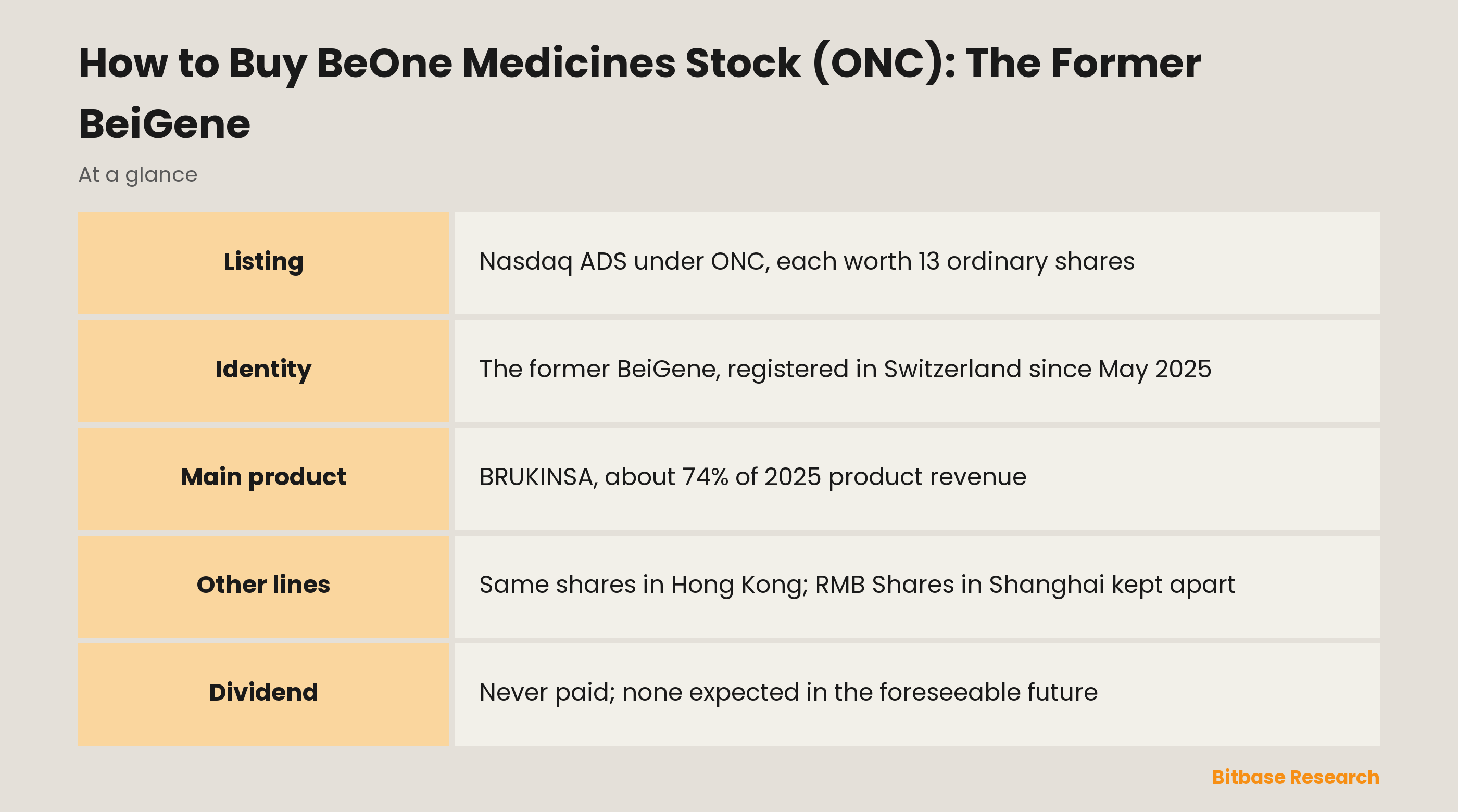
Under its Nasdaq ticker ONC, BeOne Medicines stock trades as American depositary shares (ADSs) on the Nasdaq Global Select Market, and any broker that offers US equities can fill the order; each ADS represents 13 ordinary shares. The company is the former BeiGene, which took its new name and moved its legal home from the Cayman Islands to Switzerland in May 2025, and the same equity is also listed in Hong Kong and, in renminbi form, in Shanghai. One medicine carries the business: BRUKINSA, a blood cancer drug, supplied about 74% of 2025 product revenue.
What Does BeOne Medicines Do?
BeOne describes itself in its annual report as "a leading global oncology company discovering and developing innovative treatments that are more accessible to cancer patients worldwide." It was founded in 2010 and has grown into what the 10-K calls a fully integrated global organization with nearly 12,000 employees. John V. Oyler, a co-founder, is chairman and chief executive.
The best-known product is BRUKINSA (zanubrutinib), a Bruton's tyrosine kinase (BTK) inhibitor for B-cell blood cancers. It first won US approval in November 2019, for mantle cell lymphoma (MCL), and its US label now also covers chronic lymphocytic leukemia (CLL), Waldenström's macroglobulinemia, marginal zone lymphoma and follicular lymphoma. In the ALPINE trial it beat ibrutinib, an older BTK inhibitor, in previously treated CLL. By February 2026 it was approved in 77 markets, and the company says that, although it was the third BTK inhibitor to reach the market, BRUKINSA became the global market leader across B-cell malignancies in 2025.
The second pillar is TEVIMBRA (tislelizumab), an anti-PD-1 antibody of the immunotherapy kind that helps the immune system attack tumors, approved in 51 markets including the US, the EU, China and Japan. A third blood cancer drug joined in 2026: sonrotoclax, a BCL2 inhibitor, was first approved in China in December 2025, and on 13 May 2026 the US Food and Drug Administration (FDA) granted it accelerated approval under the brand BEQALZI for adults with relapsed or refractory MCL after at least two lines of therapy, including a BTK inhibitor. Behind these sits a BTK degrader, tacabrutideg (BGB-16673), whose pivotal Phase 2 trial in relapsed or refractory CLL met its primary endpoint in the third quarter of 2026, and a solid tumor pipeline in breast, gynecologic, lung and gastrointestinal cancers.
BeOne also sells other companies' medicines. Under a collaboration with Amgen that took effect on 2 January 2020, it commercializes Amgen's XGEVA, BLINCYTO and KYPROLIS in mainland China, and an amendment in November 2025 extended those rights for as long as each product is sold there.
The company runs much of its own drug development. Its clinical team of about 3,800 people on six continents lets it run trials "largely without reliance on CROs," that is, contract research organizations. It makes small molecule drugs in Suzhou and biologics in Guangzhou, China, and in July 2024 it opened a US campus for clinical research and biologics manufacturing on a 42-acre site in Hopewell, New Jersey.
How BeOne Medicines Makes Money
Almost all revenue is product sales; the small remainder is "other revenue," mainly royalties under the Amgen collaboration and income from a Novartis agreement to market products in China's broad markets. BeOne reports a single segment, pharmaceutical products. In 2025 total revenue rose 40.2% and product revenue 39.8%. The company's own medicines did most of the work:
| Product | What it is | Share of 2025 product revenue | Growth in 2025 |
|---|---|---|---|
| BRUKINSA | BTK inhibitor for B-cell blood cancers | about 74% | 48.6% |
| TEVIMBRA | Anti-PD-1 immunotherapy | about 14% | 18.8% |
| XGEVA, BLINCYTO and KYPROLIS | Amgen medicines sold in China | about 9% | 36.4%, 40.2% and 13.3% |
| Everything else | Including POBEVCY and other products | about 2% | — |
Shares calculated from the product revenue table in the 2025 10-K.
BRUKINSA's growth came from every major region. US sales rose 45.1%, which the 10-K credits mainly to demand growth across all indications with a modest benefit from net pricing; sales in the EU rose 66.2% and in China 33.3%. Revenue is attributed by customer location, and the split shows how far the company has moved beyond its Chinese base:
| Region | Share of 2025 total revenue |
|---|---|
| United States | about 54% |
| China | about 31% |
| Europe | about 11% |
| Rest of the world | about 3% |
Shares calculated from the geographic revenue note in the 2025 10-K; they do not add to 100 because of rounding.
Margins widened as BRUKINSA's weight grew. Gross margin on product sales reached 87.3% in 2025, up from 84.3% in 2024, which the 10-K attributes to the richer product mix and lower production costs for BRUKINSA and TEVIMBRA. Research and development spending, about two-fifths of revenue, rose 9.9%. The result was a GAAP net profit in 2025 after net losses in 2024 and 2023.
Growth continued in 2026: in the third quarter, total revenue rose 34% from a year earlier, BRUKINSA's US sales 36% and TEVIMBRA's 28%, and the company raised its full-year revenue guidance.
ONC Stock at a Glance
| Item | Detail |
|---|---|
| Issuer | BeOne Medicines Ltd., incorporated in Switzerland (formerly BeiGene, Ltd., Cayman Islands) |
| US listing | ADSs on the Nasdaq Global Select Market, symbol ONC since 2 January 2025 (BGNE from 3 February 2016) |
| ADS ratio | One ADS represents 13 ordinary shares |
| Hong Kong listing | Ordinary shares on the Stock Exchange of Hong Kong, stock code 06160, since 8 August 2018 |
| Shanghai listing | RMB Shares on the STAR Market, stock code 688235, since 15 December 2021; not interchangeable with the other two lines |
| Depositary | Citibank, N.A. |
| Sector | Biotechnology: cancer medicines |
| Principal executive offices | Basel, Switzerland |
| Fiscal year | Calendar year, ending 31 December |
| Dividend policy | Never paid a dividend; none expected in the foreseeable future |
| SEC filings | CIK 1651308; Form 10-K, 10-Q and 8-K |
For a live ONC quote and chart, see the BeOne Medicines stock page on Bitbase.
How to Buy BeOne Medicines Stock
In the United States the ordinary shares are registered only in connection with the ADSs and "are not listed for trading in the United States," so a US broker sells you the ADS. The steps:
1. Choose a broker that offers Nasdaq-listed shares and accepts clients from your country.
2. Open and verify the account. Non-US residents are usually asked for a tax form such as W-8BEN.
3. Deposit funds. If your money is not in dollars, the currency conversion is a cost on top of commission.
4. Search for ONC and confirm that the description reads American depositary shares of BeOne Medicines Ltd.
5. Choose the order type. A market order fills at the prevailing price; a limit order sets the most you will pay and may not fill.
6. Mind the unit. One ADS is 13 ordinary shares, so an ADS price compares with the Hong Kong price per share only after you multiply the Hong Kong price by 13 and convert the currency. Whether you can buy a fraction of an ADS depends on your broker.
ADS or Hong Kong share. Both lines represent the same ordinary shares. The depositary holds the shares behind each ADS and charges fees, including annual service fees, and the 10-K warns that ADS holders may miss a distribution when passing it on is illegal or impractical. ADS holders can generally cancel their ADSs and withdraw the underlying shares, except at certain times, such as when the books are closed. The Shanghai RMB Shares are a separate line: they "are not fungible" with the Hong Kong shares or the ADSs and can never be converted into either.
Tax. BeOne has never declared or paid a dividend. If it ever did, Swiss law would generally withhold 35%, unless the payout came from qualifying capital contribution reserves recognized by the Swiss tax authority; the 10-K said reserves of that kind were available. US holders who qualify under the US-Swiss tax treaty may apply for a partial refund of any withholding. This is general information, not tax advice.
Through a fund. You can also hold BeOne indirectly through a fund that owns ONC ADSs or the Hong Kong shares; check the fund's holdings list rather than assuming.
What Moves ONC Stock
BRUKINSA's lead in the BTK class. With about three-quarters of product revenue from one drug, quarterly BRUKINSA sales are the number investors watch first. The 10-K names AbbVie and Janssen's IMBRUVICA, AstraZeneca's CALQUENCE and Eli Lilly's JAYPIRCA as its main competitors. In the third quarter of 2026 the FDA granted priority review to the Phase 3 MANGROVE filing, which seeks first-line use in MCL alongside rituximab; interim results from that trial were accepted for the plenary session of the American Society of Hematology meeting in 2026.
Sonrotoclax and the CLL combination. BEQALZI was designed, the company says, for greater potency and selectivity than venetoclax, the older BCL2 inhibitor, and the bigger prize is a fixed-duration BRUKINSA-plus-sonrotoclax regimen in first-line CLL. One Phase 3 trial of the combination has completed enrollment, and another, started in the first half of 2026, compares it head to head with acalabrutinib plus venetoclax.
Trial readouts in solid tumors. TEVIMBRA competes with Merck's KEYTRUDA, Bristol Myers Squibb's OPDIVO and other PD-1 and PD-L1 drugs. Its new approvals, and early data on candidates such as the B7-H4 and CEA antibody-drug conjugates, shape how the pipeline beyond blood cancer is valued.
US drug pricing. The United States is now the largest market. The 10-K says pricing reform such as the Inflation Reduction Act is putting "direct and indirect pressure on innovators," and it describes a December 2025 proposal by the Centers for Medicare and Medicaid Services that would tie some Medicare Part B rebates to international benchmark prices.
US-China relations. BeOne's main plants are in China, which also supplied about 31% of 2025 revenue. The 10-K lists tariffs, trade disputes and "actions taken by U.S. or China governmental authorities on companies with significant operations in the U.S. and China, such as us" among the risks, so news on trade policy can move ONC regardless of the company's own results.
What Could Go Wrong for BRUKINSA and BeOne
Of the risk factors in the 10-K, these bear most directly on an ONC holder:
Competition. "We face substantial competition, which may result in others discovering, developing, or commercializing competing medicines before or more successfully than we do."
Patent life. The key US composition of matter patent on zanubrutinib is expected to expire in 2034, and on tislelizumab in 2033, before any patent term extension; later patents on crystal forms, formulations and uses run further. When the core patents lapse, generic or biosimilar rivals can follow.
China. The filing warns that the Chinese government "may intervene or influence our operations at any time" and that rules there "can change quickly with little advance notice." In June 2026 the company also reported that it had concluded a statutory tax audit in China with a settlement that involved additional income tax, though no administrative penalty.
Clinical and regulatory setbacks. Accelerated approvals such as BEQALZI's depend on confirmatory trials, and the 10-K stresses that earlier results "may not be predictive of future trial results."
A profit record that is short. "We have historically incurred significant net losses and may incur net losses in the future." 2025 was profitable, but the 10-K still lists this risk.
Three markets, two legal changes. The company says the trading prices of its ADSs, Hong Kong shares and RMB Shares "can be volatile, which could result in substantial losses to you," and that the three markets differ in trading hours and liquidity. After the move to Switzerland, "your rights as a shareholder changed," and Swiss law limits some areas of capital management, including share buybacks.
Add the general risks of owning one stock: no dividend cushions a fall, and a single drug's results move the whole share price.
Reading BeOne's 10-K Alongside Its Hong Kong and Shanghai Filings
Unlike many foreign companies with US-listed ADSs, which file a Form 20-F, BeOne files the domestic reports with the SEC: under CIK 1651308, a Form 10-K for each year, the latest on 26 February 2026, Form 10-Q for each quarter, most recently on 5 November 2026, and Form 8-K for results announcements, approvals and other events. The proxy statement for the 2026 annual meeting was filed on 28 April 2026. Earnings are reported both per ordinary share and per ADS; the per-ADS figure is 13 times the per-share one.
In the 10-K, start with the product revenue table in the MD&A, then the geographic revenue note, the competitor table in the business section, and the patent expiry table under intellectual property. The Hong Kong and Shanghai listings bring their own reports: the company files results with the Hong Kong exchange and, for the STAR Market, reports prepared under Chinese accounting rules that are published in Chinese only on the Shanghai Stock Exchange website. Other listed drugmakers, such as Amgen, have their own guides on this blog, and more company pages are in Bitbase's stock directory.
BeOne Medicines Stock FAQ
Is BeOne Medicines the same company as BeiGene?
Yes. BeiGene, Ltd. changed its name to BeOne Medicines Ltd. when it moved its jurisdiction of incorporation from the Cayman Islands to Switzerland, effective 27 May 2025. The Nasdaq symbol had already changed from BGNE to ONC on 2 January 2025. The Hong Kong and Shanghai stock codes stayed the same.
How many BeOne shares does one ONC ADS represent?
Thirteen. Each American depositary share represents 13 ordinary shares, held by Citibank, N.A. as depositary. The ordinary shares themselves trade in Hong Kong under code 06160.
Does BeOne Medicines pay a dividend?
No. The 10-K says the company has "never declared or paid any dividends" and that its board intends "to retain all available funds and earnings, if any, to fund the development and expansion of our business," with no cash dividend expected in the foreseeable future.
Can I swap Shanghai-listed BeOne shares for ONC ADSs?
No. The RMB Shares on the STAR Market are not fungible with the Hong Kong shares or the ADSs, there is no trading or settlement between the markets, and they cannot be converted either way. The link between ONC and the Hong Kong shares is different: ADSs can generally be cancelled for the underlying Hong Kong-listed shares through the depositary, for a fee.
Can I buy BeOne Medicines stock with crypto?
Not directly. The ADSs settle in dollars through a broker, so crypto would first have to be sold for cash, which may be a taxable disposal, and the cash moved to the brokerage account. This blog's guide to buying stocks with crypto walks through the steps in between.
Conclusion
Buying BeOne Medicines stock means buying ONC ADSs on Nasdaq through a broker, each worth 13 of the shares that trade in Hong Kong, while the Shanghai line stays separate. Behind the new name is the old BeiGene, now Swiss-registered, profitable in 2025 and still reliant on BRUKINSA for about three-quarters of product sales. How you weigh the BTK lead, the sonrotoclax launch and China-related risk is the decision; the 10-K and the latest 10-Q are where to check.
Related reading
Other Bitbase articles on this topic:
- How to Buy Genmab Stock (GMAB): ADS Ratio and DARZALEX Royalties
- How to Buy IDEXX Stock (IDXX): Vet Diagnostics, No Dividend
- How to Buy Roivant Stock (ROIV): The Vants Behind LISRAYA
- How to Buy Takeda Stock (TAK): Two ADSs per Share, Entyvio
Disclaimer: This article is educational content from Bitbase Academy, provided for information only. It explains what a company or fund does and how the instruments referenced here differ from one another; it does not constitute investment, trading, tax, or financial advice, and it is neither a recommendation nor an endorsement of any security, token, or trading strategy. A tokenized stock is issued by a third party and is designed to give economic exposure to an underlying asset: it is not a share, it carries no shareholder rights, and it depends on the issuer's structure, eligibility rules, and redemption terms, which the issuer can change. Perpetual futures are leveraged derivatives that hold no underlying asset and can be liquidated, and trading hours, product availability, and eligibility differ by instrument and by jurisdiction and can change at any time. Written as of November 2026; verify everything yourself through company filings, the issuer's own documentation, and the product pages of the venue you trade on.
References
[1] BeOne Medicines Form 10-K for 2025 (SEC EDGAR) www.sec.gov
[2] BeOne Medicines third-quarter 2026 results, Form 8-K Exhibit 99.1 (SEC EDGAR) www.sec.gov
[3] BeOne Medicines on the US approval of BEQALZI, Form 8-K Exhibit 99.1, May 2026 (SEC EDGAR) www.sec.gov
[4] BeOne Medicines Form 8-K on a tax audit in China, June 2026 (SEC EDGAR) www.sec.gov
[5] BeOne Medicines on its STAR Market interim report, Form 8-K Exhibit 99.1, August 2026 (SEC EDGAR) www.sec.gov





