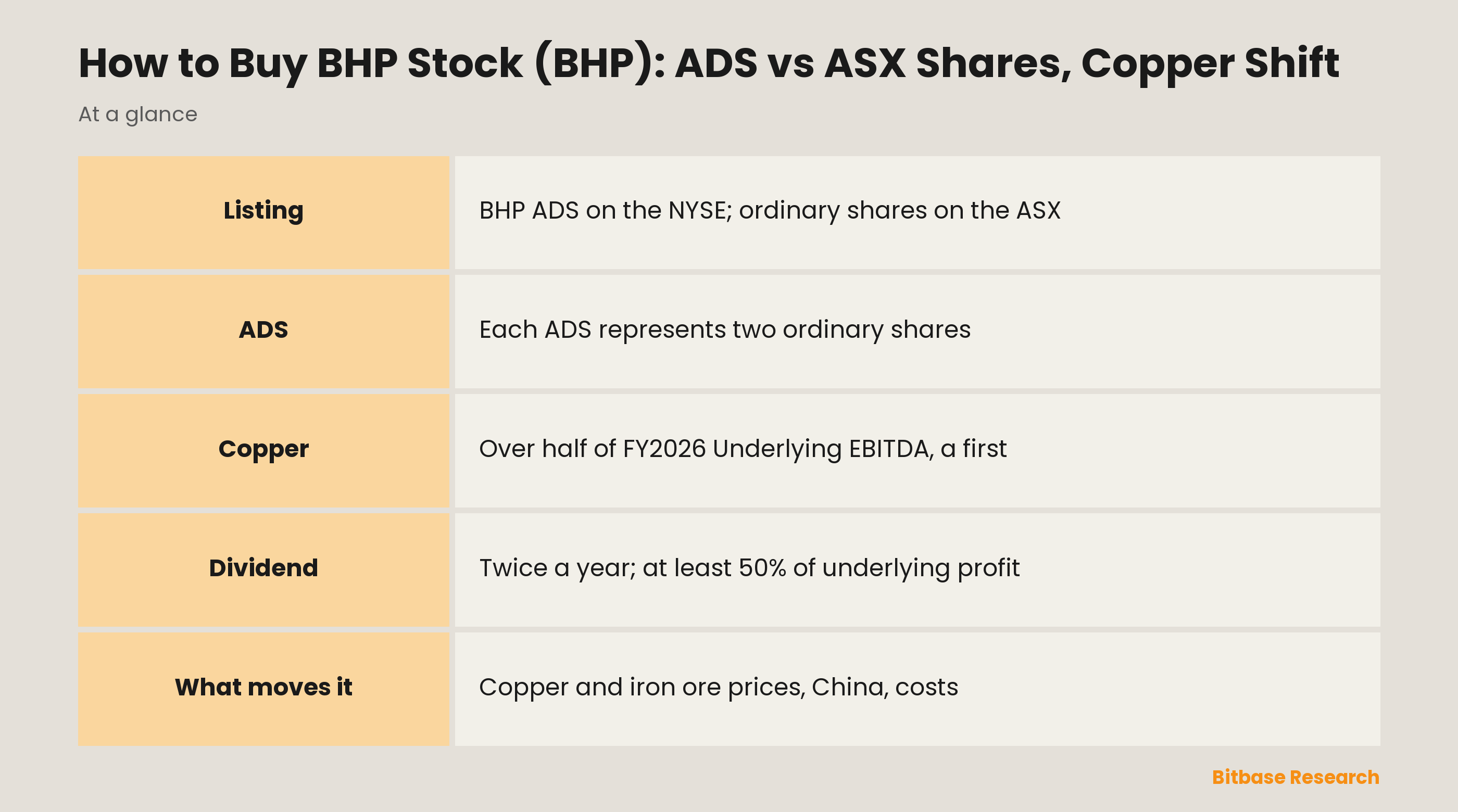
At any brokerage with access to the New York Stock Exchange, you can buy BHP as an American depositary share (ADS) under the ticker BHP, each one standing for two ordinary shares of BHP Group Limited; a broker that reaches Sydney can sell you those ordinary shares directly on the Australian Securities Exchange (ASX). The miner behind both lines is changing shape. In fiscal 2026, the year to 30 June 2026, copper contributed more than half of BHP's Underlying EBITDA for the first time, overtaking iron ore, which had earned the larger share in each of the two previous years.
What Does BHP Do?
BHP Group Limited mines copper, iron ore and coal, and is building a potash mine in Canada. It reports three segments, Copper, Iron Ore and Coal, from a global headquarters in Melbourne. Its 2026 annual report on Form 20-F calls BHP "the world's largest copper producer," a ranking the company bases on its own comparison of consolidated output with rivals' reported production.
Copper covers the mining of copper along with uranium, gold, zinc, molybdenum and silver. The centrepiece is Escondida in Chile's Atacama Desert, 57.5% owned by BHP and 30% by Rio Tinto, which the 20-F describes as the world's biggest copper mine. BHP wholly owns Pampa Norte in Chile and Copper South Australia, including Olympic Dam and the mines acquired with OZ Minerals in 2023. It holds 33.75% of Antamina in Peru and interests in two copper development projects, Resolution in Arizona and Vicuña on the Argentina-Chile border.
Iron Ore is mainly Western Australia Iron Ore (WAIO) in the Pilbara: five open-cut mines feeding four processing hubs, more than 1,000 kilometres of rail and two port facilities. BHP owns 85% of the four main joint ventures. The segment also carries BHP's half of Samarco in Brazil, a 50:50 venture with Vale that is run independently.
Coal combines BHP Mitsubishi Alliance (BMA), a 50:50 partnership with Mitsubishi that operates five steelmaking coal mines in Queensland's Bowen Basin, with the Mt Arthur energy coal mine in New South Wales, which has approval to keep mining until the end of fiscal 2030. Outside the three segments sit the Jansen potash project in Saskatchewan, Canada, and Western Australia Nickel, in temporary suspension since December 2024.
The company was incorporated in 1885 as The Broken Hill Proprietary Company Limited. A 2001 merger with Billiton left it with two parent companies, one listed in Australia and one in London, run as a single economic entity. That dual structure ended on 31 January 2022, when BHP Group Plc shareholders received one BHP Group Limited share for each Plc share and the Plc became a subsidiary. Four months later, on 1 June 2022, BHP merged its petroleum business into Woodside Energy. Brandon Craig has been chief executive since 1 July 2026, succeeding Mike Henry.
How BHP Makes Money
BHP earns its money by shipping commodities, most of them to customers in Asia. Control usually passes when a cargo is loaded onto the customer's vessel, and many sales are provisionally priced, then settled against index prices typically 60 to 120 days later. The table compares each segment's share of fiscal 2026 revenue with its share of Underlying EBITDA, the earnings measure BHP uses to judge its segments.
| Segment | Share of FY2026 revenue | Share of FY2026 Underlying EBITDA | What it sells |
|---|---|---|---|
| Copper | 49.4% | 54.2% | Copper concentrate and cathode, plus gold, silver, uranium, zinc and molybdenum |
| Iron Ore | 40.6% | 43.3% | Iron ore from the Pilbara |
| Coal | 9.5% | 2.5% | Steelmaking coal from Queensland and energy coal from New South Wales |
Revenue shares are of group revenue. EBITDA shares are of the three segments' combined total, because Group and unallocated items, which include potash and nickel, ran at a loss.
The shift was fast. Copper's share of the three segments' Underlying EBITDA was about 29% in fiscal 2024, 45% in fiscal 2025 and 54% in fiscal 2026. It came from price rather than volume: BHP's average realised copper price was about 35% higher than a year earlier while its copper production fell 3%. The realised iron ore price rose about 3%, and Iron Ore's Underlying EBITDA barely changed. The chief executive's review put copper's EBITDA margin at "a strong 70 per cent."
By customer location, China accounted for about 58% of fiscal 2026 revenue, down from about 63% a year earlier, followed by Japan at about 10%, India at about 6% and South Korea at about 5%. The accounts are presented in US dollars, but the year's earnings bridge lists movements in the Australian dollar and the Chilean peso against the US dollar as a separate cost item.
BHP Stock at a Glance
| Item | Detail |
|---|---|
| What BHP is in New York | American depositary share (ADS); each one represents two ordinary shares |
| New York listing | New York Stock Exchange, ticker BHP, trading since 28 May 1987 |
| Home and other listings | Primary listing on the ASX (BHP); international secondary listing in London (BHP); secondary listing in Johannesburg (BHG) |
| Depositary | Citibank, N.A. |
| Corporate structure | One parent company, BHP Group Limited, since 31 January 2022 |
| Legal home | Incorporated in Victoria, Australia; headquarters in Melbourne |
| Sector | Mining: copper, iron ore, steelmaking and energy coal; potash in development |
| Financial year | Ends 30 June; IFRS accounts reported in US dollars |
| Dividend policy | Interim and final dividends, with a minimum payout of 50% of Underlying attributable profit at every reporting period |
| Benchmark | MSCI World index, used with a mining peer group in the remuneration report's shareholder-return tests |
| SEC filings | CIK 811809; Form 20-F each year, Form 6-K in between |
The table carries no prices. Live quotes, volume and market value are on the BHP stock page on Bitbase.
How to Buy BHP Stock
Most of the work is choosing which BHP line to buy.
1. Pick the line. The ADS trades on the NYSE in US dollars during New York hours; the ordinary shares trade on the ASX in Australian dollars during the Sydney session. London and Johannesburg carry secondary lines.
2. Open and verify an account with a broker that takes clients from your country and can route orders to the exchange you picked.
3. Fund it. Conversion into US or Australian dollars adds a cost beyond commission, so compare the rate your broker quotes.
4. Find the right security. Search BHP and confirm the result is BHP Group Limited's ADS on the NYSE. The SEC's company record also lists a separate over-the-counter symbol, BHPLF, so check the venue before you confirm.
5. Choose the order type. A market order takes the next available price; a limit order caps your price but may go unfilled. It helps to know how a market order actually fills.
6. Size the position. Fractional ADSs are available at some brokers; others trade whole units only.
ADS or ordinary share. Citibank holds the ordinary shares behind every ADS, and on 9 July 2026 its ADR nominee account held about 5% of BHP's issued shares. The filing is blunt: "As an ADS holder, BHP will not treat you as one of its shareholders and you will not have shareholder rights." You can instruct the depositary to vote the shares behind your ADSs, but only if BHP asks it to seek instructions. Cash dividends reach you in US dollars, after the depositary's currency conversion, fees and any withholding. Sydney and New York trade at different hours, so compare the two lines with regular-session and extended-hours quotes in mind.
Tax on dividends. BHP's fiscal 2026 dividends were fully franked, meaning each one carries a credit for Australian tax the company has already paid. For US holders eligible for the Australia-US tax treaty, the 20-F says fully franked dividends are generally not subject to Australian withholding tax, while any unfranked part is generally taxed at no more than 15% unless it is declared conduit foreign income. For US federal income tax, an ADS holder is treated as owning the underlying shares, and swapping ADSs for ordinary shares is generally not taxable. Outside the US your own country's rules apply; this is general information, not tax advice.
Through a fund. Funds that track Australian, global or mining-sector indexes may hold BHP's ordinary shares. Read a fund's holdings list before relying on it for exposure.
What Moves BHP Stock
Copper prices. Spot copper averaged 26% more in fiscal 2026 than a year earlier, and the 20-F describes the market's strong fundamentals as "driven by a compelling narrative for copper-intensive sectors, particularly electrification and data centres." The same filing prints a sensitivity table estimating how far Underlying EBITDA moves for each one-cent change in the copper price per pound and each one-dollar change in iron ore per tonne.
China's steel industry. Iron ore still earns most of the rest, and customers in China account for about 58% of revenue. BHP's own view is that "China's real steel production will plateau around the 1 Bt level for the rest of the decade," with scrap taking a larger role, while new seaborne supply, including Simandou in Guinea, comes online.
Ore grades at Escondida. At Escondida the concentrator feed grade fell, as planned, from 1.02% to 0.90% in fiscal 2026, which is why copper production slipped despite record material mined. A new concentrator is in permitting, and BHP expects a final investment decision in calendar 2027 or 2028.
Costs and currencies. The fiscal 2026 earnings bridge shows exchange-rate movements in the Australian dollar and the Chilean peso, cost inflation and higher diesel prices all reducing Underlying EBITDA. Against that, the company describes WAIO as "the world's lowest cost major iron ore producer, now for the seventh year."
Jansen potash. Stage 1 of Jansen was 84% complete when the annual report appeared, with first production expected in mid-calendar 2027. In June 2026 a review raised the investment estimate for Stage 2 by about 41%, and BHP recorded an impairment charge on its spending on the project to date.
Portfolio moves. On 4 September 2026 BHP answered media reports of a possible partnership over part of WAIO, saying it "regularly explores options" and that "WAIO remains central to BHP's portfolio." It also plans to review the suspension of Western Australia Nickel by February 2027, with a sale among the options.
The dividend. The payout floor is a share of profit, so the dividend tracks earnings: dividends per share determined for fiscal 2026 were about 56% higher than for fiscal 2025 as Underlying attributable profit rose about 30%, and came to roughly 66% of that profit. BHP bought back no shares during the year.
Risks to Weigh Before Buying BHP
Commodity prices. The risk factors list "Commodity price volatility, which has historically been, and may continue to be, subject to significant fluctuation due to global economic and geopolitical factors."
Customer concentration. With China at about 58% of revenue, trade policy reaches BHP directly. The filing warns that "Concentrated customer bases, shifts in geopolitical conditions and the challenges of entering new or more complex regulatory markets can amplify commercial exposure," and names tariffs, sanctions and export controls among the threats.
Samarco. The Fundão tailings dam at Samarco failed in November 2015. A settlement with Brazilian public authorities, signed in October 2024 and ratified by the Federal Supreme Court a month later, left other claims open. In November 2025 the English High Court found the BHP defendants liable under Brazilian law in a UK group action. A second trial on causation and quantification is scheduled from April 2027 to March 2028, and under a 2024 agreement Vale will pay half of any amounts the BHP defendants owe in those claims.
Infrastructure and tailings. Among the listed risks are "Failure of a water or tailings storage facility" and a grounded vessel blocking the Port Hedland channel, which WAIO relies on to ship iron ore to customers.
Projects and royalties. The filing lists "Failure to deliver major projects and growth options on expected cost, schedule, production, quality or return assumptions," and the Jansen review shows the risk is real. Governments can also raise royalties; the 20-F cites Queensland's increase in coal royalty rates in June 2022.
The ADS itself. ADS holders depend on the deposit agreement for voting and pay depositary fees, and holding one stock, however diversified the business, ties your result to a single company.
How to Research BHP Yourself
As a foreign private issuer, BHP reports to the SEC under CIK 811809, filing a Form 20-F annually instead of a 10-K and using Form 6-K for quarterly operational reviews, half-year results and other exchange releases. The fiscal 2026 20-F was filed on 18 August 2026, alongside a 6-K carrying the Australian Annual Report, which includes material the 20-F leaves out.
Inside the 20-F, the Risk Factors section, the segment reporting note, the commodity price sensitivity table and the Shareholder information chapter on markets, ADS fees and taxation answer most buyers' questions. Note that reserves in the 20-F follow the SEC's S-K 1300 rules and differ from the figures BHP reports in Australia under the JORC Code. BHP's investor section at bhp.com hosts the same documents, and Bitbase's full list of stock pages lets you look up other listed companies.
BHP Stock FAQ
What is the difference between BHP on the NYSE and BHP on the ASX?
Each gives you a stake in the same company. In New York you buy an ADS, priced in US dollars and backed by two ordinary shares held by Citibank; on the ASX you buy the ordinary share itself, in Australian dollars. Ordinary shareholders vote directly and can choose their dividend currency, while ADS holders vote via the depositary and are paid in US dollars.
Can I buy BHP stock with crypto?
Not directly. A broker sells the ADS for US dollars and the ASX share for Australian dollars, so crypto has to be converted to cash and transferred into the brokerage account first. Depending on your country, that conversion may be a taxable event.
Does BHP pay a dividend?
Yes, twice a year. Interim dividends are determined in February and paid in March; final dividends are determined in August and paid in September or October. Since February 2016 the policy has been a minimum payout of 50% of Underlying attributable profit at every reporting period. Dividends are set in US dollars and the amount per share changes with earnings, so check the latest results release.
What happened to BHP Billiton and the BBL shares?
Until January 2022 BHP had two parent companies: BHP Group Limited, formerly BHP Billiton Limited, and BHP Group Plc, formerly BHP Billiton Plc, whose ADS traded in New York as BBL. On 31 January 2022 the two were unified, Plc shareholders received one BHP Group Limited share for each Plc share, and the Plc was delisted and became a subsidiary.
Does BHP still own oil and gas?
No. On 1 June 2022 BHP's petroleum business merged with Woodside Energy, and the Woodside shares BHP received were handed to eligible shareholders as a fully franked in specie dividend. Its remaining fossil fuel business is coal: steelmaking coal through BMA and energy coal at Mt Arthur.
What does BHP stand for?
The letters come from the company's original name, The Broken Hill Proprietary Company Limited, under which it was incorporated in 1885. It was later called BHP Limited and then BHP Billiton Limited before becoming BHP Group Limited.
Conclusion
Buying BHP mostly means choosing between the NYSE ADS, two ordinary shares held by a depositary and paid out in US dollars, and the ordinary share itself on the ASX. Either way you own the same miner, one whose earnings now lean more on copper than on iron ore and whose largest customer market is China. Read the latest 20-F and the quarterly operational reviews before deciding how much weight one diversified miner deserves in your holdings.
Related reading
Other Bitbase articles on this topic:
- How to Buy Agnico Eagle Stock (AEM): Unhedged Gold, NYSE and TSX
- How to Buy Air Products Stock (APD): Hydrogen Exits and NEOM
- How to Buy Barrick Stock (B): Formerly GOLD, ABX on the TSX
- How to Buy Rio Tinto Stock (RIO): One ADS, Two Parent Companies
Disclaimer: This article is educational content from Bitbase Academy, provided for information only. It explains what a company or fund does and how the instruments referenced here differ from one another; it does not constitute investment, trading, tax, or financial advice, and it is neither a recommendation nor an endorsement of any security, token, or trading strategy. A tokenized stock is issued by a third party and is designed to give economic exposure to an underlying asset: it is not a share, it carries no shareholder rights, and it depends on the issuer's structure, eligibility rules, and redemption terms, which the issuer can change. Perpetual futures are leveraged derivatives that hold no underlying asset and can be liquidated, and trading hours, product availability, and eligibility differ by instrument and by jurisdiction and can change at any time. Written as of October 2026; verify everything yourself through company filings, the issuer's own documentation, and the product pages of the venue you trade on.
References
[1] BHP Group Limited, Form 20-F for fiscal 2026 (SEC EDGAR) www.sec.gov
[2] BHP Group Limited, fiscal 2026 Form 20-F XBRL cover, R1.htm (SEC EDGAR) www.sec.gov
[3] BHP Group Limited, Exhibit 2.1 to the fiscal 2026 Form 20-F: Description of Securities (SEC EDGAR) www.sec.gov
[4] BHP Group Limited, Form 20-F for fiscal 2022: unification and the Woodside merger (SEC EDGAR) www.sec.gov
[5] BHP Group Limited and BHP Group Plc, fiscal 2021 Form 20-F XBRL cover, R1.htm (SEC EDGAR) www.sec.gov
[6] BHP Group Limited, Form 6-K of 4 September 2026 on Western Australia Iron Ore (SEC EDGAR) www.sec.gov
[7] SEC EDGAR company page for BHP Group Ltd www.sec.gov





