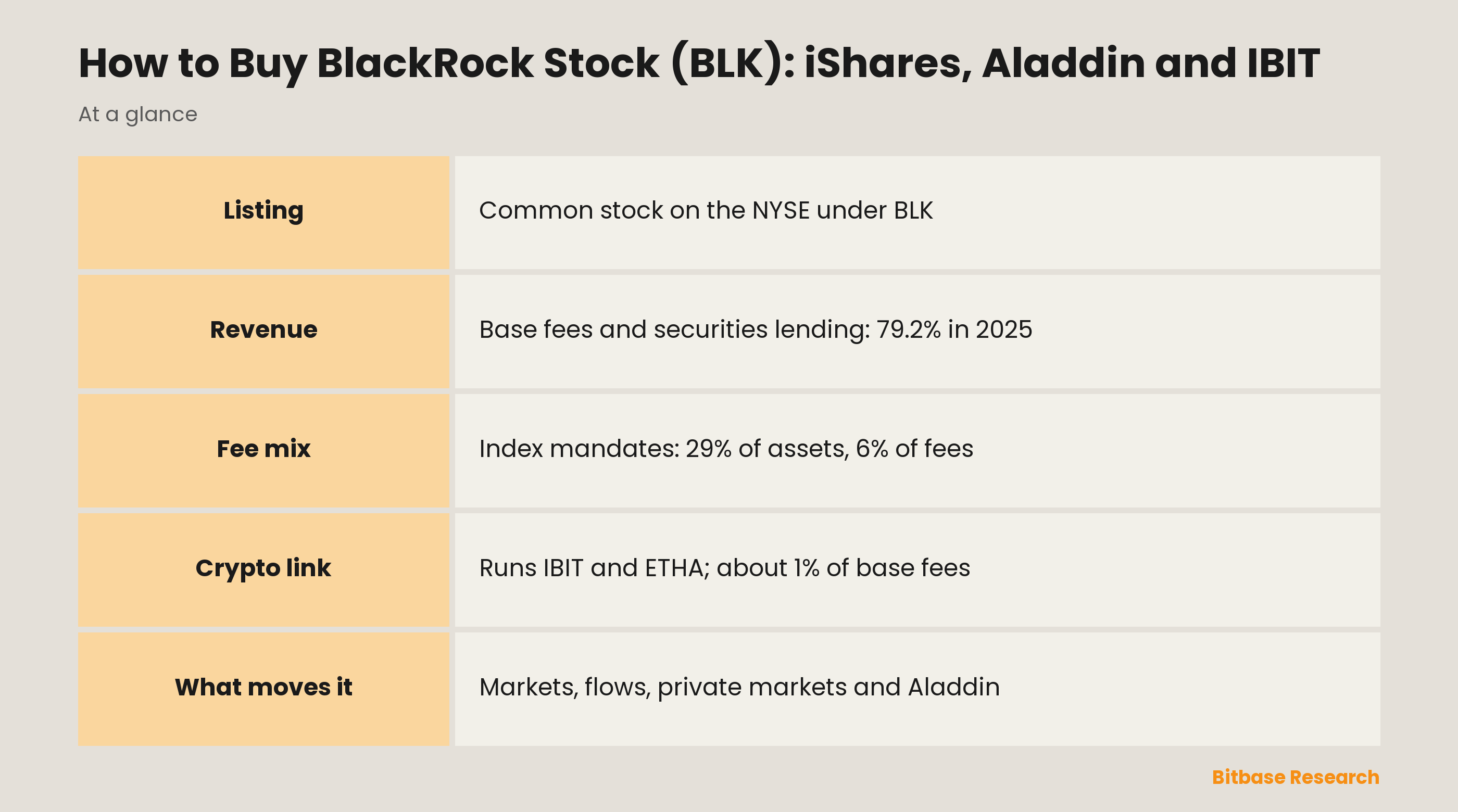
Those who want a stake in BlackRock itself buy its common stock through a brokerage account with access to the New York Stock Exchange, where the shares trade as BLK. What that share owns is a fee business: in 2025, fees charged on client assets, together with securities lending, made up 79.2% of BlackRock's revenue, and technology services such as Aladdin added another 8.2%. Those fees include the ones earned on the iShares Bitcoin Trust ETF (IBIT), yet an IBIT share is a claim on a bitcoin trust rather than on the company. This guide covers that difference, the order steps, the 2024 change of holding company and the risks its 10-K names.
What Does BlackRock Do?
BlackRock manages money for other people and licenses the software it uses to run that money to other institutions. Its strategies span active management, index tracking, private markets and cash, offered through mutual funds, separate accounts and the iShares range of exchange-traded funds. The firm was founded in 1988, went public in October 1999 and is headquartered at 50 Hudson Yards in New York.
It acts as an agent, not as a principal. The 10-K states that the company "manages its clients' assets as a fiduciary" and "does not engage in proprietary trading activities that could conflict with the interests of its clients." The assets under management (AUM) quoted in headlines belong to its clients; what BlackRock keeps is the fee for looking after them.
The filing sorts clients into three groups. Retail investors are reached mainly through intermediaries such as brokers, banks and advisers. ETFs get a column of their own because "as ETFs are traded on exchanges, complete transparency on the ultimate end-investor is unavailable." Institutional clients include pension plans, endowments, insurers and official institutions such as central banks. Products run from equity and bond portfolios to private markets, commodities, digital assets and cash management, which the 10-K says includes "tokenized liquidity offerings."
The technology side is built around Aladdin, an investment and risk management platform BlackRock runs for itself and for other investors, alongside eFront, Preqin's private markets data and smaller tools. One detail from the filing: "while Aladdin is a multi-asset system, the majority of positions managed on the platform are fixed income."
Recent deals pushed the business toward private markets. BlackRock bought Global Infrastructure Partners (GIP), an infrastructure fund manager, on 1 October 2024, the same day it moved to a new holding company (see the FAQ). Preqin followed on 3 March 2025, and HPS Investment Partners, a credit manager, on 1 July 2025, paid for mainly in units of a subsidiary that holders can exchange one-for-one into BlackRock common stock.
Unlike a bank with several divisions, BlackRock "operates in one asset management operating segment." The useful breakdowns are therefore by revenue line and by the type of client money behind the fees.
How BlackRock Makes Money
Total revenue grew 18.7% in 2025, and four-fifths of it came from one line:
| Revenue line | Share of 2025 revenue | Change from 2024 | What the line covers |
|---|---|---|---|
| Base fees and securities lending | 79.2% | Up 19.1% | Advisory and administration fees charged as a percentage of AUM, plus securities lending |
| Technology services and subscriptions | 8.2% | Up 23.6% | Aladdin, eFront, Preqin and related services |
| Performance fees | 5.9% | Up 18.0% | Fees earned when portfolios beat an agreed benchmark or hurdle |
| Distribution fees | 5.6% | Up 6.4% | Fees for distributing funds and servicing their shareholders |
| Advisory and other | 1.1% | Up 23.7% | Advisory work, transition management and other items |
Shares and changes are calculated from the revenue table in the fiscal 2025 10-K and rounded to one decimal.
"Investment management fees are typically earned as a percentage of AUM," the 10-K explains, so fees rise when client assets grow, through markets or new money, and fall when they shrink. Not every unit of AUM pays the same, though. The filing sets each client type's share of long-term AUM next to its share of long-term base fees and securities lending revenue:
| Client type | Share of long-term AUM, end of 2025 | Share of long-term base fees and securities lending, 2025 |
|---|---|---|
| ETFs (iShares) | 42% | 45% |
| Retail | 10% | 25% |
| Institutional active | 19% | 24% |
| Institutional index | 29% | 6% |
The bottom row explains the gap. Institutional index assignments "tend to be very large (multi-billion dollars) and typically reflect low fee rates," and their flows "generally have a small impact on BlackRock's revenues and earnings." Retail runs the other way, with a tenth of the assets carrying a quarter of the fees, so a modest shift into retail or alternative products can matter more than a large index mandate.
Alternatives show the pattern more strongly still: 3% of long-term AUM in 2025, yet 17% of long-term base fees and securities lending revenue. Private markets base fees rose 96.5% in 2025 as GIP and HPS joined, and alternatives produced 88.0% of the year's performance fees. Within equities, roughly half of AUM is tied to international strategies, which "tend to have higher fee rates than US equity strategies."
Technology adds a steadier stream: "Aladdin assignments are typically long-term contracts that provide recurring revenue," and annual contract value (ACV), the firm's measure of those fees, rose 31% in 2025 including Preqin and 16% excluding it. Digital assets remain small: in the third quarter of 2026 they made up about 1% of AUM and about 1% of base fees and securities lending revenue, according to the quarterly results release.
BLK Stock at a Glance
| Item | Detail |
|---|---|
| Exchange | New York Stock Exchange (NYSE) |
| Ticker | BLK |
| Security | Common stock |
| Other listed securities | One series of notes due 2035, under the symbol BLK 35 |
| Registrant | BlackRock, Inc., the holding company in place since 1 October 2024 |
| Sector | Financials: asset management and investment technology |
| Index membership | S&P 500 |
| Headquarters | 50 Hudson Yards, New York |
| Incorporated | Delaware |
| History | Founded 1988; went public in October 1999 |
| Fiscal year | Ends 31 December |
| Reporting segments | One, asset management |
| Dividend policy | Quarterly cash dividend, raised in January 2026 |
| SEC identifier | CIK 2012383 (filings before October 2024 sit under CIK 1364742) |
Share price, market value and dividend yield change with every trade. For live figures, open the BlackRock stock page on Bitbase.
How to Buy BlackRock Stock
Because BlackRock is incorporated in the US and its common stock is the NYSE listing, no depositary receipt sits between you and the share. Buying it takes a broker and a few steps:
1. Pick a broker with NYSE access. For readers outside the US, that may mean a local firm that routes orders to US exchanges or a broker operating internationally. Confirm who your legal counterparty is and which authority licenses it.
2. Open the account. Expect identity checks. A non-US individual normally signs IRS Form W-8BEN to document foreign status, and brokers use it to set the withholding on US dividends.
3. Deposit money. Funding in a currency other than the dollar involves an exchange, and its spread can cost more than the trading commission.
4. Check the line before ordering. BLK should show as BlackRock, Inc. common stock on the NYSE. BLK 35 is a note, a debt security. iShares funds have tickers of their own, and buying one buys a fund, not a piece of the company.
5. Choose the order type. FINRA explains that a market order "generally will execute at or near the current bid or ask prices in the marketplace," whereas a limit order is "an order to buy or sell a security at or better than a specified price." A limit order puts a ceiling on what you pay.
6. Decide how much. A fractional share "represents ownership of less than a full share of stock," so you can invest a set sum. FINRA adds that availability "varies by brokerage firm" and that a fractional owner "might not have shareholder voting rights."
7. Save the paperwork. Trade confirmations and statements are what you will need to calculate cost basis later.
Tax for non-US holders. Under IRS rules, "most types of U.S. source income received by a foreign person are subject to U.S. tax of 30%," though a tax treaty between your country and the US can lower that rate or remove it. The W-8BEN is the form through which the broker applies a treaty rate; your home tax authority may then tax the dividend under its own rules.
Holding it through a fund. State Street's SPDR S&P 500 ETF Trust (SPY) and its Financial Select Sector SPDR ETF (XLF) both held BlackRock according to their holdings files for 16 October 2026. In either fund, BLK is one position among many.
What Drives BLK Stock
Asset prices. Because fees are a percentage of AUM, market levels pass straight into revenue. The 10-K's first risk factor says that changes in "equity, debt, real assets, commodities, foreign exchange or other asset markets" may cause "assets under management ("AUM"), revenue and earnings to decline." Currencies add a second layer, since about 35% of total AUM is managed for clients domiciled outside the US.
Flows and fee mix. The 10-K credits 9% organic base fee growth in 2025, growth from net new business rather than markets, to record net inflows, most of them into ETFs. Where the money goes matters as much: shifts between products mean "the Company's average effective fee rate may be lower (or higher) from period to period."
Private markets and the deals behind them. GIP, HPS and Preqin moved BlackRock deeper into infrastructure, private credit and private markets data, and the near doubling of private markets base fees in 2025 shows the effect. Those businesses also earn most of the performance fees, and the risk factors warn that "performance fees may increase volatility of both revenue and earnings."
Share count and buybacks. Part of the GIP price is contingent consideration payable all in stock if targets are met and expected no later than 31 December 2028, and the HPS sellers hold units exchangeable into common stock. Pulling the other way, the board has run a repurchase program since July 2010 with no stated expiration.
Digital assets: visible, but small. According to the 10-K, BlackRock's digital asset products are bitcoin exchange-traded products listed in the US, Canada, Europe, the UK and Australia, plus one Ethereum product listed in the US. They include the iShares Bitcoin Trust ETF (IBIT) and the iShares Ethereum Trust ETF (ETHA), both on Nasdaq and both run by BlackRock subsidiaries; a spot bitcoin ETF holds the coins in trust for its shareholders. Crypto prices move this line hard: digital asset AUM, which changes with prices as well as flows, fell 38% in the first half of 2026 and rose 63% in the third quarter. At about 1% of base fees, though, the swing barely reaches the total, and minority stakes in Securitize and Circle do not turn a BLK share into a crypto position.
Politics and litigation. The firm "is subject to competing demands from different stakeholder groups with divergent views on environmental and social-related matters," and some US states have adopted or proposed legislation in response. Thirteen state attorneys general are also suing BlackRock, State Street and Vanguard in federal court in Texas, alleging that the three conspired to suppress coal supply. The court "largely denied" the motion to dismiss in 2025, and the June 2026 quarterly report described the case in the same terms.
The Risks Behind a BLK Share
The risk factor section of the 2025 annual report runs to dozens of headings. These bear most directly on a shareholder:
Competition. "Increased competition may cause BlackRock's AUM, revenue and earnings to decline," and a changing industry "may lead to additional fee compression."
Technology. "Failure to maintain Aladdin's competitive position in a dynamic market could lead to a loss of clients and could impede BlackRock's productivity and growth."
Acquisitions. BlackRock "may not be able to realize the anticipated benefits of these acquisitions, including synergies, value creation or other benefits, fully or at all, or on the timeline BlackRock expects."
ETF plumbing. Exchange prices "have in the past deviated measurably from the NAV of certain ETPs and may under certain circumstances do so in the future." Such episodes, explained in this guide to an ETF's premium or discount to NAV, could shake confidence in a product line that carries 45% of long-term base fees.
New asset classes. "New and developing asset classes, including digital assets, are also subject to heightened risks such as their potential misuse by illicit actors."
On top come the risks of owning any single share: your result rests on one company, the board decides every dividend, and for anyone who spends a currency other than the dollar, exchange rates shift both the price and the payouts.
Researching BlackRock Filings Yourself
Searching EDGAR for "BlackRock" returns dozens of funds and trusts with their own filings. The listed parent is BlackRock, Inc. under CIK 2012383, whose filing history begins in 2024; earlier annual reports sit under CIK 1364742, the former parent now named BlackRock Finance, Inc.
In the 10-K, the business section holds the AUM tables by client type, product and region, each with its share of fees; the risk factors follow; the section on the market for the common stock covers dividends and buybacks; the revenue table in the management's discussion splits revenue by line; and the legal proceedings note describes the coal case. The structured cover, R1.htm, lists two registered securities, the common stock and the 2035 notes.
Each quarterly results release reaches EDGAR as an 8-K, with a table giving every product type's share of AUM and base fees. For questions about IBIT or ETHA themselves, read the trusts' own 10-Ks under CIK 1980994 and CIK 2000638. Live prices sit on the stock page linked above, and other companies appear among the US stock pages on Bitbase.
BlackRock Stock FAQ
Does BlackRock pay a dividend?
Yes, quarterly. On 15 January 2026 the board approved a higher quarterly dividend, payable in March 2026, and authorized seven million more shares for repurchase. Amounts and dates appear in the latest 8-K.
Can I buy BlackRock stock with crypto?
Not directly. A broker buys BLK for you in US dollars on the NYSE, so any crypto must first be converted to cash and moved into the brokerage account, and selling it may create a tax bill of its own, depending on your jurisdiction. IBIT is no shortcut: it is also bought through a broker in dollars, and it gives you a share of a bitcoin trust rather than of BlackRock, a difference set out in business exposure or bitcoin exposure.
Is buying IBIT the same as buying BlackRock stock?
No. IBIT's own 10-K says the trust's assets "consist primarily of bitcoin held by a custodian on behalf of the Trust" and that its sponsor and trustee "are consolidated subsidiaries of BlackRock, Inc." An IBIT share is a fractional interest in the trust's net assets, so its value follows bitcoin. A BLK share is a stake in the company that runs the trust and collects the sponsor's fee, alongside the fees from all its other products.
Does BlackRock own the money it manages?
No. The 10-K defines AUM as "financial assets managed for clients on a discretionary basis pursuant to investment management and trust agreements." Those assets belong to clients and fund shareholders; BlackRock earns a fee on them, so a rise in AUM lifts its revenue by a fraction of that rise.
Did BlackRock's stock change in the 2024 reorganization?
Only on paper. On 1 October 2024 a new parent, until then named BlackRock Funding, Inc., took the name BlackRock, Inc., and the old parent became a subsidiary renamed BlackRock Finance, Inc. Each old share converted automatically into one new share, and the related 8-K states that the shares "will continue trading uninterrupted on the New York Stock Exchange" under BLK.
Is BLK in the S&P 500?
Yes. SPY, State Street's S&P 500 trust, included BlackRock in its holdings file dated 16 October 2026. Weights move every day.
Conclusion
The purchase itself is short: an account that reaches the NYSE, the common stock rather than the 2035 notes or an iShares fund, and a market or limit order. Understanding what you bought takes longer. A BLK share is a claim on fees that follow markets and client flows, on a growing private markets business that brings performance fees and new shares, and on a technology arm built on recurring contracts. If bitcoin is what draws you, IBIT and BLK answer different questions, and the latest 10-K and quarterly release say more about the share than its ticker does.
Related reading
Other Bitbase articles on this topic:
- How to Buy Apollo Global Management Stock (APO): Athene and Credit
- How to Buy Blackstone Stock (BX): Fees, Carry and 24/7 Perps
- How to Buy Brookfield Asset Management Stock (BAM): BN Stake, Fees
Disclaimer: This article is educational content from Bitbase Academy, provided for information only. It explains what a company or fund does and how the instruments referenced here differ from one another; it does not constitute investment, trading, tax, or financial advice, and it is neither a recommendation nor an endorsement of any security, token, or trading strategy. A tokenized stock is issued by a third party and is designed to give economic exposure to an underlying asset: it is not a share, it carries no shareholder rights, and it depends on the issuer's structure, eligibility rules, and redemption terms, which the issuer can change. Perpetual futures are leveraged derivatives that hold no underlying asset and can be liquidated, and trading hours, product availability, and eligibility differ by instrument and by jurisdiction and can change at any time. Written as of October 2026; verify everything yourself through company filings, the issuer's own documentation, and the product pages of the venue you trade on.
References
[1] BlackRock, Inc. Form 10-K, fiscal 2025: business, AUM and fee shares, revenue and risk factors (SEC EDGAR) www.sec.gov
[2] BlackRock, Inc. Form 10-Q for the quarter ended 30 June 2026: AUM by product and legal proceedings (SEC EDGAR) www.sec.gov
[3] BlackRock third-quarter 2026 results release, 14 October 2026 (Form 8-K, Exhibit 99.1) www.sec.gov
[4] BlackRock Finance, Inc. Form 8-K, 1 October 2024: holding company reorganization and GIP closing (SEC EDGAR) www.sec.gov
[5] iShares Bitcoin Trust ETF Form 10-K, fiscal 2025: trust structure, sponsor and listing (SEC EDGAR) www.sec.gov
[6] iShares Ethereum Trust ETF Form 10-K, fiscal 2025: trust structure, sponsor and listing (SEC EDGAR) www.sec.gov
[7] BlackRock: company history www.blackrock.com
[8] State Street SPDR S&P 500 ETF Trust (SPY): fund page and daily holdings www.ssga.com
[9] State Street Financial Select Sector SPDR ETF (XLF): fund page and daily holdings www.ssga.com
[10] FINRA: Order Types www.finra.org
[11] FINRA: Investing in Fractional Shares www.finra.org
[12] IRS: NRA Withholding www.irs.gov





