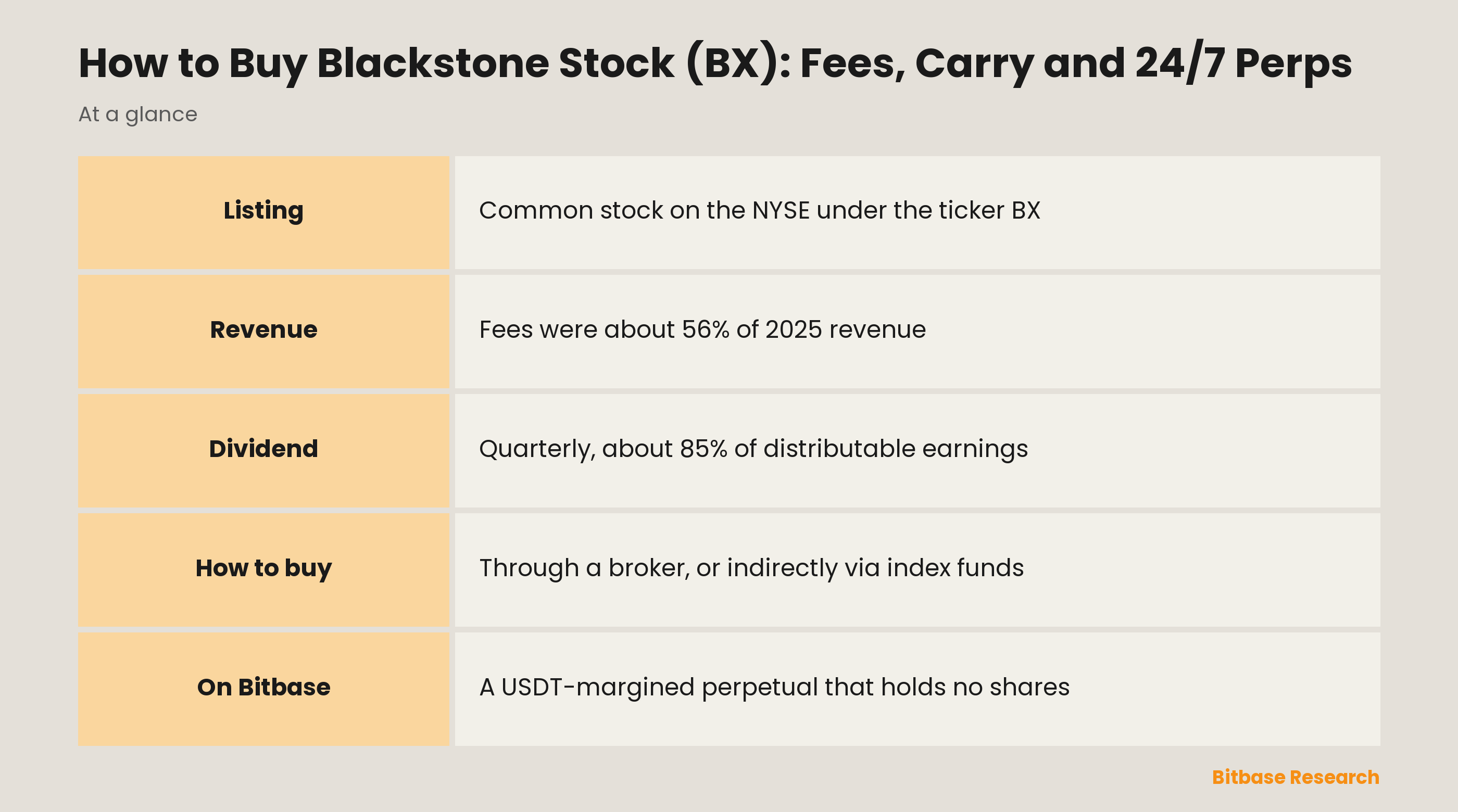
Buying into the firm behind the BX ticker takes a brokerage account with access to the New York Stock Exchange, where Blackstone's common stock is listed: you fund the account, search for BX and place an order. What the share buys is a stake in an asset manager that is paid in two ways. In 2025, management and advisory fees made up about 56% of its revenue, while investment income, most of it performance allocations such as carried interest, made up about 36%. Bitbase does not offer the shares themselves; it lists a BX perpetual, margined in USDT, that follows the share price without owning any stock.
What Does Blackstone Do?
Blackstone invests other people's money, mostly in assets that do not trade on an exchange: property, private companies, infrastructure, private loans and hedge fund portfolios. It calls itself "the world's largest alternative asset manager" and counts among its clients "pension funds, insurance companies and individual investors." The capital is theirs; Blackstone earns a fee for managing it, a share of the profit when investments do well, and returns on its own money committed alongside.
The 10-K splits the business into four segments.
Real Estate buys and runs property worldwide. Its opportunistic BREP funds have invested in logistics, data centres, rental housing, hotels, offices and retail; its Core+ strategy holds stabilised buildings, including through Blackstone Real Estate Income Trust (BREIT), a non-listed REIT for income-focused individuals; and its debt platform includes Blackstone Mortgage Trust (BXMT), a mortgage REIT listed on the NYSE.
Private Equity buys companies through its corporate funds and also houses infrastructure (Blackstone Infrastructure Partners and BXINFRA), the secondaries business Strategic Partners, GP stakes and a capital markets unit.
Credit & Insurance (BXCI) lends to companies and buys their debt across private corporate credit, liquid credit such as collateralised loan obligations (CLOs), and infrastructure and asset-based credit. It includes two business development companies, BCRED and BXSL, and an insurance platform that runs mainly investment-grade portfolios.
Multi-Asset Investing (BXMA) builds hedge fund and multi-asset portfolios on four platforms: Absolute Return, Multi-Strategy, Total Portfolio Management and Public Real Assets.
Across all four runs what the filing calls Perpetual Capital, money with "an indefinite term" held in vehicles such as BREIT and BCRED and for certain insurance clients. The 10-K adds that "capital from the private wealth channel has represented an increasing portion of our Total Assets Under Management."
Founded in 1985, the firm is led by co-founder Stephen A. Schwarzman as Chairman and Chief Executive Officer, with Jonathan D. Gray as President and Chief Operating Officer. It went public in June 2007 as The Blackstone Group L.P., whose common units traded on the NYSE, and in October 2015 it spun off its advisory and Park Hill fund placement businesses into PJT Partners, a separate listed company. On 1 July 2019 the partnership converted into a Delaware corporation: each common unit became one share of Class A common stock under the same BX ticker, and today's filings call the security simply common stock.
How Blackstone Makes Money
Two kinds of income come out of the same funds. Management fees are charged on the capital in a fund, on a base that depends on the vehicle: commitments or invested capital in drawdown "carry funds", net asset value in open-ended ones. They are "not subject to clawback."
Performance revenues arrive only when investments clear a hurdle. In a carry fund, the general partner is "generally entitled to an allocation of up to 20% of the net realized income and gains," usually after investors receive a preferred return "generally ranging from 5% to 8% per year." If later losses mean too much carry was paid, Blackstone must return the excess, a "clawback" obligation.
The income statement shows the difference. On a GAAP basis in 2025, management and advisory fees accounted for about 56% of revenue and incentive fees for about 7%. Investment income, which combines performance allocations with gains on Blackstone's own principal investments, made up about 36%. In 2023 the same line was only about 3%, because unrealized performance allocations, the paper gains and losses on holdings not yet sold, were negative for the year. Management and advisory fees grew about 12% in 2025.
Blackstone's segment measures leave out those paper marks. Fee Related Earnings is the profit on fees, "not dependent on realization activity"; Segment Distributable Earnings adds the net gains realized on sales. In 2025, Fee Related Earnings made up about 73% of Segment Distributable Earnings. By segment:
| Segment | Share of Total AUM, end of 2025 | Change in Total AUM during 2025 | Share of Segment Distributable Earnings, 2025 |
|---|---|---|---|
| Real Estate | 25.0% | Up 1.2% | 29.9% |
| Private Equity | 32.7% | Up 18.2% | 36.9% |
| Credit & Insurance | 34.7% | Up 18.0% | 24.8% |
| Multi-Asset Investing | 7.5% | Up 14.3% | 8.3% |
Shares and changes are calculated from the AUM and segment tables in the 2025 10-K.
The weight has moved. In 2023 Real Estate produced 40.3% of Segment Distributable Earnings, more than any other segment; by 2025 Private Equity had taken that place and Credit & Insurance had become the largest segment by assets. Total Assets Under Management rose 13.1% over 2025, and Perpetual Capital was about 41% of the total at year-end.
BX Stock at a Glance
| Fact | BX |
|---|---|
| Exchange | New York Stock Exchange (NYSE) |
| Ticker | BX |
| Listed security | Common stock, the only class registered for exchange trading |
| Who elects the board | The holder of the single Series II preferred share, an entity controlled by Stephen A. Schwarzman |
| Corporate form | Delaware corporation since 1 July 2019; before that, The Blackstone Group L.P. |
| Sector | Financials: alternative asset management |
| Index funds holding it | SPY (S&P 500) and XLF (financial sector), per holdings files dated 28 October 2026 |
| Headquarters | 345 Park Avenue, New York |
| Founded and listed | Founded 1985; public since June 2007 |
| Fiscal year | Ends 31 December |
| Reporting segments | Four: Real Estate, Private Equity, Credit & Insurance, Multi-Asset Investing |
| Dividend policy | Quarterly, intended to be about 85% of Blackstone Inc.'s share of Distributable Earnings, so the amount varies |
| Share buybacks | Programme authorised by the board on 16 July 2024 |
| SEC identifier | CIK 1393818 |
Quotes, the chart and market value move all day; Bitbase's Blackstone stock page shows them live.
How to Buy Blackstone Stock
A broker purchase takes six steps:
1. Find a broker with NYSE access that takes clients from where you live.
2. Complete onboarding. Identity checks come first; a non-US individual usually also signs IRS Form W-8BEN.
3. Fund the account. Money in another currency is converted into dollars, at a spread.
4. Confirm the ticker. Several Blackstone-managed vehicles have tickers of their own, BXMT and BXSL among them, and the SEC's ticker list shows each as a separate company; BX is Blackstone Inc.
5. Decide how to order. Market orders execute at what the market offers; limit orders name a maximum price and can go unfilled.
6. Decide how much. Some brokers sell slices of a share, so a set sum can be invested instead of a whole number of shares.
From abroad, no depositary receipt is involved: the NYSE line is Blackstone's own common stock, so there is no ADR conversion ratio to check. What changes across borders is tax. According to the IRS, "Most types of U.S. source income received by a foreign person are subject to U.S. tax of 30%," unless a treaty sets a lower rate or an exemption, and Form W-8BEN is filed "whether or not you are claiming a reduced rate." Treat this as general information rather than tax advice.
Via index funds, the exposure is indirect. SPY and the Financial Select Sector SPDR ETF (XLF) both listed Blackstone Inc. in their holdings files dated 28 October 2026, as one position among many.
A Blackstone fund is not Blackstone stock. BREIT, BCRED and other private wealth vehicles are separate entities with their own shares and terms; the fees they pay are Blackstone's revenue.
Trading BX on Bitbase
On Bitbase, Blackstone exposure comes as a BX perpetual futures contract that uses USDT for margin and settlement. The contract follows the BX share price; it does not give you a share, a dividend or any shareholder right. What it offers instead is the choice of long or short, leverage, and trading on evenings and weekends when the NYSE is closed.
Longs and shorts exchange funding payments at set intervals, which keeps the contract close to the stock, and liquidation is triggered on the mark price once margin is used up. For most of the week the NYSE is not open, so news arriving on a Saturday moves the contract first and the share only when trading resumes. The guide to stock perpetuals explains the mechanics.
Funding intervals, margin tiers, leverage caps and how the mark price is set while the NYSE is closed are all in the contract's rules on Bitbase, worth reading before a first order. The TradFi page on Bitbase lists the other stocks and the instrument each comes in.
What Moves BX Stock
Exits. Carried interest is mostly earned when a fund sells an investment at a gain, and the 10-K warns that the ability of its funds, "particularly our private equity funds, to dispose of investments is heavily dependent on the public equity markets." In 2025, Private Equity produced about 59% of realized performance revenues across the four segments.
Flows from individuals. Vehicles sold to wealthy individuals bring steady fees, but in volatile markets redemption requests "are likely to be elevated." BREIT is the filing's own example: volatility "drove a material increase in BREIT repurchase requests beginning in late 2022," BREIT began prorating them in November 2022, and inflows "materially declined after proration was announced," leading to net outflows.
Interest rates and property. Real Estate was the largest earner in 2023, yet its Total AUM grew only 1.2% in 2025, far less than the other three segments. The risk factors tie results to the rate path: "A slower than expected decrease in interest rates" could weigh on asset values and on funds' access to capital markets.
Credit and insurance. Credit & Insurance ended 2025 as the largest segment by assets, with inflows led by private corporate credit and growth in capital managed for insurers.
The dividend formula. With the board aiming to pay out about 85% of Blackstone Inc.'s share of Distributable Earnings, the dividend follows realizations; the amount per share differed in every quarter of 2025. Each quarter's dividend is declared and paid in the following quarter, so a strong quarter for exits shows up one payment later.
Holdings units. Partners may exchange Blackstone Holdings units for common stock "on a one-for-one basis," up to four times each year, and the 10-K warns that the price "may decline due to the large number of shares of common stock eligible for future sale and exchange."
Risks to Weigh Before Buying BX
Uneven earnings. "Our revenue, earnings, net income and cash flow can all vary materially, which may make it difficult for us to achieve steady earnings growth on a quarterly basis." Weak fund results can also "obligate us to repay Performance Allocations previously paid to us."
Fundraising and redemptions. The business "depends in large part on our ability to raise capital from third-party investors and is intensely competitive." Blackstone has limited or prorated redemptions in some vehicles before and says that can make them "less attractive to investors."
Concentrated control. Common stockholders do not elect the board. The single Series II preferred share, held by an entity owned by senior managing directors and controlled by Mr. Schwarzman, elects the directors, which makes Blackstone a "controlled company" under NYSE rules. Common stock votes only on a short list of matters, such as a merger or a sale of substantially all assets, and unhappy holders "have no ability to remove any of our directors, with or without cause."
Key people. The business "could be adversely affected by the loss of services from our co-founder and other key senior managing directors and personnel."
The stock itself. Dividends are at the board's sole discretion, the price can fall, and non-dollar investors carry currency risk on both.
The perpetual adds its own risks. Losses grow with leverage, funding keeps accruing for as long as the position stays open, and when the NYSE reopens after a gap, the price can jump past a liquidation level.
How to Research BX Yourself
An EDGAR search for "Blackstone" returns dozens of funds, BREIT and BXMT among them. The listed parent is Blackstone Inc., CIK 1393818, a filer number in use since 2007, first as The Blackstone Group L.P. and then The Blackstone Group Inc. In the 10-K, Item 1 describes the business, Item 1A lists the risk factors and Item 7 walks through segment results. Because Blackstone generally does not have to file proxy statements, board and executive pay details sit in Part III of the same 10-K. 10-Qs cover each quarter, and 8-Ks carry the quarterly results release.
The shareholder site, ir.blackstone.com, has a tax and dividends page that explains the 2019 change in tax reporting. For the manager behind the iShares ETFs, see how to buy BlackRock stock.
Blackstone Stock FAQ
Does Blackstone pay a dividend?
Yes, every quarter, but not a fixed amount. The policy targets about 85% of Blackstone Inc.'s share of Distributable Earnings, adjusted as the board sees fit, so the payout follows realized earnings and can be cut or stopped. Each quarterly results release gives the latest figure.
Is Blackstone still a partnership, and does BX issue a K-1?
No. Blackstone converted from a publicly traded partnership to a corporation on 1 July 2019, and the final Schedule K-1s covered the period that ended that day. Since then, the company says, cash distributions on BX are reported on Form 1099-DIV "by the brokerage where your shares are held."
Is BREIT the same as BX stock?
No. BREIT, Blackstone Real Estate Income Trust, is a non-listed REIT that Blackstone manages and that files its own reports with the SEC. A BREIT share is a stake in its property portfolio; a BX share is a stake in the manager, which collects fees from BREIT and many other vehicles. The proration BREIT applied from November 2022 followed BREIT's own terms.
Is Blackstone in the S&P 500?
Yes. The SPDR S&P 500 ETF Trust (SPY) held Blackstone Inc. in its holdings file dated 28 October 2026. Constituents change from time to time, so check the date of whatever list you rely on.
Can I buy Blackstone stock with crypto?
Not directly. A broker sells BX for dollars or another currency it accepts, so crypto must first be sold for cash. What Bitbase offers is the BX perpetual, traded with USDT: it tracks Blackstone's share price, but as a derivative it pays no dividend, carries no shareholder rights and can be liquidated. A guide to buying stocks with crypto compares the routes.
When does Blackstone report earnings?
Quarterly; Blackstone's fiscal year is the calendar year. Results for 2025 came on 29 January 2026 and the 10-K on 27 February 2026; the 2026 quarters were reported on 23 April, 23 July and 22 October, each in a release filed on Form 8-K.
Conclusion
Buying BX is an ordinary NYSE trade; the harder part is knowing what the share stands for. It is a claim on a manager whose fees grow with the money it oversees and whose carry arrives when funds sell, so earnings and the dividend move with exit markets and with flows from individual investors, under a board holders do not elect. Anyone who only wants to trade the price can use the Bitbase perpetual instead, a different instrument with funding costs and liquidation risk that confers no ownership of Blackstone.
Related reading
Other Bitbase articles on this topic:
- How to Buy Apollo Global Management Stock (APO): Athene and Credit
- How to Buy Brookfield Asset Management Stock (BAM): BN Stake, Fees
- How to Buy Interactive Brokers Stock (IBKR): Class A, Rates, Split
Disclaimer: This article is educational content from Bitbase Academy, provided for information only. It explains what a company or fund does and how the instruments referenced here differ from one another; it does not constitute investment, trading, tax, or financial advice, and it is neither a recommendation nor an endorsement of any security, token, or trading strategy. A tokenized stock is issued by a third party and is designed to give economic exposure to an underlying asset: it is not a share, it carries no shareholder rights, and it depends on the issuer's structure, eligibility rules, and redemption terms, which the issuer can change. Perpetual futures are leveraged derivatives that hold no underlying asset and can be liquidated, and trading hours, product availability, and eligibility differ by instrument and by jurisdiction and can change at any time. Written as of October 2026; verify everything yourself through company filings, the issuer's own documentation, and the product pages of the venue you trade on.
References
[1] Blackstone Inc. Form 10-K for 2025 (SEC EDGAR) www.sec.gov
[2] The Blackstone Group Inc. Form 8-K, July 2019: conversion to a corporation (SEC EDGAR) www.sec.gov
[3] The Blackstone Group L.P. Form 10-K for 2018 (SEC EDGAR) www.sec.gov
[4] Blackstone shareholders: tax info and dividends ir.blackstone.com
[5] SEC EDGAR: Blackstone Inc. filing history www.sec.gov
[6] SEC: company ticker list www.sec.gov
[7] State Street: SPY daily holdings, 28 October 2026 www.ssga.com
[8] State Street: XLF daily holdings, 28 October 2026 www.ssga.com
[9] IRS: NRA withholding www.irs.gov
[10] IRS: About Form W-8 BEN www.irs.gov





