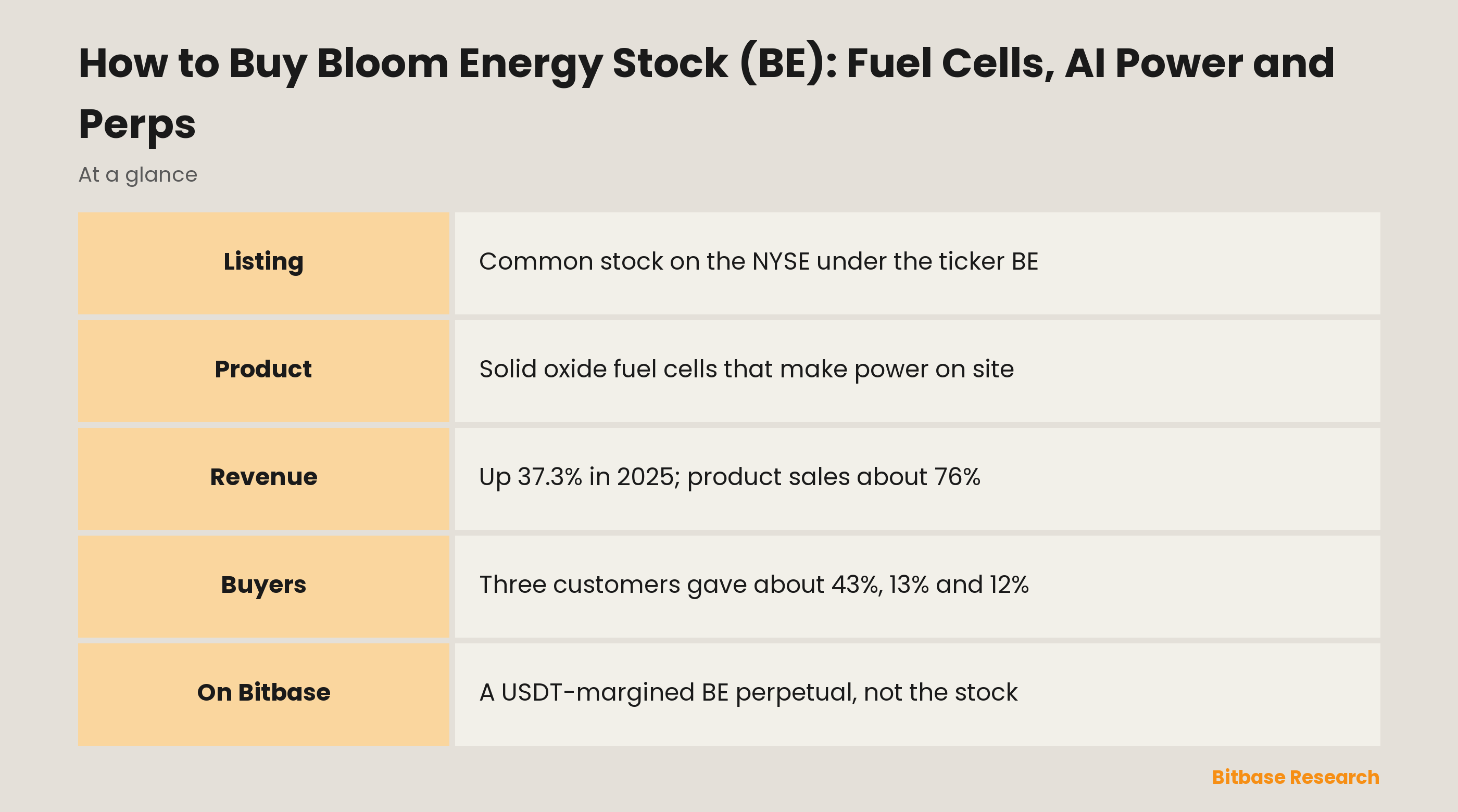
Alongside the rest of a US stock portfolio, Bloom Energy shares are bought through a broker with access to the New York Stock Exchange, where they trade as BE. The company makes solid oxide fuel cells that turn natural gas, biogas or hydrogen into electricity on site without burning the fuel, and it reports a significant increase in demand from AI data centres. On Bitbase, BE is a USDT-margined perpetual that follows the share price without conveying ownership, and a third-party tokenized version is listed on spot.
What Does Bloom Energy Do?
Bloom Energy builds power plants that sit beside the buildings they supply. Its main product, the Bloom Energy Server, is a high-temperature solid oxide fuel cell system that, in the words of its annual report, converts fuel "into electricity at high-density without combustion or moving parts." Most installations run on natural gas, and because nothing burns, the exhaust is a relatively pure stream of carbon dioxide that third-party equipment can capture.
The systems are built from repeated blocks of printed cells, stacks and columns, so one design scales from hundreds of kilowatts to hundreds of megawatts. The same platform makes the Bloom Electrolyzer, which uses electricity to split steam into hydrogen and oxygen, but so far "nearly all of our product revenue has been attributable to sales of our power generating Energy Server system."
Customers fall into three markets: data centres, where buyers range from hyperscalers to colocation operators; commercial and industrial sites; and utilities. The installed fleet, at approximately 1,100 sites in nine countries, is monitored around the clock from two centres, one in the US and one in India.
The company was incorporated in Delaware on 18 January 2001 as Ion America Corporation, took the Bloom Energy name in 2006 and listed on the NYSE in July 2018. Its main factories are in Fremont, California, and Newark, Delaware.
The 10-K measures Bloom against gas engines, turbines, combined-cycle plants, renewables with storage and small modular reactors, noting that "major turbine OEMs are currently supply constrained." The GE Vernova stock guide covers one turbine maker.
How Bloom Energy Makes Money
Revenue has four lines: product, the sale of Energy Server systems; installation; service, the maintenance agreements on the fleet; and electricity sold under contracts, some structured as leases. In 2025 total revenue rose 37.3%. Product revenue grew 41.1% and made up about 76% of the total, with installation at about 10%, service about 11% and electricity about 3%.
The buyer is often not the user. Most end customers "prefer to pay for the power they will consume," so Bloom sells the system to a financier or partner that owns it and sells the electricity to the site. Bloom counts those buyers as its customers, which concentrates revenue: three of them produced about 43%, 13% and 12% of 2025 revenue, the largest a related party.
In August 2025 Bloom and Brookfield set up a five-year financing framework for future Bloom fuel cell projects, and the joint ventures formed under it count as related parties. The 10-K links the year's higher demand "largely" to "a major hyperscaler project facilitated through the joint venture with Brookfield."
Total gross margin rose to 29% from 27% in 2024, with service turning a profit, while product gross margin slipped to 35% from 37%, partly on write-downs of electrolyzer assets. Bloom made an operating profit, but interest, charges on exchanging convertible notes and its share of joint-venture losses left a net loss for common stockholders.
The US produced 81% of 2025 revenue, against 74% in 2024 and 70% in 2023. South Korea is the second-largest market, where commercial operations began in 2018 with SK ecoplant as partner and the fleet had reached nearly 682 MW by the time of the 10-K.
BE Stock at a Glance
| Item | Detail |
|---|---|
| Exchange | New York Stock Exchange |
| Ticker | BE |
| Share class | Common stock, the only class; called Class A common stock until May 2026 |
| Industry | Onsite power generation with solid oxide fuel cells |
| Index membership | S&P 500, per SPY holdings on 29 October 2026 |
| Headquarters | San Jose, California |
| Incorporated | Delaware, January 2001, as Ion America Corporation |
| Listed | July 2018, on the NYSE |
| Fiscal year end | 31 December |
| Dividend policy | No cash dividend ever declared; none intended in the foreseeable future |
| Founder and CEO | KR Sridhar, who is also chairman |
The live quote and chart are on the Bloom Energy stock page on Bitbase.
How to Buy Bloom Energy Stock
A broker purchase takes six steps:
1. Choose a broker that offers NYSE shares and accepts residents of your country.
2. Open and verify the account. The IRS asks a foreign person to "Submit Form W-8 BEN when requested by the withholding agent or payer," so expect the form if you live outside the US.
3. Deposit money. If it is not in US dollars, the exchange into dollars is part of what you pay.
4. Search for BE. Some listings, State Street's SPY holdings file among them, still label it Class A; it is the same, and only, listed stock.
5. Choose how to order. A market order takes whatever price is on offer, while a limit order caps what you pay and may stay unfilled; buying part of a share works only if the broker offers it.
6. Know where any return comes from. With no dividend, investors "must rely on sales of their common stock after price appreciation, which may never occur," the 10-K says.
Outside the US, what you buy is the same Delaware common stock, with no depositary receipt and so no ADR ratio in between. Tax treatment varies by country of residence, and nothing here is tax advice.
Through a fund, exposure is indirect: any S&P 500 tracker owns a little Bloom among its other members.
Trading BE on Bitbase
Bitbase lists a BE perpetual futures contract that follows Bloom Energy's share price and is margined and settled in USDT. Holding it brings no share, no voting right and no claim on Bloom itself. Instead it offers a position with no expiry that can be long or short, can carry leverage, and stays open for trading through NYSE nights and weekends.
Funding passes at intervals from the more crowded side of the market to the other, keeping the contract near the stock, and a position whose margin runs out is liquidated against the mark price rather than the last trade. News released while New York is shut can move the perpetual first, so the shares may open elsewhere. Both are covered in more depth in the stock perpetual futures guide.
Bitbase's tokenized stock spot market also carries a tokenized version of Bloom Energy, priced in USDT. A third party issues it and is named on that market's page; the issuer's terms define what one token stands for and whether redemption is possible, so read them first.
Funding interval and formula, margin tiers, maximum leverage and the treatment of mark price and funding outside NYSE hours are fixed in the BE contract rules; check them before opening a position. Bitbase's TradFi page lists the rest of its stock-linked markets.
What Moves BE Stock
AI data-centre orders. Bloom says it has "recently seen a significant increase in demand" from AI data centres short of grid power, and it counts Oracle among its partners for on-site power at such sites. The 10-K also warns that slower AI adoption, tighter financing or faster grid connections "could adversely affect AI data centers' demand for our solutions."
Utility contracts. Under a supply agreement announced in November 2024, American Electric Power "is expected to procure up to 1 GW" of Bloom's fuel cells, starting with an initial order of 100 MW.
Uneven timing. A sale takes "typically 8 to 12 months" to close and installation another six to twelve months or more, and delivery and installation drive when revenue is recognised, so a few large sites can move results between quarters.
Gas and grid prices. The economics depend on the local gas price against "the cost of electricity available from alternative sources." Dearer gas or cheaper grid power weakens the case.
Policy. US projects lean on tax credits under the Inflation Reduction Act of 2022 and the One Big Beautiful Bill Act, and changes to such incentives "could cause our revenue to decline." Grid rules matter too: a December 2025 FERC order on onsite generation in the PJM market remains open to rehearing and appeal.
New shares. In November 2025 Bloom sold zero-coupon convertible notes due 2030 and swapped part of its green convertible notes due 2028 and 2029 for cash and stock; conversions settled in shares dilute holders. SK ecoplant, the Korean partner, also cut its stake from 10.3% of the Class A stock at the end of 2024 to 2.5% a year later.
Vulnerabilities in Bloom's Fuel Cell Business
Concentration and financing. One related-party customer supplied about 43% of 2025 revenue, and Bloom's ability "to deploy our backlog is directly tied to our ability to secure project financing, which is often an unpredictable process."
The natural gas label. Because its products can run on fossil fuel, Bloom says it may face "a heightened risk of regulation, the loss of certain incentives," along with shifts in how customers buy energy.
Supply and tariffs. Fuel cells need "rare earth elements, specialty alloys and industrial commodities," and Bloom expects the 50% US tariffs on imported steel, aluminium and copper "to adversely impact our costs."
Fleet life. Warranties rest on estimates of how long systems last, and Bloom concedes "we do not have a long history at a large scale, and our estimates may prove to be incorrect."
Losses and the stock. "Since our inception in 2001, we have incurred significant net losses," the 10-K says, and it calls the share price volatile, listing "the issuance of negative reports from short sellers" among the triggers.
The Bitbase products. Leverage magnifies losses, funding accumulates while a perpetual stays open, and a jump in price when the NYSE opens can push a position past liquidation. The tokenized version adds reliance on its issuer.
Where Bloom Energy's Numbers Come From
The company figures above come from SEC filings under CIK 1664703. The 10-K holds the business description, risk factors, revenue by line and, in its first note, customer concentration. Quarterly results come on 8-K and 10-Q, and a May 2026 8-K records the vote that removed the old Class B provisions. The investor site, investor.bloomenergy.com, collects the filings, quarterly results and an events calendar.
Bloom Energy Stock FAQ
Does Bloom Energy pay a dividend?
No. Bloom has "never declared or paid any cash dividends on our capital stock," does not intend to in the foreseeable future, and under a credit agreement signed in December 2025 cannot pay dividends, with limited exceptions.
Is BE stock Class A or common stock?
One class, now simply called common stock. Bloom went public with two: Class B carried ten votes a share and, right after the 2018 offering, about 98% of the voting power. On 27 July 2023 every Class B share converted automatically into one Class A share, and after a stockholder vote on 21 May 2026 removed the outdated Class B provisions, Class A was renamed common stock. The ticker has always been BE.
Is Bloom Energy in the S&P 500?
Yes, on the evidence of 29 October 2026, when SPY, State Street's S&P 500 fund, held BE. Index membership changes, so the date matters.
What fuel does a Bloom Energy Server use?
Natural gas, biogas, hydrogen or a blend, and most deployments use natural gas. The 10-K says the systems can switch to hydrogen or biogas if and when those fuels become "more readily and economically available."
Can I buy Bloom Energy stock with crypto?
Not the shares themselves: brokers sell them for money, so crypto has to be converted first. On Bitbase, USDT can trade the BE perpetual, a derivative linked to the price that holds no shares, or the tokenized version on spot under its issuer's terms. Buying stocks with crypto compares the routes.
Conclusion
Buying Bloom Energy stock takes one NYSE order; judging it takes longer. Revenue rests on Energy Server sales to a few large buyers, and demand has tilted towards AI data centres. For USDT exposure without owning any of the company, the Bitbase perpetual and the tokenized version are separate instruments with their own costs.
Related reading
Other Bitbase articles on this topic:
- How to Buy 3M Stock (MMM): Post-it Notes, PFAS and Solventum
- How to Buy AMETEK Stock (AME): Instruments and the Indicor Deal
- How to Buy Boeing Stock (BA): 737 Output, Backlog, Dividend
- How to Buy Keysight Stock (KEYS): Spirent, AI Networks, Buybacks
Disclaimer: This article is educational content from Bitbase Academy, provided for information only. It explains what a company or fund does and how the instruments referenced here differ from one another; it does not constitute investment, trading, tax, or financial advice, and it is neither a recommendation nor an endorsement of any security, token, or trading strategy. A tokenized stock is issued by a third party and is designed to give economic exposure to an underlying asset: it is not a share, it carries no shareholder rights, and it depends on the issuer's structure, eligibility rules, and redemption terms, which the issuer can change. Perpetual futures are leveraged derivatives that hold no underlying asset and can be liquidated, and trading hours, product availability, and eligibility differ by instrument and by jurisdiction and can change at any time. Written as of October 2026; verify everything yourself through company filings, the issuer's own documentation, and the product pages of the venue you trade on.
References
[1] Bloom Energy Form 10-K for 2025 (SEC EDGAR) www.sec.gov
[2] Bloom Energy Form 10-Q, third quarter of 2026 (SEC EDGAR) www.sec.gov
[3] Bloom Energy Form 8-K, May 2026: annual meeting and charter amendments (SEC EDGAR) www.sec.gov
[4] Bloom Energy IPO prospectus, July 2018 (SEC EDGAR) www.sec.gov
[5] State Street: SPY daily holdings, 29 October 2026 www.ssga.com
[6] IRS: About Form W-8 BEN www.irs.gov
[7] Bloom Energy investor relations investor.bloomenergy.com





