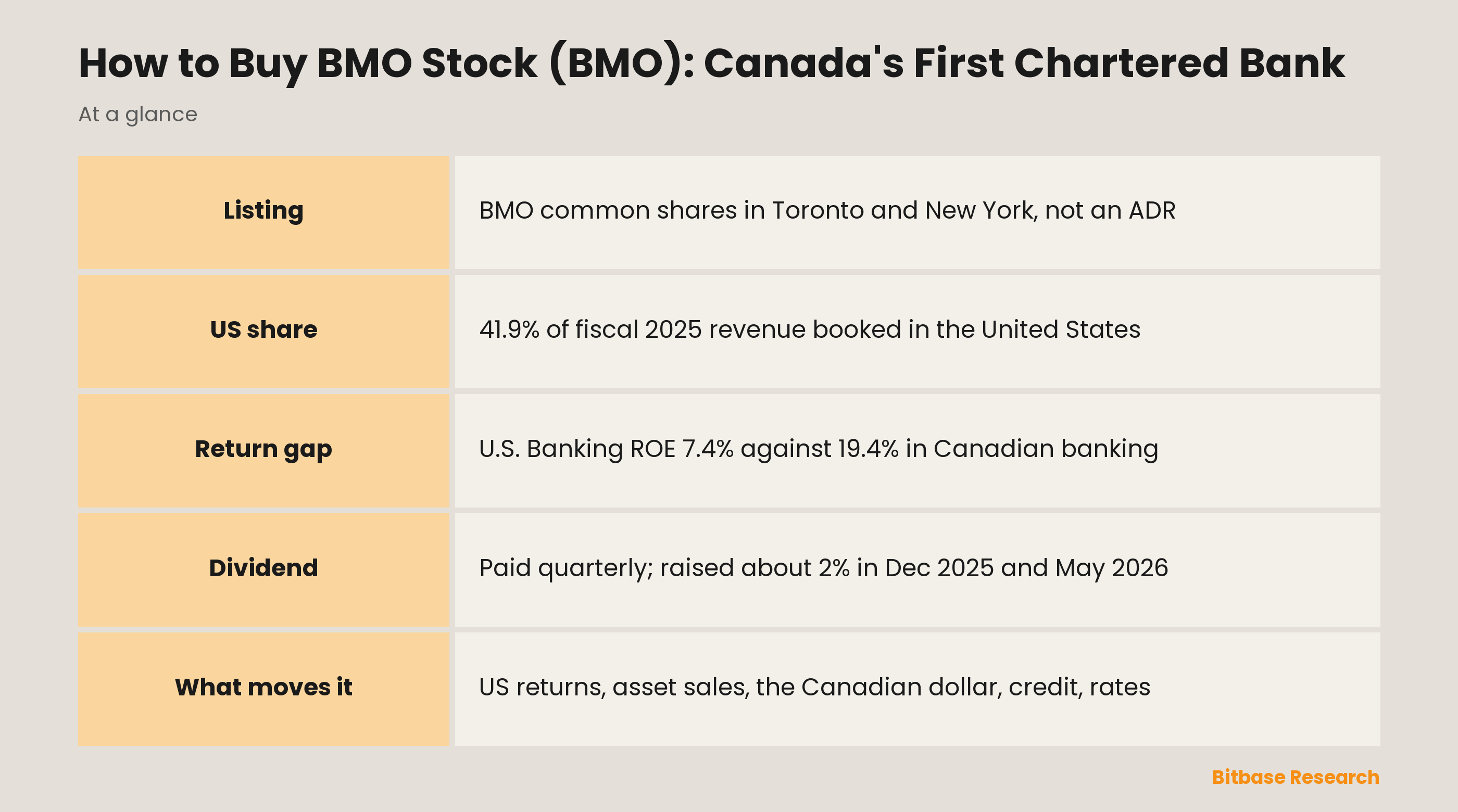
Bank of Montreal has a single class of common shares, quoted under the ticker BMO on both the Toronto Stock Exchange and the New York Stock Exchange, so to buy BMO stock you need a brokerage account with access to either market; there is no depositary receipt to deal with. The bank behind the ticker was incorporated in 1821 as the first Canadian chartered bank, and since buying Bank of the West in 2023 it has leaned heavily on the United States, where 41.9% of its fiscal 2025 revenue was booked.
What Does BMO Do?
Bank of Montreal opened for business in Montreal in 1817. Four years later an Act of Lower Canada incorporated it as the first Canadian chartered bank, and since 1871 it has operated under the Bank Act (Canada), which names it in Schedule I and serves as its charter. The legal head office is still on rue Saint Jacques in Montreal; the executive offices are at First Canadian Place in Toronto. The group markets itself as BMO Financial Group, and its fiscal 2025 annual report was its 208th.
BMO reports four operating segments, with treasury, technology and operations grouped in Corporate Services:
Canadian Personal and Commercial Banking serves individuals and businesses across Canada through branches, contact centres and digital channels, from deposits, mortgages and cards to commercial lending and payments.
U.S. Banking runs the American franchise through BMO Bank N.A., the main subsidiary of BMO Financial Corp., a Chicago-based holding company that Bank of Montreal owns outright. Since the fourth quarter of fiscal 2025 it also includes US private wealth, previously reported in Wealth Management.
Wealth Management serves Canadian clients through private wealth, the BMO InvestorLine online brokerage, Global Asset Management and insurance.
Capital Markets combines Investment and Corporate Banking, which raises debt and equity and advises on mergers, with Global Markets, which trades rates, currencies, credit, equities and commodities for clients.
Three acquisitions built today's shape. On 1 February 2023 BMO completed its purchase of Bank of the West from BNP Paribas; from the following quarter its results flowed mainly into U.S. Banking, lifting revenue, expenses and loan-loss provisions there. On 1 June 2023 it bought the AIR MILES Reward Program business, now part of Canadian P&C. On 1 November 2025 it closed the acquisition of Burgundy Asset Management, an independent Canadian wealth manager, adding to Wealth Management.
How BMO Makes Money, Segment by Segment
Fiscal 2025 ended on 31 October 2025. Net interest income, the spread between what BMO earns on loans and securities and what it pays for deposits and other funding, made up 59.2% of total revenue. The remainder came from fees, trading, insurance and other sources. Reported net income rose 19.1% on the year.
| Segment | Revenue share, 2025 | Net income share, 2025 | Return on equity, 2025 |
|---|---|---|---|
| Canadian P&C | 33.6% | 34.8% | 19.4% |
| U.S. Banking | 31.5% | 29.7% | 7.4% |
| Wealth Management | 14.5% | 14.6% | 45.4% |
| Capital Markets | 20.4% | 20.9% | 14.0% |
Shares are of the four operating segments' combined totals, from the segment note to the 2025 financial statements; Corporate Services, which posted a net loss, is left out. Return on equity is BMO's own measure, calculated on the capital it allocates to each segment.
U.S. Banking earned close to a third of segment profit, but it returned 7.4% on its allocated capital, against 19.4% in Canadian P&C and 10.6% for the bank as a whole. In US dollars, the segment's revenue grew 3% in fiscal 2025 and its net income 35%, reflecting lower provisions for credit losses, higher revenue and lower expenses. Commercial Banking produced 54.5% of the segment's US-dollar revenue, Personal and Business Banking 35.4% and Private Wealth 10.2%.
Canada moved the other way. Canadian P&C lifted revenue by 7.2%, yet its net income fell 4.7% as provisions for credit losses climbed. Wealth Management and Capital Markets grew fastest, with revenue up 15.3% and 14.3% respectively.
Measured by where revenue was booked, 52.1% came from Canada, 41.9% from the United States and 6.1% from other countries. That split ties BMO's results to two economies and to the exchange rate between their currencies.
BMO Stock at a Glance
| Item | BMO |
|---|---|
| Where it trades | TSX in Toronto and NYSE in New York |
| Ticker | BMO in both markets |
| Security | Common shares, the single class on the 40-F's list of NYSE-registered securities; no depositary receipt |
| Quote currency | CAD on the TSX, USD on the NYSE |
| Business | Personal and commercial banking, wealth management, capital markets |
| Headquarters | Head office in Montreal, executive offices in Toronto |
| Fiscal year | Ends 31 October |
| Filings | Annual 40-F and quarterly 6-K; IFRS accounts in Canadian dollars |
| Dividend policy | Quarterly, at the board's discretion; adjusted payout target 40% to 50% |
| Index membership | Held by iShares XIU (S&P/TSX 60); no SPY (S&P 500) position, per 28 October 2026 holdings files |
| EDGAR CIK | 927971 |
For the live price, open Bitbase's BMO stock page; during the hours both exchanges are open, the Toronto and New York quotes differ mainly by the exchange rate between the two dollars.
How to Buy BMO Stock on the TSX or NYSE
The shares listed in New York are the shares listed in Toronto, so the real decision is about access and currency. TD Bank stock works the same way, as one class of common shares in both cities.
1. Confirm what your broker can reach. Some brokers offer only US exchanges, others Toronto too; check that the firm is authorised where you live.
2. Open the account under your actual tax residence. It later shapes how a Canadian dividend is taxed.
3. Choose the currency deliberately. The TSX line trades in Canadian dollars and the NYSE line in US dollars; the exchange spread may exceed the trading fee.
4. Match the name before you trade. The result should read Bank of Montreal common shares; in Toronto, the bank's Class B Preferred Shares Series 44 trade under BMO.PR.E, a separate security.
5. Pick the order type. Use a limit order to name the highest price you will pay; a market order accepts whatever the order book offers when it lands.
6. Decide on the size. Not every broker sells fractions of a share, and those that do may not pass on voting rights.
7. Save the paperwork. Trade confirmations and dividend statements are what you will need for cost basis and tax withheld.
Tax on the dividend. BMO's annual filings do not say what a shareholder outside Canada pays. Their one tax point is that BMO designates its common and preferred dividends as "eligible dividends" under the Income Tax Act (Canada), a label that matters to Canadian taxpayers. Ask your broker how much will be withheld from a Canadian dividend paid into your account and whether your home country taxes it again; the NYSE line is the same Canadian security.
Reinvesting dividends. Under the Shareholder Dividend Reinvestment and Share Purchase Plan, common shareholders can have their cash dividends reinvested in more BMO shares. Since the third quarter of fiscal 2024 the plan has bought those shares on the open market without a discount, an arrangement BMO says applies until further notice. If your shares sit with a broker, ask whether it can enrol them.
Owning it through a fund. BMO appears in the 28 October 2026 holdings file of BlackRock's iShares S&P/TSX 60 Index ETF (XIU); S&P 500 funds are not a route, as the FAQ below explains.
What Moves BMO Stock
Returns from the US bank. Chief executive Darryl White presents recent quarterly results as progress against "the commitments we made at our March Investor Day to elevate ROE and accelerate growth." U.S. Banking, with the lowest return of the four segments and close to a third of segment revenue, is where that aim is tested most directly.
Pruning the portfolio. BMO says its sales improve capital efficiency and free resources for core markets. The sale of 138 US branches to First-Citizens Bank & Trust Company closed on 4 September 2026. In May 2026 BMO agreed to sell its Transportation Finance and Vendor Finance businesses to Stonepeak while taking an equity interest of about 19.9% in the new company. In August 2026 it agreed with Royal Bank of Canada to sell Moneris Solutions, which the two banks own in equal halves, to Francisco Partners. BMO estimated that the three divestitures would add about 50 basis points to its CET1 ratio once closed. At the time of the third-quarter 2026 report, it expected the Stonepeak sale to close in the fourth quarter of fiscal 2026 and the Moneris sale by the end of the first quarter of fiscal 2027.
The Canadian dollar against the US dollar. With 41.9% of revenue booked in the United States, the exchange rate changes what US profits are worth once translated into Canadian dollars. The 2025 MD&A says hedges may be used to offset part of that effect, "although we did not enter into any hedging arrangements in the current or prior year," and that every one-cent move in the Canadian dollar/US dollar rate shifts the Canadian-dollar value of US pre-tax earnings.
Consumer credit in Canada. Provisions for credit losses in Canadian P&C rose to 70 basis points of average loans in fiscal 2025, from 51 basis points a year earlier, driven by unsecured consumer lending and by commercial accounts. The segment outlook ties this to jobs: "Rising unemployment led to higher delinquencies and provisions for credit losses in unsecured consumer lending products." In the third quarter of 2026, total provisions were lower than a year earlier.
Interest rates, mostly through the US book. BMO's structural earnings sensitivity estimates how a one-point shift in interest rates would change pre-tax income from its structural balance sheet over the following 12 months. A fall would cut earnings, and 91.9% of that estimated hit sits in the US balance sheet; for a rise, the US share of the estimated gain is 70.6%.
Capital returned to shareholders. BMO bought back no shares in fiscal 2023 or 2024, then cancelled 22.2 million in fiscal 2025. Its CET1 ratio was 13.3% at the end of fiscal 2025 and 13.0% on 31 July 2026. With approval from the TSX and OSFI, the Canadian bank regulator, a new buyback for up to 25 million common shares, equal to about 3.6% of the common shares in issue on 31 August 2026, runs from 8 September 2026 to no later than 7 September 2027.
Risks BMO Lists in Its Own Reports
Trade with the United States. The 2025 MD&A warned that "the upcoming renegotiation of the USMCA in 2026 carries greater risk as termination could lead to increasingly disruptive and costly trade tariffs." By the third quarter of 2026 the US had decided not to extend the agreement's initial terms on 1 July 2026, and BMO wrote that, given its "integrated North American footprint," it is assessing potential impacts on clients and operations.
Jobs and household borrowing. "Canadian and U.S. unemployment rates increased in fiscal 2025, amid softening labour market conditions, which contributed to higher delinquencies and credit losses in the bank's consumer lending portfolios." In Canada, the bank traced the increase in provisions mainly to unsecured consumer products.
Cyber attacks. "BMO is the frequent target of attempted cyber attacks," the bank states, and a successful one could expose customer data, disrupt services and bring litigation and reputational harm.
US capital rules. BMO Financial Corp. is regulated as a Category III firm under the Federal Reserve Board's Enhanced Prudential Standards. New US rules implementing the Basel III reforms would likely revise the capital framework for BMO Financial Corp. and BMO Bank N.A., and on timing the bank writes: "It is currently not clear when the rules will be proposed or issued."
Dilution in a failure scenario. BMO's preferred shares and certain notes carry non-viability contingent capital (NVCC) terms: on specified trigger events relating to the bank's viability, they convert automatically into common shares. At the floor price in their terms, the third-quarter 2026 report puts the conversion at about 3.9 billion common shares, against roughly 695 million outstanding at the end of August 2026.
Beyond these, holding a single bank concentrates risk in one lender, and since BMO declares dividends in Canadian dollars, anyone spending another currency carries exchange-rate risk on price and income alike.
How to Research BMO Filings Yourself
On EDGAR, search for CIK 927971. The fiscal 2025 annual report arrived on 4 December 2025 as a Form 40-F bundling three documents: the annual information form (AIF), management's discussion and analysis (MD&A) and the audited financial statements. Quarterly reports and press releases come as Form 6-K; the latest, for the third quarter of fiscal 2026, is dated 25 August 2026. The same material is posted on SEDAR+, Canada's filing system, and on BMO's investor relations pages.
The AIF's three-year history lists acquisitions, appointments and buyback programs in date order; the MD&A's top and emerging risks section holds the warnings quoted above; and the segment note in the financial statements carries the figures behind the revenue table. R1.htm, the machine-readable cover of the 40-F, shows a single class registered under Section 12(b). For quotes on comparable banks, browse Bitbase stock pages.
BMO Stock: Frequently Asked Questions
Is BMO the same company as Bank of Montreal?
Yes. Bank of Montreal is the legal name of the company whose shares trade as BMO, and it brands its group as BMO Financial Group. BMO Bank N.A., the American bank, is a subsidiary held through the wholly owned BMO Financial Corp., so it has no shares of its own on the market; buying BMO stock buys the Canadian parent.
Does BMO pay a dividend?
Yes. The board declares a common dividend each quarter. Dividends declared for fiscal 2025 rose 5%, and the adjusted payout of 53% sat above the bank's target range. The board raised the quarterly dividend by about 2% in December 2025 and again by about 2% in May 2026, then held it unchanged in August 2026 for the payment due on 26 November 2026. BMO describes its dividend payout record as the longest-running of any company in Canada. Under the Bank Act, no dividend may be declared if paying it would contravene capital adequacy or liquidity rules, and preferred dividends come first.
Is BMO in the S&P 500?
No. State Street's SPY holdings file dated 28 October 2026 has no BMO entry. In Canada it is held by funds that track the S&P/TSX 60, including BlackRock's iShares XIU.
Why did BMO sell 138 US branches?
BMO said the sale was meant "to support the optimization of our U.S. branch network and the redeployment of capital and resources." Announced on 16 October 2025 and completed on 4 September 2026, it moved branches in North Dakota, South Dakota, Wyoming, Nebraska, Kansas, Missouri, Oklahoma and Idaho, plus selected branches in Minnesota, Oregon and Illinois, to First-Citizens Bank & Trust Company.
Can I buy BMO stock with crypto?
Not directly. A broker that sells BMO shares takes Canadian or US dollars, not crypto, so you would first convert crypto into one of those currencies and transfer the cash to the brokerage account. Work out the tax before you do: in many countries, selling crypto for cash can create a tax bill.
Conclusion
The mechanics are simple: a broker with access to the TSX or the NYSE, and a decision about which currency to pay in. What the order buys is Canada's first chartered bank, now a business with close to a third of its segment profit in the United States, a US arm that still earns far less on its capital than the Canadian one, and a portfolio being reshaped with the stated aim of raising returns. Before sizing a position, read the most recent 40-F and 6-K reports and find out what tax your country applies to a dividend from Canada.
Related reading
Other Bitbase articles on this topic:
- How to Buy Barclays Stock (BCS): ADS Ratio and the Ring-Fence
- How to Buy BBVA Stock (BBVA): Spanish ADS, Mexican Profits
- How to Buy BNY Stock (BNY): Custody Bank Formerly Traded as BK
- How to Buy Scotiabank Stock (BNS): Latin America and KeyCorp
Disclaimer: This article is educational content from Bitbase Academy, provided for information only. It explains what a company or fund does and how the instruments referenced here differ from one another; it does not constitute investment, trading, tax, or financial advice, and it is neither a recommendation nor an endorsement of any security, token, or trading strategy. A tokenized stock is issued by a third party and is designed to give economic exposure to an underlying asset: it is not a share, it carries no shareholder rights, and it depends on the issuer's structure, eligibility rules, and redemption terms, which the issuer can change. Perpetual futures are leveraged derivatives that hold no underlying asset and can be liquidated, and trading hours, product availability, and eligibility differ by instrument and by jurisdiction and can change at any time. Written as of October 2026; verify everything yourself through company filings, the issuer's own documentation, and the product pages of the venue you trade on.
References
[1] Bank of Montreal Form 40-F, fiscal 2025: cover page and securities registered under Section 12(b) (SEC EDGAR) www.sec.gov
[2] Bank of Montreal Annual Information Form 2025: corporate structure, three-year history, share capital, dividends and listings (Form 40-F exhibit) www.sec.gov
[3] BMO Financial Group 2025 management's discussion and analysis: segment results, risks, interest rate and currency sensitivity, capital and dividends (Form 40-F exhibit) www.sec.gov
[4] Bank of Montreal 2025 audited consolidated financial statements: income statement and operating and geographic segment note (Form 40-F exhibit) www.sec.gov
[5] BMO Financial Group fourth quarter and fiscal 2025 earnings release, 4 December 2025: first quarter 2026 dividend increase (Form 6-K) www.sec.gov
[6] BMO Financial Group second quarter 2026 earnings release, 27 May 2026: third quarter dividend increase and Stonepeak agreement (Form 6-K) www.sec.gov
[7] BMO Financial Group third quarter 2026 report to shareholders, 25 August 2026: divestitures, Moneris sale, capital, NVCC, dividend and trade risks (Form 6-K) www.sec.gov
[8] Bank of Montreal press release, 2 September 2026: TSX and OSFI approval of the normal course issuer bid for up to 25 million shares (Form 6-K) www.sec.gov
[9] BMO newsroom, 4 September 2026: BMO completes sale of 138 U.S. branches to First Citizens Bank newsroom.bmo.com
[10] BMO Financial Group Q3 2026 corporate fact sheet: dividend payout record and operating segment overview (BMO Investor Relations) www.bmo.com
[11] BlackRock Canada, iShares S&P/TSX 60 Index ETF (XIU): fund holdings as of 28 October 2026 www.blackrock.com
[12] State Street, SPDR S&P 500 ETF Trust (SPY): daily holdings as of 28 October 2026 www.ssga.com





