
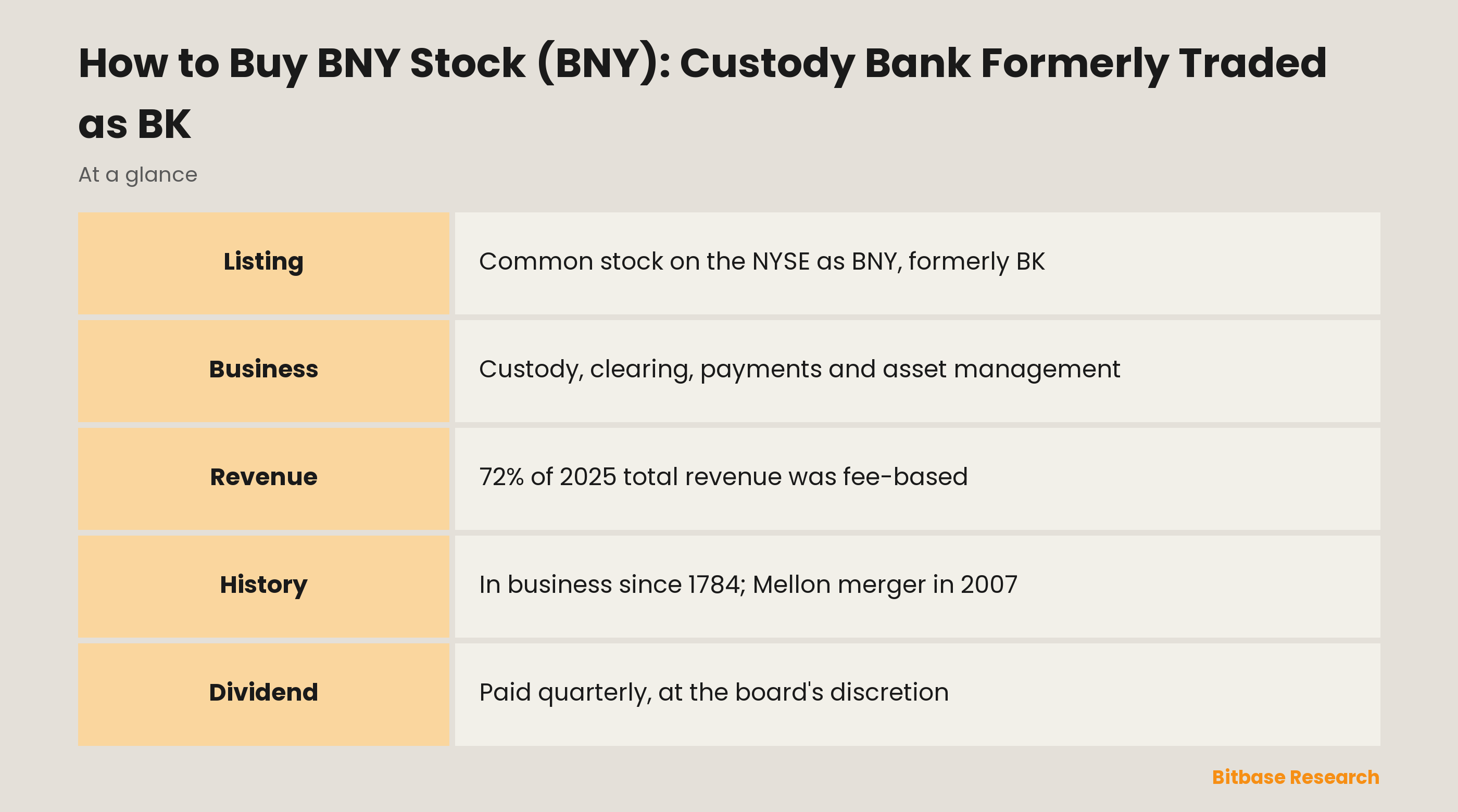
Since its ticker changed from BK on 21 May 2026, the common stock of The Bank of New York Mellon Corporation has traded on the New York Stock Exchange as BNY, so to buy it you need a brokerage account with access to that exchange and an order for the common shares under the new symbol. The bank behind it earns mainly fees rather than interest: it keeps and services securities for institutions, clears US government bonds and moves payments, and 72% of its 2025 total revenue was fee-based.
What Does BNY Do?
BNY is the brand of The Bank of New York Mellon Corporation, a Delaware holding company headquartered at 240 Greenwich Street in New York. The 10-K calls it "a global financial services platforms company," and the annual report says it "serves over 90% of Fortune 100 companies and nearly all the top 100 banks globally." Robin Vince is chief executive officer and chairman. At the end of 2025 the group had about 48,100 full-time employees, roughly 60% of its staff outside the United States.
With its subsidiaries, BNY "has been in business since 1784," the year its history page credits Alexander Hamilton with founding the Bank of New York. The present holding company was created on 1 July 2007, when The Bank of New York Company, Inc. and Mellon Financial Corporation merged into The Bank of New York Mellon Corporation, still the legal name. In 2024 the company started presenting itself simply as BNY instead of BNY Mellon, and in May 2026 the ticker followed. Results are reported in three segments:
Securities Services is the custody side. Asset Servicing safekeeps assets and handles fund accounting, ETF servicing, transfer agency, securities lending and foreign exchange, and it lists "digital asset custody and administration services" among its offerings. Issuer Services combines Corporate Trust, which acts as trustee and paying agent for bond issuers, with Depositary Receipts, which ran 1,614 programs at the end of 2025 for companies from more than 50 countries.
Market and Wealth Services sells infrastructure to other financial firms. Pershing, reported since 2026 as Wealth Solutions, provides execution, clearing, custody and technology to broker-dealers, wealth managers and registered investment advisers. Payments and Trade handles payments, liquidity management and trade finance. Clearance and Collateral Management settles equity and bond trades, acts as custodian for tri-party repo collateral and is, in the annual report's words, "the primary provider of U.S. government securities clearance."
Investment and Wealth Management is the asset manager, with firms such as BNY Investments Dreyfus for cash funds, BNY Investments Mellon for index strategies, Insight Investment for fixed income and BNY Investments Newton for equity and multi-asset portfolios, plus a wealth business for individuals, families and institutions.
An Other segment holds corporate treasury activities, including the securities portfolio.
Besides banks and asset managers, the annual report names "financial technology firms, stablecoin issuers, outsourcing companies and data processing companies" as rivals. For performance share awards, the 2026 proxy statement compares shareholder return with a peer group that includes State Street, Northern Trust, BlackRock and Morgan Stanley.
How BNY Makes Money
A typical bank earns its living by charging borrowers more than it pays savers. BNY says plainly that this is not its model: "Our principal commercial focus is on fee-based business, which is distinct from commercial banking institutions that earn most of their revenues from loans and other traditional interest-generating products and services." Its investment services fees depend mainly on the value of assets it holds or administers and on transaction volumes; management fees depend on the level and mix of assets under management.
| Revenue line | Share of 2025 total revenue |
|---|---|
| Investment services fees | 50.9% |
| Investment management and performance fees | 15.4% |
| Foreign exchange revenue | 3.5% |
| Financing-related, distribution and servicing fees | 1.9% |
| Investment and other revenue | 3.8% |
| Net interest income | 24.6% |
Calculated from the 2025 consolidated figures and rounded, so the column does not add up exactly.
Investment services fees rose 8% in 2025 on client activity, new business and higher market values. Net interest income grew 15%, mainly because maturing securities were reinvested at higher yields, and the net interest margin widened to 1.33% from 1.22%. Total revenue rose 8% while noninterest expense rose 3%.
| Segment | 2025 | 2024 |
|---|---|---|
| Securities Services | 48.5% | 47.9% |
| Market and Wealth Services | 34.9% | 33.7% |
| Investment and Wealth Management | 16.3% | 18.2% |
Shares of total segment revenue from the segment note of the 2025 annual report; the small Other segment makes up the rest.
Growth came from the infrastructure lines: Payments and Trade revenue rose 15%, Clearance and Collateral Management 13%, Asset Servicing and Pershing 9% each, and Issuer Services 8%. Investment Management fell 6% and Wealth Management was flat. The pre-tax operating margin was 49% in Market and Wealth Services, 33% in Securities Services and 17% in Investment and Wealth Management, against 35% for the whole company, up from 31% in 2024.
Assets under custody and/or administration grew 14% during 2025 and at year-end were 38% equities and 62% fixed income. Assets under management rose 7%, although long-term strategies had net outflows.
BNY Stock at a Glance
| Field | BNY |
|---|---|
| Listing venue | NYSE (New York Stock Exchange) |
| Ticker | BNY (common stock); BK until May 2026 |
| Other NYSE lines | BNY/P (preferred capital securities of Mellon Capital IV) and BNY PRK (depositary shares in Series K preferred stock) |
| CUSIP | 064058100, unchanged by the ticker switch |
| Issuer | The Bank of New York Mellon Corporation, a bank holding company |
| Sector | Custody and asset servicing, clearing, payments, asset and wealth management |
| Index membership | S&P 500 |
| Headquarters | New York, New York |
| Incorporated | Delaware |
| Financial year | Calendar year, closing on 31 December |
| Dividends | Paid each quarter on the common stock; the board decides each payment |
| Supervision | Federal Reserve for the holding company; FDIC, the New York State Department of Financial Services and the OCC for the banks |
| SEC filer number | CIK 1390777 |
Figures that change every trading minute, such as the quote and market value, are on Bitbase's BNY stock page.
How to Buy BNY Stock
BNY has one class of common stock and is not an ADR. The one trap is the rename: older articles and watchlists may still show BK.
1. Pick a broker with NYSE access. Plenty of brokers outside the US offer NYSE shares, and some US firms accept foreign clients; confirm the legal entity you sign with and the regulator it answers to.
2. Complete the account checks. Expect to fill in IRS Form W-8BEN if you are not a US person; the IRS says the form goes "to the withholding agent or payer," which for a share account means the broker.
3. Fund the account. If your savings are in another currency, weigh the conversion rate alongside the commission.
4. Check the listing. Type BNY into the search box and make sure the name shown is The Bank of New York Mellon Corporation common stock. BNY/P and BNY PRK share the prefix, and brokers spell them in different ways (EDGAR uses BNY-PK); those two are preferred securities, not the common shares.
5. Set the order. FINRA says a market order "generally will execute at or near the current bid or ask prices," but "you might not get the price you saw or were originally quoted, especially in fast-moving markets." A limit order caps the price, with "a chance your order doesn't get executed at all." The mechanics are covered in how market orders get filled.
6. Decide on fractional shares. "The availability of fractional share trading varies by brokerage firm," FINRA notes. Holding part of a share may mean you "might not have shareholder voting rights," and for now such holdings cannot move to another broker.
7. Save the paperwork. Trade confirmations and monthly statements are your record of what you paid and of every dividend received.
If you already owned BK. The company said holders did not need to do anything: positions at a broker or bank were updated automatically, and the legal name, capital structure and CUSIPs did not change.
Withholding on dividends. The IRS rule is that "most types of U.S. source income received by a foreign person are subject to U.S. tax of 30%," unless the tax code or a treaty between the United States and your country of residence sets a lower rate. Your home country may tax the dividends as well.
Indirect exposure. Because BNY is an S&P 500 member, any fund that replicates that index already holds a slice of it.
What Moves BNY Stock
Market levels and client activity. The annual report estimates that a 5% change in global equity markets, spread evenly over a year, would change fee revenue by less than 1%. Bond markets count as well, since 62% of assets under custody or administration were fixed income. The calendar matters too: volume-related fees "may decline" in the third quarter as clients trade less, while asset management performance fees are typically highest in the fourth.
Interest rates and deposits. Net interest income was 24.6% of 2025 revenue. It depends on the yields BNY earns on securities and on what it pays depositors; about 25% of average deposits were in currencies other than the dollar, roughly half of them in euros. When short-term rates are very low, money market fund fees are "typically waived to protect investors from negative returns," a 2026 10-Q explains.
Asset management flows. Investment and Wealth Management revenue fell 4% in 2025; its Investment Management line was hit mainly by the mix of asset flows and a change in how certain rebates are booked. The report adds that market and regulatory trends have increased "demand for lower fee asset management products and for performance-based fees."
Capital rules and payouts. BNY's stress capital buffer "has consistently remained at the 2.5% floor since the introduction of the SCB requirement in 2020," and the Federal Reserve said in February 2026 that current buffers would keep applying until 2027. As a US global systemically important bank it also carries a 1.5% surcharge. The CET1 ratio was 11.9% at the end of 2025, up from 11.2%. Dividends per share rose 12.4% in 2025 with a payout ratio of 27%, the share count fell 4.1% during 2025, a new buyback authorization was announced in April 2026, and in July 2026 the board approved a further 19% dividend increase.
The platform overhaul. BNY is "executing on a plan to transition our organization to a platforms operating model," expecting efficiencies and cost savings; expense growth against revenue growth is the test.
What Could Hurt a BNY Shareholder
These risk factors from the annual report sit closest to how BNY earns its money:
Processing failures. The first one reads: "Errors or delays in our operational and transaction processing, or those of third parties, may materially adversely affect our business, financial condition, results of operations and reputation."
Dependence on fees. "We are dependent on fee-based business for a substantial majority of our revenue," and those fees could suffer from "slowing market activity, weak financial markets, underperformance and/or negative trends in savings rates or in investment preferences."
Interest rates. "Levels of and changes in interest rates have impacted, and will in the future continue to impact, our profitability and capital levels, at times adversely."
Execution. "We may not realize some or all of the expected benefits of our transition to a platforms operating model."
Capital returns. "Although we have historically declared cash dividends on our common and preferred stock, we are not required to do so." The parent depends on dividends from its subsidiaries, which regulators can limit.
Legal matters. A 2026 10-Q describes lawsuits in Russian courts seeking assets that BNY holds but international sanctions have blocked, including a September 2025 judgment against BNY that it has appealed, and an SEC inquiry into Pershing LLC's compliance with SEC Rule 15c3-3.
Owning one company's shares concentrates your outcome in a single issuer, and for anyone who counts in euros, pounds or another currency, swings in the dollar change both the value of the holding and the income from it.
Following BNY Through Its Filings
BNY files on EDGAR under CIK 1390777, and its file names still begin with bk-. The 10-K, last filed in February 2026, is short because the substance sits in Exhibit 13.1, the annual report. Each quarter brings a 10-Q and an earnings 8-K with three attachments: the release, a financial supplement with line-of-business detail and the call presentation. Dividend decisions and stress test results come as 8-Ks; the May 2026 ticker announcement was published in the newsroom on bny.com. For a five-year yardstick, BNY's performance graph sets its shareholder return against the S&P 500 Financials Index and the S&P 500, and other listed companies can be found in the US stock directory on Bitbase.
BNY Stock FAQ
Why did the ticker change from BK to BNY?
BNY announced on 11 May 2026 that its common stock symbol would change from BK to BNY, effective 21 May 2026; the preferred lines moved from BK/P and BK PRK to BNY/P and BNY PRK. Holders did not have to act; BK and BNY are the same shares.
Is BNY the same company as BNY Mellon?
Yes. The legal name is still The Bank of New York Mellon Corporation, formed by the 2007 merger. BNY Mellon was the brand until 2024; the longer name survives in subsidiaries such as BNY Mellon, N.A.
Does BNY pay a dividend?
Yes, every quarter. In July 2026 the board approved a 19% increase, starting with the dividend payable on 7 August 2026. The board decides each payment, and the company stresses that it is "not required to do so."
Can I buy BNY stock with crypto?
Not directly. A broker sells you BNY shares for US dollars, so crypto would first have to be converted into cash, often a taxable disposal depending on your country, before you fund the account. BNY's digital asset custody is a service for institutional clients; owning its shares gives you no crypto at all, and a separate guide sets out the differences between crypto and stocks.
Is BNY in the S&P 500?
Yes. State Street's SPY, an ETF built to track the S&P 500, listed BNY among its holdings on 28 October 2026.
Does BNY offer digital asset custody?
Yes, within Asset Servicing, which lists "digital asset custody and administration services." The annual report gives no separate figures for it and warns that digital asset products "may introduce incremental or unique risks," particularly around cybersecurity and third-party dependencies.
Conclusion
Buying BNY is a routine NYSE order once you search for the new ticker and pick the common stock rather than a preferred line. Understanding the company takes more work, because this is not a lending bank: about half of revenue comes from investment services fees tied to asset values and volumes, about a quarter from interest on a deposit-funded balance sheet, and most of the rest from asset management. Read the segment tables and the latest quarterly release before deciding how much of your portfolio one custody bank should take.
Related reading
Other Bitbase articles on this topic:
- How to Buy Barclays Stock (BCS): ADS Ratio and the Ring-Fence
- How to Buy BBVA Stock (BBVA): Spanish ADS, Mexican Profits
- How to Buy BMO Stock (BMO): Canada's First Chartered Bank
- How to Buy Truist Stock (TFC): SunTrust Merger, Insurance Sale
Disclaimer: This article is educational content from Bitbase Academy, provided for information only. It explains what a company or fund does and how the instruments referenced here differ from one another; it does not constitute investment, trading, tax, or financial advice, and it is neither a recommendation nor an endorsement of any security, token, or trading strategy. A tokenized stock is issued by a third party and is designed to give economic exposure to an underlying asset: it is not a share, it carries no shareholder rights, and it depends on the issuer's structure, eligibility rules, and redemption terms, which the issuer can change. Perpetual futures are leveraged derivatives that hold no underlying asset and can be liquidated, and trading hours, product availability, and eligibility differ by instrument and by jurisdiction and can change at any time. Written as of October 2026; verify everything yourself through company filings, the issuer's own documentation, and the product pages of the venue you trade on.
References
[1] BNY Form 10-K for fiscal 2025 (SEC EDGAR) www.sec.gov
[2] BNY 2025 Annual Report, Exhibit 13.1 to the Form 10-K www.sec.gov
[3] BNY Form 10-Q for the quarter ended 31 March 2026 www.sec.gov
[4] BNY Form 10-Q for the quarter ended 30 June 2026 www.sec.gov
[5] BNY Form 8-K, 24 June 2026: stress test and dividend plan www.sec.gov
[6] BNY Form 8-K, 15 October 2026: third-quarter results www.sec.gov
[7] BNY press release, 11 May 2026: planned change of the stock ticker symbol to BNY www.bny.com
[8] BNY: company history page www.bny.com
[9] The Bank of New York Mellon Corporation Form 10-K for fiscal 2007 (SEC EDGAR) www.sec.gov
[10] BNY second-quarter 2024 earnings release, 12 July 2024 (Form 8-K) www.sec.gov
[11] BNY 2026 proxy statement (SEC EDGAR) www.sec.gov
[12] State Street: SPDR S&P 500 ETF Trust (SPY), holdings as of 28 October 2026 www.ssga.com
[13] FINRA: Order Types www.finra.org
[14] FINRA: Investing in Fractional Shares www.finra.org
[15] IRS: About Form W-8 BEN www.irs.gov
[16] IRS: NRA Withholding www.irs.gov





